Will the Chicago White Sox trade Eloy Jiménez? What’s the plan for Oscar Colás? Questions about the team’s outfield.

posted in: News | 0

The Chicago White Sox locked up one corner outfield spot last offseason, signing left fielder Andrew Benintendi to a five-year deal.

Right field is a question this offseason. And designated hitter might be added to that list.

Eloy Jiménez, who was the team’s primary DH and also played 14 games in right field in 2023, has been mentioned in trade speculation. The slugger appeared in more than 100 games (120) for just the second time in his career. He played in 122 games as a rookie in 2019, with injuries hampering him in 2021 and 2022.

Jiménez hit .272 with 18 home runs and 64 RBIs in 2023. He missed most of May after undergoing an appendectomy.

“I made it very clear that the White Sox are willing to listen on any of our players,” general manager Chris Getz said during a video conference call Nov. 17. “When it comes to Eloy, we just had a visit with him in the Dominican Republic as a check-in, and he’s off and running with his offseason program. He looks really good. He looks motivated and determined.

“He needs to maintain that. But Eloy’s potential with his bat, it’s just been lack of consistency mainly because of missed time. Teams are interested. It just has to make sense on both sides.”

As the discussion continues pertaining to Jiménez’s future and the team’s plan at DH, here are three questions to monitor this offseason for the Sox outfield.

1. Where does Luis Robert Jr. have room to improve?

The center fielder became the first player in Sox history to have at least 35 doubles (36), 35 home runs (38), 80 RBIs (80), 90 runs (90) and 20 stolen bases (20) in a season.

Robert earned All-Star and Silver Slugger honors for the first time in his career and set career highs in doubles, home runs, RBIs, steals, at-bats (546) and games (145).

“You look at what he provided on both sides of the ball, he was one of the top players in the game,” Getz said at the GM meetings on Nov. 7.

Robert, 26, said there is “room to improve.”

“One of the keys for me for the success I had, I was able to recognize pitches in the strike zone,” Robert said through an interpreter during a Nov. 9 video conference call.

“I think I can really improve with my offense, especially being more disciplined in the strike zone. That’s my goal. And improving on just playing daily.”

2. What should be expected of Andrew Benintendi in his second season with the Sox?

The Sox are hoping an offseason not spent on the mend will benefit Benintendi.

When the five-year, $75 million contract was announced last January, Benintendi had been bouncing back from a broken hook of the hamate bone in his right hand suffered that September with the New York Yankees.

“He had a tough offseason because he had that surgery,” Sox manager Pedro Grifol said near the end of the 2023 season. “(I’m) actually looking forward to watching him come in spring training really, really strong and doing what he’s capable of doing.”

Benintendi played through some right hand soreness in ‘23, slashing .262/.326/.356 with five homers and 45 RBIs in 151 games.

“His bat-to-ball skills are very good,” Getz said on Nov. 7. “He can put together a quality at-bat against both righties and lefties. He’s focused on getting stronger and more athletic to help him on the defensive side. Certainly that will bode well for him.

“He was excited to get to the finish line this season and get rolling into his offseason program because he’s determined to be an impactful major-league player, and I believe he has the ability to do that.”

3. What’s the plan for Oscar Colás?

Colás earned a spot on the opening-day roster out of spring training as the projected starting right fielder.

But the rookie ended the season in the minors after slashing .216/.257/.314 with five home runs and 19 RBIs in 75 games.

He made 59 starts for the Sox in right — second on the team to Gavin Sheets’ 61 — and is likely in line for more development at Triple-A Charlotte.

“Obviously the talent remains. Everyone has seen the tools and what he’s capable of doing,” Getz said on Nov. 7. “He’s got to find a way to play more under control, understand how pitchers are attacking him.

“He’s probably best fit in the minor leagues for the time being and using the experience he had at the major-league level to help him in the future. But we certainly haven’t given up on Oscar, just because you don’t give up on talent like that.”

So the Sox are pondering the best fit in right field for 2024.

()

McCarthy’s exit and the ripple effects back home

posted in: Politics | 0

Former Speaker Kevin McCarthy‘s announcement that he would resign from Congress at the end of the year throws his own political future — and the fates of vulnerable California Republicans — into murky territory.

His resignation comes as a disappointment, but not a surprise, to his loyal supporters in Congress. McCarthy is well-liked in his Central Valley district, but he would have faced withering campaign attacks over a dysfunctional Congress and his failure to rein in far-right members.

It doesn’t exactly make for a great mailer.

“He’s the hometown boy who made good, but then he had a tragic end,” Mark Salvaggio, a former Bakersfield City Council member, told POLITICO. “The reaction here locally is sadness, disappointment … but people understand. They respect his decision.”

McCarthy aimed to strike an optimistic tone in announcing his departure, promising to stay “in the fight” even though he’ll no longer be in a position to do much fighting. He can still attempt to recruit candidates and raise money for them, but there’s a big difference between having the speaker in your corner and having a former member.

“It’s going to be hard for them to replicate the operation that Kevin had,” said Rob Stutzman, a top Republican operative in California who has known McCarthy since his time in the statehouse in Sacramento. “They won’t be able to. Johnson doesn’t have the relationships and fundraising prowess.”

McCarthy’s ouster from leadership in October had already threatened to leave Republicans in Biden-won House districts rudderless, especially in fundraising. As speaker, McCarthy elevated the California GOP in both visibility and power.

Without him even in the building, incumbents like Reps. David Valadao, Mike Garcia, John Duarte, Ken Calvert and Michelle Steel could be in serious trouble.

Mike Madrid, a California Republican consultant who makes no secret of his disdain for the Trump-era version of his own party, put it in simple terms: “Investing in the California Republican party is like investing in Blockbuster. The only reason people would was because they had a relationship with Kevin.”

Madrid said the bigger impact could be on the state party infrastructure. He said he expects Republicans will be able to fully fund candidates in battleground races without McCarthy. (Worth noting: GOP candidates currently have more cash on hand than Democrats in seven of the state’s 10 most-watched House districts.)

Democratic Gov. Gavin Newsom is expected to call a special election for the remainder of McCarthy’s term. It would be held simultaneously as the March primary and November general election, meaning the candidates would likely appear multiple times on the ballot.

Potential replacements include state Sen. Shannon Grove and Assemblymember Vince Fong. Neither Grove nor Fong returned messages on Wednesday asking about a bid for the seat, but both released public statements praising McCarthy for his years of leadership.

Grove, one of the more right-leaning Republicans in the California statehouse, received huge recognition this year for forcing passage of a human-trafficking bill that some Democrats had initially tried to block. Fong, who used to work as McCarthy’s district director, maintains close ties to the former speaker, and even called him “one of my best friends” in an Instagram post on Wednesday.

Jeremy B. White and Melanie Mason contributed reporting.

Like this content? Consider signing up for POLITICO’s California Playbook newsletter.

Top lawmakers drop abortion limits from defense bill, setting up fight with the right

posted in: News | 0

A compromise defense policy bill unveiled late Wednesday will not include a Republican-backed proposal to block the Pentagon’s abortion travel policy, nixing a controversial measure that threatened to tank the legislation.

The exclusion sets up a test for Speaker Mike Johnson, who will need to sell a deal that is more moderate than the hard-right defense bill the House passed in July largely along party lines.

Johnson’s task of uniting Republicans behind the $886 billion National Defense Authorization Act will be further complicated by congressional leaders’ decision to attach a four-month extension of warrantless government surveillance authorities.

The Senate is set to consider the deal first, and could take an initial procedural vote as soon as Thursday. The House will follow and is likely to consider the measure under suspension of the rules — an expedited process that requires a two-thirds majority. The tactic could ease Johnson’s push to pass the deal by bypassing tricky procedural votes that hardliners have tanked recently.

This new version of the bill is on track to pass both houses with bipartisan support. Yet the abortion policy omission is a blow to conservatives who muscled the provision into the House version of the bill over the summer.

Hard-right Rep. Marjorie Taylor Greene (R-Ga.), a member of the conference committee on the defense bill, described her position as “hell no” after GOP provisions on abortion and transgender troops fell away and an extension of the surveillance authorities was included.

“This was a total sell-out of conservative principles and a huge win for Democrats,” Greene tweeted.

Still, Republicans saw wins with some concessions that rein in Pentagon efforts to promote diversity and inclusion in the ranks.

Lawmakers in both parties expect Johnson to help shepherd a bipartisan bill through the House. But pushing through a bill that drops many conservative priorities could earn Johnson even greater ire. He’s already taking heat from his right flank on government funding, Ukraine aid and other issues.

The Pentagon instituted a policy this year to reimburse troops for the costs of traveling to seek abortions. Republicans argue it undermines laws that bar taxpayer money for abortions.

Sen. Tommy Tuberville (R-Ala.) had tied up hundreds of senior military promotions for months in protest of the policy. Tuberville finally ended the blockade on Tuesday with no change in the policy, paving the way for over 400 nominees to be confirmed.

The Democratic-led Senate sidestepped the abortion issue altogether in the debate on its version of the defense bill. Blocking the Pentagon’s abortion travel policy was a red line for Democrats that would have tanked the bill.

The final deal also drops controversial House GOP-backed language blocking coverage of transition surgeries and hormone treatments for transgender troops.

Still, conservatives won some concessions in the final Pentagon policy bill that Republican leaders hope will sell the package to their ranks.

The bill kept House language banning the endorsement of critical race theory in the military.

The deal also requires the Pentagon comptroller to review the workforce dedicated to diversity, equity and inclusion programs and policy. It also includes a salary cap and hiring freeze for the diversity workforce.

The bill text also includes a requirement that the Pentagon develop a plan on what to do with unused border wall materials. The language follows a push from Senate Armed Services ranking member Sen. Roger Wicker (R-Miss.) to halt the Biden administration’s auctioning of those materials.

Crazy about pickleball? Now you can check out padel in Mendota Heights.

posted in: News | 0

Pickleball is popular, but padel is next.

That’s according to founders of The Heights Racquet and Social Club in Mendota Heights, which officially opened its doors last week. It’s a racquet sport speakeasy of sorts, with year-round, indoor play spread across four pickleball courts, four squash courts – and what’s believed to be the first padel court in the state of Minnesota.

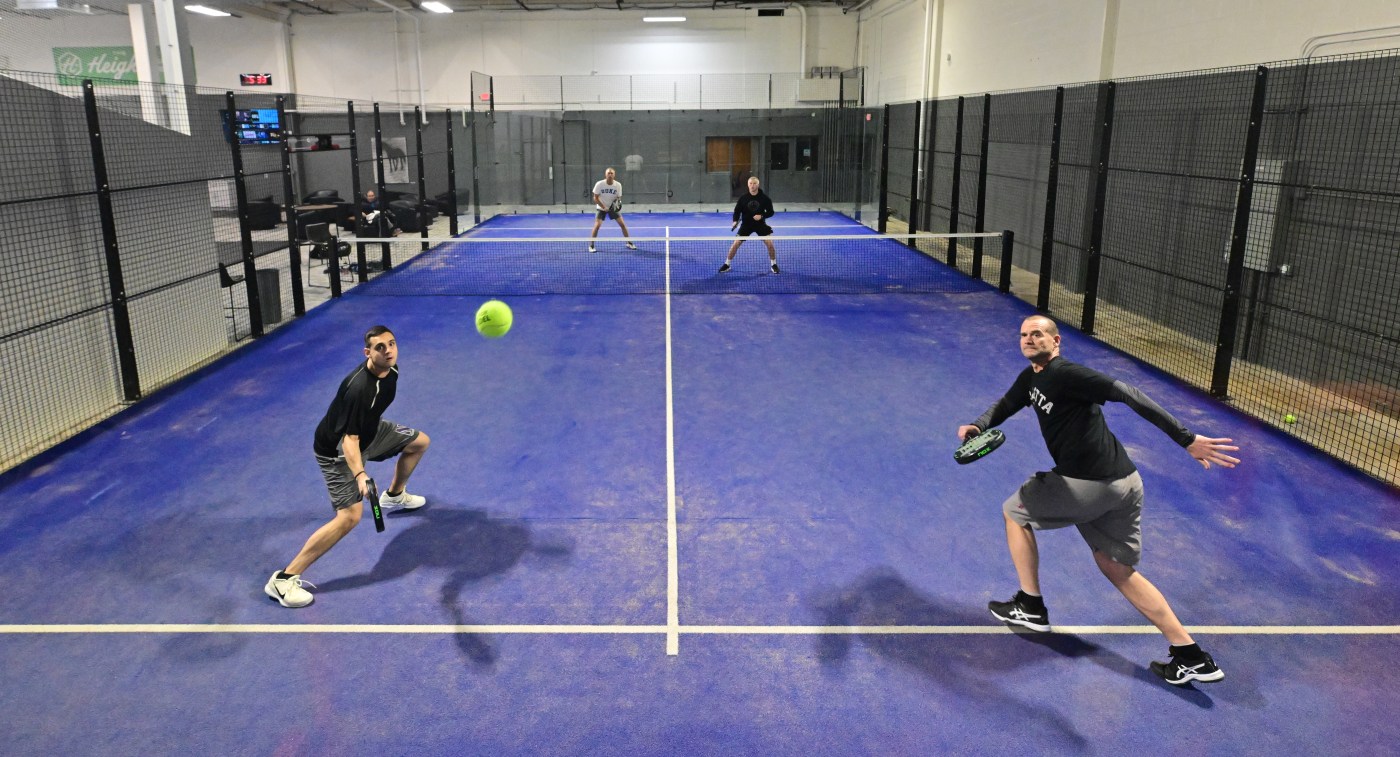
Padel is a game that marries parts of tennis, pickleball and squash to create a unique racquet sport where players use a stringless paddle to strike a ball similar to a tennis ball. The court is smaller than a tennis court – roughly three padel courts fit inside one tennis court – but larger than a squash court. It is surrounded by glass walls on the baselines, and has a steel cage near the middle. The glass walls are in play.

“I love everything about (padel),” said Jeff Mulligan, a retired professional squash player who serves as a consultant for The Heights Racquet and Social Club. “When you get out there, it’s easy to see why it’s the fastest growing sport in the world. It’s the perfect marriage of squash and tennis.”

General manager Sheldon Vaz explains the properties of a padel racquet and ball at the Heights Racquet and Social Club in Mendota Heights on Wednesday, Dec. 6, 2023. Padel is a bit like tennis, a bit like racquetball and bit like pickleball and is the fastest growing sport in the world, according to Vas. (John Autey / Pioneer Press)

The “racket” in padel looks like something from the pickleball court, made of foam, but wrapped with a carbon fiber shell. The ball looks an awful lot like a regular tennis ball, but is slightly smaller. Watching someone strike the ball off of the glass walls calls to mind squash or racquetball, but seeing it sail over the net looks completely different at the same time. Padel is primarily played in doubles, and players serve underhand.

Squash uses a smaller ball that heats up as the volley continues, and is played on a hardwood surface. For longtime players like Mulligan, padel offers an intense racket sport option that is easier on the joints. The padel court is artificial grass over sand infill.

For new players, or for pickleball players interested in another game, it’s easier to pick up than squash or tennis.

“Similar to what’s nice about pickleball, it’s so easy to learn and play since you have a paddle. Everything you hit is a sweet spot,” Mulligan said.

Popular outside U.S.

Pickleball continues to be the fastest growing sport in America, according to the Sports and Fitness Industry Association’s Topline Participation Report. Participation almost doubled in 2022, and has increased nearly 159 percent over three years.

Meanwhile outside of the U.S., padel has experienced tremendous growth, and is one the fastest growing sports in the world, according to the International Padel Federation. The sport has exploded in popularity particularly in Spain, Mexico, Argentina and Sweden. Padel was first developed by Enrique Corcuera in Acapulco, Mexico in 1969.

Courts in the U.S. are still fairly rare, but padel courts in Miami and New York City have gained a foothold among racquet sport aficionados, The Heights Racket and Social Club General Manager Sheldon Vaz said.

The nearest padel club listed by the U.S. Padel Association is in Illinois.

RELATED: Is everyone playing padel without us? 

Commodore Squash Club connection

Planning for The Heights Racquet and Social Club began about two years ago, when Commodore Squash Club owner John O’Brien announced plans to sell the St. Paul property.
O’Brien hopes to keep the club going, but with the property potentially being sold, some members wanted to ensure they would continue to have a place to play.

For Vaz, it went beyond the games. The club provided friendship and camaraderie. It was a home of sorts.

The 49-year-old moved from Kenya to Minnesota 30 years ago to attend the University of Minnesota. He has been playing squash for 15 years, he said.

“People embraced me, and really became my family,” Vaz said.

Ivan Martinez agreed.

Martinez, a member of the Commodore Squash Club, has also joined The Heights Racquet and Social Club. People at the St. Paul club would often sit and relax between games, spinning vinyl records while taking a break before the next contest, Martinez said. He is also Minnesota Squash Association board chair.

“It wasn’t just, ‘play squash and go home,’” Martinez said. “That was something that we wanted to maintain (with The Heights). We wanted to make sure that it’s not just a racquet club. I met some of my closest friends at The Commodore.”

Members and friends

The Heights is membership based and has separate tiers for pickleball only or for all three sports. In addition to the courts, the club has full workout facilities, showers, locker rooms, and a sauna. Between the different courts is a large open space, with a pool table and table tennis, with space for the conversations Martinez and Vaz mentioned.

Vaz said there are plans to potentially add outdoor courts in the future. He is looking forward to continuing to play squash and padel with old friends, while hopefully new members feel comfortable making new friendships.

“I love the game, it’s such a huge part of my life,” Vaz said.

Learn more: heightsracquetmn.com

Related Articles

Local News |


25 schools, 9 Jewish facilities ‘swatted’ with threats about bombings, shootings, says MN law enforcement

Local News |


DFLer Bianca Virnig wins special election for vacant Dakota County House seat

Local News |


Dakota County Historical Society is looking for new board members

Local News |


Burnsville man identified as Minneapolis homicide victim

Local News |


Woman killed in Sunday night rollover crash on I-35W in Burnsville