The labor market is slowing down. That makes Jerome Powell’s job easier.

posted in: Politics | 0

The strong labor market of President Joe Biden’s first three years in office has started to slow down. For both Democrats and the Federal Reserve, that isn’t as bad as it sounds.

The U.S. added 199,000 jobs last month — off the eye-popping 240,000 average of the previous 12 months — and the unemployment rate dipped to 3.7 percent, the Labor Department reported on Friday.

The November tally was boosted by the roughly 40,000 workers who went back on the job after the conclusion of lengthy strikes affecting the auto and movie industries. That one-shot increase means private companies are adding jobs at “a relatively soft pace, although one that will probably be welcomed at the Fed,” Omair Sharif of Inflation Insights said in a research note published after the report was released.

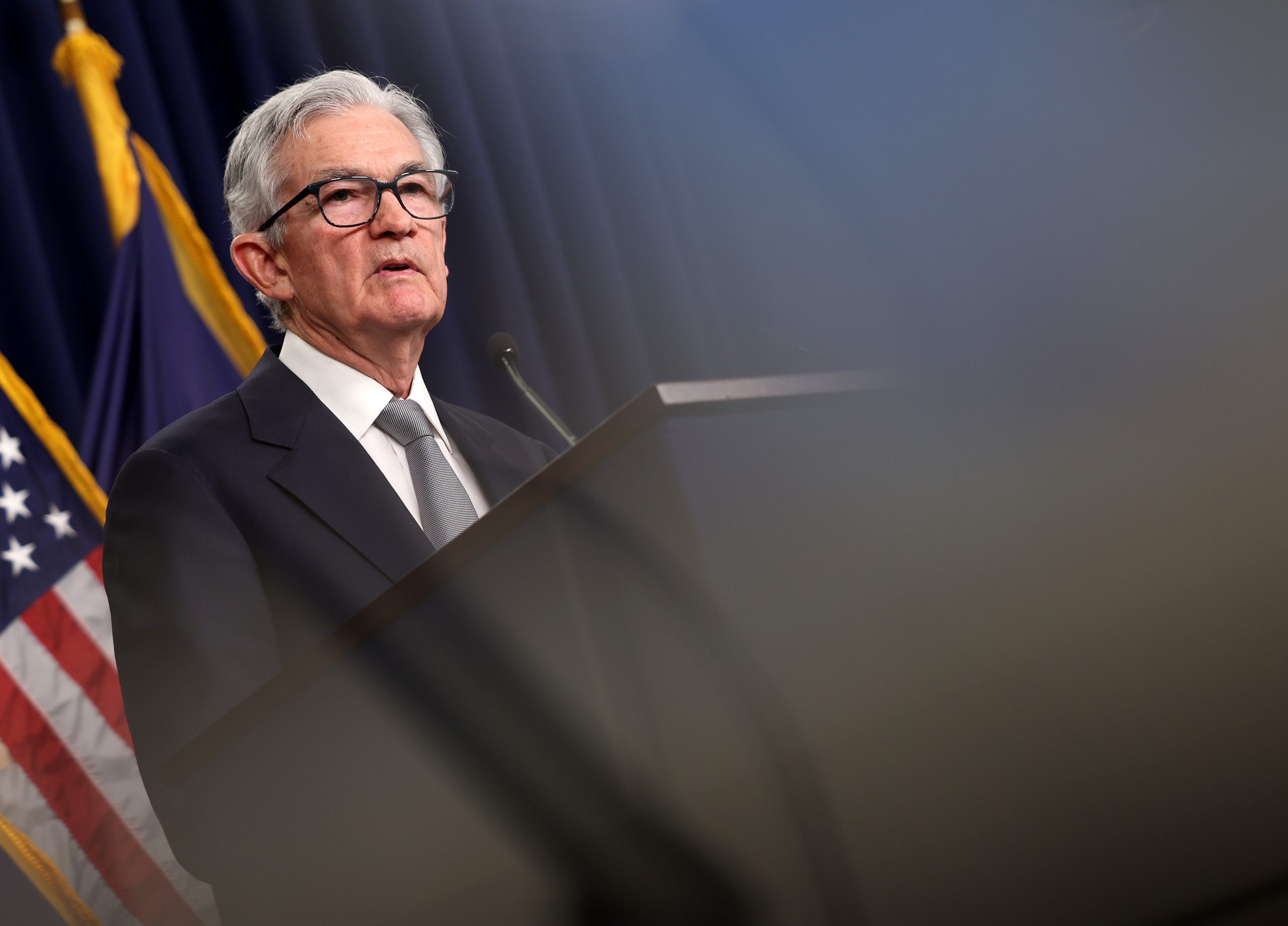
Federal Reserve Chair Jerome Powell has placed a lot of emphasis on the labor market in his drive to bring down inflation. When the demand for labor exceeds supply, wage growth accelerates. That’s good for workers, but it can prompt businesses to raise prices so they can cover the cost of paying or retaining their employees. That complicates the Fed’s push to curb inflation.

Last week, Powell said the jobs market was “very strong” but that it’s “returning to a better balance between the demand for and supply of workers.” This week’s report on job openings in October was interpreted as a sign that the market is starting to normalize. Fed policymakers will meet next week to decide on the next steps on interest rates.

As long as unemployment doesn’t spike and wages continue to climb, White House officials say a slowdown in monthly job tallies won’t have much bearing on how Americans experience the real economy.

So far, the cooler job market hasn’t translated into weaker paychecks for workers. Wages are continuing to climb at a faster rate than inflation — a trend that top Democrats and White House officials are watching closely. Hourly earnings climbed by an annual rate of 4 percent through November.

“Many doomsayers were getting ready to confirm their#recession priors,” Gregory Daco, chief economist at EY-Parthenon posted on X, formally known as Twitter, on Friday. “This #jobsreport confirms that while employment growth has downshifted, we’re not witnessing a retrenchment.”

The Labor Department slashed 35,000 jobs from its September estimate as well, reducing the total number of jobs added that month to 262,000 — adding more evidence to the growing sense around Wall Street that the labor market is coming back to earth.

Through August, the Labor Department’s revisions trimmed an average of roughly 37,000 jobs from its initial estimates.

Erica Groshen, a senior economics adviser at Cornell University and former Bureau of Labor Statistics commissioner, said the consistent downward revisions often reflect that “you’re heading into a real downturn.” Still, the revisions to the initial estimate could be a reflection of declining response rates to surveys the Labor Department uses to compile the jobs report.

Martha Gimbel, a former senior adviser to Biden’s Council of Economic Advisers now at Yale Law School, observed in a research note that a “‘slowing’ economy is not the same as a ‘stalling’ economy.” And despite the downward revisions, a stall doesn’t appear to be imminent.

“Part of the problem that we’re dealing with in this is that everyone wants the economy to just snap back to normal with no transition period. And that’s just not going to happen,” Gimbel said. “We all have to be patient; we all have to sit through this period of real weirdness and real transition in the economy.”

US employers added a solid 199,000 jobs in November in sign of a still-sturdy labor market

posted in: Society | 0

The nation’s employers added a solid 199,000 jobs last month and the unemployment rate fell, fresh signs that the economy could achieve an elusive “soft landing,” in which inflation would return to the Federal Reserve’s 2% target without causing a steep recession.

Friday’s report from the Labor Department showed that the unemployment rate dropped from 3.9% to 3.7%, not far above a five-decade low of 3.4% in April.

The November job gain was a reminder that many employers continue to hire, though last month’s increase was inflated by the return of about 40,000 formerly striking auto workers and actors, who were not at work in October but returned in November.

Still, the job market is gradually decelerating along the lines that Fed officials have wanted to see. The Fed has raised its key short-term rate from near zero to about 5.4%, a 22-year peak, leading to higher borrowing rates for consumers and businesses and lower inflation. Despite that headwind, the economy and the job market are still expanding. Layoffs remain historically low.

When the Fed meets next week, it is considered sure to keep its benchmark rate unchanged for the third straight time in light of the easing inflation pressures. Most economists and Wall Street traders think the Fed’s next move will be to cut rates, though that might not happen until the second half of 2024.

Even modest hiring helps ensure that consumers, who drive most of the economy’s growth, keep spending. Early reports on holiday shopping showed healthy growth in online sales.

Many of the most recent economic figures have been encouraging. Companies are advertising fewer job openings, and Americans are switching jobs less often than they did a year ago, trends that typically slow wage growth and inflation pressures. Hiring is cooling, and price increases have moderated significantly.

Still, the number of people receiving unemployment aid, though still low, has risen. And for much of this year, hiring has been concentrated in just a few sectors — notably health care, restaurants and hotels and government — rather than broadly across the economy.

Hiring has been cooling as the Fed’s sharp interest rate hikes have raised borrowing costs for consumers and businesses, depressing sales of homes, cars, appliances and other high-priced purchases and investments.

For now, most analysts are offering a positive outlook of slower but still steady growth and easing inflation. The economy is expected to expand at a modest 1.5% annual rate in the final three months of this year, down from a scorching 5.2% pace in the July-September quarter. Cooler growth should help bring down inflation while still supporting a modest pace of hiring.

The economy is still growing even after the Fed has raised its benchmark rate 11 times, from near zero in March 2022. The aggressive pace of those hikes has made mortgages, auto loans and business borrowing much more expensive.

At the same time, inflation has tumbled from a peak of 9.1% in June 2022 to just 3.2% last month. And according to a different inflation measure that the Fed prefers, prices rose at just a 2.5% annual rate in the past six months — not far below the central bank’s target.

Such progress has fueled speculation in the financial markets that the Fed could soon cut its benchmark rate, perhaps as early as March. Wall Street traders now expect five rate cuts next year, according to futures prices tracked by CME FedWatch. Most economists envision fewer.

Christopher Waller, a key Fed official who typically favors higher rates, buoyed the markets’ expectations last week when he suggested that if inflation kept falling, the Fed could cut rates as early as spring.

Fed Chair Jerome Powell, though, pushed back against such speculation last Friday, when he said it was “premature to conclude” that the Fed has raised its benchmark rate high enough to quell inflation. And it was too soon, he added, to “speculate” about when the Fed might cut rates.

But Powell also said interest rates are “well into” restrictive territory, meaning that they’re clearly constraining growth. Many analysts took that remark as a signal that the Fed is done raising rates.

Trump’s shadow looms over California at climate talks

posted in: News | 0

The specter of Donald Trump regaining the presidency is casting a pall over California’s sunny presence at this week’s COP28 climate negotiations.

Global admirers of California’s approach to climate policy are worried about what might happen if Trump wins and resumes his attacks on the Golden State, California Air Resources Board Chair Liane Randolph said in an interview from Dubai, United Arab Emirates.

“I’ve definitely had a few people ask me, ‘What do you think will happen? Do you think he’s going to win?’” she said. “They ask that question with huge amounts of concern.”

California has long positioned itself as a stable partner on climate change in the face of national division. Former Gov. Jerry Brown defiantly flew to COP23 to push for ongoing collaboration after Trump pulled out of the Paris agreement. “We will continue to make progress, regardless of who leads our federal government,” Natural Resources Secretary Wade Crowfoot said on a press call before this year’s conference.

But Randolph said international partners familiar with the U.S. legal system are digging deeper, asking how a Trump presidency will affect California’s ability to meet its electrification targets for cars and buildings — one of the main things California is trying to promote at the conference.

They’re also particularly worried about California’s special permission under the Clean Air Act to set stricter-than-federal emissions rules for vehicles and heavy-duty equipment. Trump’s EPA revoked a California waiver to set its own fuel economy standards, and even after Biden reinstated it, it’s still a live issue: Seventeen red states, led by Ohio, are currently challenging the constitutionality of the entire waiver program before the Supreme Court.

“Some of the folks we work with, like our partners in Canada, for instance, they know the system really well and they’re like, ‘What do you think the Supreme Court is going to do with the Ohio litigation? Is that going to cause issues with your waiver? And then what happens if Trump gets in and then you have a federal government that’s not defending the waiver?’” Randolph said. “They understand the stakes.”

Randolph is optimistic that a Trump presidency won’t happen. But she’s assuaging her international partners on two fronts in case it does:

One, she said, the auto industry has already come around more on the issue of electrification.

Major automakers backed Trump’s blocking of the California waiver in 2019 to set stricter-than-federal fuel economy standards. But they opposed British Prime Minister Rishi Sunak’s move earlier this year to delay the U.K.’s gas car ban from 2030 to 2035.

“The automakers were like, ‘Wait a minute, we’re planning for this transition,’” said Randolph. “So I don’t think that there’s a lot of support for backtracking on climate politically.”

The second thing is that a lot of California’s climate work happens under the state’s own authority. She pointed to the cap-and-trade program and the low-carbon fuel standard as examples.

She also thinks that the waivers will prevail in court. At a September panel, judges expressed skepticism at some of the plaintiffs’ claims and spent a significant amount of time questioning if they could demonstrate injury because of the waiver.

‘We’re still not in attainment [with clean air standards],” said Randolph. “That’s why I’m hopeful that the courts at the end of the day will realize that this is the fundamental reason why Congress took action and that hasn’t changed.”

Like this content? Consider signing up for POLITICO’s California Climate newsletter.

Movie review: ‘Poor Things’ with Emma Stone is rich in lessons of humanness

posted in: News | 0

In the middle of “Poor Things,” the new film from Oscar-nominated oddball auteur Yorgos Lanthimos, our heroine Bella Baxter (Emma Stone) toddles off on a solo adventure for the very first time. Wandering the streets of a pastel storybook Lisbon in silky shorts and a blouse with enormous puff sleeves, her long mane of raven hair swaying down back, Bella heads for a pastry stand, where she crams as many custard tarts as she can into her mouth. Later, she vomits them up on a balcony overlooking a picturesque vista of the city. Cause, meet effect. Bella observes this bit of data and reports it back to her scientist father figure, Godwin Baxter (Willem Dafoe) in a crudely scrawled postcard home.

This kind of self-experimentation is the backbone of “Poor Things,” Lanthimos’ strange and ravishing masterpiece about a young woman who receives one of life’s rare gifts: a chance to start over, from scratch. What will Bella do with her new lease on life? She’ll devour every last crumb, without an ounce of shame.

This adaptation of the 1992 novel by the late Scottish writer Alasdair Gray (the script is by “The Favourite” scribe Tony McNamara) has long been a pet project of Lanthimos’, and it fits with themes he has explored in his other films, specifically “Dogtooth,” wherein adult innocents seek to escape cloistered confines. But Bella Baxter might be his most daring, and shockingly self-possessed, creation yet.

She is, in fact, the creation of Godwin, a brutally disfigured surgeon who was the subject of his own father’s medical meddling, who lives, teaches and researches in Victorian London. Godwin is a tender, loving figure, a Dr. Frankenstein whose ethereal waif of a monster is like a daughter to him. While her brain catches up to her body, she waddles around his house, stiff-legged and petulant, every step, bite and word carefully cataloged by a sweet young medical student named Max (Ramy Youssef).

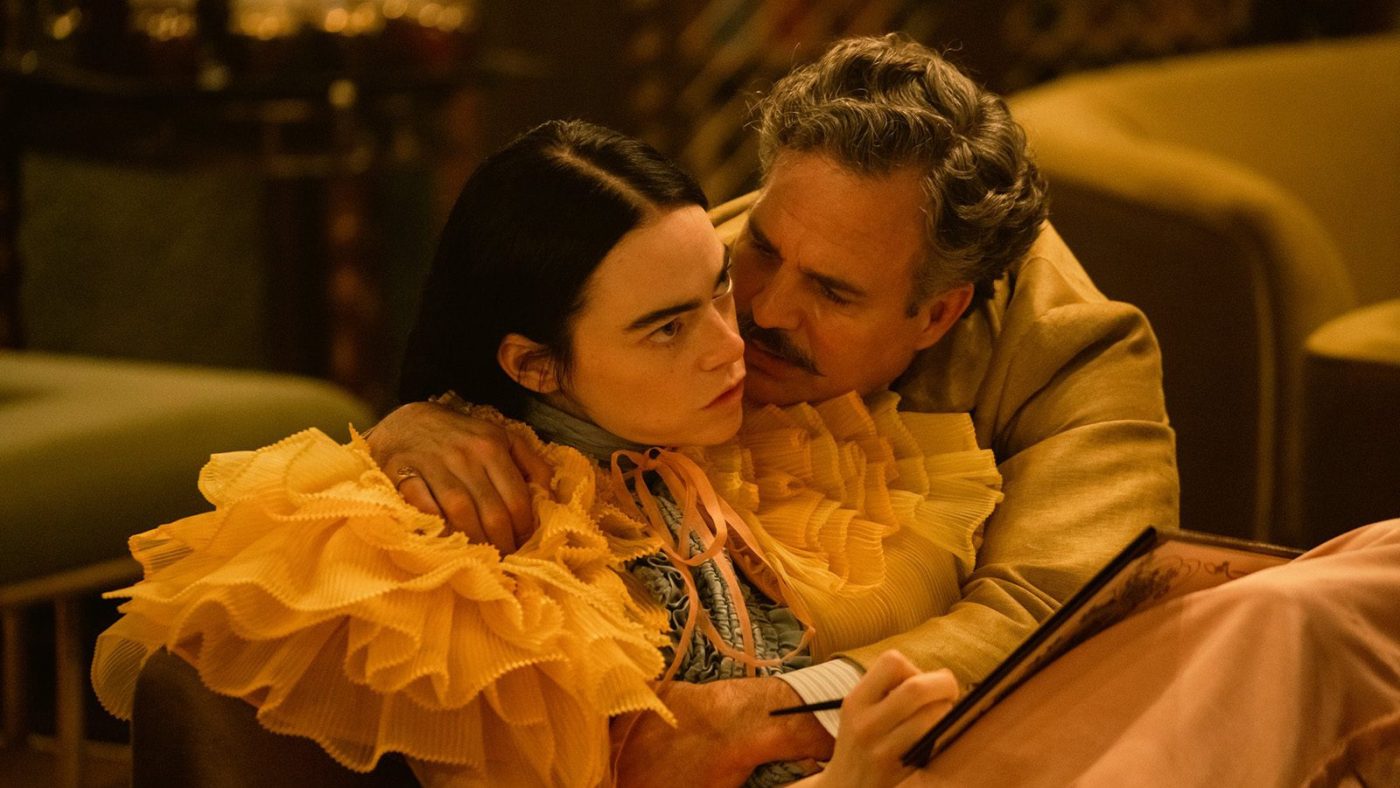
Emma Stone in the movie “Poor Things.” (Atsushi Nishijima/Searchlight Pictures/20th Century Studios/TNS)

Despite his desire to keep the conditions of his experiment pure, Bella is a being of free will, and Godwin is just one of many guides in her personal evolution. He instills in her a love of science, but soon her burgeoning sexual appetite leads her astray, and Bella becomes taken with a dastardly cad named Duncan Wedderburn (a terrific heel turn from Mark Ruffalo), who whisks her away to Lisbon. Thus begins the adventure that makes Bella who she is, learning the highs and lows of life with the help of various characters who demonstrate to her what it means to be human: the corporeal pleasures, intellectual quandaries, emotional lows and political questions — and that people can be “cruel beasts,” too.

She gains philosophical and pragmatic knowledge aboard an ocean liner from Martha (Hanna Schygulla) and Harry (Jerrod Carmichael), and learns more about herself and others though sex work and socialism in Paris, under the tutelage of a madam named Swiney (Kathryn Hunter) and a new comrade (Suzy Bemba). The final stop on her experimental journey through the human condition is back home to London where she has to face herself, or the self that others expect her to be. Will she accept or reject it?

This image released by Searchlight Pictures shows Ramy Youssef, left, and Willem Dafoe in a scene from “Poor Things.” (Yorgos Lanthimos/Searchlight Pictures via AP)

There’s an obvious comparison to be made here to “Barbie,” another film about a beautiful naïf discovering the sharp corners of the world. But where Barbie cracks under her existential crisis, Bella only grows stronger, absorbing power as she explores more and more. Stone delivers the most astonishing performance, and is perhaps the only actress who could convincingly convey such simultaneous expressions of sincerity, absurdity, intelligence, libidinousness and humor.

Stone’s performance evokes modern dance and movement both avant-garde and primitive. While she incrementally evolves Bella before our eyes, Lanthimos evolves the film’s style alongside her, from the film stock and camera movements, to the gorgeously rendered production design by Shona Heath and James Price, to the elaborate costumes by Holly Waddington.

“Poor Things” was shot by Robbie Ryan on a variety of 35mm film stocks, starting with Bella’s “babyhood” in black and white, captured with wide-angle, often fish-eye lenses. English musician Jerskin Hendrix offers an eerie, keening musical theme that echoes throughout, as Bella embarks on her magical mystery tour through a child’s-eye view of Europe, detailed jewel-box sets captured in soft color. As her strides and words lengthen, the film grain changes, the color deepens, the camera fluidly following her maturation. It is at once subtle and obvious; it happens so smoothly it almost sneaks up on you, changing and growing in concert with its protagonist.

This image released by Searchlight Pictures shows Emma Stone in a scene from “Poor Things.” (Yorgos Lanthimos/Searchlight Pictures via AP)

This film may be fantastical, outré, at times bizarre, and sexually frank. But ultimately, “Poor Things” is a traditional heroine’s journey forging its own singular path. That Bella achieves a fully embodied sense of personal liberation makes it a truly radical — and feminist — fairy tale.

‘Poor Things’

4 stars (out of 4)
Running time: 2:21
MPA rating: R (for strong and pervasive sexual content, graphic nudity, disturbing material, gore and language)
How to watch: In theaters on Friday.

Related Articles

Entertainment |


The top 10 best (and worst!) movies of 2023

Entertainment |


7 must-read nonfiction graphic novels

Entertainment |


Best TV of 2023: In a tumultuous year for Hollywood, standouts include Chicago-set ‘The Bear’ and Netflix’s ‘The Diplomat’

Entertainment |


4 spirited cocktails for Hanukkah

Entertainment |


Crazy about pickleball? Now you can check out padel in Mendota Heights