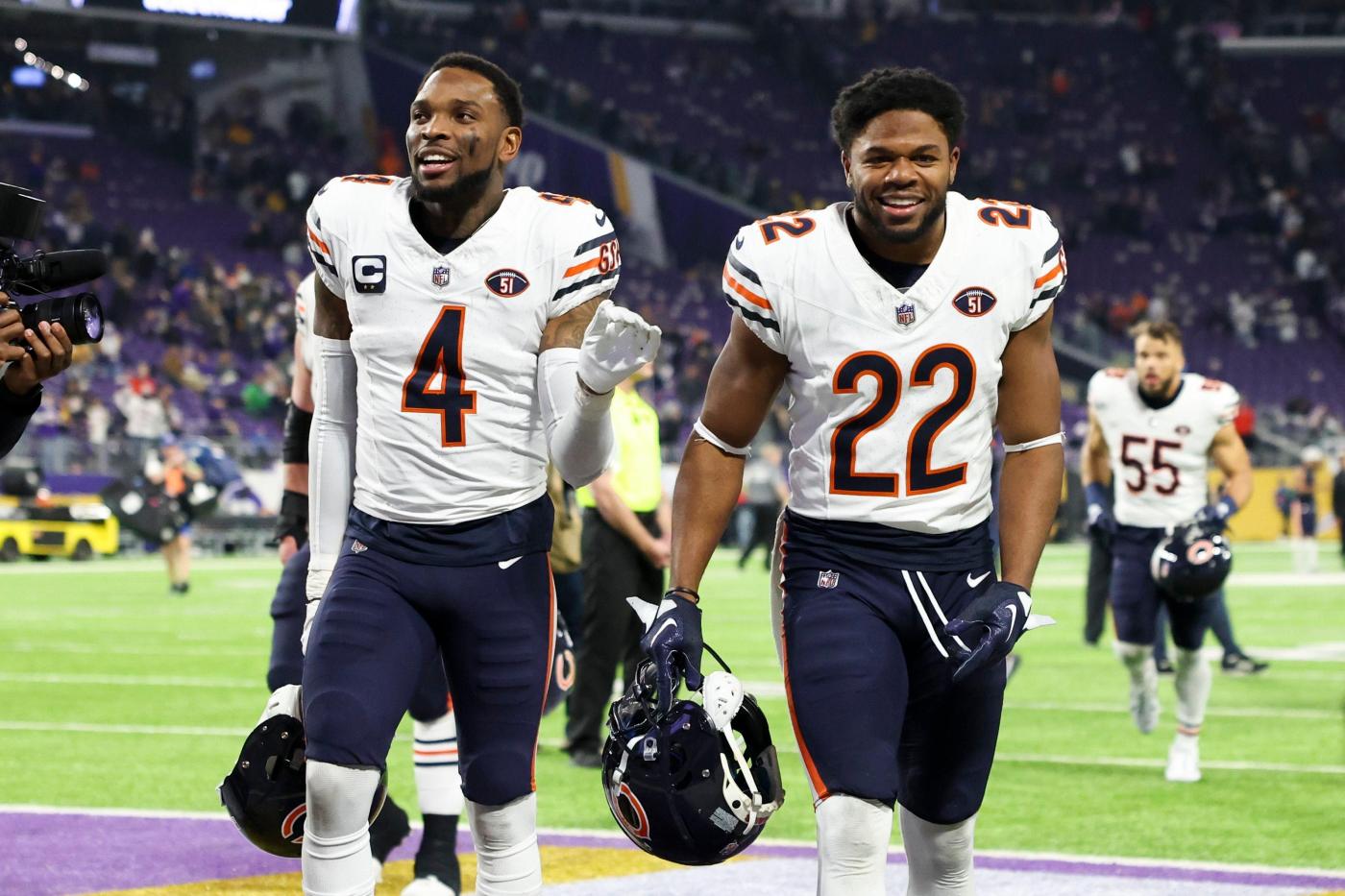
Three weeks after suffering one of their most crushing losses of the season in Detroit, the Chicago Bears will welcome the Lions to Soldier Field for a rematch. The Lions rallied from 12 points down in the final four minutes at Ford Field in Week 11 and stole a 31-26 victory. The Bears haven’t forgotten.
Still seeking their first two-game winning streak since late in the 2021 season and eyeing a potential signature win against a first-place team, the Bears feel ready to compete with the Lions and have designs on an upset. With kickoff of Sunday’s game approaching, here’s the inside slant on three notable storylines.
‘I found my work partner’
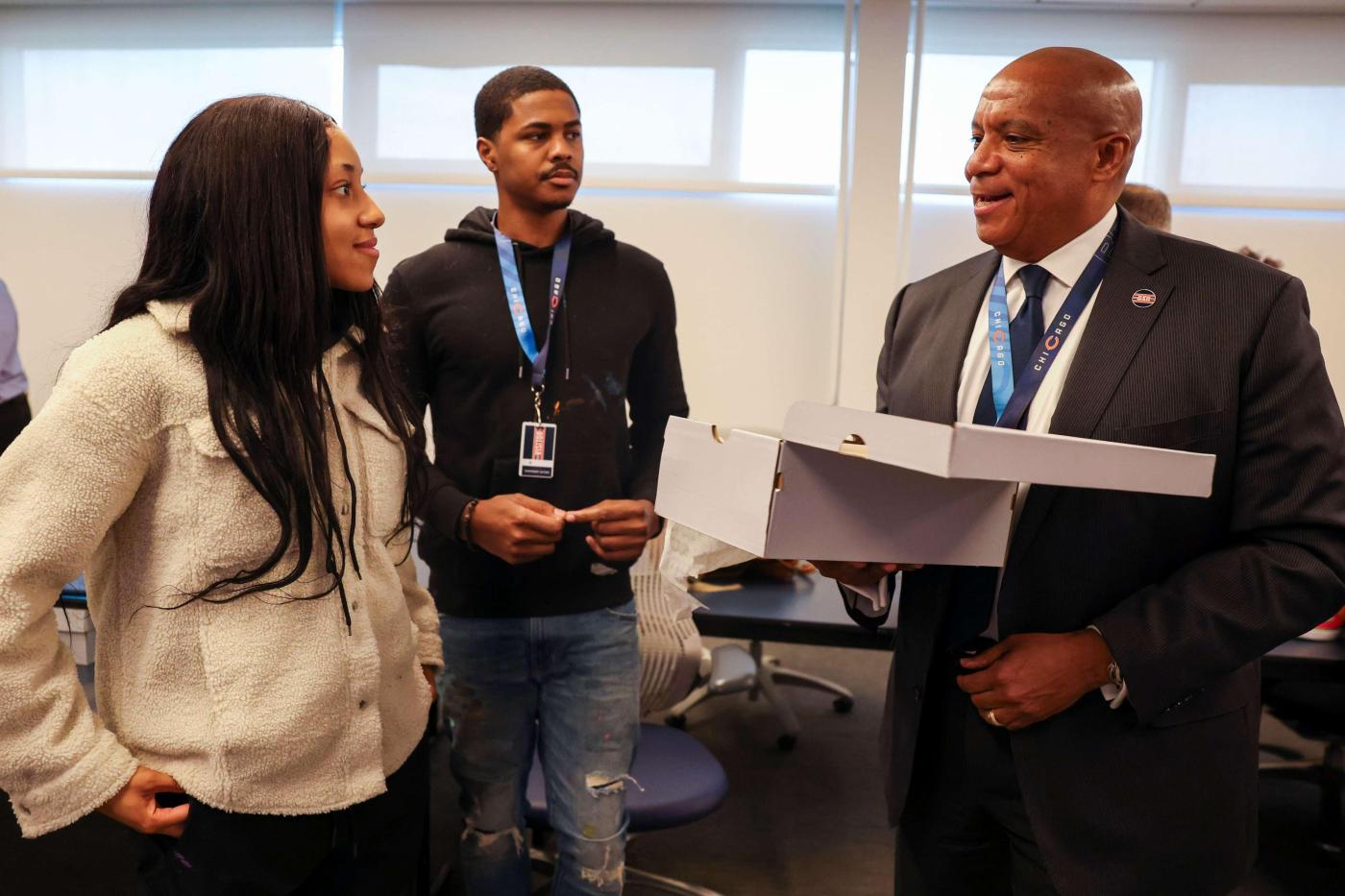
Kevin Warren was gushing. He couldn’t help himself. It was the last day of June and Warren was readying to head out on a short vacation before training camp. Still, he could not have been more enthused about his opportunity to continue working with general manager Ryan Poles, eager to embark on a yearslong journey that would reestablish the Bears as a model of NFL excellence.
During transition meetings last winter, as Warren prepared to move from his role as Big Ten commissioner into the chair of president and CEO at Halas Hall, he felt immediately drawn to Poles. The two had similar ambition plus a shared vision for how to propel their team to sustained success.
Warren and Poles clicked almost instantly and in a way that made all their interactions sincere and honest.
Warren wasn’t just impressed with Poles. He didn’t just appreciate the steady confidence from the leader of the Bears football operations. He felt something more powerful, more profound.
“I have such strong feelings about him,” Warren told the Tribune at his office at 1920 Football Drive. “(It’s) the way I feel about people in my family. I want the best for him.”
When you know, you know, right?
“With my wife, Greta,” Warren said, “I was able to call my mom after our first date and say ‘I found my wife.’ (Here) I was able to go home with Greta and tell her after my first meeting with Ryan, ‘I found my work partner.’”
Within a career journey that started in the world of law in 1990, Warren emphasized he had felt such a heightened workplace bond only twice before – with Mai Davis, his current executive assistant with whom he has worked across six jobs over 33 years; and with former St. Louis Rams coach Dick Vermeil, a mentor and colleague for three NFL seasons in the late 1990s.
Very quickly, Poles elicited similar confidence and trust from Warren, who promised to be the young GM’s “sunshine and his water for his continued growth.”
“We don’t agree on everything. And we won’t,” Warren said. “Ryan and I can talk about anything, deal with any issue. We won’t agree on everything. But to have that relationship? This is a really special environment.”
That was in the summer, before a single training camp practice, before the Bears had thrown a backbreaking pick-six or blown a commanding second-half lead or dismissed an assistant coach. And sure, perhaps Warren’s feelings might have dulled some over the last five months and specifically during a last-place season that has been extraordinarily turbulent and discouraging at points. But it’s hard to imagine his belief in Poles would have shifted so drastically since July that he would seriously be considering a quick reboot at the top of the front office without offering his trusted GM the opportunity to see through the vision they had united on.
Sure, this is the NFL. Wild things happen all the time. Life comes at you fast. Things change. Relationships fray.
Still, there’s reason to believe Warren will stand firmly behind Poles when the regular season ends in 30 days. From there, the Bears must decide what paths to steer down during what undeniably will be a landmark offseason for the organization.
Increasingly, eyes from across the NFL are zeroing in on Chicago. What happens next? And how much influence will Warren exercise in the biggest decisions the team will soon make?
As has been well established, the Bears soon likely will have rare freedom in choosing who they want to lead them at quarterback. And at head coach. It’s not implausible to think the organization could stay the course with Justin Fields and/or Matt Eberflus, particularly if either or both write a convincing finishing chapter to the 2023 season. But across league circles, there’s also an increasing expectation that some sort of significant change will occur, especially with the Bears holding the Carolina Panthers’ first-round pick for 2024, the one that currently sits at the top of the draft board.
Warren will have an important voice in all those conversations and debates. A significant say, to be certain. During the hiring process in January, his desire to have oversight and authority over the football operations department was noted and granted by Bears Chairman George McCaskey. But Warren never issued that request with a power-hungry, overbearing stance. Instead he was eager to use nearly 30 years of experience in the NFL to become a sounding board and trusted confidant for Poles, to provide valuable guidance and input that could offer direction to the Bears.
Before training camp, even Poles acknowledged how energizing it was to have Warren’s continual feedback and assistance on so many issues. Through a big-picture lens, Poles also felt supreme confidence that he was working with a boss who would empower and equip him with all the necessary resources to perform his job at the highest level.
“I promise you, I never lose sleep worrying about whether I’ll have to fight for something that should be pretty easy to ask for,” Poles told the Tribune in June.
More importantly, Poles shared Warren’s sentiments that their working relationship was incredibly healthy and strong without either leader displaying selfish tendencies or a combative nature.
Said Poles: “When you remove the ego part of, ‘This is my space, this is your space,’ there’s a really cool space for us to play in on both sides so we’re doing what’s best for the organization and doing what’s best first and foremost for the players. When two people share that philosophy, it’s amazing. That’s why our relationship is off to a really good start. When that’s the foundation, we know all the lines of communication back and forth are going towards the most important thing. And that’s getting our players to perform at a high level.”
Poles said he also could feel Warren’s competitive hunger daily and appreciated the fire that burned inside Warren as a college basketball player at both Penn and Grand Canyon University in the 1980s was still fueling him as an accomplished executive almost four decades later.
“I love it,” Poles said. “He’s just a competitive person. There’s an athlete in there. And that desire to be the best in the world is how he moves. Those are his expectations. And it’s comforting. It fits. It works for me.”
Together, Warren and Poles vowed to continue pushing each other, to seek ideas and discussions that would push the envelope, to envision a Bears organization that could get itself out of a cycle of perpetual mediocrity and march to the staircase that leads to the escalator that climbs toward the elevator for high-level NFL excellence.
It will be interesting to see whether that partnership continues. If so, the strength of that relationship might become paramount as the Bears approach a truly pivotal period in team history, readying for a series of decisions that will affect the franchise’s direction for years to come.
Vertical horizon
A funny thing happened coming out of the Bears’ 12-10 victory against the Minnesota Vikings in Week 12, a result that deodorized a clunky offensive performance. As anger from many Bears fans mushroomed, centered specifically on the heavily horizontal passing attack the team deployed against a blitz-heavy Vikings defense, Bears players expressed both confidence and contentment in the strategy they wedded to for the week.
Quarterback Justin Fields: “It seemed like this is what you’ve kind of got to do. If they want to mug a bunch of guys up at the line of scrimmage and want to have two DBs (outside) for three receivers, you’ve got to outflank them sometimes to get them out of that stuff. That was the plan going in. A big emphasis was just to get the ball out quick and let our guys work on the outside.”
Receiver DJ Moore: “They were bringing a lot of pressure as usual. So (the thought was) just to spit the ball out to the edge and get what you can get. It’s like part of the running game even though it counts as passes. I was happy with it. … You know the game plan and how they play and you just get your mind ready for it.”
Tight end Cole Kmet: “It all just comes with the pressure you’re expecting and not knowing whether they’re always coming or not. Now, they ended up bailing out a bunch and you saw that they adjusted at times with their ends jumping out to create some dangerous throws on some of those screens. That can be tough. They can get you. They’re either going to bring everybody or drop everybody. But you have to have answers. That’s kind of the cat and mouse game.”
Those were all sentiments shared from the locker room at U.S. Bank Stadium with the night’s win obviously affecting the immediate mood and disintegrating any frustrations that might have existed for an offense that didn’t reach the end zone on 10 possessions.
But it also gave voice to a group that understood the need to make a handful of opponent-specific, one-game alterations to its approach in an effort to neutralize a defense that had given the Bears fits win six weeks earlier in a 19-13 Vikings win.
In that first matchup, Vikings coordinator Brian Flores blitzed and pressured and blitzed some more. The Vikings limited Fields to 40 net passing yards on 17 drop-backs over seven possessions, then knocked him out of the game on a third-quarter sack.
From there, the Vikings forced rookie Tyson Bagent into two second-half turnovers and kicked the Bears aside for good.
In the rematch, the Bears sought answers to respond to the pressure. And while that resulted in a head-spinning passing performance in which 17 of Fields’ 37 throws didn’t travel beyond the line of scrimmage and only five were thrown more than 10 yards down the field, the Bears didn’t feel quite as dismayed as the outside world seemed to.
On Thursday, 10 days removed from that game, offensive coordinator Luke Getsy was asked for his critique of the passing attack against the Vikings and cited the perimeter passing approach as “RPO-ish” with Fields empowered to make a presnap diagnosis of the congestion at the line of scrimmage and adapt, when needed, with quick passes outside.
“When they come up and they’re bringing a lot of pressure, you have to have an answer,” Getsy said, also noting Fields’ overall recognition was on point.
“There were maybe one or two where he saw something, and it really wasn’t (that),” Getsy said. “But for the most part, Justin did a really nice job of diagnosing that stuff and seeing what they presented to us.”
On the whole, did the Bears dedicate themselves too much to the horizontal passing attack? Probably, particularly during a second-quarter sequence in which they followed a 22-yard reception by Moore on a screen with a screen the other way to Trent Taylor (batted down) and yet another screen back to Moore that was read well by the Vikings and blown up for no gain.
“At least half of those (in the game), you’re not calling to do that,” Getsy said. “That’s the reaction because of what you’re presented. So as you go through those types of game plans, you want to have answers for your guys. Whether it’s changing to max protection, whether you’re changing to a perimeter RPO screen, whether it’s Cole on a delay (release), there are a bunch of different ways you can attack it.”
Still, Eberflus believes the Bears missed out on several chances to stretch the field vertically.
“You’re always wanting more chunks,” Eberflus said. “Explosive plays are where it’s at. When you’re playing a team that pressures that way and they’re vulnerable in their coverage, I believe we should have more (explosives). We’re always looking to get that. Certainly we had some opportunities to hit some more of those.”
Getsy identified a handful of instances where the Bears should have had big-play chances in the passing game against the Vikings.
“I think there were three or four huge explosives we lost because — whether it was a protection (problem) or a miscommunication from the backfield or up front — we lost some opportunities to take advantage of that all-out pressure.”
Again, it’s important to note the Bears’ approach in that last game was focused centrally on accounting for a unique approach from Flores. Things won’t look like very similar Sunday against the Lions, whose approach under coordinator Aaron Glenn is much different.
In fact, in three games against a Glenn-led defense over the last two seasons, Fields has topped 100 rushing yards each time, finding avenues to gash the Lions with scrambles and designed runs.
In Week 11, he turned 18 rushing attempts into 104 yards. Fields also threw 23 passes with nine traveling at least 10 yards past the line of scrimmage, including a beautiful 39-yard touchdown strike to Moore on a post route.
Fields’ downfield opportunities should continue with the quarterback and the offense needing to capitalize when those moments for explosive passing plays present themselves.
“I think they’re coming,” Eberflus said. “I really do. I know Justin throws a really good deep ball. He’s proven that and we’re excited about our opportunity this week.”
‘Highway robbery’
There’s a hornet’s nest in the Bears locker room this week, right inside the stall of defensive end DeMarcus Walker. It takes only three words to disturb it. College. Football. Playoff.
Seek cover.
“(Expletive), man!” Walker said. “OK. We’re going to do this? OK. (Expletive).”
Here is where we introduce Walker as a proud Florida State Seminole (2013-16). Walker is also an agitated Florida State Seminole, irate with the CFP selection committee and its decision to exclude his former program from the championship chase.
Undefeated Florida State. Champions of the ACC.
And still, the Seminoles have been excluded from the four-team playoff bracket.
“Man,” Walker said, shaking his head. “It’s bull … It’s highway robbery. Highway robbery, honestly. I feel for those players, man. I mean, that (decision) stuck with me. Now imagine being on that team. Honestly? It’s (expletive) up. It is.”
Walker was going about his bye week last weekend and in a good mood when the CFP’s big announcement popped. Walker got word from Bears teammate Eddie Jackson, who called to, uh, share the news.
“Oh, yeah,” Jackson said. “I had to let him know.”
Here is where we introduce Jackson as a proud former standout for the Alabama Crimson Tide (2013-16) and, in this case, a gleeful instigator. Jackson might have a short memory as a defensive back. But as a loyalist to his college program, he was easily able to remember the repeated calls he was getting from Walker on Nov. 25 when Alabama was losing to Auburn for the entire fourth quarter in the Iron Bowl — until a season-saving, final-minute, fourth-and-goal, 31-yard miracle touchdown pass.
“Oh, my God,” Jackson said. “D-Walk was blowing me up. ‘Y’all going to lose! Y’all going to lose!’ So I had to get back to him on Sunday.”
Walker was certain Jackson was just messing with him. He asked at least three times if Jackson was for real.
Florida State was really left out of the playoff? And Alabama was in, jumping from No. 8 in the CFP rankings after an SEC title game upset of top-ranked Georgia to grab the No. 4 seed behind Michigan, Washington and Texas?
Confirmed, Jackson said.
“I just told him, ‘Y’all didn’t make it,’ “ Jackson said. “I don’t know where he was at. He was on his way out to eat or something. So I kind of ruined his day. But I kind of liked it. Because he was talking all that trash.”
Said Walker: “I was pissed. Just to be honest with you, it was harsh. If this gets out to Florida State, those dudes need to know I love my guys. So proud of y’all. Just keep it going.”
Of course, there’s complexity and nuance to Florida State’s exclusion with star quarterback Jordan Travis suffering a serious leg injury in the team’s Nov. 18 win against North Alabama. That swayed the selection committee to view the Seminoles as a weaker team heading into the postseason.
Undefeated or not, the Seminoles ultimately were judged to be inferior to the four teams chosen for the playoff. So Walker has been left outside the small circle of current Bears players who will be rooting for their college programs to win it all next month.
Running backs D’Onta Foreman and Roschon Johnson went to Texas. Cornerback Kyler Gordon starred at Washington. And Jackson, of course, is a proud Nick Saban disciple.
That enlivened the locker-room banter at Halas Hall this week. Foreman, for example, was thrilled last weekend as his Longhorns were pounding Oklahoma State 49-21 in the Big 12 championship game to get to 12-1. That gave the selection committee convincing evidence that the Longhorns are equipped to win college football’s biggest prize.
“I was so proud of those guys,” Foreman said. “Seeing them work to get where they got to? It’s been years in the making. Now I just want them to finish this off.”
Like Alabama, Texas is a one-loss team, their lone stumble coming against Oklahoma (34-30) in early October. Still, that was one more defeat than Florida State experienced. So can Foreman understand Walker’s beef and the Seminoles’ disappointment?
“It sucks,” Foreman said. “But I understand the decision. Part of the guidelines are looking at who’s healthy and who’s available. In my honest opinion, when you look at the four teams the committee chose, I don’t think Florida State beats any one of them without their quarterback.
“I’ll also say this. If Texas didn’t go out and put together the performance they had in the Big 12 championship game, I don’t think they get in either. Those (conference) championship games were big for the committee to watch and see how well teams were playing. And I don’t think Florida State played well enough to prove to people that they were one of the four best teams.”
What about Gordon?
“With the season Florida State had, I understand their disappointment,” he said. “But at the end of the day, somebody has to make a decision. And I think I agree with the committee. I look at the ending performances of Alabama and Florida State. And one of those teams just looks like a completely different team than the other from the beginning of the year to the end.”
Still, if Gordon had played on an undefeated, conference championship-winning Power 5 team that got left out of the championship bracket, he admits he probably would not agree with the committee so readily.
“Oh, I’d be hot,” Gordon said. “I would be. I’d be hot. I’d be like, ‘You can’t just take us out of this because someone got hurt.’”
What about the counter-argument that TCU’s ugly and nonentertaining 65-7 loss to Georgia in last season’s national championship game created pressure on the selection committee to find the most deserving and compelling quartet of playoff teams?
“Bro,” Walker said, “we’re not (bleeping) TCU.”
Besides, before the blowout loss to Georgia, TCU outlasted Michigan 51-45 in a shootout at the Fiesta Bowl in a national semifinal. So is it really fair to use the Horned Frogs as an example of a team undeserving of a playoff bid?
And another thing: Why slam the door shut on a possible postseason underdog story for Florida State just because Travis can’t play? To grab a readily available NFL example, Nick Foles became a permanent Philadelphia legend for propelling the Eagles to their first ever Super Bowl championship in 2017 after he replaced injured MVP candidate Carson Wentz late in the season and then wrote an absolute playoff fairy tale that culminated with a captivating 41-33 upset of Tom Brady and the New England Patriots in Super Bowl LII.
In that instance, Foles got his big opportunity and jumped all over it.
“That’s true,” Jackson said. “And he’s got his own statue there now. That story doesn’t happen (with these dynamics).”
While Jackson still suggests he was hoping Florida State would get into the playoff last weekend, he also isn’t losing any sleep about Alabama replacing the Seminoles.
Walker, though, is left to shake his head in disgust at all of it.
“Eddie hasn’t said a word about Alabama all season,” Walker said. “And now he can’t stop talking.”
It might take awhile before the Bears defensive end accepts what happened.
“We go 13-0 and did our job and we get left out. Seriously?” he said. “It’s crazy. It doesn’t make sense.”
()