How a local museum helped 100-plus Chicago Bears employees tell their stories through sneakers for My Cause, My Cleats campaign

posted in: News | 0

When Sneakerhead University first opened its doors on State Street in fall 2022, co-founders Shay Belvin and Mykol Branch had one room with three tables, a bucket of 12 paints and a desire to preserve sneaker history and tell stories using sneakers.

While students at North Carolina Central, a historically Black university in Durham, N.C., Belvin and Branch came up with the idea to sell Black empowerment T-shirts through their now-defunct label “HBCU Made.” It was during that time they also had the idea to create a sneaker museum.

“We wanted a creative way to tell the Black story of different topics and the movement of America,” Belvin told the Tribune. “Selfie museums were really huge (at the time).”

The two studied marketing in college, and after graduation Belvin, a Detroit native, came to Chicago to start a museum while Branch initially returned home to Baltimore to open one. They chose Chicago, they said, because they could list brands and people who got their start in the city and they hoped to become a part of it.

Branch eventually joined Belvin in Chicago, and they focused on getting a single museum off the ground.

“(We wanted to) dive into Instagram culture, fashion and things like that,” Belvin said. “The Black story is really tied into that, and a lot of people don’t realize how much influence we have.”

In addition to storytelling, they added customization classes in which visitors could document their own bit of sneaker history.

“Our exhibit started out as just a museum, and it kind of told the backstory of the greatest sneakers that were dropped in history,” Belvin said. “And then from there, as we started deep diving into the actual creators and the people behind the brands, that’s when we realized people should be able to tell their story too.”

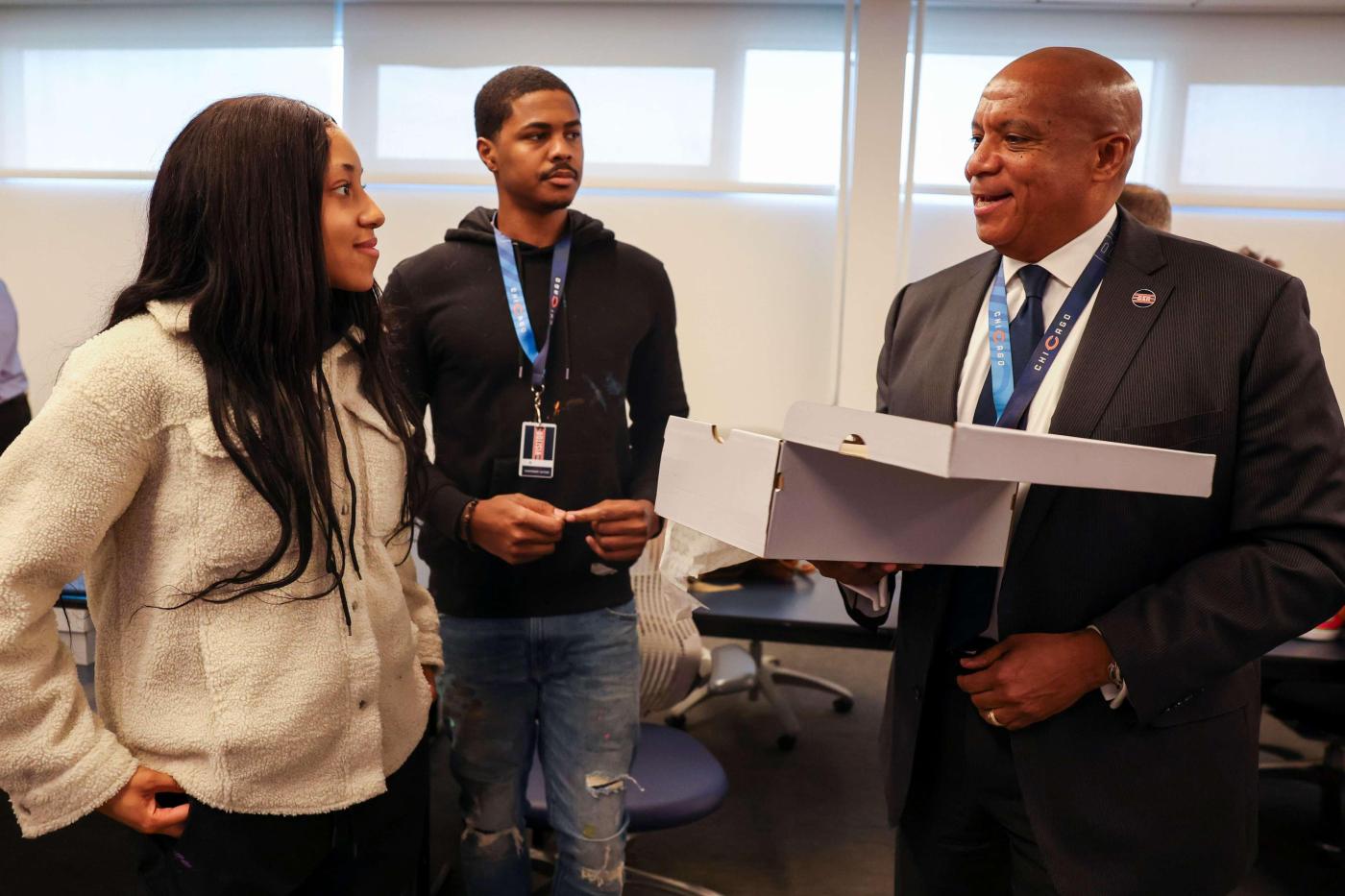
A little more than a year after its modest opening, The SHU Experience led more than 100 members of the Chicago Bears organization in customizing Nike Air Force Ones as part of the NFL’s My Cause, My Cleats initiative.

It’s the eighth year NFL players have an opportunity to participate in the campaign, which allows them to design and wear custom cleats that support a charitable organization of their choice. But for the first time, everyone associated with the Bears was invited to participate.

For Sunday’s game against the Detroit Lions at Soldier Field, Bears players will wear cleats customized to represent causes near and dear to their heart. And Bears employees will wear their custom sneakers.

Bears Chairman George McCaskey and President and CEO Kevin Warren are participating, with their shoes painted by members of the organization who paint sneakers as a hobby. Warren’s sneakers were customized in support of the Warren Family Foundation.

“It’s important because a lot of us as an organization — and then the individuals that we have, from players and coaches to staff to ownership — are able to amplify causes that are near and dear to each one of us,” Warren told the Tribune, “and to do it in a manner that brings awareness to just how blessed we are and the positive impact of the Chicago Bears of what we can have in the community.”

The idea for the organization-wide event came from the Bears Young Professionals Employee Resource Group, led by partnership activation specialist Dominic Hillesheim and events coordinator Lorena Soria.

“We thought My Cause, My Cleats symbolizes everything that we’re trying to create because shoes don’t discriminate at all,” Hillesheim said. “Every single person, whether it’s a flip-flop or a boot, everybody has to wear a pair of shoes. Everybody also had a cause that was close to their heart, whether they knew about it right away or they had to research it a little bit.”

Soria, who describes herself as “a huge sneaker person,” learned about Sneakerhead University on TikTok. Mallorie Sanders, the Bears manager of diversity, equity and inclusion, said the museum’s mission aligned with the team’s community-based values.

Sneakerhead University’s museum now includes multiple rooms of immersive sneaker history — including a “real versus fake” exhibit — and hosts both private and ticketed (open to the public) customization classes and parties.

According to Branch, when the Bears reached out to them, they thought they would just be putting the team logo on the shoes. They had no idea they would be doing something so meaningful for so many.

“We didn’t realize how many people wanted a piece of them on their shoes,” Branch said. “We’ve seen a lot of stories. It’s been cool seeing them develop.”

In November, SHU held workshops at both the Bears offices in the Loop and at Halas Hall in Lake Forest. Team employees supported charitable organizations such as Easter Seals, Special Olympics and their kids’ schools. They spent hours coming up with designs and painting their shoes.

At an unboxing event Wednesday at Halas Hall, staffers excitedly saw their finished sneakers and shared their causes.

“When we start working on the shoes, it starts off as the blue-and-green shoe or the red-and-yellow shoe,” Belvin said. “And then after it’s, ‘Where’s Larry’s shoe?’ because you almost feel like you know the person.”

Bears running back Khalil Herbert is participating in My Cause, My Cleats, though he didn’t paint his own shoes. His cleats were customized in support of Heartland Animal Shelter.

“I chose Heartland because of my love for animals, specifically dogs,” Herbert said. “I have two dogs and just wanted to bring awareness to the shelter. They do a great job of bringing in a lot of these dogs from kill shelters and giving them another opportunity in a second home.”

He learned about Heartland, located in Wheeling, through his dog sitter when he needed a place to donate extra toys and treats, and he has since visited twice. Herbert’s blue cleats feature painted paw prints and pictures of his dogs, Khazi and Khace.

He wasn’t the only animal lover whose shoes stood out.

“There’s someone whose shoes are about his cat,” Branch said. “And you can tell he really loves cats. He put all the cats he’s ever had on a sneaker. That really stuck out to me.”

For others, customizing their shoes was an opportunity to pay homage to a lost friend or relative. As they showed colleagues their shoes, you could see the emotion in their faces. Belvin and Branch talked with people about their shoes and helped lace them properly, making sure every detail was just right for their big moment Sunday.

The event with the Bears was SHU’s largest to date, an opportunity for which Belvin and Branch said they are grateful. By helping members of the organization tell their stories, they got to add to their own.

“You can tell these shoes really mean a lot to people,” Belvin said. “Being able to walk around and somebody ask, ‘Where’d you get those shoes?’ they have a reason to tell their story.

“I think that’s the biggest thing that they’ll get from it and the biggest thing we get from it — getting to know a little piece of everybody and having a different appreciation for the art and the shoes.”

()

What to know about home care services

posted in: News | 0

Reed Abelson | (TNS) KFF Health News

Most older Americans want to live at home as long as they can, but finding and affording the help they need often isn’t easy. There are severe shortages of home health aides in many parts of the country. Hiring them is costly. And most middle-class people will have to pay for home care themselves if it’s needed for the long haul.

Here’s a guide to locating home care for an older person.

What kind of home care do you need?

After a fall or surgery, some older people will need short-term care at home from a nurse or therapist to help them recover. Medicare, the federal insurance program for those 65 and older, typically pays for this kind of home health care. A nurse can make sure a wound is healing properly, for example, while a physical therapist can help a person get back on their feet after a knee replacement.

But millions of older Americans need assistance over months or years to stay in their homes safely instead of moving to an assisted living facility or nursing home. They may require help getting out of bed, taking a shower, or going to the bathroom; getting to the doctor; shopping for groceries; or making meals. They would need a home aide or personal care assistant, who may not have much, if any, medical training.

How do I find help?

A wide range of services are available, whether it’s light housekeeping or hiring a private-duty nurse. Monica Moreno, senior director of care and support at the Alzheimer’s Association, suggests that you start by making a simple list of the kind of help you or your loved one needs and the number of hours each day or week required.

To identify agencies and services available in your area, Moreno recommends looking through a database of community resources provided jointly by the association and AARP, the nonprofit group representing older Americans, that is searchable by location. A list of agencies and a brief description of what they provide can be found under the category “care at home.” AARP also has a guide to finding a home health aide.

Should I use an agency?

While Medicare certifies and gives star ratings to home health agencies, the businesses that provide home care services are not subject to federal oversight or required to be licensed in every state. But a good agency will run background checks on its workers and give them training and support. If an aide calls in sick or quits, the agency can find a replacement. Some businesses also bond and insure their caregivers.

To choose an agency, Jennifer Battista, chief operating officer for the Home Care Association of America, suggests inviting several of them to your home to conduct an assessment. Ask them how they vet their employees, whether they run criminal background checks, and whether their employees are required to know how to perform CPR or provide first aid. Be sure to ask for references for individual aides and talk to families who have employed them before.

Once you pick an agency, you may want to try a few caregivers before finding the right one. The more information you share about your loved one’s needs, the better the agency will be able to find an aide who’s a good fit. “It’s a lot like matchmaking,” Battista said.

What about finding someone through word-of-mouth?

Many families have success finding a caregiver by asking people they trust for recommendations, said Nicole Jorwic, a lawyer who is the chief of advocacy and campaigns for Caring Across Generations, an advocacy organization. “Cast a wide net, post on private social media, and ask family and friends,” she said, noting that she found caregivers for her grandparents by asking people in her community.

Churches and other religious institutions, local charities, and community organizations may also have suggestions. A primary care doctor or local medical practice may have experience with specific home care agencies or know of individual caregivers. If you decide to hire someone privately, you should be sure to do a thorough background check and talk to families who have employed them before. Family Caregiver Alliance, a California nonprofit group, provides a guide.

Will Medicare cover the cost of an aide?

Many home agencies erroneously say they can’t send a home aide and will tell a doctor’s office or patient that Medicare won’t pay for one. “This is a long-standing problem,” said Judith Stein, executive director of the Center for Medicare Advocacy, a nonprofit legal group.

While it’s true that Medicare doesn’t pay for long-term care, it may pay for an aide as part of a patient’s care plan if that person also qualifies for a home nurse or therapist for a time. Agencies often refuse to provide someone because Medicare pays a lump sum per patient, meaning the agency isn’t paid more for sending an aide in addition to the nurse or therapist. Talk to the doctor about whether an aide is necessary so one can be specified in the care plan presented to the agency.

Medicare patients are getting fewer visits from an aide now than they did some 25 years ago, and the center is now appealing a judge’s dismissal of a lawsuit claiming that Medicare, under the Department of Health and Human Services, discouraged the use of aides for thousands of people. The judge did acknowledge that many people were not getting care.

Will other insurance pay for an aide?

Under Medicaid, the state-federal program for low-income people that provides long-term care, the cost of an aide is often covered as an alternative to a nursing home. But a shortage of workers can make it difficult to find one even if you qualify. Families complain of frequent no-shows, and because wages are low under the program, agencies often have high turnover among workers.

Some private Medicare Advantage plans offer home care as a supplemental benefit, and it’s possible that some help will be covered under a long-term care insurance policy. If you or your loved one is a veteran, it’s worth checking with the Department of Veterans Affairs to see if it will pay for home care.

How much will an aide cost?

If you decide to pay privately, the hourly rates charged by agencies vary widely, and some agencies may not be able to fill a position for just a few hours a week. In San Jose, California, half the agencies charged more than$37 an hour for a home health aide in 2021, according to Genworth, a long-term care insurer. Across the country, agencies are charging roughly $27 an hour with a little more than half of that going to pay their workers.

There are no good estimates for how much people working for themselves may charge. You could save some money because there is no go-between agency taking a cut, but some independent caregivers charge roughly the same as an agency.

How do I report a problem?

If the agency you’re using is licensed by your state, you can check with the government office overseeing it if you run into a problem. You can also file a complaint with various state agencies, including the state health department.

Where else can I get help?

State or local government agencies that focus on aging or nonprofit groups can provide information. You can also try the Eldercare Locator. The Alzheimer’s Association also has some advice for finding caregivers, and it offers a 24-hour help line: 1-800-272-3900.

What about respite care?

Family caregivers should also think about taking advantage of respite care to give themselves a break from time to time. Depending on the circumstances, insurance may cover the cost, and there are local government and community groups that will pay for an aide for a brief period. Churches and other organizations might also provide respite care.

(KFF Health News, formerly known as Kaiser Health News (KHN), is a national newsroom that produces in-depth journalism about health issues and is one of the core operating programs of KFF — the independent source for health policy research, polling and journalism.)

©2023 KFF Health News. Distributed by Tribune Content Agency, LLC.

Opinion: Universal Housing Vouchers are Key to Ending a National Crisis

posted in: News | 0

“Fully funding Section 8 to establish a Universal Housing Voucher program will clear the way to reduce spending on everything from health care to food security, and set a course to end this housing crisis.”

Adi Talwar

CityViews are readers’ opinions, not those of City Limits. Add your voice today!

There are conversations taking place every day among our elected representatives, from the U.S. Capitol to our local town halls, about how to solve the housing crisis that worsens every year.

This summer showed the urgency for solutions as record high temperatures swamped the nation, taking a devastating toll on our homeless neighbors. As previously unprecedented weather and climate events become regular occurrences, looming threats of disasters have the potential to make hundreds of people homeless overnight.

This is is a complex problem with no simple answer, and just as numerous causes led to our current housing crisis, numerous solutions need to work in concert to stem the tide. Leadership and adequate investments must start at the top. We need a nationwide, federal commitment that matches the scale of the crisis to help all Americans secure affordable, good quality housing.

This commitment could take many forms, from innovative bipartisan tax incentives like the Neighborhood Homes Investment Act and the Affordable Housing Tax Credit Improvement Act, which would help boost production of new housing and ramp up preservation of existing housing, to increased appropriations for public housing and rental assistance programs that directly support those most at risk of housing insecurity.

This crisis is too dire for too many people. The federal government must act with urgency now.

For the one-in-three households in the U.S. that rent, the need is particularly urgent. Last year, rental prices saw the fastest growth on record across multiple housing sectors, with rents in 116 of 150 of the nation’s largest metro markets growing by double digit percentages and by more than 20 percent in 25 of those markets. Today, nearly one-in-four renters are spending at least half their earnings on housing with little left for other necessities, leaving millions teetering on the edge of homelessness. 

For some, help comes in the form of a housing voucher. Since it was created in 1978, the Housing Choice Voucher Program has helped eligible low- and moderate-income families by capping their rental costs at 30 percent of their earnings. Today, more than 3 million U.S. households benefit from rental assistance vouchers either directly through the program or as renters in affordable homes financed by the consistent revenue the vouchers provide.

While there’s a long history of reducing voucher holders to unfavorable stereotypes, the reality is the folks who benefit come from every walk of life. They’re our nurses, our firefighters, our teachers, our bus drivers. They live in every community and every type of housing, from rural single-family homes to suburban townhouses. These are hard-working people who are doing everything asked of them, but are still struggling to get by.

Despite its proven track record of positive impact, the Housing Choice Voucher program remains woefully underfunded, covering just one-in-four eligible renters nationwide. That leaves some 16 million households on the outside looking in, often on waiting lists for years as they fight to avoid homelessness. Simultaneously, landlords have become frustrated with the inefficient and cumbersome administrative requirements, and wary of annual appropriation battles.

With so many American families on the edge of homelessness, we simply cannot afford to spend so little of our nation’s more than $6 trillion budget on a program we know works. By tripling annual spending on the Housing Voucher Program to $100 billion annually, still less than 2 percent of the federal budget and about one-tenth of what we spend on Social Security, we can make housing vouchers universally available to all eligible households. This investment could help the program lift an estimated 2.2 million additional families out of poverty while providing low-income renters a new level of tenant protections and housing quality standards.

Inaction is costly. When you add up the tab for the myriad federal, state, and local services that support the unhoused, studies show a chronically homeless person costs taxpayers as much as $30,000 to $50,000 each year. Fully funding Section 8 to establish a Universal Housing Voucher program will clear the way to reduce spending on everything from health care to food security, and set a course to end this housing crisis.

We can’t stop there. Government must also address our crippling housing undersupply if we’re going to make long-term progress. Post-World War II, facing a huge housing shortfall, government-subsidized development fueled economic growth that increased supply and led to deeper affordability. Today, sky-high interest rates and costs have stymied development. Our elected leaders have the opportunity to learn from the past, and can take action to make housing production the focal point of our economic resurgence.  

Congress must take an “all of the above” approach, and move swiftly to pass legislation like the Affordable Housing Tax Credit Improvement Act, the Neighborhood Homes Investment Act, and the Community Development Investment Tax Credit Act to boost the production of new housing and preservation of existing affordable housing. 

Such transformative public investment in rental housing affordability and supply would be in many ways analogous to a homeowner’s down payment on a house: An upfront investment that unlocks long-term stability, opportunity, and, most importantly, affordable homes for millions of Americans—returns that will be realized for generations to come.

Rafael Cestero is CEO of the Community Preservation Corporation (CPC) and co-host of The Housing Problem podcast. He was commissioner of the New York City Department of Housing Preservation and Development (HPD) from 2009-2011. 

Trump’s first criminal trial is scheduled to begin in March but legal appeals threaten that date

posted in: Politics | 0

By ALANNA DURKIN RICHER and ERIC TUCKER (Associated Press)

WASHINGTON (AP) — Donald Trump’s 2020 election interference case in Washington once appeared likely to be the first of the former president’s criminal trials to begin, with the judge having scheduled a March 4 start date. But appeals of issues central to the case are threatening to change that.

U.S. District Judge Tanya Chutkan on Wednesday put the case on hold while Trump pursues his claim in higher courts that he is immune from prosecution. Chutkan raised the possibility of keeping the March date if the case promptly returns to her court, but it is possible the appeal could tie up the case for months.

Potentially further complicating prosecutors’ effort to go to trial swiftly is the Supreme Court’s review of an obstruction charge used against Trump and hundreds of his supporters who stormed the Capitol on Jan. 6, 2021. Trump’s lawyers have made clear that their legal strategy involves pushing his trial off until after the 2024 election and they could use the Supreme Court’s involvement to try to further delay the case. Trump is the current front-runner for the 2024 Republican presidential nomination.

A look at the legal issues complicating the trial date and the potential political ramifications:

Trump is charged, as are more than 300 people accused of participating in the Capitol riot, with obstruction of an official proceeding, which refers to the joint session of Congress held Jan. 6 to certify Democrat Joe Biden as the winner of the presidential election. The Supreme Court on Wednesday said it would consider a case challenging the use of the obstruction charge against a former police officer who joined the mob at the Capitol.

Trump’s lawyers could try to make the argument that Trump’s case cannot go forward until the Supreme Court rules on the scope of the obstruction offense, which potentially could affect both the obstruction charge and a related conspiracy charge against Trump. His team would have to persuade the trial court judge to agree to the pause.

At least two other Jan. 6 defendants convicted of the obstruction charge have asked to cancel sentencing hearings scheduled for next week and put them off until after the Supreme Court rules on the issue. Under the Supreme Court’s normal schedule, the justices would not hear arguments on the case until late March or April.

David Alan Sklansky, a former federal prosecutor, said he does not think Trump has a good argument for delaying the case while the justices review the obstruction charge. Sklansky, now a professor at Stanford Law School, noted that cases move forward all the time even though they involve laws that are being challenged in other cases.

“If the Supreme Court ultimately decided to interpret the statute that’s an issue in that case narrowly, that could affect whether convictions under that statute in Trump’s case would be upheld on appeal,” Sklansky said. But he said: “It would be unusual to delay a trial waiting for the Supreme Court to decide a legal issue of this kind.”

Immunity.

It’s a word and legal concept that will dominate discussion in the courts in the coming weeks. And it could wind up delaying the trial.

In addition to taking up the obstruction statute, the Supreme Court is also being asked to consider a question with an even more direct impact on the Trump case. It’s one that never has been tested before the justices: Is a former president immune from federal prosecution?

Chutkan rejected the Trump team’s arguments that an ex-president could not be prosecuted over acts that fall within the official duties of the job.

After Trump’s lawyers appealed, special counsel Jack Smith’s team sought a quick, once-and-for-all resolution, asking the Supreme Court this week to not only consider that question but to fast-track a decision so the case can continue along the current schedule.

The Supreme Court has said it would decide quickly whether or not it will hear the case. In the meantime, Smith’s team also asked the U.S. Court of Appeals for the D.C. Circuit to expedite a decision of its own on presidential immunity.

That appeals court late Wednesday agreed to expedite the case, setting deadlines for briefs to be filed between Dec. 23 and Jan. 2. But the appeals court has yet to set a date for when it will hear arguments.

It’s possible.

The other criminal case brought by Smith charges Trump with illegally hoarding classified documents at his Florida estate and obstructing FBI efforts to get them back. The trial is currently scheduled for May 20. But the judge in that case has pushed back has multiple other deadlines and signaled an openness to revisiting the trial date during a pivotal pretrial conference set for March.

A separate case on charges that Trump falsified business records in connection with hush money payments to a porn actress is set to go to trial on March 25 in New York state court, but that date isn’t set in stone either. Judge Juan Manuel Merchan, responding to a Trump team request to postpone that trial, said in September that he would rather stick to the original schedule for now and wait until the next pretrial hearing in February to see if “there are any actual conflicts” requiring a delay.

No trial date has been set in Fulton County, Georgia, where the district attorney’s office has charged Trump with trying to subvert that state’s election in 2020. Prosecutors have asked for an August trial date, but his lawyer has said it would amount to “election interference” to stage a trial then.

The trial dates carry enormous political ramifications.

If Trump was the GOP nominee and won election next November, for instance, he presumably could use his authority as head of the executive branch to try to order a new attorney general to dismiss the federal cases or he potentially could seek a pardon for himself — something that’s a legally untested proposition.

Smith’s team is looking to secure convictions and sentences in the coming year before that election. Trump, as a private citizen and not an officeholder, possesses no more power or privileges than anyone else under the law. In a recent filing in the election subversion case, Smith’s team said the “public has a strong interest in this case proceeding to trial in a timely manner.”

Trump’s team has accused Smith of trying to rush the case through for political reasons. Trump’s lawyers told an appeals court this week that “the prosecution has one goal in this case: To unlawfully attempt to try, convict, and sentence President Trump before an election in which he is likely to defeat President Biden.”

____

Richer reported from Boston.