Minnesota Yacht Festival coming to Harriet Island Regional Park in St. Paul

posted in: News | 0

It’s been years since a major music festival alighted on Harriet Island Regional Park, despite its seemingly choice location along the Mississippi River below the downtown St. Paul river bluffs.

Counting Crows headlined a “Taste of Minnesota” concert line-up in 2010 that ended in bankruptcy for the longstanding food festival. In 2012, the odd match-up of dark alt-metal rockers Tool and the dreamy roots-rock of the Dave Matthews Band put the nail in the coffin of Live Nation’s short-lived River’s Edge Music Festival.

C3 Presents now plans to sail into the same scenic venue that other concert promoters have feared to tread for more than a decade. The team behind the popular Austin City Limits Music Festival, Lollapalooza and Bonnaroo have announced they’ll take over Harriet Island Regional Park on July 19 and July 20 for the inaugural Minnesota Yacht Club Festival.

Music line-up to come

The music line-up won’t be announced until sometime next month, according to C3, which is headquartered in Austin, Texas. Still, other promoters within the event industry with an inkling of the goings-on say to expect big things of the company, in which Live Nation bought a majority stake in 2014.

St. Paul Mayor Melvin Carter this week said “stellar performances” and local cuisine are on tap.

“These are the people who do Austin City Limits,” said Rand Levy, a veteran promoter currently producing the Glow Holiday Festival at downtown CHS Field. “They’re not amateurs.”

Levy, who is not directly attached to the Yacht Club Festival, would not divulge what he’s learned of the line-up, except to say “it appears to me they’re putting together a big show. … I think it’s a great flexible grounds. It’s very pliable and flexible. I’ve done shows there and it’s terrific.”

An attractive venue built like a park

Why have promoters avoided Harriet Island for so long?

The answers have as much to do with the venue as trends within the music fest industry. Among the challenges, the Harriet Island bandshell is too low to the ground to serve as a primary stage, forcing the construction of temporary stages. Large concerts require power, fencing and other infrastructure that isn’t in abundant supply on site.

Apartments and condos constructed along the river trigger noise variance and permitting requirements that can force a stage to be relocated or reoriented. Then there’s the vagaries of drawing 30,000 fans or more to a riverfront that can flood and grassy fields that can turn to mush after heavy rains.

In short, “it’s not built out like the Summerfest grounds in Milwaukee or the State Fairgrounds, where it was purpose-built for the festival experience,” said Joe Spencer, president of the St. Paul Downtown Alliance. “Harriet Island was built as a park.”

“And at the same time, being down right by the water, it’s such a beautiful site, I’m not surprised they’re going to find a way to make it work,” added Spencer, who previously served as a cultural adviser to former St. Paul Mayor Chris Coleman. “Having 30,000 music fans parking in downtown and having an experience down by the river is going to be a fantastic addition.”

Levy noted that music festivals have run aground elsewhere, largely because of event costs.

“You’ve got to have deep pockets,” he said. “You’ve got to have the right talent. The talent is not cheap.”

Pent-up demand

Still, with some other festivals like the Basilica Block Party in Minneapolis repeatedly side-lined in recent years, there’s a pent-up demand to come together for communal cheer following the pandemic, and there’s plenty of energy left in downtown St. Paul event venues.

The European Christmas Market at the downtown St. Paul Union Depot has been mobbed with visitors this season. This is Levy’s fourth year producing a holiday lights festival just down the street at CHS Field, the home of the St. Paul Saints, and the 31 scheduled shows have been drawing crowds. “We’re jamming them in,” he said. “This is our best year ever.”

Opening the city’s riverfront parklands to tens of thousands of visitors will take careful coordination with City Hall, but officials say they’re fully on board.

“We’re excited about it,” said Clare Cloyd, a spokesperson for St. Paul Parks and Recreation, which is working alongside the mayor’s office to make the the Minnesota Yacht Club Festival a success. “It’s been a while.”

C3 Presents are encouraging music festival fans to sign up for text alerts, emails and social media notifications at MinnesotaYachtClubFestival.com, or to follow along on Facebook, Instagram, X (previously Twitter) and TikTok.

Related Articles

Local News |


St. Paul advocate, co-founder of Minnesota Deaf Queers, named Unsung Hero by McKnight Foundation

Local News |


St. Paul murder trial: Jurors to deliberate in case of 2nd man charged in killing of 22-year-old walking home from work

Local News |


Study: Outlooks brightened but savings elusive during St. Paul’s guaranteed income project

Local News |


St. Paul schools’ Joe Gothard finalist for national superintendent award

Local News |


To bridge funding gaps, Winter Carnival holding ‘clean out the attic’ auction of vintage memorabilia

Millions in opioid settlement funds sit untouched as overdose deaths rise

posted in: Society | 0

Katheryn Houghton, Aneri Pattani | (TNS) KFF Health News

Nearly a year after Montana began receiving millions of dollars to invest in efforts to combat the opioid crisis, much of that money remains untouched. Meanwhile, the state’s opioid overdose and death counts continue to rise.

The money is part of the approximately $50 billion that states and local governments will receive nationwide in opioid settlement funds over nearly two decades. The payments come from more than a dozen companies that made, distributed, or sold prescription opioid painkillers that were sued for their role in fueling the overdose epidemic.

Many places have begun deciding where that money will go and making payments to schools, public health departments, and local governments. South Carolina, for example, has awarded more than $7 million to 21 grantees. Wisconsin has posted two years’ worth of spending plans that total nearly $40 million.

Montana, West Virginia, and Hawaii are among the states moving slower.

Montana began receiving its first settlement payments in January, and, by fall, payments totaled roughly $13 million. As of early December, the Montana Opioid Abatement Trust — a private nonprofit created to oversee 70% of the state’s share — had met once to agree to its rules of operation, and its money remained locked behind an inactive grant portal. The remainder, divided among the state and local governments, either hadn’t been spent or wasn’t publicly recorded.

Those charged with distributing the money say they’re building a framework to spend it in ways that last. Meanwhile, some addiction treatment providers are eager to use the funds to plug gaps in services.

The tension in Montana reflects a nationwide push-pull. Those handling settlement dollars say governments should take their time planning how to use the enormous windfall. Others argue for urgency as the drug supply has become increasingly deadlyMore than 100,000 Americans died of overdoses in 2022, surpassing the previous year’s record-setting death toll.

Nearly 200 Montanans died of a drug overdose in 2021, the latest year state data is available. That number, likely an undercount, is roughly 40 more deaths than the year before. Emergency medical responders have continued to record an increasing number of opioid-related emergencies this year.

In Billings, the Rimrock Foundation, one of the state’s largest behavioral health providers, has seen its number of clients with opioid use dependency more than triple since 2021. Like other treatment facilities, Rimrock has a waitlist, and addiction treatment providers worry about the limited community resources that exist for patients once they are discharged. “The result of not addressing this is a lot of deaths,” said Jennifer Verhasselt, Rimrock Foundation’s chief clinical officer.

Debbie Knutson, Rimrock’s medical unit and nursing supervisor, said there is widespread confusion about how and when the state’s settlement dollars can be used.

“It’s very concerning if we have money available that we could use to help people that is just kind of sitting, waiting for somebody to decide where it should go,” Knutson said.

Rusty Gackle, the Montana Opioid Abatement Trust executive director, said a lot of work has happened behind the scenes to get local governments ready to accept their initial payments and for regional leaders to form systems to request money from the trust. That included hosting a series of town hall-style meetings to share information about the process. He said many of those local regions are still finalizing their governance structures.

“I would love to progress a little bit faster,” Gackle said. “But I’d rather do it right so that we’re not having to go backwards.”

Montana officials got a late start too, he added. Some states began receiving settlement dollars last year, but Montana was toward the tail end of the line.

Montana is dividing its money three ways: 15% to the state, 15% to local governments, and the rest to the Montana Opioid Abatement Trust, with some money set aside for attorneys’ fees.

As of late November, the state hadn’t begun spending the $2.4 million it had in hand for state agencies. Officials also aren’t tracking how and when local governments spend their direct payments.

Similarly, West Virginia and Hawaii hadn’t — by late November — begun spending the largest shares of their funding. In West Virginia, the makeup of the foundation board that will oversee roughly 70% of the state’s settlement dollars was announced only in August, six weeks after the state’s deadline, and the board is now sitting on more than $217 million.

Nationwide, state and local governments have received more than $4.3 billion as of Nov. 9. How much of that has been used remains uncertain due to states’ lack of public reporting. But from what is known, it varies.

Colorado, whose spending plan is similar to Montana’s but received its settlement money earlier, has allocated millions toward school and community-based programs, recovery housing services, and expanded treatment services.

Sara Whaley, a Johns Hopkins researcher who tracks states’ uses of opioid settlement funds, said a slower start isn’t inherently wrong. She prefers governments take time to spend the money well rather than fund outdated or untested practices. In some cases, governments are building entirely new systems to dole out the money. Several waited until the courts finalized the settlement amounts and details.

“There are definitely states that were like, ‘We are going to get money at some point. We don’t know how much or when, but let’s start setting up our system,’” Whaley said. “Other folks were like, ‘We have a lot going on already. We’ll just wait until we get it and then we’ll know what the settlement terms are.’”

Even once committees start meeting, it can take months for the money to reach front-line organizations.

Connecticut’s opioid settlement advisory committee made its first allocation in November, eight months after it was formed. Maine’s recovery council, which controls half the state’s settlement funds, has been meeting since November 2022, but just recently voted on priorities for the more than $14 million it has on hand and still needs to establish a grant application process.

Tennessee’s Opioid Abatement Council accepted grant applications this fall. Stephen Loyd, council chair, said the process — from picking awardees to processing payments — will take roughly six months. Within that time, he said, 2,808 Tennesseans are likely to die of drug overdoses.

As an interim step, Loyd proposed at an October meeting to award $7.5 million to an emergency six-month initiative to flood the state with naloxone, a medication that reverses opioid overdoses.

But his proposal was met with protests from council members, who pushed back on what they saw as a circumvention of the grant process they had spent months establishing. The council didn’t vote on the emergency initiative but instead created an expedited review process to consider fast-tracking future applications.

Gackle said he doesn’t think Montana is far behind others. Now that spending systems are almost in place, he said, things should move faster.

Lewis and Clark County, home to the state capital, Helena, has a yearlong plan and budget for opioid settlement funds. A cohort of 17 counties in rural eastern Montana defined its regional settlement decision-makers in November and, by early December, had yet to begin official talks about where the money should go.

Brenda Kneeland, CEO of Eastern Montana Community Mental Health Center and an advisory committee member for the Montana Opioid Abatement Trust, said eastern Montana has one inpatient treatment center for substance use disorders and zero detox facilities, so emergency rooms end up serving as a fallback resource.

Kneeland said local officials want to ensure they understand the rules to avoid trouble later and to stretch the funding.

“You don’t get an opportunity to try to correct such a wrong very often,” Kneeland said. “It’s just a huge job at a county level. I’ve never seen an undertaking like this in my career.”

The Montana Opioid Abatement Trust advisory committee will meet quarterly, meaning its next chance to review any submitted grants will be next spring.

___

(KFF Health News, formerly known as Kaiser Health News (KHN), is a national newsroom that produces in-depth journalism about health issues and is one of the core operating programs of KFF — the independent source for health policy research, polling and journalism.)

©2023 KFF Health News. Distributed by Tribune Content Agency, LLC.

‘Healing the scars:’ New York to study state reparations

posted in: Politics | 0

ALBANY, N.Y. — New York on Tuesday created a commission to study potential reparations for state residents of African descent, making it the second state after California to do so.

The commission, which will report its findings in 2025, will have a broad charge. It will examine New York’s legacy of slavery and discrimination and will make recommendations on both statutory changes and potential payments to combat generational wealth inequality.

“In New York, we like to think we’re on the right side of this — slavery was a product of the South, the Confederacy,” Hochul said while signing the bill at an event in Manhattan. “What is hard to embrace is that our state also flourished from that slavery. It’s not a beautiful story, but it’s the truth.”

Hochul was joined by Black leaders in the state Legislature and the Rev. Al Sharpton in the bill signing. They praised the measure as a way to rectify generations of wrongs caused by slavery, such as housing and job discrimination. The panel will look at ways, in addition to any financial payments, to address racial and structural inequities in the state.

“Some of the media will act like [Hochul] met us here and she gave Rev. Al and all of us a check for a billion dollars,” Sharpton said. “But that’s not what this does. This is the beginning of healing the scars.”

The commission, which will wrap up its work by the summer of 2025, will only make recommendations. Anything it proposes will need to be passed as a bill by the Democratic-led Legislature and governor.

New York is the second major state to establish such a commission. One in California wrapped up its work earlier this year by recommending payments of as much as $1.2 million per eligible resident over time.

Leaders there, though, have not yet acted on any of the recommendations, with officials such as Gov. Gavin Newsom casting doubt on the potential for payments. But California’s commission has helped put the issue of historic racial injustice front-and-center with the Legislative Black Caucus preparing a push for some of its ideas in 2024.

Hochul admitted she has had “some concerns about this” as she pressured by supporters and detractors over the bill, which was approved in June by state lawmakers.

“There’s a part of me that worries about leaping into this conversation because of the racial division and strife it could sow. People will say what does this have to do with us in 2023?” she said.

“Anybody that thinks that racism and hatred for Blacks no longer exists, tell that to the families of the 10 victims at the grocery store in the massacre in Buffalo, who once again will be staring at empty chairs at their Christmas dinner.”

Hochul’s first bid for a full term in 2022 was defined by an effort to win over Black voters, after early polls showed they were less likely to support her than previous statewide Democratic statewide candidates. On Tuesday, the state’s first woman governor received the praise of a long list of top Black leaders.

“It took a courageous young white woman from Western New York to say I’m going to do what all the urban men before me wouldn’t,” Sharpton said.

Assembly Speaker Carl Heastie, the first Black man to have a top role in New York’s Legislature, said the bill signing is “not going to be popular.”

But, Heastie said, “This is one of those moments where you put what was right over what may have been perceived as the political thing to do.”

State GOP chair Ed Cox criticized the bill.

“Governor Hochul’s decision to endorse this divisive and unproductive reparations study is misguided,” he said in a statement. “Instead of focusing on the issues that truly matter to New Yorkers, like our ongoing immigration crisis, crime, and the exodus of residents from our state, she’s chosen to reopen old wounds and stoke racial tensions for political gain.”

Chicago Bears Q&A: When would a potential Justin Fields trade take place? How realistic are their playoff chances?

posted in: News | 0

Once left for dead at 2-7, the Chicago Bears have stoked long-shot playoff hopes with three wins in their last four games, including two in a row.

Before they try to make it three straight Sunday in Cleveland, Brad Biggs gauges the playoff scenarios and answers a slew of other questions in his weekly Bears mailbag.

You’ve been pretty transparent with your thoughts on Justin Fields’ future with the Bears. Assuming you are correct and the Bears trade him away (respectfully, I hope they don’t!), what would you anticipate that timeline looking like? Is this a move that would likely take place in March or could it stretch out down to the wire? — Vince R.

I’m not exactly sure what you mean by “the wire,” but I would imagine if they decide to move on from Fields, they would prefer to have a 2024 draft pick in return. That could happen in March after the new league year begins, or it could be a move made during the draft. The timing would depend on a handful of factors, including how many teams might be interested. In this scenario, some teams might have Fields as a Plan B if they can’t get a quarterback they desire in the draft. Some might be considering other veteran options as well. There are a lot of moving parts.

What could a return package for Fields look like? Again, that would depend on a couple of factors, including how many teams are involved. If the Bears can play multiple teams off each other, maybe they could push the price up a little bit. In 2021 the New York Jets traded Sam Darnold to the Carolina Panthers for three draft picks. (Are you sensing a trend here? The Panthers make bad trades.) The Jets got a sixth-round pick in 2021 and second- and fourth-round picks in 2022. A package similar to that probably would be a best-case scenario for Fields. I don’t believe the Bears would be able to get a first-round pick in return if they opt to trade him, but you never know.

It’s not a given the Bears will move on from Fields, but as you say, I’ve been consistent with my opinion on how this will play out, while also reminding everyone that weekly referendums don’t do a whole lot of good beyond promoting discussion.

NFL Network draft analyst Daniel Jeremiah was asked about Fields’ future Sunday before the Bears won, and he framed it this way:

“I use the phrase ‘the confetti test,’” Jeremiah said. “Can you close your eyes and imagine him as a quarterback on the podium with the confetti falling that you’ve just won a world championship? I don’t know that he’s shown you enough to give you that. To me, you look at this draft — and we’ll get into the names over the next few months — but you’ve got a chance to, in my opinion, get better, younger, cheaper at that position and you still possess the fifth pick as of right now as well to address some other needs.”

Lot of talk about the Bears, not long ago 2-7, now being in the playoff hunt? How realistic is this? — Tom F., Elburn

It’s a long shot but it has fueled optimism in the locker room and created some excitement for the fan base, and in mid-December, that’s a very good thing. Thirty of the NFL’s 32 teams remain alive for a playoff spot, which is just what the league hopes for and a result of the expanded 14-team playoff system. The Bears and New York Giants are 5-8, right behind a group of five 6-7 teams for the seventh and final NFC playoff spot. That’s a lot of traffic.

The Green Bay Packers, Los Angeles Rams, Seattle Seahawks, Atlanta Falcons and New Orleans Saints are 6-7. Tiebreakers get complicated, especially if three or more teams are involved, and with four games remaining, a lot of movement is possible. The way the Bears have been playing, they should have a shot to win all of their remaining games: at the Cleveland Browns, home against the Arizona Cardinals and Falcons and at the Packers. They have head-to-head losses to the Packers and Saints.

According to the New York Times’ interactive playoff simulator, the Bears have an 8% chance to reach the playoffs. A win over the Browns on Sunday would boost their odds to 11%. If the Bears win out and finish 9-8, they have a 62% chance. That’s without setting results for other games, but it shows you they’re still not a shoo-in if they run the table.

If you’re interested in scoreboard watching this week, here are outcomes you need to root for:

Bengals over Vikings
Broncos over Lions
Buccaneers over Packers
Panthers over Falcons
Giants over Saints
Commanders over Rams
Eagles over Seahawks

Let’s say the Bears win their final four games and those seven outcomes occur (the odds on this parlay would be through the roof). In that case the simulator gives the Bears a 98% chance of making the playoffs.

You could get lost in the playoff simulator all day. The bottom line is the Bears need to play quality football for a good stretch. If they can do that, you should feel better about how things set up for 2024 and they’re going to have a shot.

Will Matt Eberflus ever complain about the late hits Justin Fields takes? — @mabdacuma

This is a recurring question after Fields gets contacted by defenders, usually on running plays when he slides. You saw it happen in Sunday’s win over the Lions when linebacker Jack Campbell hit Fields when he was already on the ground. You saw it Monday night in the New York Giants’ win when quarterback Tommy DeVito slid and was hit by a Packers defender. Giants coach Brian Daboll went nuts on the sideline, and it wasn’t hard to read his lips and see language not suitable for publication.

It’s a fine line for officials to determine what is a legal hit and what crosses the line, and fans want to see a honked-off coach when a hit is questionable. I get it. That’s not necessarily Eberflus’ style, and he’s not the kind of guy who wants to rail on officiating to reporters and put himself in jeopardy of being fined by the league. I can’t blame him in that regard.

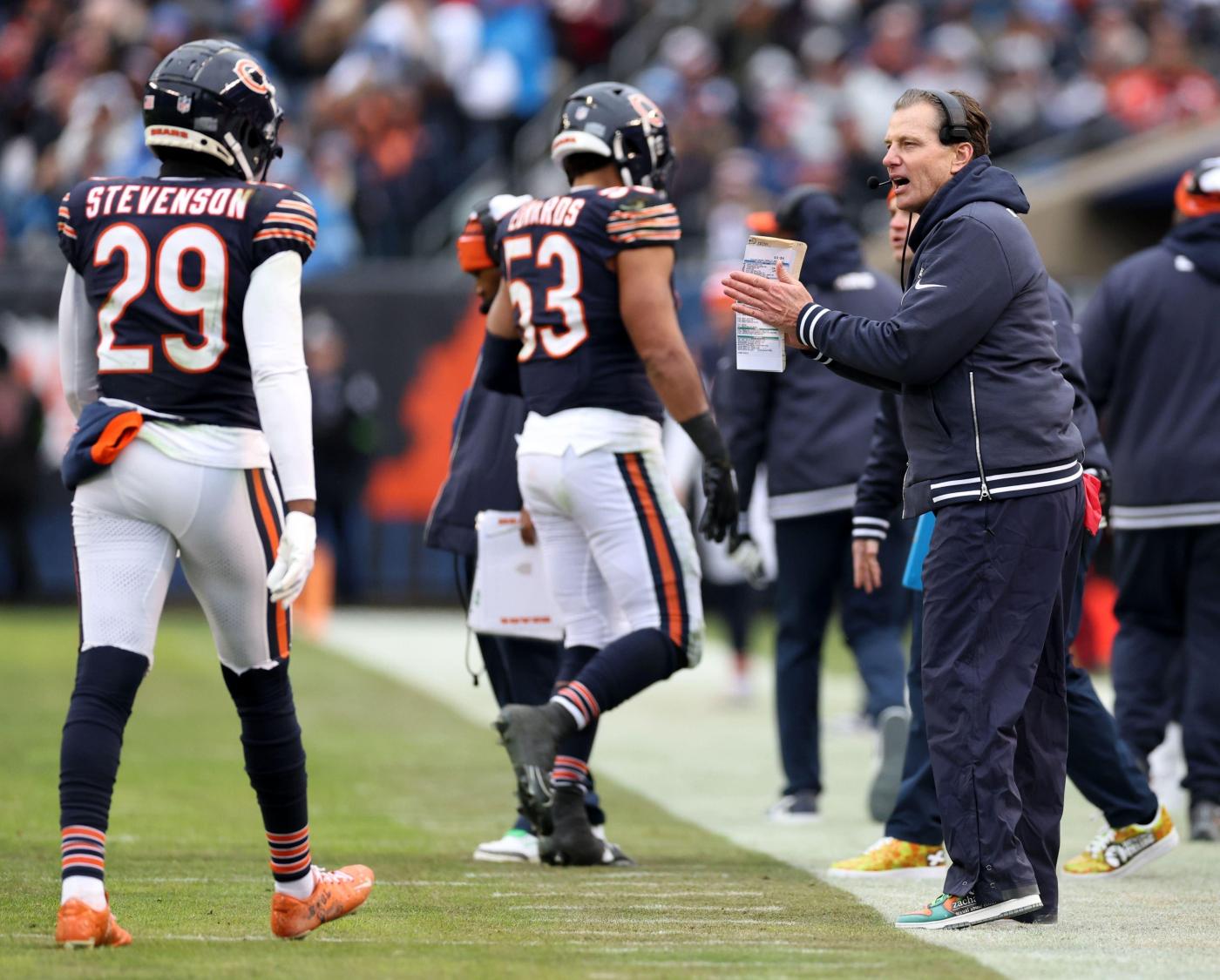
I can promise you Eberflus is doing two things that are more meaningful than ripping officiating to the press. First, he and his staff are working officials before games. This is standard protocol. “Hey, we’ve seen No. 53 with some questionable hits on quarterbacks the last few weeks. Be on the lookout for that.” Coaches are constantly working officials for calls, and this begins pregame with stuff they’ve seen in scouting. “Hey, our QB has taken some hits lately that have crossed the line. I need to make sure he’s protected today.”

Second, Eberflus is reaching out to the league office weekly when he thinks a call was missed. That can be educational. Sometimes the league admits a call was missed. Sometimes the league explains why a flag wasn’t thrown. Either way, the Bears get a detailed response explaining how the play was evaluated upon review.

“I’m always in their ear about that because protecting the quarterbacks in this league is big,” Eberflus said Monday. “Those guys are the league, so it’s important that we do that and we continue to do that. If you have a guy that’s a runner and he slides down like that, we’ve got to protect him.”

Just because Eberflus isn’t channeling his inner Ditka and providing the kind of sound bite you would hear on sports talk radio for an entire week doesn’t mean he’s not making his displeasure known in more meaningful channels.

Have Darnell Mooney’s agents thrown out a number? Is he a sure free agent and gone after the year? — @hubrogers

Mooney doesn’t have a lot to negotiate off of this season in terms of productive numbers, but I think the Bears believe in him and understand what he is capable of doing with increased opportunities. The Bears need to consider which direction they want to take at wide receiver in the offseason. Do they want to tap into a terrific draft class for receivers?

From Mooney’s standpoint, why eliminate 31 other teams from bidding by talking about a deal with the Bears now? Four regular-season games remain, and then he can wait until March and see what the marketplace looks like. Maybe the Bears would make an offer that’s close to what’s available for him in free agency. But he would be smart to find out, wouldn’t he?

Do you think the Bears might extend Jaylon Johnson and/or Cairo Santos before the end of the season? — @jtbarczak

General manager Ryan Poles seemed to indicate after the trade deadline that Johnson’s camp was intent on playing out the season. Survey the NFL for long enough and you learn never to say never. But I’m not sure what would motivate Johnson to sign a contract now, so close to reaching free agency. Unless he’s offered almost exactly what he wants, why not play out the season and then see if the Bears want to use the franchise or transition tag to keep him?

Overthecap.com estimates the franchise tag for cornerbacks in 2024 will be $18.4 million and the transition tag will be $15.9 million. Most of the time, teams use a tag to create more time and space for negotiations; otherwise, they have a player they want playing on another expiring contract. We’ll have to see if the Bears and Johnson have a big surprise the next few weeks.

I could see the Bears trying to get an extension done with Santos. I think it would take a solid offer because Santos otherwise could explore the marketplace. There’s virtually no chance the Bears would tag him (estimated $5.8 million for the franchise tag and $5.3 million for the transition tag). If they did, I’m betting he would run, not walk, to sign that offer and return it immediately. He’s due a raise as he nears completion of a three-year, $9 million contract.

Given your experience, how surprised are you in the space of a few weeks, in the minds of fans, Matt Eberflus has gone from 100% gone after this season to possibly staying, something fans now may be supporting? — @jpoch1983

It’s a what-have-you-done-for-me-lately world we’re in. My guess is some of the loudest who were speaking out against Eberflus when the team was 2-7 after the Nov. 5 loss in New Orleans are some of the loudest now about his possible return for a third season. Some folks just like to yell.

The Bears will make a decision on the future after the completion of two full seasons, and the improved play of late on both sides of the ball gives Eberflus and his staff a chance.

Why are the Bears lately choosing to take the ball if they win the toss instead of the traditional deferring until the second half? Are they trying to play more from the lead earlier so they can stay with their run game longer? — @noah_booty

The Bears elected to receive the opening kickoff the last four times they won the coin toss, and they are 3-1 in those games with an opening-drive touchdown in three of them. Matt Eberflus is going against what has become traditional strategy, as most teams elect to defer when they win the toss, hoping they can score late in the second quarter and then double up with points on the first series of the third quarter to swing momentum.

Why is Eberflus zigging when most teams are zagging? The Bears feel pretty good about how their offense produces with coordinator Luke Getsy’s scripted plays to open the game. They have five touchdowns on their first possession (not necessarily the first series of the game), which is tied for fifth in the league. The San Francisco 49ers are tops with eight, and the Seattle Seahawks, Denver Broncos and Baltimore Ravens all have six.

I don’t think it has anything to do with the running game. The idea is they think they can get some early momentum and set the tone. Eberflus deferred the first two times the Bears won the toss this season. The opponent has won the toss in seven games and deferred each time.

Why not keep Justin Fields for $6 million next year and draft a first-round quarterback and let him learn, a la Aaron Rodgers/Jordan Love? Gives Fields one more year (maybe with a new offensive coordinator) and that lets them kick the tires on a new guy in practice and probably in a game or two given Fields’ injury history. — @carlso1

You’re making an apples-to-oranges comparison. What do Fields and Rodgers have in common besides the fact both play quarterback? Rodgers is a four-time MVP who will be a first-ballot Hall of Fame selection. The Packers were trying to plot a future after Rodgers when they saw a quarterback they really liked fall into the back of the first round in 2020.

The Bears would be selecting a quarterback at or near the top of the first round because they don’t believe Fields is their guy for the long haul. The Packers felt like they had the luxury of grabbing a quarterback and continuing to win with Rodgers when some thought they should have selected a player who could help them immediately.

Any chance they’d bring in a new punter? When watching games, it’s remarkable to see the talent-level difference between opposing punters and Trenton Gill. Starting field position matters and it would be great if they could get someone more consistent. Odds they add one this offseason? — @shootermcconlon

The Bears have struggled in the punting game this season, and Gill ranks last in the league among qualifiers with a net average of 35.2 yards — 2.6 yards worse than 31st-place Sam Martin of the Buffalo Bills. That’s not all on Gill — it’s an 11-man operation — and the coverage unit has had too many breakdowns. But he’s a big part of the equation and it’s certainly something the team will want to look at in the offseason.

Gill’s gross average is 45.5 yards, tied for 25th. As a rookie last year he had a better season with a 40.3 net average, which tied for 25th. Soldier Field is one of the toughest stadiums in the league for punters, and it would be hard for the Bears to have a punter in the top third of the league with half of their home games along the lakefront.

Gill is young and can improve, but I’d have to guess they want to provide him some legitimate competition in the offseason, which they didn’t do last spring.

()