Apple has kept an illegal monopoly over smartphones in US, Justice Department says in antitrust suit

posted in: News | 0

By MICHAEL LIEDTKE, LINDSAY WHITEHURST and MIKE BALSAMO (Associated Press)

WASHINGTON (AP) — The Justice Department on Thursday announced a sweeping antitrust lawsuit against Apple, accusing the tech giant of engineering an illegal monopoly in smartphones that boxes out competitors and stifles innovation.

The lawsuit, filed in federal court in New Jersey, alleges that Apple has monopoly power in the smartphone market and uses its control over the iPhone to “engage in a broad, sustained, and illegal course of conduct.”

The lawsuit — which was also filed with 16 state attorneys general — is the latest example of the Justice Department’s approach to aggressive enforcement of federal antitrust law that officials say is aimed at ensuring a fair and competitive market, even as it has lost some significant anticompetition cases.

Apple called the lawsuit “wrong on the facts and the law” and said it “will vigorously defend against it.”

President Joe Biden has called for the Justice Department and the Federal Trade Commission to vigorously enforce antitrust statutes. The increased policing of corporate mergers and business deals has been met with resistance from some business leaders who have said the Democratic administration is overreaching, but it’s been lauded by others as long overdue.

The case is taking direct aim at the digital fortress that Apple Inc., based in Cupertino, California, has assiduously built around the iPhone and other popular products such as the iPad, Mac and Apple Watch to create what is often referred to as a “walled garden” so its meticulously designed hardware and software can seamlessly flourish together while requiring consumers to do little more than turn the devices on.

The strategy has helped make Apple the world’s most prosperous company, with annual revenue of nearly $400 billion and, until recently, a market value of more than $3 trillion. But Apple’s shares have fallen by 7% this year even as most of the stock market has climbed to new highs, resulting in long-time rival Microsoft — a target of a major Justice Department antitrust case a quarter-century ago — to seize the mantle as the world’s most valuable company.

Apple said the lawsuit, if successful, would “hinder our ability to create the kind of technology people expect from Apple — where hardware, software, and services intersect” and would “set a dangerous precedent, empowering government to take a heavy hand in designing people’s technology.”

“At Apple, we innovate every day to make technology people love — designing products that work seamlessly together, protect people’s privacy and security, and create a magical experience for our users,” the company said in a statement. “This lawsuit threatens who we are and the principles that set Apple products apart in fiercely competitive markets.

Apple has defended the walled garden as an indispensable feature prized by consumers who want the best protection available for their personal information. It has described the barrier as a way for the iPhone to distinguish itself from devices running on Google’s Android software, which isn’t as restrictive and is licensed to a wide range of manufacturers.

Fears about an antitrust crackdown on Apple’s business model have contributed to the drop in the company’s stock price, along with concerns that it is lagging Microsoft and Google in the push to develop products powered by artificial intelligence technology.

But antitrust regulators made it clear in their complaint that they see Apple’s walled garden most as a weapon to ward off competition, creating market conditions that enable it to charge higher prices that have propelled its lofty profit margins while stifling innovation.

“Consumers should not have to pay higher prices because companies violate the antitrust laws,” Attorney General Merrick Garland said in a statement. “We allege that Apple has maintained monopoly power in the smartphone market, not simply by staying ahead of the competition on the merits, but by violating federal antitrust law. If left unchallenged, Apple will only continue to strengthen its smartphone monopoly.”

With the attempt to rein in Apple’s dominance, the Biden administration is escalating an antitrust siege that has already triggered lawsuits against Google and Amazon accusing them in engaging in illegal tactics to thwart competition, as well as unsuccessful attempts to block acquisitions by Microsoft and Facebook parent Meta Platforms.

Apple’s business interests are also entangled in the Justice Department’s case against Google, which went to trial last fall and is headed toward final arguments scheduled to begin May 1 in Washington, D.C. In that case, regulators are alleging Google has stymied competition by paying for the rights for its already dominant online search engine to be the automatic place to handle queries on the iPhone and a variety of web browsers in an arrangement that generates an estimated $15 billion to $20 billion annually.

Now that the Justice Department is mounting a direct attack across its business, Apple stands to lose even more.

The Justice Department is following up an other recent attempts to force Apple to change the way it runs the iPhone and other parts of its business.

Epic Games, the maker of the popular Fortnite video game, filed an antitrust lawsuit against Apple in 2020 in an effort break down the barriers protecting the iPhone App Store and a lucrative payment system operating within it. Apple has long collected commissions ranging from 15% to 30% on digital transactions completed within apps, a setup that Epic alleged was enabled by an illegal monopoly that drives up prices for consumers.

After a monthlong trial in 2021, a federal judge ruled mostly in favor of Apple with the exception of deciding that links to competing payment options should be permitted inside of iPhone apps. Apple unsuccessfully resisted that portion of the ruling until the U.S. Supreme Court refused to hear an appeal in January, forcing the company to relent. But the concessions that Apple made to comply with the ruling are still facing a “bad faith” challenge from Epic, which is seeking an April 30 hearing to ask U.S. District Judge Yvonne Gonzalez Rogers to order more changes.

Apple also had to open up the iPhone to allow apps to be downloaded and installed from competing stores in Europe to comply with a new set of regulators called the Digital Markets Act, or DMA, earlier this month but its approach is being pilloried by critics as little more than an end-around the rules that will enable it to continue to muscle out real competition. European Union regulators already have vowed to crack down on Apple if it finds the company’s tactics continue to thwart true consumer choice.

All of this comes on top of a $2 billion (1.8 billion euro) fine that European regulators slapped on Apple earlier this month after concluding that the company had undermined competition in the music streaming through the iPhone, despite Spotify being the leader in that market.

___

Liedtke reported from San Francisco.

US Jews upset with Trump’s latest rhetoric say he doesn’t get to tell them how to be Jewish

posted in: Politics | 0

By PETER SMITH and TIFFANY STANLEY (Associated Press)

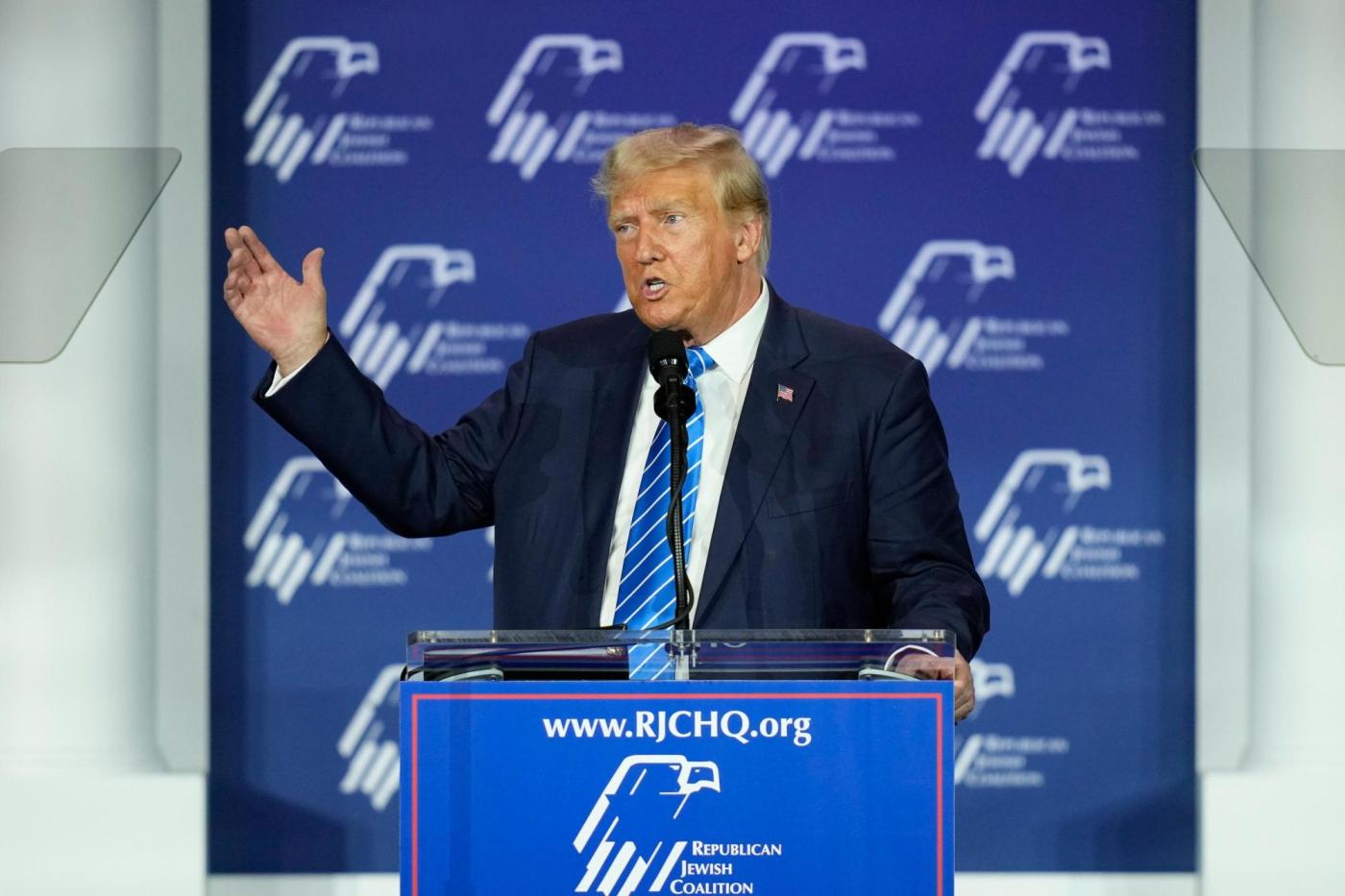
Since the start of his political career, Donald Trump has played on stereotypes about Jews and politics.

He told the Republican Jewish Coalition in 2015 that “you want to control your politicians” and suggested the audience used money to exert control. In the White House, he said Jews who vote for Democrats are “very disloyal to Israel.”

Two years ago, the former president hosted two outspoken antisemites for dinner at his Florida residence.

And this week, Trump charged that Jewish Democrats were being disloyal to their faith and to Israel. That had many American Jews taking up positions behind now-familiar political lines. Trump opponents accused him of promoting antisemitic tropes while his defenders suggested he was making a fair political point in his own way.

Jonathan Sarna, American Jewish history professor at Brandeis University, said Trump is capitalizing on tensions within the Jewish community.

“For people who hate Donald Trump in the Jewish community, certainly this statement will reinforce their sense that they don’t want to have anything to do with him,” he said. “For people who like Donald Trump in the Jewish community, they probably nod in agreement.”

To many Jewish leaders in a demographic that has overwhelmingly identified as Democratic and supported President Joe Biden in 2020, Trump’s latest comments promoted harmful antisemitic stereotypes, painting Jews as having divided loyalties and that there’s only one right way to be Jewish religiously.

“That escalation of rhetoric is so dangerous, so divisive and so wrong,” said Rabbi Rick Jacobs, president of the Union for Reform Judaism, the largest U.S. Jewish religious denomination. “This is a moment when Israel needs there to be more bipartisan support.”

But Matt Brooks, CEO of the Republican Jewish Coalition, said the president’s comments must be heard in context of the Israel-Gaza war and Democratic criticisms of the state of Israel.

“What the president was saying in his own unique style was giving voice to things I get asked about multiple times a day,” Brooks said. “How can Jews remain Democrats in light of what is going on?” He contended the Democratic Party is “no longer the pro-Israel bastion it used to be.”

More than 31,800 Palestinians have been killed in the Israeli offensive that followed Hamas’ Oct. 7 attack on southern Israel, in which militants killed some 1,200 people and took hostages. Much of northern Gaza has been leveled, and officials warned famine is imminent.

Trump’s comments followed a speech by Senate Majority Leader Chuck Schumer, the country’s highest-ranking Jewish official. Schumer, a Democrat, last week sharply criticized Prime Minister Benjamin Netanyahu ’s handling of the war in Gaza. Schumer called for new elections in Israel and warned the civilian toll was damaging Israel’s global standing.

“Any Jewish person that votes for Democrats hates their religion,” Trump retorted Monday on a talk show. “They hate everything about Israel.”

A cascade of Jewish voices, from Schumer to the Anti-Defamation League to religious leaders, denounced Trump’s statement.

In a statement to The Associated Press on Wednesday, the Trump campaign doubled down, criticizing Schumer, congressional Democrats’ support of Palestinians and the Biden administration’s policies on Iran and on aid to Gaza.

“President Trump is right,” said Karoline Leavitt, national press secretary for the Trump campaign.

Jeffrey Hert, an antisemitism expert at the University of Maryland, disagrees with Schumer’s call for a ceasefire in Gaza, but believes most Democrats support Israel — and he said a second Biden term would be better for it than a second Trump one.

“If (Trump) loses the 2024 election, his comments prepare the way for blaming the Jews for his defeat,” Herf said. “The clear result would be to fan the flames of antisemitism and assert that, yet again, the Jews are guilty.”

Sarna saw Trump as trying to appeal to politically conservative Jews, particularly the small but fast-growing Orthodox segment, who see Trump as a defender of Israel.

Also, about 10% of U.S. Jews are immigrants, according to a 2020 Pew Research Center report. Sarna said significant numbers are conservative.

At the same time, Democrats face the tension between their Jewish constituency, which is predominantly pro-Israel, and its progressive wing, which is more pro-Palestinian.

Sarna said that while it may seem odd to focus so much attention on subsections of a minority population, “elections in America are very close, and every vote counts.”

Conservative commentator Ben Shapiro said Tuesday on his podcast that Trump “was making a point that, frankly, I have made myself, which is that Jews who are voting Democrat do not understand the Democratic Party.” Shapiro, who practices Orthodox Judaism, contended the party “overlooks antisemitism” within its ranks.

Rabbi Jill Jacobs, the CEO of T’ruah, a rabbinic human rights organization, said Trump has no business dictating who’s a good Jew.

“By insinuating that good Jews will vote for the party that is best for Israel, Trump is evoking the age-old antisemitic trope of dual loyalty — an accusation that Jews are more loyal to their religion than to their country, and therefore can’t be trusted,” she said. “Historically, this accusation has fueled some of the worst antisemitic violence.”

In his own time in office, Trump’s policy “of supporting Prime Minister Netanyahu and the settler agenda only endangered Palestinians and Israelis and made peace more difficult to achieve,” Jacobs said.

Pittsburgh-based journalist Beth Kissileff — whose husband, a rabbi in the Conservative denomination of Judaism, in 2018 survived the nation’s deadliest antisemitic attack — said it was highly offensive for Trump to be a “self-appointed arbiter” of what it means to be Jewish.

“Chuck Schumer had every right to say what he said,” Kissileff added. “Just because we’re Jews, it doesn’t mean we agree with everything the (Israeli) government is doing. We have compassion for innocent Palestinian lives.”

Brooks, of the Republican Jewish Coalition, defended the former president against antisemitism charges, pointing to his presidential record as an example of proof.

Trump pursued policies that were popular among American Christian Zionists and Israeli religious-nationalists, including moving the U.S. embassy to Jerusalem and supporting Jewish settlements in occupied territories. His daughter Ivanka is a convert to Orthodox Judaism, and her husband and their children are Jewish. The couple worked as high-profile surrogates to the Jewish community during Trump’s administration.

Trump’s core supporters include white evangelicals, many of whom believe the modern state of Israel fulfills biblical prophecy. Prominent evangelicals who support Zionism have also been criticized for inflammatory statements about Jewish people.

Sixty-nine percent of Jewish voters in 2020 supported Biden, while 30% supported Trump, according to AP VoteCast, a survey of the electorate conducted in partnership with NORC at the University of Chicago. That made Jewish voters one of the religious groups where support for Biden was strongest. Also, 73% of Jewish voters in 2020 said that Trump was too tolerant of extremist groups.

Rabbi Bradley Shavit Artson said Trump’s comments are “in a complex middle zone” — not explicitly antisemitic, but reliant on such tropes.

American Jews base their votes on a complex mix of issues and values, “among them inclusion, diversity, climate change, civil rights,” said Artson, a leader within Conservative Judaism. “While they love Israel diversely, many of us also care about the wellbeing and self-determination of Palestinians.”

___

Associated Press reporters Mariam Fam and Amelia Thomson DeVeaux contributed to this report.

Related Articles

National News |


Judge clears way for Trump to appeal ruling keeping Fani Willis on Georgia 2020 election case

National News |


Jay Ambrose: The test Biden can’t pass

National News |


Thomas Friedman: What Schumer and Biden got right about Netanyahu

National News |


Trump suggests he’d support a national ban on abortions around 15 weeks of pregnancy

National News |


Trump asks Supreme Court to dismiss case charging him with plotting to overturn 2020 election

Congress unveils $1.2 trillion plan to avert federal shutdown and bring budget fight to a close

posted in: Politics | 0

By KEVIN FREKING (Associated Press)

WASHINGTON (AP) — Lawmakers introduced a $1.2 trillion spending package Thursday that sets the stage for avoiding a partial government shutdown for several key federal agencies this weekend and allows Congress, nearly six months into the budget year, to complete its work in funding the government through September.

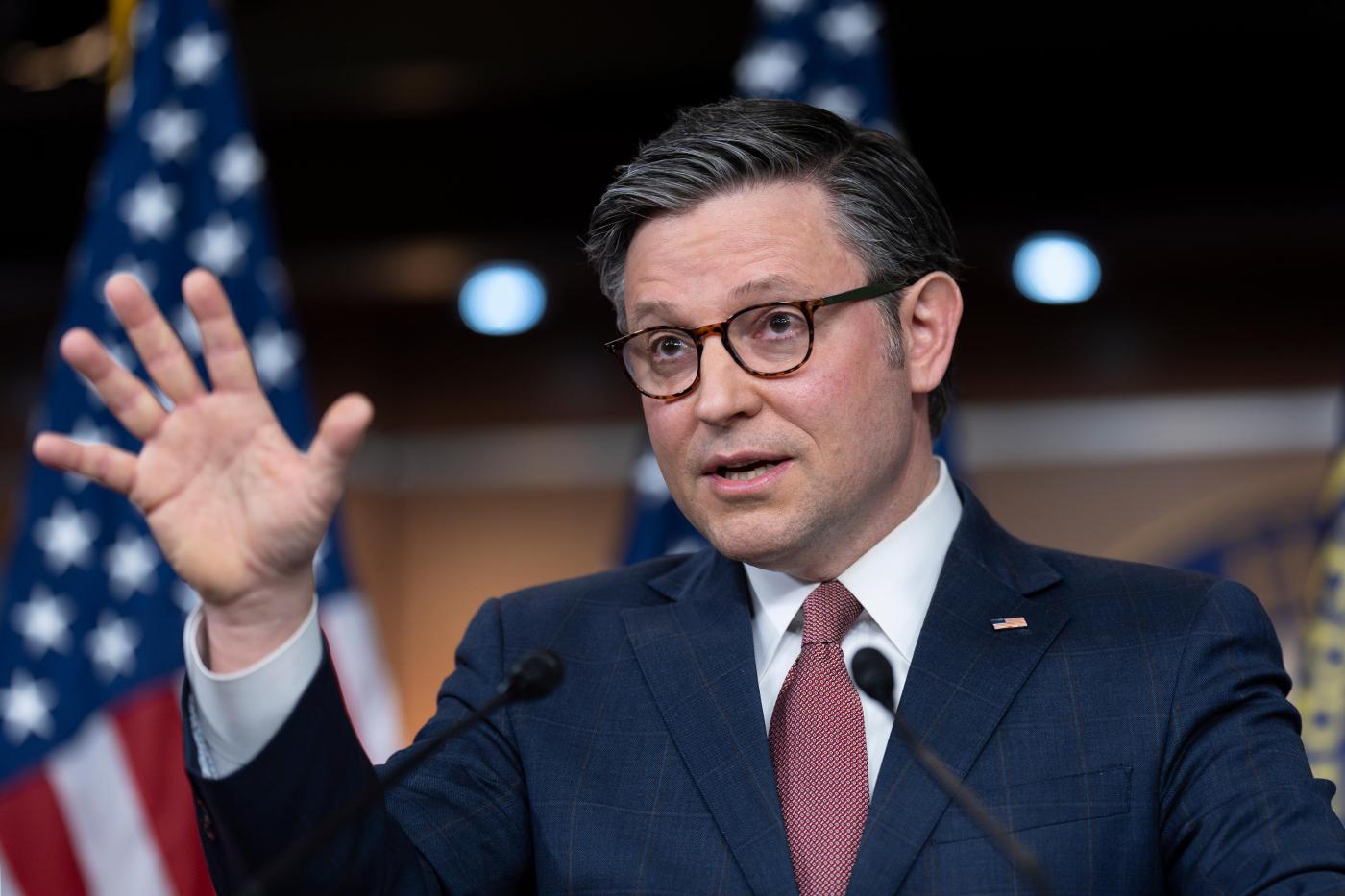
Democrats were largely able to swat back hundreds of policy mandates and some of the steeper budget cuts that House Republicans were seeking to impose on nondefense programs, though House Speaker Mike Johnson, R-La., highlighted some policy wins, including a nearly 24% increase in detention beds for migrants awaiting their immigration proceedings or removal from the country.

This year’s spending bills were divided into two packages. The first one cleared Congress two weeks ago, just hours before a shutdown deadline for the agencies funded through the bills.

Now Congress is focused on the second, larger package, which includes about $886 billion for the Defense Department, about a 3% increase from last year’s levels. The 1,012-page bill also funds the departments of Homeland Security, Health and Human Services, Labor, and others.

Nondefense spending will be relatively flat compared with the prior year, though some, such as the Environmental Protection Agency, are taking a hit, and many agencies will not see their budgets keep up with inflation.

When combining the two packages, discretionary spending for the budget year will come to about $1.66 trillion. That does not include programs such as Social Security and Medicare, and financing the country’s rising debt.

The House is expected to take the measure up first, on Friday. Then it would move to the Senate where senators would have to agree on taking it up expeditiously to avoid a partial shutdown. Usually, such agreements include votes on proposed amendments to the bill.

Johnson promoted the bill as a serious commitment to strengthening national defense by moving the Pentagon toward a focus on its core mission while expanding support for those serving in the military. The bill provides for a 5.2% pay increase for service members.

One of the changes Johnson cited for Republicans was prohibiting funding through March 2025 for the U.N. Relief and Works Agency, which is the main supplier of food, water and shelter to civilians in Gaza.

Republicans are insisting on cutting off funding to the agency after Israel alleged that a dozen employees of the agency were involved in the attack that Hamas conducted in Israel on Oct. 7.

But the prohibition does concern some lawmakers because many relief agencies say there is no way to replace its ability to deliver the humanitarian assistance that the United States and others are trying to send to Gaza, where one-quarter of the 2.3 million residents are starving.

Democrats also emphasized that humanitarian assistance will increase overall, though.

Sen. Patty Murray, the chair of the Senate Appropriations Committee, also highlighted a $1 billion increase for Head Start programs and new child care centers for military families. And Democrats played up a $120 million increase in funding for cancer research and a $100 million increase for Alzheimer’s research.

“We defeated outlandish cuts that would have been a gut punch for American families and our economy,” said Murray, D-Wash.

She also said Democrats successfully fought off scores of policy measures, known as riders, that House Republicans were seeking to add.

“From Day 1 of this process, I said there would be no extreme, far-right riders to restrict women’s reproductive freedoms — and there aren’t, she said.

Among the few policy provisions that House Republicans did secure was a requirement that only allows for the American flag and “other official flags” to fly over U.S. diplomatic facilities. Under the Biden administration, U.S. embassies have been invited to fly the pride flag or light up with rainbow colors in support of the LGBTQ community.

There is also a provision that prevents the Consumer Product Safety Commission from banning gas stoves. But the White House has said President Joe Biden would not support a ban, and the commission, an independent agency, says no such ban was in the works.

The spending in the bill largely tracks with an agreement that former Speaker Kevin McCarthy worked out with the White House in May 2023, which restricted spending for two years and suspended the debt ceiling into January 2025 so the federal government could continue paying its bills.

McCarthy, R-Calif., was ousted from the speaker’s role a few months after securing the debt ceiling deal. Eight Republicans ended up joining with Democrats in removing McCarthy as speaker. And some of those unhappy with that debt ceiling deal also expressed misgivings about the latest package.

“I hope there will be some modest wins. Unfortunately, I don’t expect that we will get much in the way of significant policy wins based on past history and based on our unwillingness to do use any kind of leverage to force policy wins, meaning a willingness to walk away and say no,” said Rep. Bob Good, R-Va.

Work on the spending bills has been more bipartisan in the Senate. Murray issued a joint statement after the bill’s release with Sen. Susan Collins, R-Maine, praising the package of bills and urging colleagues to vote for it.

“There is zero need for a shutdown or chaos — and members of Congress should waste no time in passing these six bills, which will greatly benefit every state in America and reflect important priorities of many Senators,” Murray and Collins said.

Johnson said that after the spending package passes, the House would next turn its attention to a bill that focuses on aiding Ukraine and Israel, though lawmakers are scheduled to be away from Washington for the next two weeks. The Senate has already approved a $95.3 billion aid package for Ukraine, Israel and Taiwan, but Johnson has declined to bring that up for a vote.

An Open Letter to Richard Linklater on Our Texas Death Penalty

posted in: News | 0

Dear Richard,

Your movie “God Save Texas: Hometown Prison,” which debuted recently on HBO, was joyfully upsetting for me. Kudos to you for loving Huntsville, the complex setting of your formative high school years. Kudos for not moving on, for coming back time and again to the life and culture there in your many films. Kudos for loving the people there but not looking away, bringing your unflinching lens to the things they find hard to see. Spoiler alert: This is a movie review about the human subjects of your film.

Working as a postconviction capital defense attorney for almost three decades, I drove through Huntsville many times a year en route to visit clients on death rows at the nearby Ellis and Polunsky units. Ultimately, upon entering the town on U.S. 190, I would veer off to the north on parallel streets to avoid passing and having to look at your hometown prison, the Walls Unit, where some of my clients had been killed. Unlike the many Huntsville residents who drive daily by the Walls, paying it no attention, I chose to avoid it as an aspect of my self-care.

Others who have taken into their minds and hearts what goes on in the Walls have reacted differently. In your film, when Fred Allen, the former execution tie-down team guard, says he’s opposed to the death penalty, you flash a black-and-white photo of a silver-haired man whose name is David Atwood. Dave, a Catholic peace activist who recently died, is the only person I know who has committed an act of nonviolent civil disobedience at the Walls. Dave frequently traveled from Houston to protest at the Walls on execution days. In November 2004, when a man named Anthony Fuentes was being killed, Dave found himself standing next to Anthony’s grandmother who was shaking from cold and fear. Her husband was inside witnessing their grandson’s death, and, when she said she’d like to get closer to the building, Dave and his wife Peggy accompanied her to the yellow crime scene tape that the guards spread in front of the unit on execution days. Dave suddenly felt he needed to do more. He gave his wallet, keys, and phone to his wife, and he crossed under the tape. After he was arrested, when he was offered no community service or probation for his trespass offense, Dave chose to serve five days in the Walker County Jail rather than pay a fine.

“The death penalty takes one tragedy, a murder, and expands the pain and suffering to include so many others.”

You also captured my friend Dennis Longmire, the bearded Sam Houston State University professor standing as a witness outside the Walls where he has stood on 90 percent of execution days since Texas reinstated capital punishment in 1973. Dennis is compassionate and intelligent, a prolific author of studies on the death penalty and violence.  “Moral disengagement” is one of the subjects he’s explored, “the cognitive restructuring of harmful actions or behavior as good or moral through mechanisms of moral justification, drawing palliative or advantageous comparisons to harmful acts of others, and the euphemistic labeling or use of euphemistic language in regard to harmful conduct.” Although “execution” and “murder” are both the premeditated killing of a human being, we take great care to make execution look nothing like murder. We ritualize and medicalize the procedure. We embrace it as somehow less violent than the crime being punished. 

Near the end of the film, you interview Dennis. He shares how, every time he stands at the Walls, he keeps “the victims as well as the offenders” in his prayers, and he imagines the conversations between the parents and children in the cars driving by. “The ultimate measure of the justice of what we do,” he suggests, “is, ‘Can we rightly explain it to our children?’” 

Then there’s Gloria Rubac, who is just as determined as my other friends to be at the Walls for every possible execution. She always carries her bullhorn, through which she tries to awaken consciences in passersby, loudly accusing the State of Texas of murder. More than once I have lectured Gloria about how if she calls the governor a “murderer” he won’t be able to hear her. Offending him, I tell her, won’t awaken his conscience. And it’s the law itself that is the murderer, not the governor. The law’s designed to kill; it’s the labyrinth that we have tragically built to trap ourselves. All of us. We are all in this thing that we built with no exit and even Governor Ann, a saint among Texas liberals, was as caught up in it as the boys. In the face of all my protests, Gloria is quite unrepentant, just as she appears in your film. She is all about exposing “moral disengagement” without excuses. I’m for that too.

Richard, your mother dated Bill Habern? I knew Bill, an attorney legendary for his expertise on parole issues. With most of my clients in no danger of being paroled, I had spotty interaction with Bill. On one occasion, however, with his help, I and one of his firm’s lawyers collaborated to help a prisoner’s mother have a last visit before her son was executed. The mother had been accused of trying to introduce contraband into the Polunsky death row unit and, as a consequence, she had been banned from the prison under Texas Department of Criminal Justice (TDCJ) rules. Last visits between family members and the condemned are held in the Polunsky visiting area before the prisoner is transported to the Walls. Shortly prior to the execution date, the prison was refusing to let the mother see her son. While Bill’s colleague was negotiating his way through the TDCJ bureaucracy, I drafted a civil rights lawsuit to file if diplomacy failed. It was like the suit Bill describes in your movie: I had next to no idea what I was doing, but it needed doing. As I typed at my computer, the mother lay slumped over a desk on the other side of my Austin office in a catatonic state, surrounded by family rubbing and soothing and cooing, trying to elicit a response from her. Ultimately, TDCJ relented and allowed the mom a noncontact visit surrounded by guards before her son was whisked away.

It is more than interesting to me that you share the story of Bill rescuing Darrell Shaw, who was expelled from Huntsville High School for declining to be paddled by the principal.  

Over the last half-century, American society has moved away from corporal punishment in tandem with its move away from the death penalty. Now, none of the states that have abolished the death penalty allow corporal punishment in the public schools. States that continue to have the death penalty but have abolished corporal punishment are responsible for only 7 percent of all modern executions. I suggest this is no coincidence. Unfortunately, the U.S. Supreme Court largely has limited its investigation into “evolving standards of decency” to questions about the acceptable severity of court-ordered criminal punishments under the Eighth Amendment. However, if the court were to take a broad view of the “evolving standards” as reflected in our changing laws, it would be easy for the court to see that the restrictions on and ultimate abolition of the death penalty fall right in with the strong social and legal currents in our society moving us away from male dominance and justified violence within the family and in society.  

Evolving standards of decency are tantamount to the decline of patriarchy. The author bell hooks defined patriarchy as “a political-social system that insists that males are inherently dominating, superior to everything and everyone deemed weak, especially females, and endowed with the right to dominate and rule over the weak and to maintain that dominance through various forms of psychological terrorism and violence.” This definition essentially describes the law as it stood two centuries ago. Adult white men had a monopoly on rights, wealth, power, everything. But, unquestionably, American and Texas law have evolved, and we have evolved with it. Husbands and fathers may no longer legally treat their wives and children as property nor terrorize them with impunity. Women are no longer prohibited from voting and the male-dominated political, academic, artistic, sports, and business spheres have been flooded with women demanding to be treated equally. 

My mother was born before women could vote. In 1963, she gained the federal right to equal pay. In 1974, she gained the federal right to open her own bank account without a male co-signer. In 1994, Texas finally removed the “marital rape exception” from the law, dissolving a legal shield that had allowed husbands to assault their wives with impunity. Government child protective services began in the 1960s responding to a rise in awareness of the detrimental mental health and social effects of child abuse in the home. By 2005, in this world of rising rights for women and children, the U.S. Supreme Court decided it made no sense to maintain the death penalty for crimes committed by children.

You’ll notice that many prosecutors and politicians who still promote the death penalty as somehow “necessary” are attached to the old patriarchal world. They are likely to support “traditional family values,” with the husband in charge, and to embrace corporal punishment. They believe that respect for authority in society is built upon violence. When your friend Ed, a warden troubled over participating in executions, sought guidance from his pastor, he was told not to worry about God’s chastisement because the law allows capital punishment. Doubtless, the same pastor would refuse to conduct a gay marriage, although the law allows it. He’d say that’s an ungodly law, so he mustn’t follow it. What I think he was really telling Ed is that God requires a measure of necessary violence, that Ed needed to subordinate the feeling he had “when one minute the guy was fine and the next he was deceased” to the righteousness of necessary violence. Long ago, when we built the trap for ourselves that is the death penalty, we buttressed it in Texas with patriarchal religion that promotes domination—children obey your fathers, wives obey your husbands, slaves obey your masters—and the measure of violence perceived as needed to maintain that order. The trap barred compassion.

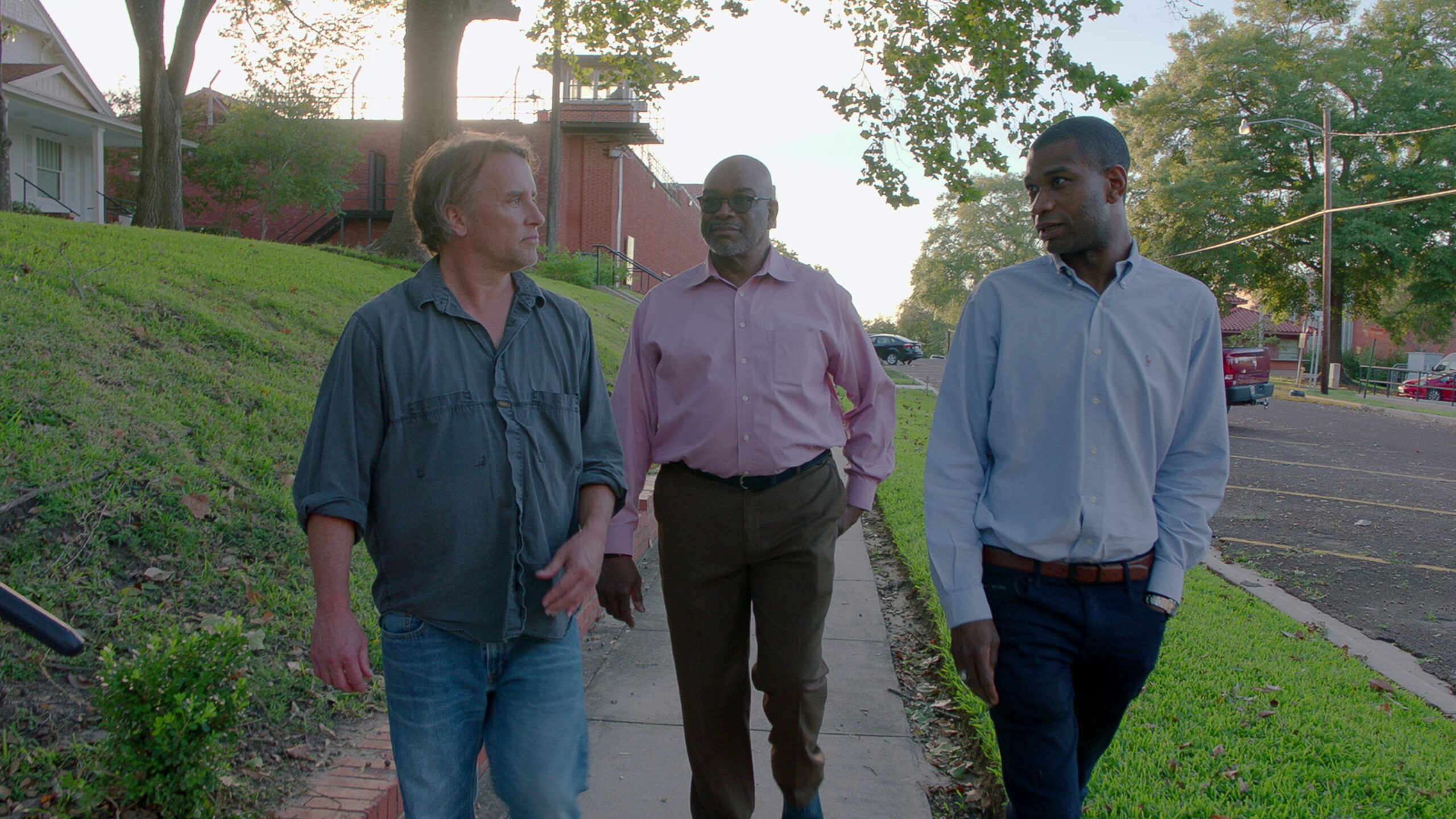
Richard Linklater with Ed Owens and Trey Owens Courtesy of HBO

Yet, when Fred Allen, your high school football teammate who later served as a captain on an execution tie-down team, met Karla Faye Tucker, she opened the door of compassion to him. There in the holding cell next to the death chamber, while Karla was waiting to be killed by Fred, she asked Fred, “Are you doing okay?” Karla knew that Fred felt troubled and she spoke straight to him and held him tenderly with her words in a time of distress for him. He wasn’t aware of the distress. In other movies, Fred has dramatically described what happened to him when he became aware a couple of days later. Sitting in his shop at home, he heard a news account of Karla’s execution and he began shaking uncontrollably, sweating, and shedding tears.  He saw Karla in front of him and, then, he began to visualize the scores of men he’d led to execution sitting in their holding cells, one right after another. Karla opened the trap in Fred’s mind that had enabled his moral disengagement.

Karla was my client. When Fred was executing her, my co-counsel (George McCall Secrest, lead counsel, and David Botsford, Mac’s co-counsel and my boss) were at the Walls Unit and I, exhausted after a final string of litigation, was alone in our Austin office fielding calls from concerned people as far away as Australia asking about her. Karla was the real thing. The scores of people who visited her at the Mountain View Unit to get spiritual advice recognized that. I’m not aware if she studied Martin Luther King Jr. or Gandhi. But she daily practiced the active nonviolence of Jesus that King and Gandhi articulated. It resulted in the transformed lives of others, like Fred and like me. Some evangelical Christians, of the sort that hawk a gospel of afterlife and normalize systems of oppression, laid hold of Karla as an exemplar. I felt as though they turned her into a tool to advance their proselytizing. I want to correct the record on that. Karla was way more. She held a key to the labyrinth. She was walking with Jesus and when she touched Fred, the captives were released.

Richard, we’ve had common contact with so many people. We also share, I think, a love of place, a sense of duty to our place and people. In discussion with the writer Lawrence Wright, whose book inspired your movie, you talk about Huntsville “radicals” who have the option to move but choose to stay. Wright describes them as cherishing the place they come from in order to help it become something better. I don’t know if you consider yourself one of those radicals, but in my opinion you are. You keep coming back to the place in movie after movie, studying the people, loving the people, being present, looking for understanding, going toward the root. The thing that I intentionally have avoided looking at, in order to manage my own trauma, you portray in almost every other scene: the red-bricked Walls from all sides and the air.  You examine how its architecture of cruelty holds your friends and high school mates. When you come to your conclusion in voice-over as to why you oppose the death penalty, you let them know that you see them in the way Karla let Fred know she saw him. I felt seen too. That is why the film was joyfully upsetting for me. The subject matter is deeply upsetting. But there is no greater joy than to be seen.  

You say, “The death penalty takes one tragedy, a murder, and expands the pain and suffering to include so many others, all the people involved in the legal and criminal appeals process that get dragged slowly to the death chamber, all the obligatory witnesses, and all the people with various jobs in the system.” Then you lay bare the moral disengagement that leads to moral injury: “The Eighth Amendment to the U.S. Constitution specifically prohibits cruel and unusual punishment, but what could be more cruel, certainly unusual, than to have to play a part in or witness another person’s murder, however state-sanctioned?” The U.S. Department of Veterans Affairs defines moral injury as occurring when “in traumatic or unusually stressful circumstances, people … perpetrate, fail to prevent, or witness events that contradict deeply held moral beliefs and expectations.” That is all of us who have any real contact with Texas’ death penalty system. The ones most damaged by the moral injury inflicted by capital punishment are those ensnared in the outworking of the lethal law, whether we are killing or rescuing or bystanding, whether we are aware of the damage or not.

The death penalty is mental torture as defined by the United Nations Convention against Torture. Everyone in contact with the tortured prisoner or the system doing the torturing is subjected to the same threat that constitutes the torture. Richard,  beautifully you put it: We all are “dragged slowly to the death chamber.” We live in a State of anticipatory homicide.