Opinion: Congestion Pricing is a Step Forward for NYC

posted in: News | 0

“Congestion pricing is just one of many tools that will help tame some of the city street chaos a generation of car-centric planning left us with. And one of the primary benefactors of congestion pricing will be automobile drivers themselves.”

Adi Talwar

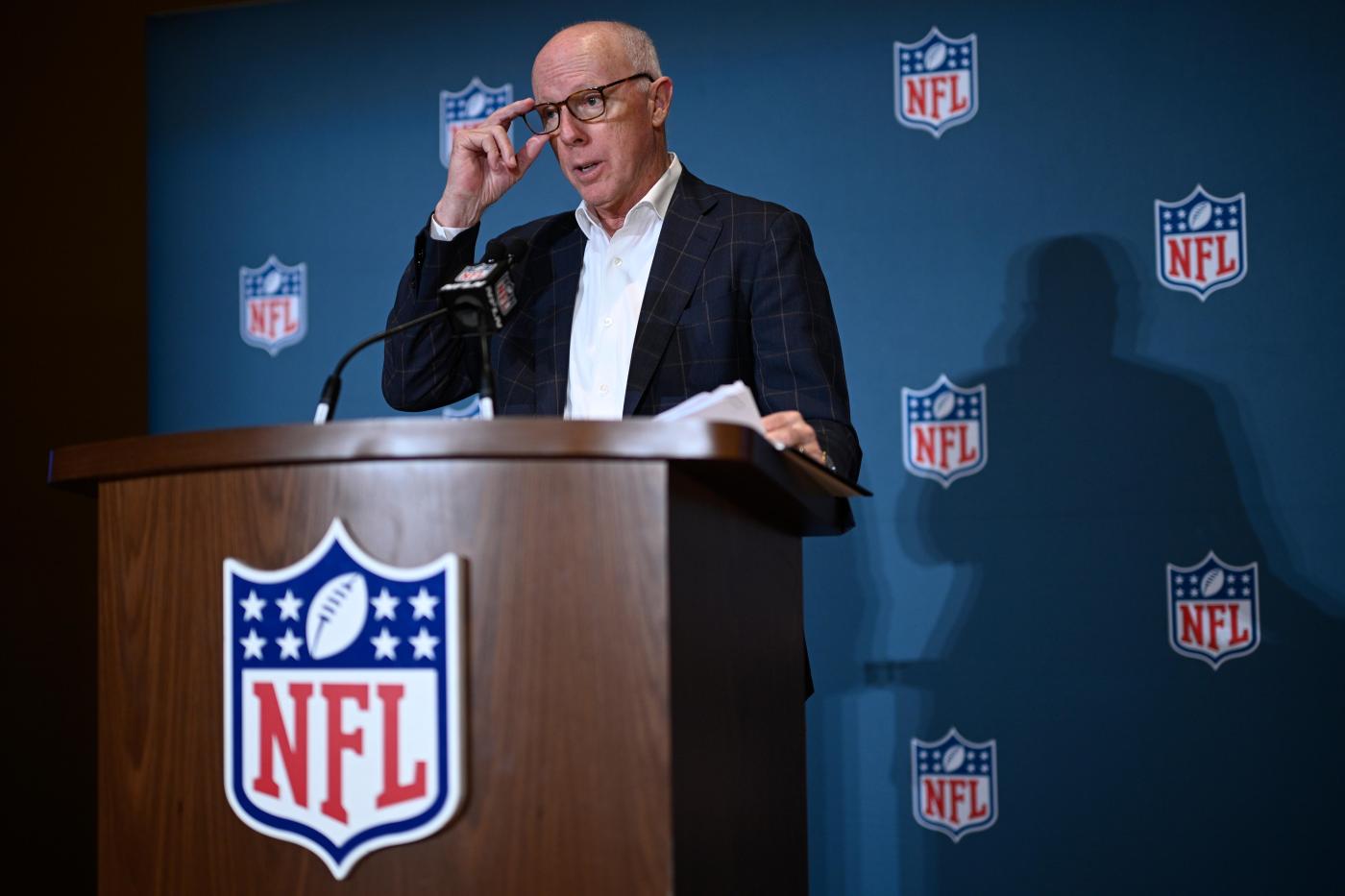
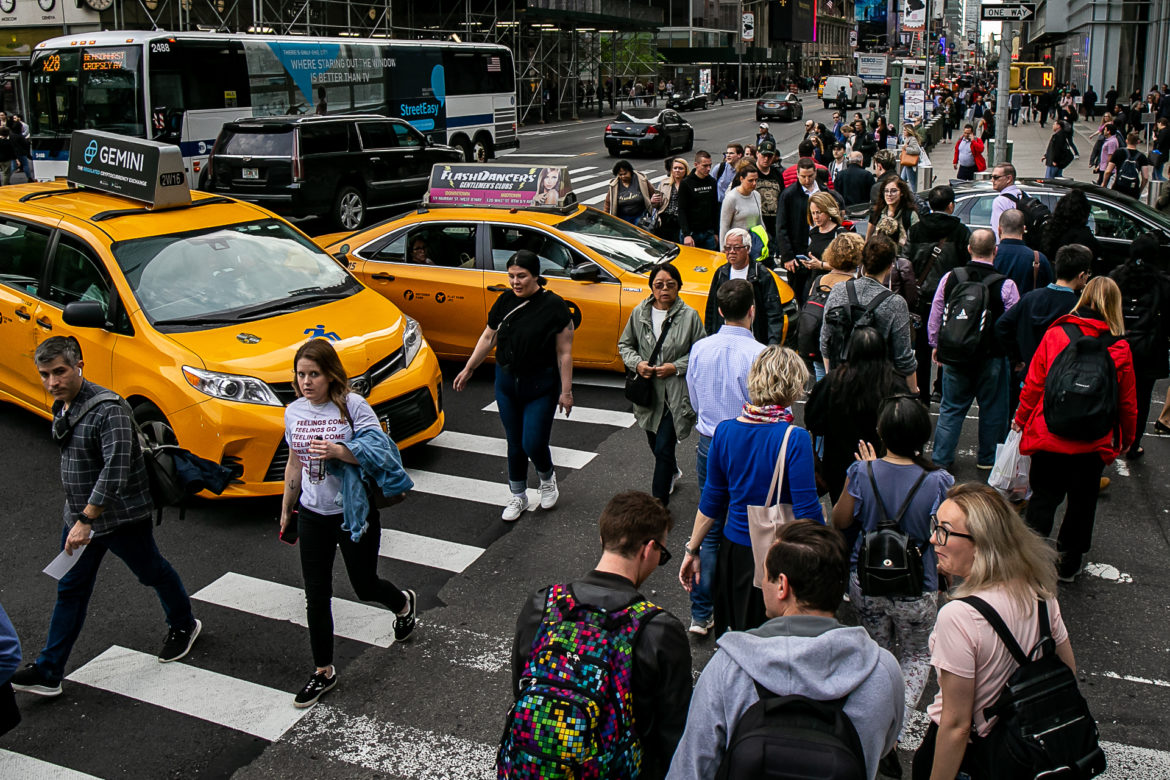
Friday evening traffic near Times Square.

CityViews are readers’ opinions, not those of City Limits. Add your voice today!

Hundreds of supporters and critics of the city’s proposed congestion pricing tolling plan sounded off at a final public hearing with MTA officials on March 4 in lower Manhattan.

Among the critics was New Jersey Gov. Phil Murphy, who phoned in a claim that congestion pricing was not about congestion or the environment, but instead a means to solve the MTA’s deficit. The toll would be “backbreaking” for New Jersey commuters and would displace pollution from Manhattan to parts of New Jersey, the governor said.

Displace pollution from Manhattan to New Jersey? Cry me a carbon-free river.

Three to four days each week, I commute from Brooklyn to my job in lower Manhattan by bicycle. The route to the Brooklyn bridge takes me north from where I live in Carroll Gardens along a narrow, unprotected bike lane on Clinton Street to downtown Brooklyn and the entrance onto the bridge’s two-way bike path, which by the way, is right next to the car lanes headed into Manhattan. Along the way, I pass what seems like hundreds of cars, most of them oversized SUVs, inching slowly along like a crowded herd of angry hippos.

More than 90 percent of the time, the number of individuals inside those cars, both big and small, is just one.  I’d wager the same is true for the scores of private cars heading in from New Jersey and beyond.

This being New York City, the demand for real estate will always outweigh supply—and that includes space on our city streets, which in Manhattan’s case, are filled to capacity with big, loud, carbon-belching automobiles. Considering the toll they take on the rest of us, automobile drivers have been getting an absurdly generous deal for that valuable space.

Streets are our largest public spaces. Yet, with 19,000 lane miles and three million street parking spots, New York City surrenders an astonishing amount of these precious public assets to automobiles, free of charge. Our streets should be valued by imposing monetary costs on the automobile drivers who crowd onto them each day.

Like the majority of city residents, I don’t have a car. I’ve not owned a car since I moved to New York City from the car-loving deep south more than three decades ago. I never really wanted the burden of owning, driving and storing a car. Besides that, I’ve always been a bicycling or public transit commuter.

New Yorkers own fewer than a third as many cars per capita as the average U.S. urban resident (about 23 per 100 residents compared to about 77 per 100 in most urban areas). Across the five boroughs, around 45 percent of residents own a car but only a fraction of those individuals commute by car to work in Manhattan each day.  The Traffic Mobility Review Board has said 150,000 people travel by car into Manhattan for work, while nearly 1 million take public transit.

And that makes Gov. Murphy’s whining about the burdens a tolling system will place on a tiny yet very vocal group of New Jersey drivers all the more grating.

In addition to our city tax dollars paying for the constant repairs to damage done to our infrastructure caused by congestion, we should also call out the mental and physical health toll automobiles wreak on pedestrians, cyclists and city residents.

Cars rattle our nerves and they inflict bone crushing, life changing and crippling injuries upon thousands of New Yorkers each year. Cars kill cats, birds and dogs. More heartbreaking, we lost nearly 100 pedestrians to auto violence in 2023 and a record number of cyclists were killed by drivers as well. Vision Zero is still just a vision today because of irresponsible and often entitled automobile drivers.

That sense of entitlement has its roots in the decades of destructive, car-centric urban planning from the likes of highway-happy power broker Robert Moses, who for all his accomplishments was inexcusably hostile to public transportation. It’s through no fault of our own, that no matter what part of the United States we come from, we’re conditioned early on to believe streets and roads were created solely for the automobile’s use.

Congestion pricing is just one of many tools that will help tame some of the city street chaos a generation of car-centric planning left us with. And, one of the primary benefactors of congestion pricing will be automobile drivers themselves.  

In 10 years, New Yorkers will probably look back on the days of toll-free driving in Manhattan’s central business district—and, hopefully someday too, at the absurdity of free on street parking—with bemusement.

Congestion pricing is a step forward into the sort of city I want to live in; a city with an even more extensive, fast moving and reliable transit system, a city where riding a bicycle or other micro-mobility device is not only safe, but seen as the norm.

I also want to live in a city where pedestrians don’t have to spend so much time worrying about dodging aggressive drivers, who are understandably angry after being stuck in Manhattan congestion for hours at a time. 

Cody Lyon is a former journalist and a Manhattan Community Board 1 member.
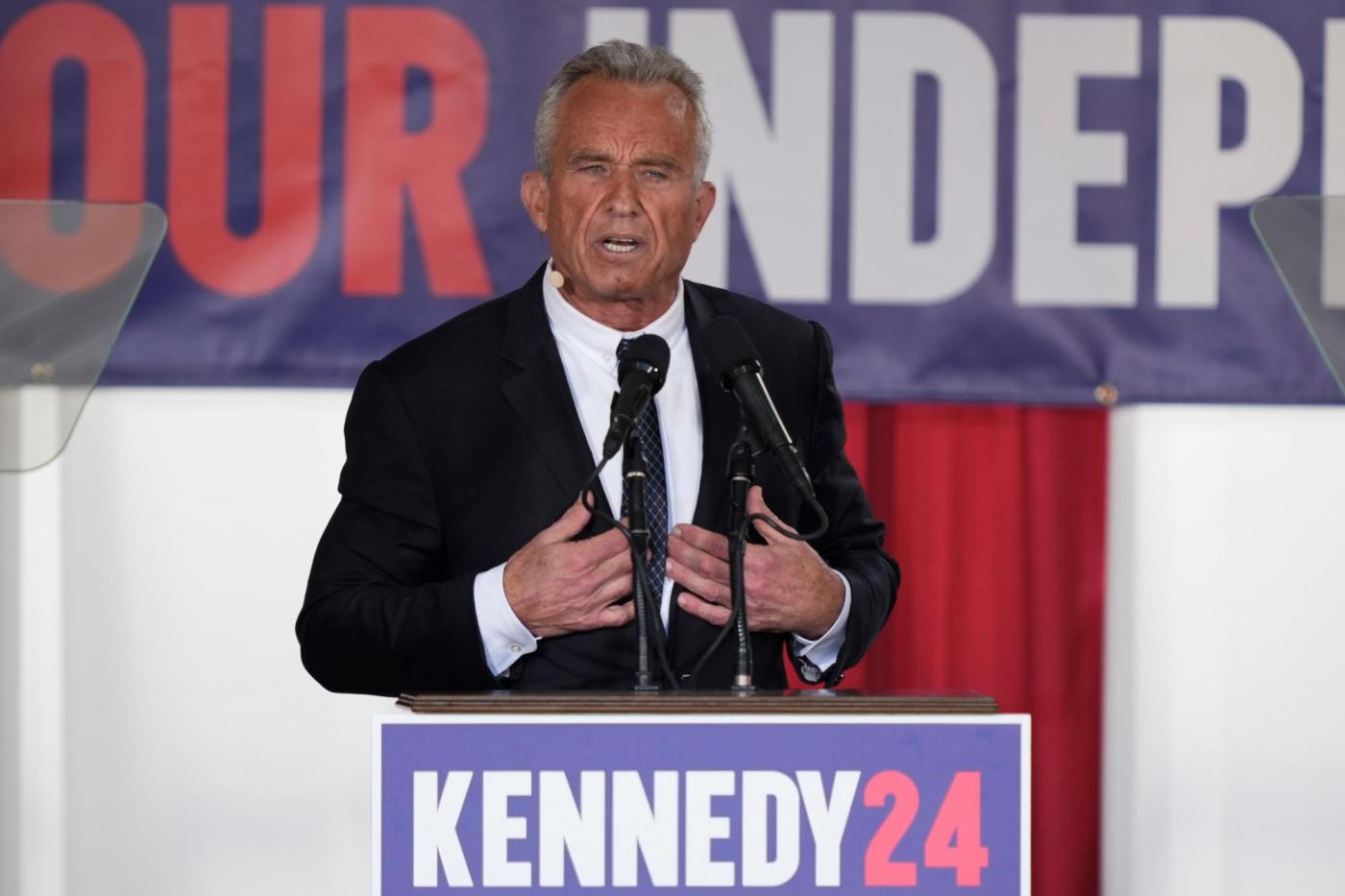
Robert F. Kennedy Jr. is expected to announce his VP pick for his independent White House bid

posted in: Politics | 0

By JONATHAN J. COOPER (Associated Press)

OAKLAND, Calif. (AP) — Robert F. Kennedy Jr. plans to announce his running mate Tuesday as he races to secure a place on the ballot for his independent campaign for president.

In advance of an event Tuesday in Oakland, Kennedy and his aides have circulated the names of several contenders, including celebrities with no political experience. Those names include NFL quarterback Aaron Rodgers and “Dirty Jobs” star Mike Rowe as well as former Minnesota Gov. Jesse Ventura. Speculation most recently has centered on Nicole Shanahan, a lawyer and philanthropist who bankrolled a Super Bowl ad for Kennedy.

“This announcement is really going to shake up the political establishment,” Kennedy said in a video he posted on social media last week.

Kennedy’s campaign has spooked Democrats, who are fighting third-party options that could draw support from President Joe Biden and help Republican former President Donald Trump. As they head into a 2020 rematch, Biden and Trump are broadly unpopular with the U.S. public and will compete for the votes of people who aren’t enthusiastic about either of them.

Without the backing of a party, Kennedy faces an arduous task to get on the ballot, with varying rules across the 50 states. He’s picking a running mate now because about half of the states require him to designate one before he can apply for ballot access.

The requirement is already bedeviling Kennedy’s ballot access effort in Nevada, where Democratic Secretary of State Francisco Aguilar said in a March 7 letter to independent candidates that they must nominate a vice presidential candidate before collecting signatures. The letter came days after Kennedy’s campaign announced he’d collected enough signatures in the state. If Aguilar’s opinion survives a likely legal challenge, Kennedy will have to start again in collecting just over 10,000 signatures in the state.

“This is the epitome of corruption,” said Paul Rossi, a Kennedy campaign lawyer, in a statement Monday, accusing Aguilar of doing the bidding of the Democratic National Committee.

Kennedy has secured access to the ballot in Utah. He and an allied super PAC, American Values 2024, say they’ve collected enough signatures to qualify in several other states, including swing states Arizona, Nevada and Georgia, but election officials there have not yet signed off.

Kennedy is a descendant of a storied Democratic family that includes his father, Robert F. Kennedy, who was a U.S. senator, attorney general and presidential candidate, and his uncle former President John F. Kennedy.

He began his campaign as a primary challenge to Biden but last fall said he’d run as an independent instead.

Kennedy was a teenager when his father, known as RFK, was assassinated during his own presidential campaign in 1968. RFK Jr. built a reputation of his own as an activist, author and lawyer who fought for environmental causes such as clean water.

Along the way, his activism has veered into conspiracies and contradicted scientific consensus, most infamously on vaccines. Some members of his family have publicly criticized his views. Dozens of Kennedy family members sent a message when they posed with Biden at a St. Patrick’s Day reception at the White House in a photo his sister Kerry Kennedy posted to social media.

Related Articles

National Politics |


Supreme Court’s anti-abortion conservatives could restrict abortion pills sent by mail, even in blue states

National Politics |


270,000 overdose deaths thrust fentanyl into heart of US presidential race

National Politics |


Trump’s New York hush money case is set for trial April 15

National Politics |


Court agrees to pause collection of Trump’s massive civil fraud judgment if he puts up $175M

National Politics |


Biden and Trump win Louisiana’s presidential primary having already clinched nominations

RFK Jr. is leveraging a network of loyal supporters he’s built over years, many of them drawn to his anti-vaccine activism and his message that the U.S. government is beholden to corporations.

The Democratic National Committee, meanwhile, is gearing up to take on Kennedy and other third-party options, including No Labels, a well-funded group working to recruit a centrist ticket. The effort is overseen by veteran strategist Mary Beth Cahill, whose resume includes chief of staff to the late Sen. Edward M. Kennedy of Massachusetts, another of RFK Jr.’s uncles.

Many Democrats blame Green Party candidates for Al Gore’s loss to George W. Bush in 2000 and Hillary Clinton’s loss to Trump in 2016.

‘It’s where he belongs’: Twins teammates excited to have Byron Buxton back in outfield

posted in: News | 0

FORT MYERS, Fla. — Every Twins pitcher who has been on the roster for more than a season could probably name a time or two when Byron Buxton used his glove to help the team out of a jam.

But ace Pablo López, acquired before last season, had only heard about Buxton’s defensive prowess and seen it on highlights. He hadn’t had his own experience seeing the dynamic center fielder run around and flash the leather.

That changed this spring.

In a game earlier this month, with López on the mound, Buxton charged in and made a diving snag. He wasn’t planning on diving during spring training but his instincts took over.

It was vintage Buxton.

Buxton, a Gold and Platinum Glove winner limited to serving as a designated hitter because of various injuries, has talked plenty about how much he missed playing the outfield last season. Now, his teammates are happy to see him back where he belongs.

“Actually seeing it in person, knowing what he’s able to do behind me when I’m on the mound, it’s awesome,” López said. “… He’s Byron Buxton when he’s on the field. He likes what he does. And he leaves everything out there. He wants to let the pitchers know that he will cover all the ground that he possibly can.”

The Twins went into last season planning on having Buxton serve as their designated hitter as he worked his way back from knee surgery. The idea was that he eventually would start playing the outfield.

That never happened.

Buxton’s knee limited him to hitting all season and he eventually underwent a second surgery.  This time around, it’s clear to everyone around him that he’s feeling much better.

“(It’s) very cool to see him be able to go out there and be himself, just play baseball and have fun, watch him run around the park,” pitcher Bailey Ober said. “(It’s) very fun, and I’ll take that any day I’m pitching.”

Last year, one of the things Buxton said challenged him the most was not having the distraction of playing the outfield.

He had too much time to think about his at-bats  — maybe he swung at a bad pitch and was mad at himself for it — and would tend to dwell on them. The fact that he then couldn’t go rob an opposing batter of a hit or help his team out in a different way ate at him.

“Getting him back this season as a healthy center fielder is one of the better additions that any team can make, and for him, seeing him go run around on the grass again, I know mentally for him is just the biggest relief in the world,” catcher Ryan Jeffers said.

Buxton was limited to just 85 games last year, hitting 17 home runs and slashing .207/.294/.438. He was hampered by pain in his knee, which he described earlier this spring as feeling like a knife in his knee. He eventually suffered a hamstring strain that held him out from early August through October, returning only for the Twins’ final playoff game.

A smile hardly left his face this spring, and it was clear from the beginning when he was leaving his teammates in the dust during their warm-up runs, that he felt much better.

When he takes the outfield for Opening Day on Thursday, it will be the first time he has been out there in a major-league game since Aug. 22, 2022.

It has been a long time coming — and all involved are ready for it.

“It’s fun to see him with so much joy, so happy, performing great, playing center field,” shortstop Carlos Correa said. “It’s where it belongs.”

Related Articles

Minnesota Twins |


Twins reliever Daniel Duarte impresses this spring in push for roster spot

Minnesota Twins |


Royce Lewis, Twins looking forward to his first full season in the big leagues

Minnesota Twins |


After strong 2023, Twins catcher Ryan Jeffers looking to ride hot spring into season

Minnesota Twins |


Already down two relievers, Twins lose Justin Topa for start of the season

Minnesota Twins |


Twins ace Pablo López has final tune-up of spring. Next up: Opening Day

NFL owners approve a radical overhaul to kickoff rules, AP source says, adopting setup used in XFL

posted in: Politics | 0

By ROB MAADDI (AP Pro Football Writer)

ORLANDO, Fla. (AP) — Kickoff returns are returning to the NFL.

Team owners on Tuesday approved a new rule that will take what essentially had become “a dead play” and make it an integral part of the game again, a person familiar with the decision told The Associated Press. The person spoke to the AP on condition of anonymity because the league hasn’t announced the change.

The major overhaul to special teams — which has been in the works for years — takes elements of the kickoff rules used in the XFL and tweaks them for use in the NFL beginning in 2024. The rule will be in play for one season on a trial basis and then be subject to renewal in 2025.

NFL Competition Committee chairman Rich McKay said Monday there was urgency to vote on this rule before the draft because it could impact the way teams structure rosters. There were 1,970 touchbacks on kickoffs last season that now could be returns.

“I think it’s good for the game,” said Rams coach Sean McVay, who is one of three coaches on the eight-member committee. “I think all the intentions are in the right direction, and I’m really appreciative of the time and effort that the special teams coordinators have put in to try to be able to keep this play relevant in our game.”

For a standard kickoff, the ball would be kicked from the 35-yard line with the 10 kick coverage players lined up at the opposing 40, with five on each side of the field.

The return team would have at least nine blockers lined up in the “set up zone” between the 30- and 35-yard line, with at least seven of those players touching the 35. There would be up to two returners allowed inside the 20.

Only the kicker and two returners would be allowed to move until the ball hits the ground or was touched by a returner inside the 20.

Any kick that reaches the end zone in the air can be returned, or the receiving team can opt for a touchback and possession at the 30. Any kick that reaches the end zone in the air and goes out of bounds or out of the end zone also would result in a touchback at the 30.

If a ball hits a returner or the ground before the end zone and goes into the end zone, a touchback would be at the 20 or the play could be returned. Any kick received in the field of play would have to be returned.

“It’s a drastic kind of move that’s going to be way different,” said Ravens coach John Harbaugh, a former special teams coordinator. “Is that the right move at this time? I don’t know. I think that’s to be determined.”

Under current rules, any touchback — or if a returner calls for a fair catch in the field of play — results in the receiving team getting the ball at its 25.

The proposal needed 24 of 32 votes to pass.

“I’m all for it,” Chiefs coach Andy Reid said. “You have 2,000 dead plays. Nobody wants to see that. It’ll add excitement and newness.”

___

AP Pro Football Writer Mark Long contributed to this report.

___

AP NFL: https://apnews.com/hub/nfl