US-China competition to field military drone swarms could fuel global arms race

posted in: News | 0

By FRANK BAJAK (AP Technology Writer)

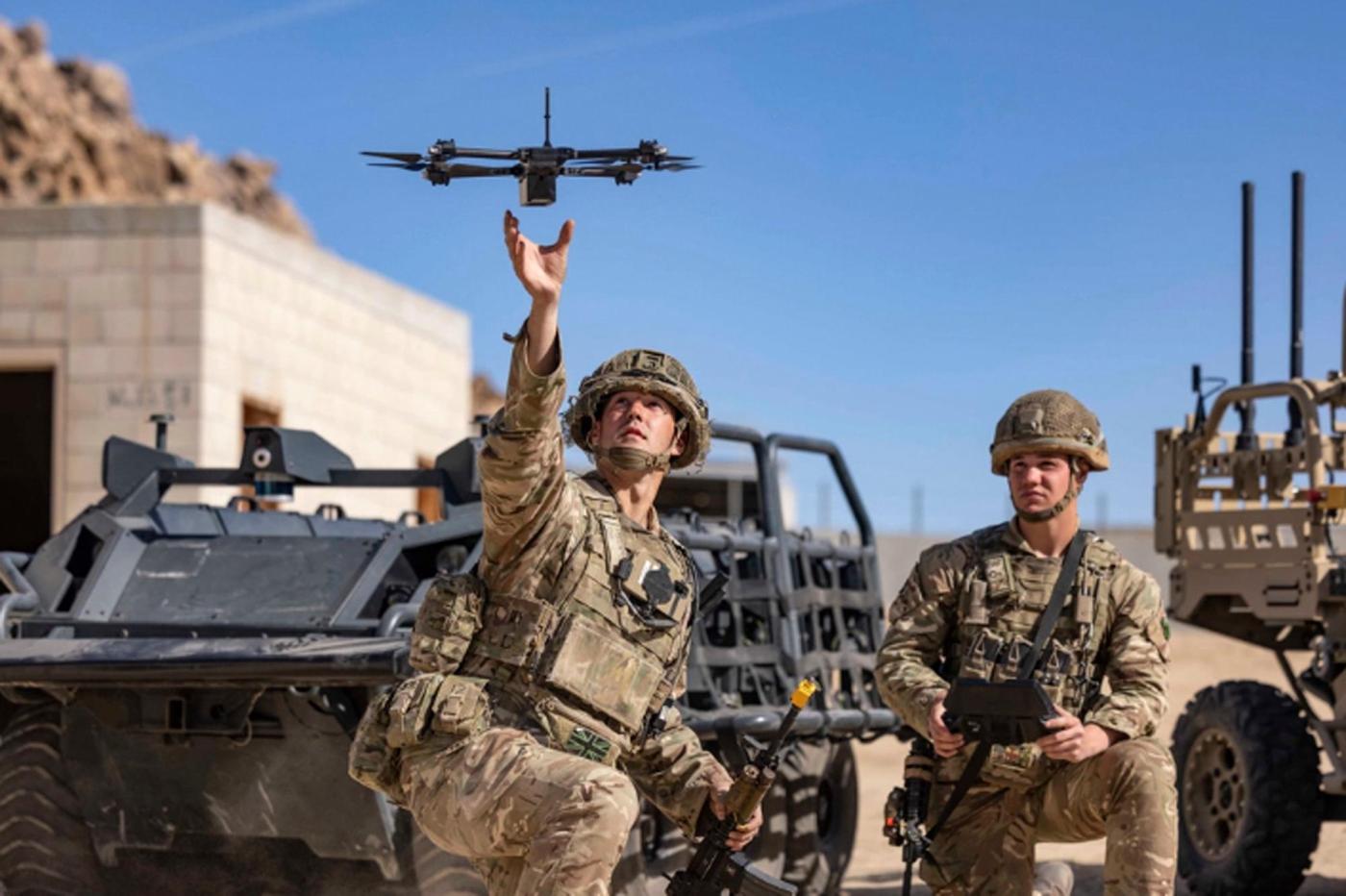
As their rivalry intensifies, U.S. and Chinese military planners are gearing up for a new kind of warfare in which squadrons of air and sea drones equipped with artificial intelligence work together like a swarm of bees to overwhelm an enemy.

The planners envision a scenario in which hundreds, even thousands of the machines engage in coordinated battle. A single controller might oversee dozens of drones. Some would scout, others attack. Some would be able to pivot to new objectives in the middle of a mission based on prior programming rather than a direct order.

The world’s only AI superpowers are engaged in an arms race for swarming drones that is reminiscent of the Cold War, except drone technology will be far more difficult to contain than nuclear weapons. Because software drives the drones’ swarming abilities, it could be relatively easy and cheap for rogue nations and militants to acquire their own fleets of killer robots.

The Pentagon is pushing urgent development of inexpensive, expendable drones as a deterrent against China acting on its territorial claim on Taiwan. Washington says it has no choice but to keep pace with Beijing. Chinese officials say AI-enabled weapons are inevitable so they, too, must have them.

The unchecked spread of swarm technology “could lead to more instability and conflict around the world,” said Margarita Konaev, an analyst with Georgetown University’s Center for Security and Emerging Technology.

As the undisputed leaders in the field, Washington and Beijing are best equipped to set an example by putting limits on military uses of drone swarms. But their intense competition, China’s military aggression in the South China Sea and persistent tensions over Taiwan make the prospect of cooperation look dim.

The idea is not new. The United Nations has tried for more than a decade to advance drone non-proliferation efforts that could include limits such as forbidding the targeting of civilians or banning the use of swarms for ethnic cleansing.

MILITARY CONTRACTS OFFER CLUES

Drones have been a priority for both powers for years, and each side has kept its advances secret, so it’s unclear which country might have an edge.

A 2023 Georgetown study of AI-related military spending found that more than a third of known contracts issued by both U.S. and Chinese military services over eight months in 2020 were for intelligent uncrewed systems.

The Pentagon sought bids in January for small, unmanned maritime “interceptors.” The specifications reflect the military’s ambition: The drones must be able to transit hundreds of miles of “contested waterspace,” work in groups in waters without GPS, carry 1,000-pound payloads, attack hostile craft at 40 mph and execute “complex autonomous behaviors” to adapt to a target’s evasive tactics.

It’s not clear how many drones a single person would control. A spokesman for the defense secretary declined to say, but a recently published Pentagon-backed study offers a clue: A single operator supervised a swarm of more than 100 cheap air and land drones in late 2021 in an urban warfare exercise at an Army training site at Fort Campbell, Tennessee.

The CEO of a company developing software to allow multiple drones to collaborate said in an interview that the technology is bounding ahead.

“We’re enabling a single operator to direct right now half a dozen,” said Lorenz Meier of Auterion, which is working on the technology for the U.S. military and its allies. He said that number is expected to increase to dozens and within a year to hundreds.

Not to be outdone, China’s military claimed last year that dozens of aerial drones “self-healed” after jamming cut their communications. An official documentary said they regrouped, switched to self-guidance and completed a search-and-destroy mission unaided, detonating explosive-laden drones on a target.

In justifying the push for drone swarms, China hawks in Washington offer this scenario: Beijing invades Taiwan then stymies U.S. intervention efforts with waves of air and sea drones that deny American and allied planes, ships and troops a foothold.

A year ago, CIA Director William Burns said Chinese Communist Party leader Xi Jinping had instructed his military to “be ready by 2027” to invade. But that doesn’t mean an invasion is likely, or that the U.S.-China arms race over AI will not aggravate global instability.

KISSINGER URGED ACTION

Just before he died last year, former U.S. Secretary of State Henry Kissinger urged Beijing and Washington to work together to discourage AI arms proliferation. They have “a narrow window of opportunity,” he said.

“Restraints for AI need to occur before AI is built into the security structure of each society,” Kissinger wrote with Harvard’s Graham Allison.

Xi and President Joe Biden made a verbal agreement in November to set up working groups on AI safety, but that effort has so far taken a back seat to the arms race for autonomous drones.

The competition is not apt to build trust or reduce the risk of conflict, said William Hartung, a senior research fellow at the Quincy Institute for Responsible Statecraft.

If the U.S. is “going full speed ahead, it’s most likely China will accelerate whatever it’s doing,” Hartung said.

There’s a risk China could offer swarm technology to U.S. foes or repressive countries, analysts say. Or it could be stolen. Other countries developing the tech, such as Russia, Israel, Iran and Turkey, could also spread the know-how.

U.S. national security adviser Jake Sullivan said in January that U.S.-China talks set to begin sometime this spring will address AI safety. Neither the defense secretary’s office nor the National Security Council would comment on whether the military use of drone swarms might be on the agenda.

The Chinese Foreign Ministry did not respond to a request for comment.

A FIVE-YEAR WAIT

Military analysts, drone makers and AI researchers don’t expect fully capable, combat-ready swarms to be fielded for five years or so, though big breakthroughs could happen sooner.

“The Chinese have an edge in hardware right now. I think we have an edge in software,” said CEO Adam Bry of U.S. drone maker Skydio, which supplies the Army, the Drug Enforcement Agency and the State Department, among other agencies.

Chinese military analyst Song Zhongping said the U.S. has “stronger basic scientific and technological capabilities” but added that the American advantage is not “impossible to surpass.” He said Washington also tends to overestimate the effect of its computer chip export restrictions on China’s drone swarm advances.

Paul Scharre, an AI expert at the Center for a New American Security think tank, believes the rivals are at rough parity.

“The bigger question for each country is about how do you use a drone swarm effectively?” he said.

That’s one reason all eyes are on the war in Ukraine, where drones work as eyes in the sky to make undetected front-line maneuvers all but impossible. They also deliver explosives and serve as sea-skimming ship killers.

Drones in Ukraine are often lost to jamming. Electronic interference is just one of many challenges for drone swarm development. Researchers are also focused on the difficulty of marshaling hundreds of air and sea drones in semi-autonomous swarms over vast expanses of the western Pacific for a potential war over Taiwan.

A secretive, now-inactive $78 million program announced early last year by the Pentagon’s Defense Advanced Research Projects Agency, or DARPA, seemed tailor-made for the Taiwan invasion scenario.

The Autonomous Multi-Domain Adaptive Swarms-of-Swarms is a mouthful to say, but the mission is clear: Develop ways for thousands of autonomous land, sea and air drones to “degrade or defeat” a foe in seizing contested turf.

DRONES IMPROVISE — BUT MUST STICK TO ORDERS

A separate DARPA program called OFFensive Swarm-Enabled Tactics, had the goal of marshaling upwards of 250 land-based drones to assist Army troops in urban warfare.

Project coordinator Julie Adams, an Oregon State robotics professor, said swarm commanders in the exercise managed to choreograph up to 133 ground and air vehicles at a time. The drones were programmed with a set of tactics they could perform semi-autonomously, including indoor reconnaissance and simulated enemy kills.

Under the direction of a swarm commander, the fleet acted something like an infantry squad whose soldiers are permitted some improvisation as long as they stick to orders.

“It’s what I would call supervisory interaction, in that the human could stop the command or stop the tactic,” Adams said. But once a course of action — such as an attack — was set in motion, the drone was on its own.

Adams said she was particularly impressed with a swarm commander in a different exercise last year at Fort Moore, Georgia, who single-handedly managed a 45-drone swarm over 2.5 hours with just 20 minutes of training.

“It was a pleasant surprise,” she said.

A reporter had to ask: Was he a video game player?

Yes, she said. “And he had a VR headset at home.”

___

Associated Press Writer Zen Soo in Hong Kong contributed to this report.

Saints’ Jensen trying another team in journey to make majors

posted in: News | 0

So far this season, Saints reliever Ryan Jensen has looked very much like a pitcher worthy of being a first-round draft choice in 2019. The fact that he is playing for his fourth organization in less than a year suggests that there have been a few trials and tribulations since he left Fresno State.

But make no mistake, the Twins think they have something in the 26-year-old right-hander they picked up off of waivers in January. Just as the Chicago Cubs did when they drafted him. Just as the Seattle Mariners did when they claimed him off waivers last summer. Just as the Miami Marlins did when the claimed him off waivers after the season.

Jensen has a major-league arm. Finding a way to harness that talent in the form of consistently throwing strikes will determine if his potential will be met.

“It speaks highly of the stuff, where that many teams are interested and want to strike gold,” Saints pitching coach Pete Larson said prior to the Saints’ 5-2 win over the Iowa Cubs on Thursday night at CHS Field. “There’s that thought, that we can be that team to help turn it around.

“We saw him last year (against) Iowa and saw an explosive arm. If he can attack the zone well he has a shot, because the stuff is exceptional, and its high-end.”

Jensen (2-0) has made three appearances for the Saints this season and has yet to allow a run.

He has given up three hits in four innings while striking out seven. He’d like to think his control problems — and vagabond days — are behind him.

“It was definitely a whirlwind,” Jensen said of the past few months. “It made me reconnect with who I am, so it was almost a blessing in disguise. It led to me focusing on myself and what I need to accomplish, and not focus on what teams had in mind for me.”

A converted starter, Jensen has cut down on the number of different pitches he throws, with the goal of gaining more command. His fastball has reached 96 miles per hour this season, and Jensen said he has reached triple digits in the past.

“We saw 99 in spring training, which is extremely exciting,” Larson. “He has a power slider and a change-up, which is a little hard. It’s funny to say hard change-up, but it’s got really good depth and run to it.”

Larson’s work between outings this season has been all about honing his control. Among other things, the Saints have turned to something as simple as changing the spot Jensen makes contact with the pitching rubber.

“Some of his misses where down on the glove side,” Larson said. “Shift you over and throw the same way, and those misses are now more over the plate. That’s how we’re going to attack it initially, and so far the results have been there.”

Jensen faced Iowa, the former team he has the most history with, on Wednesday night, coming on in the ninth inning and striking out three while allowing a single.

“It was probably the most butterflies I’ve had in a while,’ Jensen said. “Just because they’re all my friends, so competing against them almost means more than some random person.”

Briefly

The Saints got a three-run home run from Diego Castillo and a solo shot by DaShawn Keirsey Jr.

David Festa, the No. 5 prospect in the Twins organization according to MBL Pipeline, started for the Saints but lasted only 2 2/3 innings. Festa allowed one run on three hits, striking out four while walking four.

Twins reliever Caleb Thielbar made his second rehab appearance with the Saints. He struck out four in two innings of work while giving up a home run.

Related Articles

Sports |


Aaron Rozek relishing opportunity with Saints, who lost 4-1 to Iowa Cubs on Wednesday

Sports |


Despite Camargo’s efforts, Saints can’t battle back

Sports |


Nashville holds Saints to 4 hits, wins game in 10th

Sports |


Injury-plagued Saints open season with victory over Columbus

Sports |


‘Ozempig’ remains Saints’ mascot despite uproar that name is form of fat-shaming

Will Gophers get a second chance with former top in-state recruit Jaxon Howard?

posted in: News | 0

The Gophers football program missed out on defensive end Jaxon Howard, the top in-state recruit in the 2023 class, when the Robbinsdale Cooper product committed to LSU in July 2022.

The U now might get a second chance.

After one season in the SEC, Howard is expected to enter the NCAA transfer portal when it opens on Monday.

The Pioneer Press understands the Gophers will seek adding at least one defensive lineman via the portal, and the U will likely see if Howard’s desires and the U’s opportunities align this time around.

Howard, the son of former Stanford and Vikings lineman Willie Howard, had two tackles in five games last season, including one stop against Wisconsin in the ReliaQuest Bowl.

The Gophers had success in re-recruiting Quinn Carroll, the Edina offensive lineman who initially went to Notre Dame before coming back to Minnesota in 2022. He was the top player in the state in the 2019 class and has been a mainstay on the Gophers’ offensive line for the last two seasons.

The transfer portal will remain open until April 30. The U’s needs will shift considering which players on the current roster might leave.

“I don’t know,” head coach P.J. Fleck said about specific roster objectives. “It depends on what happens with if we lose players or things like that.”

Less than passing grade

It’s still spring ball, but the Gophers passing game looked in need of a lot of work during its open-to-fans practice Thursday.

New quarterback Max Brosmer is three weeks into the learning curve from FCS-level New Hampshire to the speed and size that comes within a Big Ten program.

“There is just small nuances,” Fleck said about Brosmer’s need to adjust. “Lineman are bigger, windows close faster, shape of the ball matters more.”

Brosmer didn’t have enough zip on one pass and it was intercepted during a team section of practice. Another red zone throw from Brosmer should have been picked off, but a defender dropped it.

“On the field, it’s feeling space,” Brosmer said about his adjustment. “It’s learning how to lead new people in that same environment while being under the pressure of the situation.”

With all-Big Ten receiver Daniel Jackson sidelined in spring, there is a drop off to Elijah Spencer and Le’Meke Brockington and a slew of very inexperienced reserves. Spencer, in particular, had a tough Thursday with multiple dropped passes, and the second-year transfer from Charlotte chatted with Fleck after one of them.

Meanwhile, true freshman backup QB Drake Lindsay had a handful of impressive throws Thursday against the second-team defense, connecting on a deep ball to third-year wideout Kristen Hoskins for a big gain and followed it up with a fade-route touchdown to Donielle Hayes.

Fleck was asked about offensive playmakers stepping up so far in spring ball, and he mentioned Ohio transfer running back Sieh Bangura, Hayes and tight end Pierce Walsh, who had a nice over-the-middle catch on a ball from Lindsey.

Depth at corner

Last spring, the Gophers had only four scholarship cornerbacks. This year, it’s more than double that amount.

“There is competitive depth,” cornerbacks coach Nick Monroe said Monday. “I think last year during the spring game we were flipping guys back and forth between the maroon and the gold team. It’s a totally different — totally different — deal right now.”

The most-important addition is senior transfer Ethan Robinson, who played 31 games across three seasons at Bucknell.

“Everything he has shown so far is, the guy is a professional in every way,” Monroe said. “He comes to work. He comes to get better. … He is a winner. He is a playmaker. He’s athletic. I cannot say anything bad about Ethan. He’s got experience, too.”

Robinson came away with the interception of Brosmer on Thursday.

Related Articles

College Sports |


Gophers add tall Ohio tight end Cross Nimmo to 2025 recruiting class

College Sports |


Gophers assistant football coach draws laughter during NBC game show appearance

College Sports |


Gophers add California quarterback Jackson Kollock to 2025 recruiting class

College Sports |


Gophers snag Badgers football commitment in Wisconsin defensive lineman Torin Pettaway

College Sports |


Gophers season ends in NIT second-round loss to Indiana State

Denver scores in overtime to beat Boston in Frozen Four semifinal

posted in: News | 0

Tristan Broz did it again for Denver.

Broz scored off a rush on a shot that beat Boston University goalie Mathieu Caron low to the stick side at 11:09 of overtime to send the Pioneers to the national championship game. Denver beat BU 2-1 Thursday at Xcel Energy Center.

“I think that’s what every kid dreams of, to do something like that for your team,” said Broz, a 21-year-old forward from Bloomington.

The Pioneers (31-9-3) will play the winner between Boston College (33-5-1) and Michigan (23-14-3) for the national title at 5 p.m. Saturday (ESPN2) at Xcel. Boston University finishes its season 28-10-2 and loses for the second straight year in the national semifinals. Denver will be trying to win an NCAA record 10th title.

The game-winning play started in the Denver defensive zone. Junior defenseman Sean Behrens got to a loose puck at the faceoff dot to the left of goalie Matt Davis. Behrens hit Broz, a Pittsburgh Penguins draft pick and transfer from Minnesota, with a pass in the neutral zone. He skated into the offensive zone and shot it in from the slot for the game-winner.

“I just remember back-checking and I kind of got turned over to Behrens at the left faceoff dot,” Broz said. “He made a nice pass to me in the middle. I knew it was a kind of 2-on-1. (Massimo Rizzo) had a little bit of a step on the guy. We ran that drill yesterday doing 2-on-1s and few times I scored. Just kind of no-look, trying to shoot 5-hole. And just kind of blacked out in that moment and happened to go in.”

Broz also scored the game-winner in a 2-1 double overtime win over Massachusetts in the Springfield Regional semifinals.

Denver had a good opportunity to end the game in regulation. BU’s Dylan Peterson was called for boarding at 18:47 of the third period to give Denver its fourth power play of the game.

But the Terriers did not allow a goal to send the game into overtime. Denver was 0-for-4 on the power play in the game.

“I thought it was excellent from the goalie on out,” Terriers head coach Jay Pandolfo said of his team’s penalty kill. “They were sacrificing. We were pretty confident that they were going to get the job done. And then the one save that Caron made was incredible.”

The Pioneers tied the game at 1-1 when they took advantage of a turnover below the Terriers goal line. Boston University All-American defenseman Lane Hutson threw a behind the back pass that was intercepted by Denver freshman right wing Miko Matikka. Matikka, an Arizona Coyotes draft pick, quickly got it to Tristan Lemyre, who shot it past Caron on the Pioneers’ ninth shot of the game at 15:21 of the second period.

It was the second goal of the season for Lemyre, a sophomore wing listed as the 13th forward on Denver’s roster in the game.

“He comes in tonight as our 13th forward,” Denver coach David Carle said of Lemyre, who scored his second goal of the season. “He’s been a big part of why we went 12-1-1 without Rizzo in the lineup. He’s been really good for us. He’s been fighting through an injury of his own, putting his body on the line for the guys and for the team.

“And really happy for him that he was able to get rewarded, scoring that goal. He’s done everything right. This year, he hasn’t always had the most opportunity, but a total team-first guy. And, again, couldn’t be happier for him.”

Denver nearly took the lead with 23.4 seconds left in the second period. Aidan Thompson came across the low slot, made a move that put Caron on the ice. Thompson got the puck to his backhand, but Caron was able to sprawl to make a glove save to keep it 1-1.

Boston University took a 1-0 lead with a short-handed goal. Denver’s Jack Devine could not handle a puck off the wall in the offensive zone and BU’s Luke Tuch picked up the puck in the neutral zone and went in and scored on a breakaway at 7:45 of the first period. It was the 10th goal of the season for Tuch, a senior from Baldwinsville, N.Y., and a Montreal Canadiens draft pick.

But goalie Matt Davis did not allow a goal the rest of the game. Davis, the MVP of Denver’s regional championship, stopped 33 of the 34 shots he faced to win his third straight 2-1 NCAA tournament game.

“We were 100% battle tested,” said Davis, a junior from Calgary. “(The Terriers) had a tough regional as well, but we were just confident in all aspects of our game coming in.

“We had to win in different ways throughout the regional. And today we were able to showcase a little bit more skill than we were in Springfield. So we’re just extremely confident and feel battle tested.”

Caron, a junior from Abbotsford, British Columbia, and a transfer from Brown, made 27 saves and took the loss.

“I thought both goaltenders were the teams’ two best players tonight,” Carle said. “Our guy happened to make one more save than theirs. That’s these games this time of year sometimes.”