Tim Walz says copper wire theft bills are ‘top priority,’ urges legislators to move them forward

posted in: Politics | 0

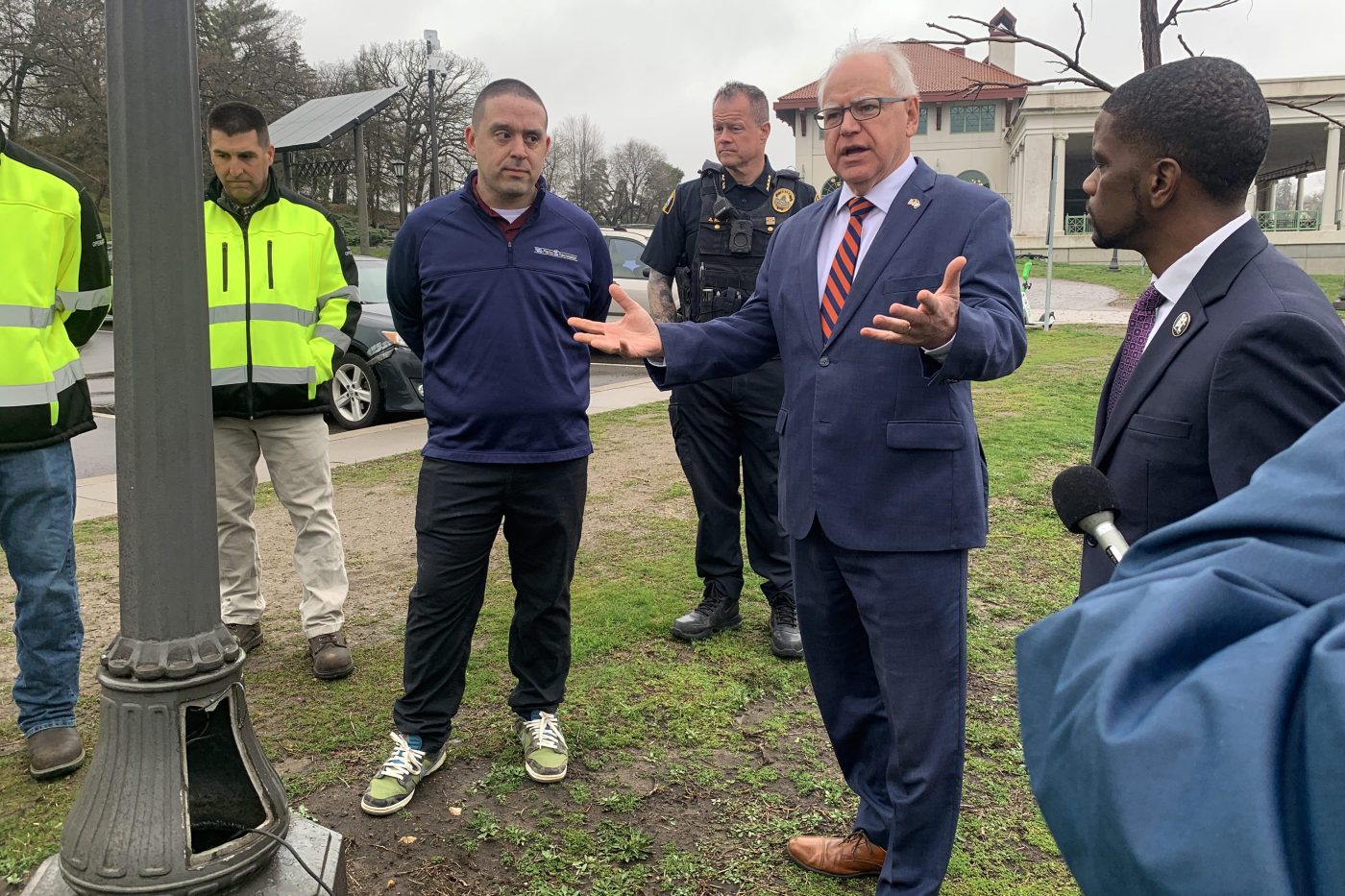
Gov. Tim Walz went to St. Paul’s Como Lake Wednesday to get a close-up view of the damage that copper wire thieves have caused to 100 light poles, darkening the path around the popular destination.

“Our teams come and replace them and replace them and replace them,” St. Paul Mayor Melvin Carter told him about fixing the wire. “We’ve seen these stripped out literally the next day.”

“From the very same one?,” Walz asked.

“From the very same one,” Carter answered.

Walz and Carter visited Como Regional Park to highlight what they say is a need for legislation to curb copper wire theft.

The legislation would require anyone selling copper metal to have a state-issued license. Construction contractors, people who work in residential trades, and other licensed workers would continue to be allowed to sell copper and wouldn’t need a separate license. The bills would still allow residents and businesses to recycle copper materials with scrap metal companies for free.

St. Paul spent $1.2 million last year on repairs and replacement due to wire theft from street lights and traffic signals, and the problem has been growing. The cost was about $250,000 in 2019, according to the city.

Copper wire theft “may seem like a fairly innocent thing,” Walz said as he addressed the media Wednesday. “If you think about it, it is not only incredibly costly and time consuming for the city, it’s also incredibly dangerous. We light our cities so that we make sure that these beautiful places are safe.”

The danger was evident on Christmas Eve when a driver fatally struck Steven Wirtz, a 64-year-old retired Marine, as he walked his dog across a St. Paul street in his North End neighborhood that was pitch black due to copper wire theft.

Concerns from scrap metal industry

Sen. Sandy Pappas and Rep. Athena Hollins, both DFL-St. Paul, are sponsoring the bills. With about a month left in the legislative session, Walz said Wednesday, “This is a top priority” and he encouraged legislators to move the bills forward.

Jeremy Estenson, representing the Institute of Scrap Recycling Industries, said at a Senate committee hearing last week that the problem with theft used to be catalytic converters, it’s now copper wire and “it will be aluminum. … It will be something else.”

There’s a need “to do something more comprehensive and meaningful as opposed to this whack a mole strategy where we might try to tackle or license whatever commodity happens to be the most popular to steal at that time, probably driven by market prices,” Estenson said.

The industry’s main concern, Estenson added, is “this will only license people who do things legally to start with. … Criminals generally don’t go get their paperwork in order before a night out on the town with their Sawzall and their tools stealing copper.”

Furthermore, scrap metal recyclers believe a side effect of requiring a $250 license for sellers will be “a cooling effect on recycling because there are people who just do a little bit of recycling” and might throw it in the garbage instead of seeking out a license that costs more than what they’d earn from recycling, Estenson.

Estenson said they’d like to continue talking about the price of the license or allowing a small amount of wire to be recycled without a license.

Why officials say licenses are needed

The problem extends beyond St. Paul — 38 mayors signed onto a letter supporting the legislation.

State law already requires scrap metal dealers to collect information from a seller’s driver’s license or identification and the license plate of the vehicle they arrived in.

Requiring a license to sell copper wire would help police because they can’t trace where copper brought to scrap yards is coming from, said St. Paul Police Chief Axel Henry. Though St. Paul labels its wires with “City of St. Paul,” people strip it off, so there’s not another easy way to identify it as stolen.

Someone selling stolen wire could just tell a scrap metal recycler, “It’s mine.’ … And (police) can’t prove where it came from,” Henry said.

People have been charged in cases when they’re caught in the act of stealing wire, and police and St. Paul officials encourage anyone who sees suspicious activity around light poles to call 911.

Related Articles

Crime & Public Safety |


Jacob Wetterling Resource Center director honored with national award

Crime & Public Safety |


Court says private vehicle is ‘public place’ under Minnesota gun law

Crime & Public Safety |


25 years after Nathan Edberg’s truck was found abandoned in Vadnais Heights, search for answers continues

Crime & Public Safety |


Hennepin County Attorney Mary Moriarty campaigned on change. Some say she’s gone too far.

Crime & Public Safety |


What ever happened to Twin Cities’ ‘Fishing Hat’ bank robber and his victims? Filmmaker takes deep look

House’s Ukraine, Israel aid package moving ahead as Speaker Johnson fights to keep his job

posted in: Politics | 0

By STEPHEN GROVES and LISA MASCARO (Associated Press)

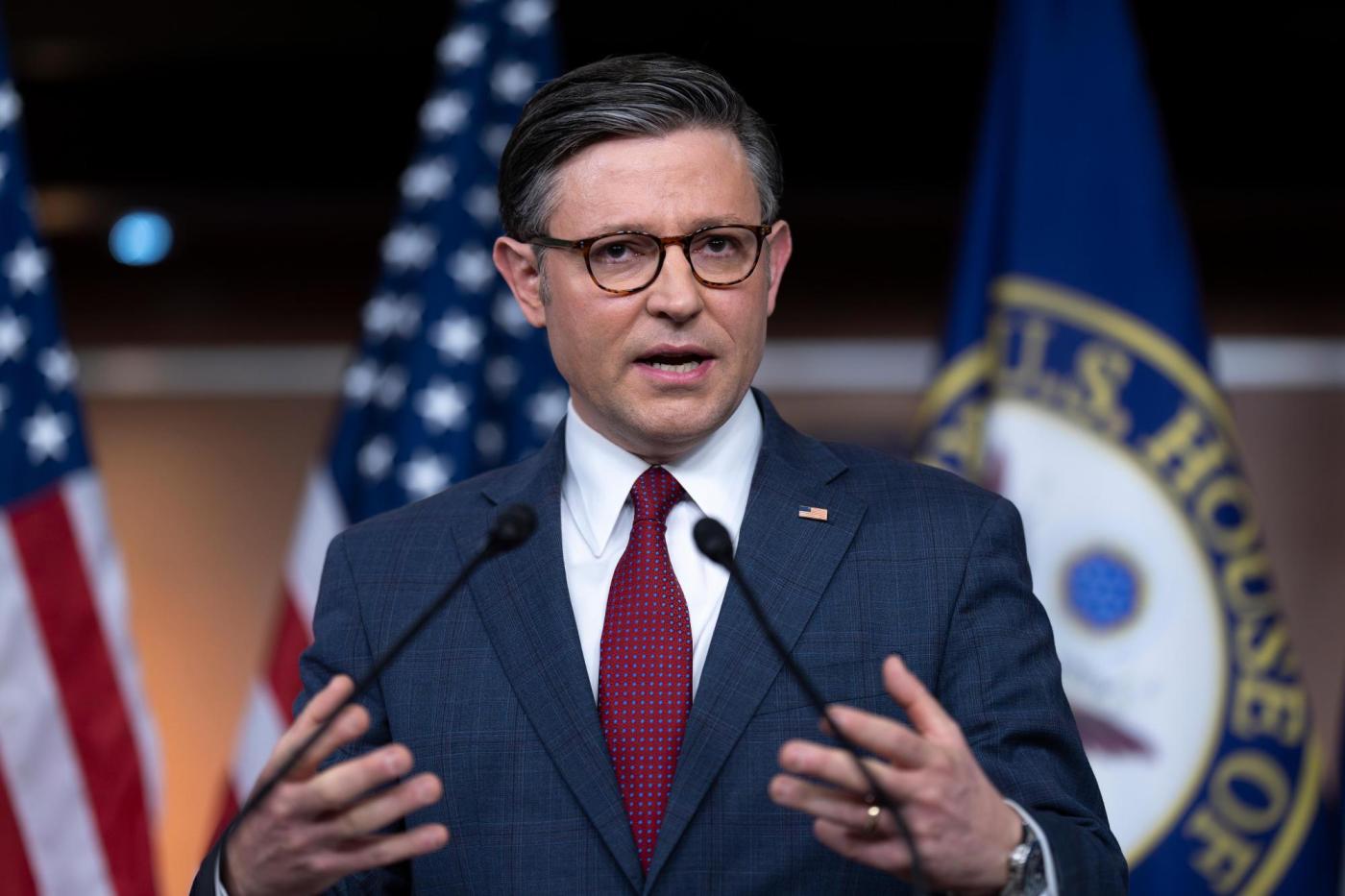
WASHINGTON (AP) — House Speaker Mike Johnson, facing a choice between potentially losing his job and advancing aid for Ukraine, forged ahead Wednesday toward a vote later this week on a package of funding that also includes Israel and Taiwan.

After agonizing over how to proceed on the package for days, the Republican speaker texted GOP lawmakers that he will start a days-long push to hold votes on three funding packages for Ukraine, Israel and allies in the Indo-Pacific, as well as a several other foreign policy proposals in a fourth bill.

Johnson said he was proposing that some of the aid for Kyiv be structured as loans, along with greater oversight, but the decision to support Ukraine at all has angered populist conservatives in the House and given new energy to a threat to remove him from the speaker’s office.

“By posting text of these bills as soon as they are completed, we will ensure time for a robust amendment process,” Johnson wrote in his message, which was shared by two Republican lawmakers.

The votes on the package are expected Saturday evening, Johnson said. But he faces a treacherous path to get there.

The speaker will almost certainly need Democratic support on the procedural maneuvers to advance his complex plan of holding separate votes on each of the aid packages.

It was not clear whether Democrats would assist Johnson. They were still awaiting the details of the legislation and have become increasingly impatient with his deliberations.

Democrats have demanded that the foreign aid bill hew closely to a $95 billion foreign aid package that the Senate passed in February. That legislation would fund the U.S. allies, as well as provide humanitarian aid for civilians in Gaza and Ukraine.

Meanwhile, the threat to oust Johnson from Rep. Marjorie Taylor Greene, a Republican of Georgia, gained support this week. One other Republican, Rep. Thomas Massie of Kentucky, said he was joining Greene and called for Johnson to resign. Other GOP lawmakers have openly complained about Johnson’s leadership.

“You are seriously out of step with Republicans by continuing to pass bills dependent on Democrats,” Greene wrote on the social platform X. “Everyone sees through this.”

In an effort to satisfy conservatives, Johnson said he would hold a separate vote on a border security package that contains most of a bill that was already passed by House Republicans last year. That bill has already been rejected by the Democratic-controlled Senate, and conservatives quickly denounced the plan to hold a separate vote on it as insufficient. Rep. Chip Roy of Texas called the strategy a “complete failure.”

The ultraconservative House Freedom Caucus posted on X that Johnson had was “surrendering the last opportunity we have to combat the border crisis.”

As part of the foreign aid push, Johnson also said House members would have an opportunity to vote on a raft of foreign policy proposals, including allowing the U.S. to seize frozen Russian central bank assets, placing sanctions on Iran, Russia and China, and potentially banning the video app TikTok if its China-based owner doesn’t sell its stake.

The precarious effort to pass the foreign aid comes as lawmakers who are focused on national security warn that the House must act after waiting for nearly two months for Johnson to bring up the foreign aid.

In the House Intelligence Committee, the Republican chairman, Rep. Mike Turner, and top Democrat, Rep. Jim Himes, issued a joint statement Tuesday saying that they had been informed in a classified briefing that it was important to provide funding for Ukraine this week.

“The United States must stand against Putin’s war of aggression now as Ukraine’s situation on the ground is critical,” the lawmakers said in a statement.

Still, there was a growing acknowledgement in the House that Johnson could soon be out of the speaker’s office.

“This is a chance to do the right thing,” Rep. Don Bacon, a Nebraska Republican, said this week. “If you pay for it, you’ll be known in history as the man who did the right thing even though it cost him a job.”

Olympic champion Suni Lee back in form after gaining 45 pounds in water weight due to kidney ailment

posted in: News | 0

By EDDIE PELLS (AP National Writer)

Olympic gymnastics all-around champion Suni Lee revealed that at the height of dealing with a kidney disease last year, she retained 45 pounds in water weight that made her question whether a return to top form was even possible.

“My motivation started to fall,” Lee said this week at the Team USA media summit.

“I could not bend my legs the slightest, I couldn’t squeeze my fingers, my face was swollen,” Lee said. “I looked like a completely different person. It was very, very miserable.”

She said she lived with constant pain, nausea and lightheadedness.

“We have it under control now,” she said. “We know what to do and the right medication to take.”

The then-18-year-old Lee was thrust into the spotlight at the Tokyo Games when teammate and reigning Olympic champion Simone Biles unexpectedly dropped out in the middle of the team final, citing her mental health. Lee hadn’t been in the original lineup for the U.S. team’s floor exercise but scored a team-best 13.666 to help the Americans claim a silver medal.

A few days later, Lee became the fifth straight American woman to win the Olympic all-around title, using a dazzling set on uneven bars — her signature event — to edge Brazil’s Rebeca Andrade in a tight final that turned Lee into a star.

On to Auburn University she went, but she left the Tigers upon falling ill after her sophomore season last year. She was never a sure thing to come back for Paris, but now she’s expected to make the U.S. team, along with Biles, who is coming back as well.

“Initially I decided I wanted to come back because I really was only getting better and I love gymnastics,” Lee said. “I was not ready to be done and I wanted to prove to myself that I could be better than I was at the last Olympics.”

Lee is working on a new bars move that, if she pulls it off in an international competition, could be named after her in the sport’s Code of Points.

She said she had a strong support system back home in Minneapolis, which helped her get back on the road to the Olympics.

“I was learning my new skill and I was still able to catch it even at less than 100%,” she said. “It made me realize how much better I was than I thought.”

Related Articles

Sports |


Despite weather glitch, the Paris Olympics flame is lit at the Greek cradle of ancient games

Sports |


6 ways to save money in Paris during the Olympics

Sports |


Olympic champ Sunisa Lee falls on bars, beam in USA Gymnastics Winter Cup. Kayla DiCello takes gold.

Sports |


Photos: Minnesotans turn out to support Jessie Diggins at World Cup ski race in Minneapolis

Asian Americans and Pacific Islanders in US more likely to believe in climate change: AP-NORC poll

posted in: News | 0

By TERRY TANG and LINLEY SANDERS (Associated Press)

Asian Americans, Native Hawaiians and Pacific Islanders in the United States are more likely than the overall adult population to believe in human-caused climate change, according to a new poll. It also suggests that partisanship may not have as much of an impact on this group’s environmental views, compared to Americans overall.

A recent poll from AAPI Data and The Associated Press-NORC Center for Public Affairs Research finds 84% of AAPI adults agree climate change exists. In comparison, 74% of U.S. adults hold the same sentiment. And three-quarters of AAPI adults who accept climate change is real attribute it entirely or mostly to human activity. Among the general U.S. adult population surveyed in an AP-NORC poll in September, only 61% say humans are causing it.

The poll is part of an ongoing project exploring the views of Asian Americans, Native Hawaiians and Pacific Islanders, whose views can usually not be highlighted in other surveys because of small sample sizes and lack of linguistic representation.

Scientists overwhelmingly agree that heat-trapping gases released from the combustion of fossil fuels are pushing up global temperatures, upending weather patterns and endangering animal species. Many scientific organizations have made public statements on the issue.

In terms of partisanship, the percentage of AAPI Democrats, 84%, who acknowledge climate change falls exactly in line with the share of Democrats overall in the September poll. The share of AAPI Republicans who believe there is a climate crisis is lower, but they somewhat outnumber Republicans in general, 68% versus 49%.

Adrian Wong, 22, of Whippany, New Jersey, is registered as unaffiliated but leans Republican. A biology major in college, the Chinese American says the science behind climate change is indisputable.

“I’ve probably done more or looked more into it than the average person has,” Wong said. “It’s to me clear that it’s changing due to human activity, not natural shifts.”

There has been growing conflict within the Republican Party between those who insist climate change is a progressive-generated hoax and those — mostly younger generations — who say the issue cannot be ignored. GOP lawmakers, in general, refuse to consider measures like mandated lowering of carbon emissions. However, some consider that an untenable position long-term. American Conservation Coalition, the largest conservative environmental group in the nation, has said Republicans running for office cannot risk alienating people who care about climate change.

Wong is not surprised that AAPI conservatives like himself recognize that the climate is changing. He thinks they are more highly educated and more likely to be exposed to science, technology, engineering and mathematics.

“It wouldn’t surprise me if they were more likely to have studied more and actually more likely to have studied in science and STEM-related fields rather than, say like, finance or something,” Wong said.

While climate change is an afterthought to her parents, Analisa Harangozo, 35, of Alameda, California, worries a great deal about it. She has noticed a rise in “crazy heatwaves and droughts and just like crazy weather in general” in the San Francisco Bay Area. She and her husband are teaching their sons — ages 7 and 4 — to take small steps to reduce their carbon footprint like composting, growing food and eating less meat. They’re also trying to minimize their accumulation of household items.

“I always second-guess myself, ‘Do I really need this?’” Harangozo said. “Stuff will eventually end up in the landfill. So, we’re really mindful with the products we buy, and whether or not they can be recycled or they’re made from materials that are natural, like wood or what-not.”

A registered independent with Democratic leanings, Harangozo is open to proposals from California Gov. Gavin Newsom and other state lawmakers to slash greenhouse gas emissions and invest in renewable energy.

“I’m not knowledgeable enough to know what an attainable goal is,” she said. “But, whatever it takes to actually make a difference, I’m all for it. I fully support.”

Karthick Ramakrishnan, a public policy professor at the University of California, Riverside, and founder of AAPI Data, said the richness and detail of the data shows environmental groups need to consider reaching out to AAPI populations. They make up a relatively small share of the U.S. population — around 7%, according to a Pew Research Center analysis of 2021 census data — but their numbers are growing quickly.

“Asian American and Pacific Islander voters are environmental voters,” Ramakrishnan said. “Many of us still have an image in our minds of a particular kind of person maybe of a particular race, gender or age group. What we see here is across the board Asian Americans and Pacific Islanders care about the environment.”

Asian American and Pacific Islanders may also have more of a stake in climate change because of connections to relatives abroad. China, considered one of the world’s biggest emitters of greenhouse gases alongside the U.S., vowed last year to reduce emissions. More Chinese companies are considering selling wind and solar power equipment in other countries. Around this time last year, Japan was preparing for another sweltering summer and risks of floods and landslides. That country has also pledged to curb emissions.

Heavy rains swept across Pakistan last month, causing landslides and leaving over 36 people dead and dozens of others injured. In 2022, unprecedented rainfall and flooding in that country killed more than 1,700. In India, farmers are grappling with frequent cyclones and extreme heat. In southern India, the city of Bengaluru is seeing water levels running desperately low after an unusually hot February and March.

“There’s a fairly high level concern of what climate change means to low-income countries,” Ramakrishnan said. “That sensitivity is either because people still have friends or family back in their home country or at least have some concern about what climate change does to other countries.”

The poll of 1,005 U.S. adults who are Asian American, Native Hawaiian and Pacific Islanders was conducted from March 4-11, 2024, using a sample drawn from NORC’s probability-based Amplify AAPI Panel, designed to be representative of the Asian American, Native Hawaiian, and Pacific Islander population. The margin of sampling error for all respondents is plus or minus 4.9 percentage points.