Recovery of missing dog Boro brings hope after Spain’s train crashes

posted in: All news | 0

By SUMAN NAISHADHAM

MADRID (AP) — After back-to-back fatal train crashes sent shock waves through Spain, some good news arrived on Thursday: Boro, the missing dog, was found.

Days earlier, Boro’s owner Ana García issued a desperate plea to help find him after the dog bolted Sunday in the aftermath of the high-speed train crash in southern Spain that killed at least 45 people. García, 26, and her pregnant sister were traveling with Boro on the train that derailed.

On Thursday, forest firefighters in southern Spain found the black-and-white pooch, and posted images that showed García with one of her legs in a brace embracing Boro. Sitting inside a car, she spoke to reporters.

“Many thanks to all of Spain and everyone who has got involved so much,” she said. “It gave me great hope and we’ve done it.”

The search for Boro appeared to provide Spaniards something to hope for amid the week’s tragedy, and ultimately something to celebrate.

For days, people had rallied online to find him, amplifying García’s call by sharing video of an interview she had given to local media. Photos of Boro, a medium-sized black dog with white eyebrows, went viral alongside phone numbers for García and her family. Spanish television broadcasters and newspapers covered the search.

García, her sister and the dog had been traveling Sunday by high-speed train from Malaga, their hometown in southern Spain, to the capital Madrid, when the tail of their train car jumped the rails for reasons that remain unclear, and smashed into another train.

The collision killed dozens and injured more than 150 people. Rescue crews helped García and her sister out of the tilted train car. That’s when she briefly saw Boro before he ran. She spoke to the cameras with a blanket draped over her shoulders and a bandage on her cheek after Spain’s worst rail accident in more than a decade.

Guardia Civil officers collect evidence next to the wreckage of train cars involved in a collision in Adamuz, southern Spain, Tuesday, Jan. 20, 2026. (AP Photo/Manu Fernandez)

“Please, if you can help, look for the animals,” a limping García told reporters at the time, choked up and holding back tears. “We were coming back from a family weekend with the little dog, who’s family, too.”

On Thursday, she had a bruise beneath her eye but, with Boro back by her side, also a smile plastered across her face.

“Now we have him and we have him for all our life,” García told reporters. “Now let’s go home, buddy.”

Associated Press journalist Teresa Medrano in Madrid contributed to this report.

Related Articles


People in Gaza dig through garbage for things to burn to keep warm — a far cry from Trump’s vision


Guinea-Bissau suspends Trump-backed hepatitis B vaccine study for ethical review


Trump’s European threats could cause lasting damage to US standing in the world


NATO chief Mark Rutte shows he’s a ‘Trump whisperer’ with Greenland diplomacy


US government warns it will take action if Haitian politicians destabilize country

A Kentucky cathedral called ‘America’s Notre Dame’ gets a rehab, gargoyles and all

posted in: All news | 0

By PETER SMITH

COVINGTON, Ky. (AP) — Gargoyles have watched over this small Kentucky city for more than a century from their lofty perches on a cathedral known as “America’s Notre Dame.” A new renovation will ensure they keep their posts for years to come on the meticulously restored facade of the towering stone sanctuary.

Workers in recent weeks have been installing new terra cotta gargoyles as one of the final steps of a major, two-year restoration of the Cathedral Basilica of the Assumption. The Catholic cathedral’s nickname stems from how its exterior was modeled on the larger Notre Dame Cathedral in Paris — from the pointed arches and flying buttresses to the gargoyles and chimeras with their reptilian grins and piercing, canine eyes.

Unlike the Paris landmark, which recently underwent a massive renovation because of a sudden and devastating fire, the Covington cathedral needed a rehab due to the slow deterioration of old stone, metal and terra cotta after 125 years of exposure to the elements in its Ohio River city across from Cincinnati.

“We consider ourselves blessed to be able to ensure the cathedral is taken care of for coming generations,” said Assumption’s rector, the Very Rev. Ryan Maher.

Workers have been painstakingly repairing and replacing tons of Indiana limestone. The new gargoyles are replicas based on meticulous scans of the 32 worn originals.

Workers aim to complete the two-year restoration by March. The finishing touch will be the installation of new 26 chimeras along the rooftop. These grotesque creatures, similar to gargoyles, are exact replicas of their weathered predecessors.

“It’s hard to believe that you’re able to replicate a piece that was built a hundred years ago by men that are no longer with us,” said Brian Walter, executive vice president of Trisco Systems, the prime contractor for the restoration.

Restoration expert says work is both ‘an art and a science’

Workers have faced numerous challenges throughout the project: hoisting and fitting heavy stones into the façade while operating cranes above a busy street in the heat, cold and wind. They have been patching and fixing what they can and replacing other parts entirely.

“It’s an art and a science that’s passed down from generation to generation,” Walter said. “Every part of it is challenging.”

Related Articles


Uvalde officer’s acquittal shifts focus to the next case over police response to attack


Under Armour looking into data breach affecting customers’ email addresses


Former Iowa superintendent pleads guilty to falsely claiming US citizenship


Maine’s governor demands data on immigration arrests as fear spreads amid enforcement surge


Huge winter storm to bring crippling snow, sleet and ice from Texas to Boston

Those challenges began long before the materials even arrived at the cathedral, for a project involving architects, stonecutters, terra cotta artists and more.

Workers made precise scans of deteriorated finials, arches, balustrades and other architectural elements so stonecutters could make exact matches. Organizers sourced stone from Bedford, Indiana, where limestone for the original cathedral was quarried.

Over the generations, the cathedral has had several renovations and overhauls, with exterior statues added in 2019.

But Maher knew a comprehensive exterior renovation was needed when, in 2018, he found a large, fallen piece of stone — evidence of a wider deterioration.

This time, workers used more durable stainless steel pins and brackets to secure the stone and replace the original carbon steel, which had rusted.

Bishop in a small city had big ambition

The cathedral opened in 1901, following a multiyear construction campaign by the Belgian-born Bishop Camillus Paul Maes, head of the Diocese of Covington and an admirer of the French Gothic style.

While the exterior is modeled on Notre Dame, it has adaptations. It is just under half of the Paris cathedral’s size, lacking the original’s twin towers and featuring a narrower but still imposing façade. The high-vaulted interior, bathed in light from large stained-glass windows, is modeled on another landmark Paris cathedral, Saint-Denis.

The ambition was striking, cathedral historian Stephen Enzweiler said. The city then had just over 40,000 people, similar to its population today.

“At the time, no one had ever heard of Covington,” Enzweiler said.

Maes wanted a sanctuary large enough to accommodate the rapidly growing immigrant Catholic population and grand enough to fulfill the medieval vision of a cathedral that would “represent heaven on earth,” he said.

The cathedral was part of a larger Gothic revival happening around the turn of the century that also saw the emergence of such landmark cathedrals as St. Patrick’s and St. John the Divine in New York.

“This is a smaller version of that revival of French Gothic in America, done at a very high level in a little town at the time, of surprisingly high quality,” said Duncan Stroik, an architect, professor of architecture at the University of Notre Dame and author of “The Church Building as a Sacred Place: Beauty, Transcendence and the Eternal.”

“It shows the talent of the bishop, the architect and the craftsmen,” he said.

Comparing the Gothic features of the Kentucky and Paris cathedrals

Ironically, some of that Gothic revival wasn’t quite as medieval as it may seem. The movement drew strong influence from the mid-19th century renovation of the Paris cathedral after the popular novel, “The Hunchback of Notre Dame,” called attention to its deterioration.

Notre Dame’s renovation architect, Eugène Viollet-le-Duc, added new elements such as the gargoyle-like chimeras on the rooftop. Unlike the gargoyles on Notre Dame, which double as rainspouts, the Covington sanctuary’s fantastical creatures are purely decorative.

Theories vary about the medieval intent behind the gargoyles. Were they to ward off evil spirits? Did they represent the demonic realm outside the sanctuary of the church? Were they allegorical figures for morality lessons? Or simply the imaginative fruits of medieval craftsmen?

In modern times, gargoyles and chimeras have often become objects of endearment — portrayed by Disney as animated comic sidekicks and replicated in miniature as bookends, figurines and garden art. The Covington cathedral’s newsletter is named the Gargoyle Gazette.

The renovation price tag is $7.8 million, most of which has been raised. More than 2,000 donors contributed, along with foundations, Maher said.

“It was kind of an easy sell, because of what the cathedral means to not only our parishioners but to the whole community,” he said.

The goal is to maintain the cathedral as a sanctuary for years to come.

“When everything is upside down, this is a place of people where people can experience the calm of the Lord,” Maher said.

Associated Press religion coverage receives support through the AP’s collaboration with The Conversation US, with funding from Lilly Endowment Inc. The AP is solely responsible for this content.

Homeland Security vastly overstating jail and prison immigration holds, MN Corrections says

posted in: All news | 0

The Minnesota Department of Corrections contacted all county jails in the state Monday to ask how many people in custody had immigration detention holds. The number totaled 94, Corrections Commissioners Paul Schnell said Thursday.

Combined with the 207 people with immigration holds in Minnesota prisons, the number is about 1,000 less than U.S. Department of Homeland Security has been saying, Schnell pointed out.

With a federal immigration enforcement surge underway in Minnesota, DHS has repeatedly said 1,360 people in the state have detention holds and, in response to Pioneer Press questions Thursday, they repeated those numbers:

“As DHS stated, across the state of Minnesota nearly 470 criminal illegal aliens including violent criminal illegal aliens have been RELEASED into communities,” a DHS spokesperson said. “We have more than 1,360 active detainers on illegal aliens in the custody across all jurisdictions in Minnesota. We are once again calling on Governor Walz and his fellow sanctuary politicians to commit to honoring all ICE detainers. Instead, Governor Walz and Mayor Frey are actively encouraging an organized resistance to ICE and federal law enforcement officers.”

Schnell said DOC’s count is “nowhere close” to DHS’ 1,360 figure.

Meanwhile, a U.S. Immigration and Customs Enforcement official said Thursday that “the 1,300 number is statewide in counties that we have lodged.”

“They may not have record of it if they don’t file them because they don’t honor them. They have no reason to keep them,” said Marcos Charles, ICE Enforcement and Removal Operations executive associate director.

‘Sheriffs want to help’

ICE can pick up people with detainers from the state’s Corrections Department, said Charles, who told reporters that federal immigration officials are now “opening up dialogue” with some Minnesota counties to see if they will honor their detainers as well.

“The governor should talk to the counties and let them honor our detainers. Many of these sheriffs want to help us,” he said.

But Schnell said Charles’ statement “that the governor controls the actions of county jails is patently false.”

State law says local law enforcement cannot hold people in custody in county jails solely based on civil immigration detainer requests from ICE, according to a legal opinion last year from Minnesota Attorney General Keith Ellison.

“Civil liability in this area can be substantial,” the opinion noted and pointed to two lawsuits in Minnesota, one in which a person was awarded $30,000 in damages and more than $248,000 in attorney fees and another settled for $200,000.

The “vast majority of sheriffs across the state do provide notification to ICE” of people who have immigration holds, Schnell said.

When a person is arrested and booked into a county jail, ICE works to determine a person’s legal status, Schnell said. “In the meantime, the person can be seen by the court, could be subject to a bail release, released on their personal recognizance … and there is nothing that the jail can do to hold custody of that person, to wait for ICE, to pick them up,” Schnell added.

Related Articles


Minnesota 7-year-old found safe following Amber Alert


Nekima Levy Armstrong, Chauntyll Allen to be released following church protest arrest


Minnesota corrections officials again dispute ICE numbers on criminals


Lakeville man pleads guilty to killing pregnant sister, dismembering body


3 dead in 2 separate Minnesota structure fires, authorities say

At the Dakota County jail, ICE placed roughly 80 detainers last year, said Sheriff Joe Leko. “Every single one, ICE was notified of their release and I can recall dozens and dozens of times of agents waiting there” to pick them up, he said.

Ramsey County Sheriff Bob Fletcher said his jail occasionally receives judicial arrest warrants that include a complaint signed by a deportation officer and a judge, which are different matters than immigration detainers. For example, a person currently in custody at the Ramsey County jail has such a warrant and is being held; the U.S. Marshals Service is scheduled to pick him up.

Jail rosters are public information. Two immigration officers were in the Ramsey County jail last week to interview people who may be in the U.S. illegally, Fletcher said. He said he hasn’t had reports of people being arrested by ICE as they left the jail.

The majority of people in the Ramsey County jail are “repeat offenders that are citizens,” Fletcher added.

County boards can enter into agreements with ICE, according to another advisory opinion from Ellison. Seven of Minnesota’s 87 counties have agreements with ICE. They are Cass, Crow Wing, Freeborn, Itasca, Kandiyohi, Mille Lacs and Sherburne counties, according to ICE.

Released or handed over?

Federal agents search for an address along Thomas Avenue near Avon Street in St. Paul’s Frogtown neighborhood on Friday, Jan. 16, 2026. (John Autey / Pioneer Press)

Schnell said Thursday that DHS has insinuated that the feds arrested people who were released into the community when it was a matter of transferring them from prison into ICE custody.

He highlighted a Jan. 12 case.

DOC notified ICE when two men — Meng Khong Yang and Joshua Fornoh — were in prison, in accordance with state law, Schnell said. ICE issued detainers for both men.

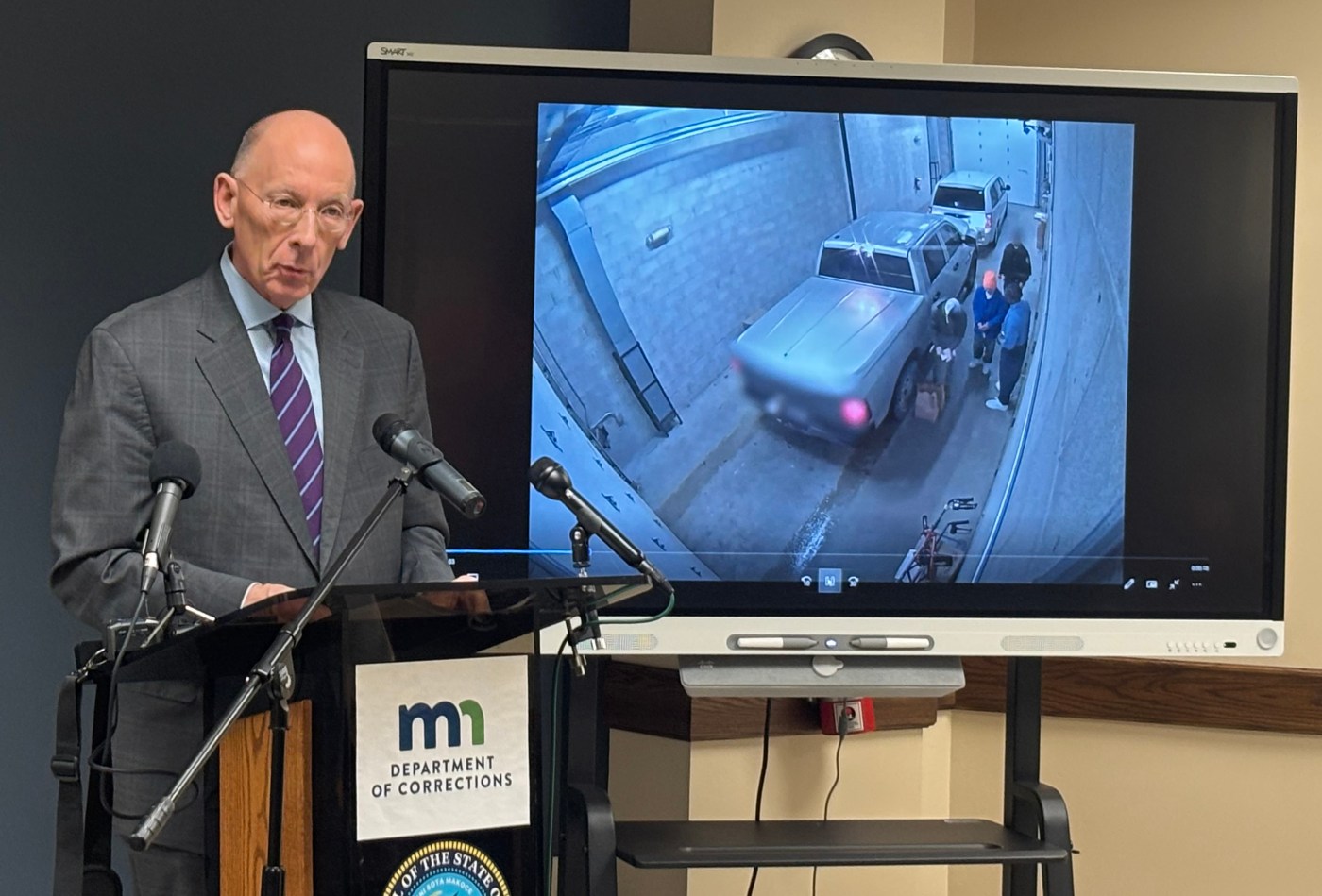
Schnell showed surveillance video from the sallyport at the Lino Lakes prison on Jan. 12, which he said showed this transfer of Yang and Fornoh to ICE.

“As is the case for every single release where there is an ICE detainer in place, we contacted them weeks before the individuals reached the end of their prison term … and we coordinated pickup arrangements with them,” Schnell said.

The next day, DHS included Yang and Fornoh in a press release that listed “criminal illegal aliens arrested yesterday during Operation Metro Surge.”

Assistant DHS Secretary Tricia McLaughlin said in the release: “Minnesota’s sanctuary politicians have chosen to side with criminal illegal aliens and ignored their American victims. Just yesterday our law enforcement arrested rapists, armed robbers, and drug traffickers. We are doing what Governor Walz and Mayor Frey REFUSED to do — make Minnesota safe again.”

But Schnell emphasized that when it came to Yang and Fornoh, “their custody was transferred from the DOC directly to (ICE). They were not picked up in the community, as is implied.”

Requested meeting

DHS hasn’t provided a source for their numbers of people with ICE detainers, jurisdictional breakdown or timeframe.

Schnell said they’ve requested to meet with DHS to “square up these numbers, to talk about things that we think could improve processes,” but as of Thursday morning “we have not had a response to those inquiries.”

Schnell said he wants the public to understand that:

Related Articles


Could a president deploy wartime law against the Beatles? Trump administration says ‘yes’


Former Iowa superintendent expected to plead guilty to falsely claiming he was a US citizen


Maine’s governor demands data on immigration arrests as fear spreads amid enforcement surge


Trial of Chicago man accused of putting bounty on top Border Patrol leader sent to jury


Vance’s message in Minneapolis: Local officials must cooperate with the immigration crackdown

• DOC operates state prisons, not county jails.

• “We do not decide who receives an ICE detainer.”

• “When DHS conflates the processes and procedures of state prisons, county jails and ICE detention into a single talking point, the result is misinformation.”

• DOC has reviewed every person that DHS has publicly named as those they’ve arrested and many were never in DOC custody, several have no Minnesota court or prison records, some had short stays in county jails in Minnesota, and some were in custody in other states.

“Many were released directly to ICE, including cases going back to 2009, 2001, even into the 1990s,” Schnell said. “In some cases, DHS publicly implied Minnesota recently released individuals who were transferred to ICE years ago or decades ago.”

Alex Derosier contributed to this report.

‘Heated Rivalry’ stars Hudson Williams and Connor Storrie to be torchbearers for Winter Olympics

posted in: All news | 0

MILAN (AP) — The actors co-starring in the hit hockey romance TV series “Heated Rivalry” are set to be among the torchbearers carrying the Olympic flame on the way to the Opening Ceremony for the Milan Cortina Games.

The organizing committee announced Thursday that Hudson Williams and Connor Storrie will take part in the torch relay. The Opening Ceremony is scheduled for Feb. 6.

The series based off “Game Changers” books has captivated viewers with the fictional story of a Canadian and a Russian hockey player sustaining a decade-long secret relationship.

The first season became the the No. 1 series on HBO Max. Originally developed for the Canadian streaming service Crave, the show scored a distribution deal with HBO and has already been renewed for a second season, and it will broadcast in Italy beginning next month.

AP Olympics: https://apnews.com/hub/milan-cortina-2026-winter-olympics

Related Articles


Lindsey Vonn, Chloe Kim, Mikaela Shiffrin headline US ski and snowboard squad named to the Olympics


How Norway’s ski jumping scandal led to new rules in place for the Winter Olympics


Laila Edwards prepares to make Olympic debut as USA Hockey’s first Black female


Leonardo da Vinci’s legacy lights up the Milan Cortina Olympics with two cauldrons


Ilia Malinin: The 20-year-old American figure skater redefining the sport