Poland’s president becomes the latest leader to visit Donald Trump as allies eye a possible return

posted in: Politics | 0

By JILL COLVIN and MONIKA SCISLOWSKA (Associated Press)

NEW YORK (AP) — Former President Donald Trump met Wednesday in New York with Polish President Andrzej Duda, the latest in a series of meetings with foreign leaders as Europe braces for the possibility of a second Trump term.

The presumptive Republican nominee hosted Duda at Trump Tower, where the two discussed the war in Ukraine and Duda’s push to boost NATO members’ defense spending, according to a readout from Trump’s campaign. Duda, who has long expressed admiration for Trump, is also a staunch supporter of Ukraine and has encouraged Washington to provide more aid to Kyiv amid Russian’s ongoing invasion. That funding has been held up by Trump allies in Congress.

As he arrived, Trump praised the Polish president, saying, “He’s done a fantastic job and he’s my friend.”

“We had four great years together,” Trump added. “We’re behind Poland all the way.”

Following the almost 2 1/2 hour meeting, Duda said only that it was a “friendly meeting in very nice atmosphere.”

His aide, Wojciech Kolarski, also in attendance, described it as an “excellent meeting” of “two friends who reminisced on the time when for four years they cooperated while holding presidential offices,” a time that was “very fruitful for Polish-U.S. relations.”

Duda is the latest foreign leader to meet with Trump in the weeks since he locked up the Republican nomination. U.S. allies across the world were caught off guard by Trump’s surprise 2016 win, forcing them to scramble to build relationships with a president who often attacked longstanding treaties and alliances they valued. Setting up meetings with him during the 2024 campaign suggests they don’t want to be behind again.

Even as he goes on trial for one of the four criminal indictments against him, Trump and Democratic President Joe Biden are locked in a rematch that most observers expect will be exceedingly close in November.

While some in Poland worried the visit might damage the country’s relationship with Biden, Sen. Chris Murphy, D-Conn. — a Biden ally and a major voice in his party on foreign affairs — said such meetings make sense.

“The polls are close,” he said. “If I were a foreign leader — and there’s a precedent attached to meeting with candidates who are nominated or on the path to being nominated — I’d probably do it too.”

Murphy noted that former President Barack Obama did a lengthy international tour and met with foreign leaders when he first ran for the White House. So did Mitt Romney, the former Massachusetts governor, who challenged Obama in 2012 and whose trip included a stop in Poland’s capital, Warsaw.

Duda’s visit comes a week after Trump met with British Foreign Secretary David Cameron, another NATO member and key proponent of supporting Ukraine, at the former president’s Florida estate.

Related Articles

National Politics |


Climate change concerns grow, but few think Biden’s climate law will help, an AP-NORC poll finds

National Politics |


The abortion debate is giving Kamala Harris a moment. But voters still aren’t sold

National Politics |


Republicans scrutinize voting rolls and ramp up for mass challenges ahead of election

National Politics |


Fact check: Biden is right about $35 insulin cap but exaggerates prior costs for Medicare enrollees

National Politics |


Things to know as courts and legislatures act on transgender kids’ rights

In March, Trump hosted Hungarian Prime Minister Viktor Orbán, an autocrat who has maintained the closest relationship with Russia among European Union countries. Orbán shared a montage of footage of the visit on his Instagram feed, which included an image of him and his staff meeting with Trump and the former president’s aides in a scene that looked like an official bilateral meeting.

Trump also met briefly in February with Javier Milei, the fiery, right-wing populist president of Argentina who ran a campaign inspired by Trump, complete with red “Make Argentina Great Again” hats. Milei gave Trump an excited hug backstage at the annual Conservative Political Action Conference outside Washington, according to video posted by a Trump campaign aide.

Biden administration officials have been careful not to weigh in publicly on foreign leaders’ meetings with Trump, acknowledging he has a real chance of winning the race.

While some officials have privately expressed frustration with such meetings, they are mindful that any criticism would open the U.S. to charges of hypocrisy because senior American officials, including Secretary of State Antony Blinken, meet frequently with foreign opposition figures at various forums in the United States and abroad.

Security and policy officials monitor the travel plans of foreign officials visiting the U.S., but generally don’t have a say in where they go or with whom they meet, according to an administration official who spoke on the condition of anonymity to discuss protocol.

Trump has been back in his hometown this week for the start of his criminal hush money trial, which has dramatically limited his ability to travel and campaign. While in town, aides have been planning a series of events that began Tuesday evening when Trump, after court adjourned, stopped by a Harlem bodega where a man was killed to rail against crime, and to blast the district attorney who made him the first former president in U.S. history to stand criminal trial.

Duda, a right-wing populist who once proposed naming a military base in his country “Fort Trump,” described the dinner earlier Wednesday as a private get-together between friends at Trump’s former residence while he is in town for meetings at the United Nations, where Duda is to deliver a speech.

“I have been invited by Mr. Donald Trump to his private apartment,” Duda told reporters, saying it was “a normal practice when one country has good relations with another country” to want those relations to be as strong as “possible with the representatives of various sides of the political stage.”

“We know each other as people. Like two, I can say in some way, friends,” said Duda, whose term ends in 2025.

Duda’s visit comes as House Republicans wrangle over a $95 billion foreign aid bill that would provide new funding to Ukraine, including money for the U.S. military to replace depleting weapon supplies. Polish leaders have been urging the House to approve the aid bill and ease domestic concerns.

Many Trump allies in the House are fiercely opposed to aiding Ukraine, even as the country warns that it is struggling amid a fresh Russian offensive. Trump has said he might be open to aid in the form of a loan.

One area where Trump and Duda agree when it comes to the conflict is a desire to push NATO members to increase their defense spending. Duda has called on fellow members of the alliance to raise their spending to 3% of gross domestic product as Russia continues its invasion of Ukraine. That would represent a significant increase from the current commitment of 2% by 2024.

Trump, in a stunning break from U.S. precedent, has long been critical of the Western alliance and has threatened not to defend member nations that do not hit that spending goal. That threat strikes at the heart of the alliance’s Article 5, which states that any attack against one NATO member will be considered an attack against all.

In February, Trump went even further, recounting that he’d once told leaders that he would “encourage” Russia to “do whatever the hell they want” to members that are — in his words — “delinquent.”

Trump’s campaign said the two discussed the NATO proposal during the meeting. The two also discussed Israel and the Middle East, Trump’s 2017 trip to Warsaw, “and many other topics having to do with getting to world peace,” the campaign said in its readout, which described the men as “great friends.”

The visit was met with mixed reaction in Poland, where fears of Russia run high and Duda’s friendly relationship with Trump has been a source of controversy.

Poland’s centrist Prime Minister Donald Tusk, a political opponent of Duda, was critical of the dinner but expressed hope that Duda would use it as an opportunity “to raise the issue of clearly siding with the Western world, democracy and Europe in this Ukrainian-Russian conflict.”

Scislowska reported from Warsaw. Associated Press writers Matthew Lee, Zeke Miller and Seung Min Kim in Washington contributed to this report.

Allman Brothers Band co-founder and legendary guitarist Dickey Betts dies at 80

posted in: News | 0

By STEVEN WINE and RUSS BYNUM (Associated Press)

Guitar legend Dickey Betts, who co-founded the Allman Brothers Band and wrote their biggest hit, “Ramblin’ Man,” has died. He was 80.

The Rock & Roll Hall of Famer died at his home in Osprey, Florida, David Spero, Betts’ manager of 20 years, confirmed. Betts had been battling cancer for more than a year and had chronic obstructive pulmonary disease, Spero said.

“He was surrounded by his whole family and he passed peacefully. They didn’t think he was in any pain,” Spero said by phone.

Betts shared lead guitar duties with Duane Allman in the original Allman Brothers Band to help give the group its distinctive sound and create a new genre — Southern rock. Acts ranging from Lynyrd Skynyrd to Kid Rock were influenced by the Allmans’ music, which combined the blues, country, R&B and jazz with ‘60s rock.

Founded in 1969, the Allmans were a pioneering jam band, trampling the traditional notion of three-minute pop songs by performing lengthy compositions in concert and on record. The band was also notable as a biracial group from the Deep South.

Duane Allman died in a motorcycle accident in 1971, and founding member Berry Oakley was killed in a motorcycle crash a year later. That left Betts and Allman’s younger brother Gregg as the band’s leaders, but they frequently clashed, and substance abuse caused further dysfunction. The band broke up at least twice before reforming, and has had more than a dozen lineups.

The Allman Brothers Band was inducted into the Rock & Roll Hall of Fame in 1995 and earned a Lifetime Achievement Grammy Award in 2012. Betts left the group for good in 2000, and also played solo and with his own band Great Southern, which included his son, guitarist Duane Betts.

Forrest Richard Betts was born Dec. 12, 1943, and was raised in the Bradenton, Florida, area, near the highway 41 he sang about in “Ramblin’ Man.” His family had lived in area since the mid-19th century.

Betts grew up listening to country, bluegrass and Western swing, and played the ukulele and banjo before focusing on the electric guitar because it impressed girls. At 16 he left home for his first road trip, joining the circus to play in a band.

He returned home, and with bassist Oakley joined a group that became the Jacksonville, Florida-based band Second Coming. One night in 1969 Betts and Oakley jammed with Duane Allman, already a successful session musician, and his younger brother, and together they formed the Allman Brothers Band.

The group moved to Macon, Georgia, and released a self-titled debut album in 1969. A year later came the album “Idlewild South,” highlighted by Betts’ instrumental composition “In Memory of Elizabeth Reed,” which soon became a concert staple.

The 1971 double album “At Fillmore East,” now considered among the greatest live albums of the classic rock era, was the Allmans’ commercial breakthrough and cemented their performing reputation by showcasing the unique guitar interplay between Allman and Betts. Their styles contrasted, with Allman playing bluesy slide guitar, while Betts’ solos and singing tugged the band toward country. When layered in harmony, their playing was especially distinctive.

The group also had two drummers — “Jaimoe” Johanson, who is Black, and Butch Trucks.

Duane Allman died four days after “Fillmore” was certified as a gold record, but the band carried on and crowds continued to grow. The 1973 album “Brothers and Sisters” rose to No. 1 on the charts and featured “Ramblin’ Man,” with Betts singing the lead and bringing twang to the Top 40. The song reached No. 2 on the singles charts and was kept out of the No. 1 spot by “Half Breed” by Cher, who later married Gregg Allman.

The soaring sound of Betts’ guitar on “Ramblin’ Man” reverberated in neighborhood bars around the country for decades, and the song underscored his knack for melodic hooks. “Ramblin’ Man” was the Allmans’ only Top Ten hit, but Betts’ catchy 7½-minute instrumental composition “Jessica,” recorded in 1972, became an FM radio staple.

Betts also wrote or co-wrote some of the band’s other best-loved songs, including “Blue Sky” and “Southbound.” In later years the group remained a successful touring act with Betts and Warren Haynes on guitar. Gregg Allman and Butch Trucks died in 2017.

After leaving the Allmans for good, Betts continued to play with his own group and lived in the Bradenton area with his wife, Donna.

Climate change concerns grow, but few think Biden’s climate law will help, an AP-NORC poll finds

posted in: News | 0

By ALEXA ST. JOHN and LINLEY SANDERS (Associated Press)

Like many Americans, Ron Theusch is getting more worried about climate change.

A resident of Alden, Minnesota, Theusch has noticed increasingly dry and mild winters punctuated by short periods of severe cold — symptoms of a warming planet.

As he thinks about that, future generations are on his mind. “We have four children that are in their 20s,” the 56-year-old truck driver and moderate Democrat said. “It’s like, what’s our grandkids’ world going to be like?”

A new poll from The Associated Press-NORC Center for Public Affairs Research shows that 45% of adults in the United States say they have become more concerned about climate change over the past year, including roughly 6 in 10 Democrats and one-quarter of Republicans.

President Joe Biden’s signature climate change policy, the Inflation Reduction Act, was intended to address some of those fears, investing billions in incentives for consumers and businesses to move toward clean energy sources. Biden has pointed to this climate agenda as a major presidential success during his run for reelection. But the poll suggests that although the law has already affected some Americans, it’s not widely known among the general population — and may not be the electoral boost Biden is looking for.

About one-quarter of Americans say tax credits for renewable energy projects such as wind power have benefited people like them so far, with similar numbers for incentives for companies to manufacture clean energy technologies in the U.S. rather than abroad, tax credits for individuals to add solar panels to their homes, or subsidies and tax credits for electric vehicles and energy-efficient appliances like heat pumps. Those numbers are fairly substantial for a law that passed less than two years ago, where the benefits largely hinge on big-ticket purchases like cars or home improvements.

Promoting electric vehicles has also been a major focus for the Biden administration, and 15% of U.S. adults say electric vehicles have had a good impact on them personally.

“I totally agree with the act because it’s done so many things for people,” said Charles Lopez, a 65-year-old liberal Democrat from the Florida Keys. “They help everybody … I’m not ready for a full electric, but I’ll get there when there’s enough charging stations.”

But the people who say they have benefited from the law are disproportionately Democrats. And while only about 1 in 10 U.S. adults think the individual tax credits and subsidies have hurt people like them, those provisions of the law aren’t yet registering with the majority of Americans — roughly one-quarter say those credits haven’t made a difference to people like them. Nearly 4 in 10 in each instance don’t know enough to have an opinion about them.

“I still think that, as much as we’d like for them to be implemented in a way that we can actually see results, it’s not really happening in my eyes,” said Sandra Sherman, a 62-year-old resident of Vero Beach, Florida, who identifies as a liberal Democrat. “With solar panels, although it seems like a really good idea, I see very few people in the area in Florida that I live in that actually have them.”

Generally, U.S. adults also aren’t confident the IRA will have an impact even in more time. The poll found that only between 23% and 35% of U.S. adults say the law’s key components will eventually help address climate change. About 2 in 10 think the main provisions of the law will make no difference in addressing climate change, and about one-third don’t know enough to say.

“A lot of the public feeling on it is, ‘well something needs to be done,’ but not necessarily knowing what needs to be done or not even necessarily having strong feelings about what needs to be done,” said David Weakliem, a University of Connecticut professor emeritus.

Biden still has an advantage over his opponent, former President Donald Trump, when it comes to climate change generally. About 4 in 10 U.S. adults and two-thirds of Democrats have “a lot” or “some” trust in Biden on climate change. That includes 29-year-old Jaime Said, a moderate Republican.

Biden has “talked about it more and he has mentioned a few plans of things he wants to do. So even if he doesn’t do them, at the very least he’s thinking about them. That’s kind of headed in the right direction,” Said, a medical student in Panama City, Florida, said.

“I know already, right off the bat, (Trump is) not going to address it much,” Said added. “That’s why I don’t have too much faith in him doing anything about it.”

Only about 3 in 10 say they have “a lot” or “some” trust in Trump with regard to addressing climate change.

But one of Biden’s major pitches for the IRA — that it will help the American economy and U.S. workers — doesn’t seem to be resonating. According to the poll, only about 2 in 10 Americans say the law has done more to help the U.S. economy, while about one-quarter think it’s done more to hurt the economy, and about half think it either made no difference or don’t know enough to say.

Related Articles

National Politics |


The abortion debate is giving Kamala Harris a moment. But voters still aren’t sold

National Politics |


Republicans scrutinize voting rolls and ramp up for mass challenges ahead of election

National Politics |


Fact check: Biden is right about $35 insulin cap but exaggerates prior costs for Medicare enrollees

National Politics |


Things to know as courts and legislatures act on transgender kids’ rights

National Politics |


Asian Americans and Pacific Islanders in US more likely to believe in climate change: AP-NORC poll

And broadly, a majority of Americans say the federal government is currently doing “too little” to address climate change. They generally agree it’s important for the government to support climate solutions. About half say it’s extremely or very important to limit the use of products and technologies that harm the environment, and nearly half say it’s important for the government to pass stricter environmental laws and regulations. About 4 in 10 say it’s important for the government to build a national network of public charging stations for electric vehicles, which is another Biden administration priority.

Most say it’s extremely or very important for the federal government to invest in new, environmentally friendly technologies, and most, like 38-year-old Julio Carmona, a health program associate who lives in Stratford, Connecticut, and identifies as a moderate Democrat, say the same about enforcing current environmental regulations.

“We can all do our part when it comes to saving energy, recycling and all those other things,” said Carmona. “But if the big corporations aren’t doing it, I think that, for me, would be where the government should start.”

The poll of 1,204 adults was conducted April 4-8, 2024, using a sample drawn from NORC’s probability-based AmeriSpeak Panel, which is designed to be representative of the U.S. population. The margin of sampling error for all respondents is plus or minus 3.9 percentage points.

Alexa St. John is an Associated Press climate solutions reporter. Follow her on X, formerly Twitter, @alexa_stjohn. Reach her at ast.john@ap.org.

The Associated Press’ climate and environmental coverage receives financial support from multiple private foundations. AP is solely responsible for all content. Find AP’s standards for working with philanthropies, a list of supporters and funded coverage areas at AP.org.

Once praised, settlement to help sickened BP oil spill workers leaves most with nearly nothing

posted in: Society | 0

By TRAVIS LOLLER and MICHAEL PHILLIS (Associated Press)

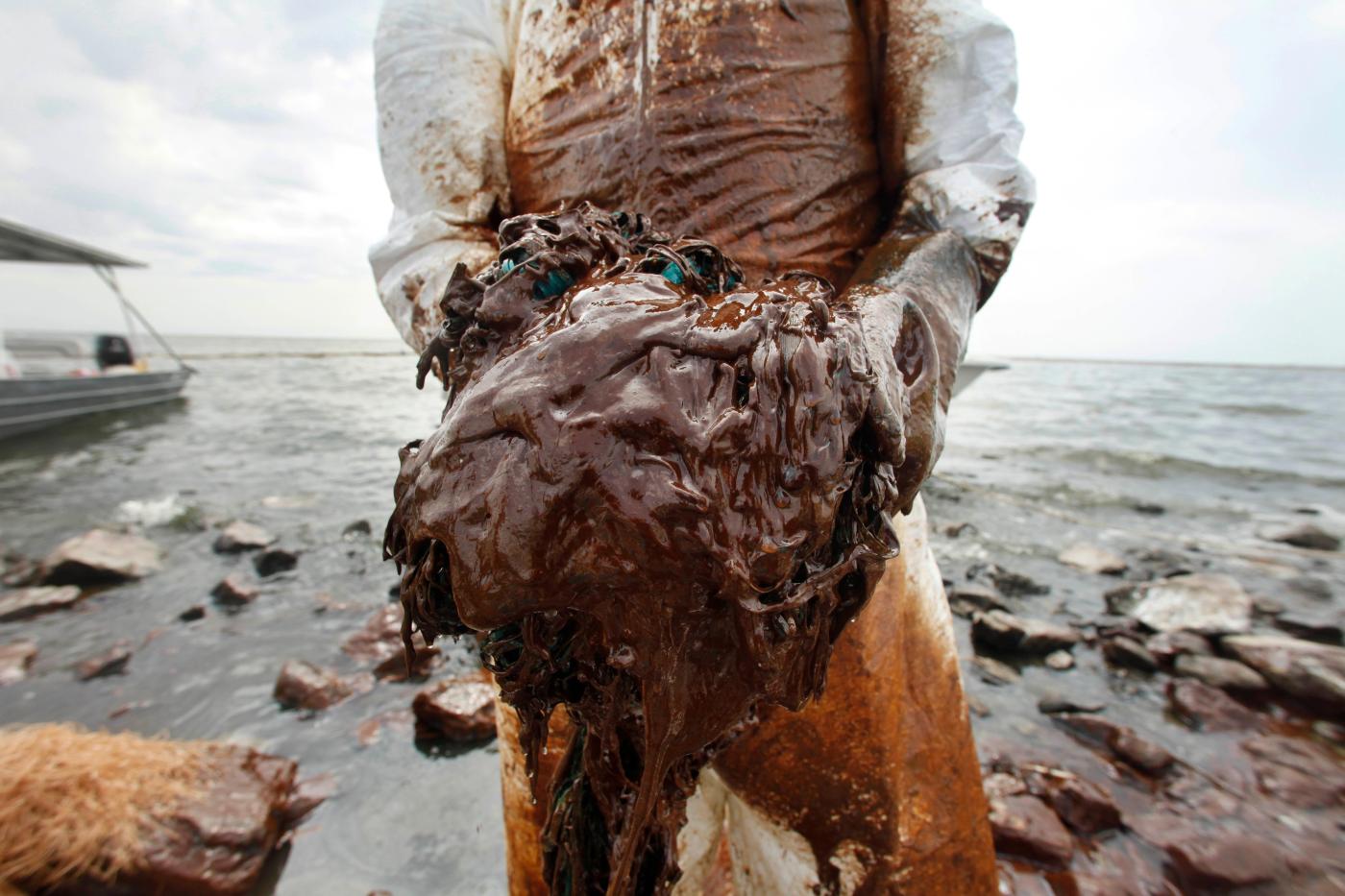
When a deadly explosion destroyed BP’s Deepwater Horizon drilling rig in the Gulf of Mexico, 134 million gallons of crude erupted into the sea over the next three months — and tens of thousands of ordinary people were hired to help clean up environmental devastation from the biggest offshore oil spill in U.S. history.

These workers were exposed to crude oil and the chemical dispersant Corexit while picking up tar balls along the shoreline, laying booms from fishing boats to soak up slicks and rescuing oil-covered birds.

Recognizing that some members of cleanup crews had likely become sick, BP agreed to a medical claims settlement two years after the 2010 disaster. Experts hailed it as “an extraordinary achievement” that would compensate workers fairly with little hassle.

But it hasn’t turned out that way.

The effort has fallen far short of expectations, leaving many workers who claimed lasting health effects stranded with little or no payment.

Through the settlement, BP has paid ill workers and coastal residents a tiny fraction — $67 million — of the billions the company has spent on restitution for economic and environmental damage. The vast majority — 79% — received no more than $1,300 each.

Many workers claiming illnesses from the spill were forced to sue — and they’ve fared worse. All but a handful of roughly 4,800 lawsuits seeking compensation for health problems have been dismissed.

Attorneys familiar with the cases say they are unaware of any that have gone to trial and know of only one that’s been settled. Former boat captain John Maas received $110,000 from BP for his lung ailments in 2022, according to a confidential copy of the settlement.

The repeated failures demonstrate how extremely difficult it is to prove to a court that a specific illness is caused by chemical exposure — even when those chemicals are recognized causes of illness more generally.

An Associated Press investigation that included dozens of interviews with cleanup workers, attorneys and experts, and a review of voluminous court filings revealed:

—A single switched word in the settlement prevented thousands of workers from receiving anything over the minimum of $1,300 each. To get more, they had to file individual lawsuits — an option that almost always led to defeat.

—Most federal judges hearing those cases required a level of proof connecting chemical exposure to worker illnesses that the lead government epidemiologist studying the spill says is likely impossible to meet.

—Big law firms representing dozens or even thousands of workers failed their clients in various ways. After BP accused one firm of manufacturing medical claims, its cases were dismissed in big batches.

Robin Greenwald, one of the plaintiffs’ attorneys who negotiated the settlement, said even her firm has not been able to win a single medical case against BP.

“I wanted people to get their day in court and they win or lose at trial,” said Greenwald, a former federal environmental prosecutor. “Let a jury decide. … But they weren’t even given the chance to do that.”

BP declined to comment for this story, citing ongoing litigation 14 years after the spill.

GETTING SICK

After the explosion on April 20, 2010, the spill was spectacular. A camera live-streamed the rupture on cable news, showing the world in real time gushing oil that wouldn’t stop. Oil floated on the Gulf and washed ashore, covering plants, birds and other animals.

To break up oil, roughly 1.8 million gallons of Corexit were dropped from planes and sprayed from boats — far more than previous U.S. oil spills. The manufacturer said it was safer than dish soap.

But lab research on human tissue and animals has revealed Corexit can damage cells that protect the airways and cause scarring that narrows breathing tubes, according to Dr. Veena Antony, a University of Alabama professor of pulmonary and critical care medicine who has studied Corexit’s effect on lung tissue. Over time, she said, the process can make it harder and harder to breathe.

“I genuinely believe that there was harm done and we didn’t realize the harm was being done — and now people are suffering,” said Antony, who testified as an expert witness in one suit against BP. “I would not, at the present time, put my hand even in Corexit without wearing double gloves.”

The current producer of Corexit, ChampionX, said the dispersant was pre-approved by the government for use on oil spills and the manufacturer had no role in deciding when or how to spray it.

Oil itself has long been known to cause illness. One of its toxic components is benzene, which can cause conditions ranging from skin irritation to cancer.

But now researchers, including Dale Sandler at the National Institutes of Health, are finding that spill workers exposed to amounts of oil assumed safe have suffered from dizziness, nausea, lung problems and heart attacks.

“The exposures on average were still pretty low,” said Sandler, an epidemiologist leading the GuLFSTUDY, a major effort to quantify workers’ exposure and track health woes over years. “What surprised us is that we did see a wide range of health effects that were associated with these exposures.”

Sandler said the study is the largest ever of an oil spill and is ongoing. “We’re looking at long-term risks like diabetes, cancer incidence,” she said.

What researchers have found so far is echoed by other studies, including one involving about 3,500 Coast Guard responders. The responders who reported breathing oil fumes were 40% to 50% more likely to have chronic obstructive pulmonary disease-like symptoms and sinus problems compared to those who said they didn’t breathe fumes. And responders who reported exposure to both oil and Corexit were more than twice as likely to suffer shortness of breath.

A PROMISING SETTLEMENT

Proving to a court that a specific person’s illness was likely caused by their exposure to oil or Corexit can be difficult.

Yet the settlement for medical claims was supposed to make it easier for workers: BP would agree exposure to the spill could cause a host of known health issues — and workers suffering from them could file claims for payment. Initially, attorneys advocating for the settlement said it could help as many as 200,000 possibly injured workers and residents.

The settlement also included $105 million from BP for regional health outreach and free health checkups for exposed workers every three years for 21 years.

But things quickly went awry.

The third-party administrator hired to handle claims, Garretson Resolution Group, initially rejected 78% of roughly 37,000 claims. After many were resubmitted, around 36% still were rejected and claimants received nothing.

Greenwald was especially frustrated her clients’ claims were repeatedly deemed deficient. “We had many a meeting with Garretson’s team to try to shake them loose of some of their narrow reading and obsession with deficiencies,” she said. “We clearly knew the claim form. We negotiated it.”

Matthew Garretson, founder of Garretson Resolution Group, defended his claims handling in an email, saying, “it was the process the parties agreed upon and we had to administer the settlement exactly in the way the parties’ Settlement Agreement mandated.” The company was paid roughly $115 million to $120 million for administering claims and for the outreach program and medical checkup effort as of 2018, he said.

There was a bigger problem.

At the most basic level, workers could submit affidavits attesting to their medical problems and collect $1,300 — and residents could collect $900. About 18,000 received that much.

Those with longer-term illnesses who had proof from medical tests could collect up to $60,700, or more if they had been hospitalized.

But few people had that proof. Forty of about 23,000 with approved claims collected the maximum award — less than 0.2%.

Many people lacked health insurance or easy access to a doctor and the required medical tests — a problem U.S. District Court Judge Carl Barbier, who approved the settlement, acknowledged in a hearing.

“Speaking for south Louisiana, I know — you’re dealing with people who are probably at the lower end of the socioeconomic scale. Most of these people, I feel sure, likely have no health insurance,” he said.

Even when people did seek medical attention, doctors untrained in treating chemical exposures often did not link illnesses to a patient’s cleanup work in medical records, according to Greenwald.

THE NATIONS CLIENTS

The Nations Law Firm, based in Houston, represented thousands of workers like Paul Loup IV, who helped clean an oil-contaminated beach in Pascagoula, Mississippi for several months.

Loup, 68, says he now has chronic respiratory issues, making it hard to stand or speak at length. He quit his job as a procurement manager because it involved too much travel.

The firm had wanted to help clients collect more than the settlement’s $1,300 minimum, so it developed a plan to obtain needed medical proof.

It was an assembly line. Out-of-state nurse practitioners who were paid $20 per plaintiff entered medical histories based on information the law firm — not a doctor — provided. Firm-designed forms listed illnesses that paid more under the settlement — and doctors could simply circle them. The forms included a statement linking a patient’s illness to oil spill work — with a line for the doctor to sign. Doctors didn’t keep their own patient records.

While such a process might seem suspect, firm founder Howard Nations said in an interview that he met with the claims administrator Garretson to try to develop an acceptable one.

Garretson rejected the claims — not based on the process, but on a deadline.

THE DEADLINE AND A SWITCHED WORD

The settlement was designed to make it easy to collect money for illnesses that surfaced quickly after crude oil exposure. People with diseases that can show up years later — such as cancer — would be forced to file individual federal lawsuits.

Early settlement drafts defined this second group as people with a disease that “manifests” after April 16, 2012. However, a later draft changed the word “manifests” to “diagnosed.”

In 2014, BP seized on that change to argue no one diagnosed after the deadline could receive an award for a long-term illness through the settlement, regardless of when they first got sick. Instead, they would need to sue individually to get compensated.

Judge Barbier said that’s not how he was led to believe the settlement he okayed would work.

“It is rather strange … that the court would approve a settlement, a class settlement that really doesn’t settle thousands of claims and requires them to file another lawsuit,” Barbier said at a 2014 hearing. “I mean, it doesn’t sound like much of a settlement.”

BP attorneys said any other interpretation would invite fraud, allowing opportunistic law firms to pay for a medical diagnosis after the deadline to get a settlement claims payout. They also said the word change was requested by the workers’ own attorneys, and Stephen Herman, co-lead counsel for plaintiffs’ attorneys, testified they didn’t recall how it happened.

Despite his doubts, Barbier said he had to follow the settlement language.

His ruling forced thousands of workers out of the relatively easy administrative claims process into federal courts throughout the South.

THE FEDERAL LAWSUITS

The ruling was devastating for Nations clients whose only option was to file federal lawsuits.

After BP attorneys alleged in Mississippi federal court that the firm manufactured medical diagnoses, Nations agreed to dismiss its cases by the dozens. In an interview, Nations did not deny BP’s allegations but said the cases were unwinnable without an adequate expert witness.

Loup, the former beach cleanup worker, said he didn’t know until informed by a reporter last year that his case had been dismissed years earlier. “I call (Nations) every six months or so … and they’ve just said it’s going to take some time,” he said.

Another Nations client was Jeff Herring, the deckhand of Maas, the boat captain believed to be the only person whose case reached a settlement.

When their boat was sprayed with Corexit, Herring started throwing up so badly an ambulance was called to pick him up. Although released from the hospital after a few days, he developed chronic sinus and respiratory problems, according to his lawsuit.

Months later, a doctor at an oil spill medical station referred him to a specialist, and he was hospitalized again, said Herring, now 39. An X-ray found spots on his lungs, and he was supposed to go to New Orleans for further testing but never did.

“That would have took another two weeks being in a hospital over there,” he said. “I couldn’t because I had to get back to work.”

Noting he had no insurance, Herring said he received about $8,000 through the claims process — not enough to even pay hospital bills.

Herring’s suit was thrown out in 2020 along with 235 other Nations cases, but he said he wasn’t told.

Howard Nations said the firm communicated with clients about the status of their cases and although the individual suits were dismissed, he intends to go back to Judge Barbier with new arguments.

EXPERT WITNESSES

Other law firms met a different obstacle:

Workers filing individual lawsuits have to prove they were exposed to enough oil or dispersant to — more likely than not — cause their illness.

The workers’ experts relied on studies, such as those from the National Institutes of Health and the Coast Guard, that found people exposed to oil and Corexit were more likely to develop certain illnesses.

But BP’s experts maintained workers needed to show exactly how much oil and dispersant they had inhaled or ingested and that it was sufficient to cause their sickness.

Greenwald, the attorney who helped craft the settlement, said meeting such a standard is almost impossible: “I mean, ‘How deep did you breathe? Right at the moment you were standing there, was the wind blowing?’” she said. “What mortal human would be able to testify about that?”

Most judges have sided with BP, rejecting workers’ experts as unreliable and effectively ending the cases.

Sandler, the NIH epidemiologist, said its researchers went to great lengths to develop data on exposure like nothing ever been done before. “I’m not sure that they’ll ever meet the standards that the court is imposing on what constitutes evidence,” she said.

It also can be difficult to find an expert witness who knows the science but doesn’t have a conflict of interest through work with the oil industry.

The Falcon Law Firm brought on Jerald Cook, a retired Navy physician trained in occupational and environmental medicine, as an expert on numerous cases. He was rejected again and again by judges as BP poked holes in his professional history and work.

“Your report really doesn’t balance the evidence favoring your conclusions with the evidence that disfavors your conclusions; isn’t that fair?” a BP attorney asked Cook in a deposition.

“Yeah. I think that’s — that’s fair,” Cook replied.

He declined comment, and Falcon did not reply to requests for comment.

Some law firms that took on hundreds of cases have simply buckled under the strain, begging judges for more time so their overloaded experts could produce reports.

LOOKING FORWARD

It’s not completely over.

The Downs Law Group, which has lost hundreds of cases against BP, is appealing in the 5th and the 11th U.S. Circuit Courts of Appeals, hoping they’ll rule federal district judges have misconstrued the level of proof needed for toxic exposure cases. One of those judges said the issue is “very ripe for the Supreme Court to resolve.”

“It has a broader reach than the BP oil spill,” said Jason Clark, a Downs attorney. “If the burden is one that’s too high for any plaintiff to meet, then a lot of people who are exposed … are never going to see justice.”

Meanwhile, Downs is talking to thousands of people interested in suing over illnesses such as cancer that emerged years after the spill, Clark said.

Sandler, the NIH epidemiologist, said the high burden of proof demanded by most judges means “people can’t win.”

“I think at the end of the day, did the oil from the oil spill make people sick? Yes,” Sandler said. “Now, courts may view this from a very different lens, but from a public health standpoint — yes, the oil spill made people sick.”

___

The Associated Press receives support from the Walton Family Foundation for coverage of water and environmental policy. The AP is solely responsible for all content. For all of AP’s environmental coverage, visit https://apnews.com/hub/climate-and-environment