National Jewish study looks to sand as possible explanation for combat veterans’ breathing problems

posted in: News | 0

A new study at Denver’s National Jewish Health found an unexpected potential culprit for lung disease in some combat veterans: silica, which is one of the most common elements in dust, soil and sand.

The study, published in the International Journal of Environmental Research and Public Health, examined lung tissue from 65 people with unexplained shortness of breath and other respiratory symptoms after deploying to Afghanistan or Iraq. Deployed veterans were more likely to have silica in their lungs than people who weren’t in the armed forces, with combat veterans showing more damage than service members who worked in other jobs.

People with combat roles tended to have a variety of unhealthy respiratory exposures, including burn pits, sandstorms, diesel exhaust, tiny particles generated by explosions, dust from heavy equipment on dry soil, and pollution from local industries or trash burning, said Dr. Cecile Rose, an occupational and environmental pulmonologist at National Jewish Health.

She and the other researchers didn’t think silica would be the primary contaminant they’d find in veterans’ lungs.

“That was unexpected, but not surprising” when considering their exposure to dust and sandstorms, she said.

People who inhale large amounts of silica over a prolonged period can develop silicosis, a disease in which inflammation in the lungs causes scarring and difficulty breathing, Rose said. Silica inhalation is one factor in the increase in cases of black lung disease among coal miners in recent decades, because the miners have to cut through other rock types to reach narrow coal seams, she said.

“Silica dust is a powerful stimulant of lung inflammation,” she said.

Lung samples taken from people who died in accidents and hadn’t deployed overseas during their lifetimes showed small amounts of silica, but not comparable to what the combat veterans had, Rose said. Because the veterans were younger and less likely to have smoked, if anything, their lungs should have looked healthier, she said.

Related Articles

Health |


With new PFAS limits, some east metro cities have big water cleanup jobs ahead

Health |


Fact check: Biden is right about $35 insulin cap but exaggerates prior costs for Medicare enrollees

Health |


To close racial gap in maternal health, some states take aim at ‘implicit bias’

Health |


Ten doctors on FDA panel reviewing Abbott heart device had financial ties with company

Health |


FDA announces recall of heart pumps linked to deaths and injuries

People who inhale significant amounts of silica can reduce their likelihood of disease by limiting further exposures, but that may not be feasible for career soldiers, Rose said. They also would want to avoid civilian jobs that would increase their risks, like mining, stone cutting and certain construction trades, she said.

Not everyone who served in combat experienced the same hazards, and the country needs more research to determine who needs careful lung monitoring, Rose said. Combat veterans shouldn’t ignore lung symptoms, though, and might consider joining the Airborne Hazards and Open Burn Pit Registry to help with research, she said.

“We don’t really know how many people are at risk,” she said.

Sign up for our weekly newsletter to get health news sent straight to your inbox.

How did the Twins get here? A look at their slow start this season

posted in: News | 0

The Twins walked off the field Wednesday in Baltimore with their heads down as Cedric Mullins rounded the bases and his Orioles teammates crowded around home plate waiting for him.

The fourth straight loss for the Twins plunged their record to 6-11 on the season. For a team that had high hopes of winning the American League Central for the second straight season, it certainly is not the start they envisioned.

It’s still early, but they’ve already dug themselves into a hole, currently sitting 5 1/2 games behind Cleveland in the division.

“It feels quite hard. It feels like no matter what you try, nothing is smooth, nothing is working like you want,” Twins manager Rocco Baldelli said. “And it’s tough to play the game with confidence and with an air of anything when it’s so difficult. Even when we do things well, we’re not getting the results.”

Here’s a look at how they got to this point:

Injuries

After a relatively healthy spring, the injury bug came for the Twins bullpen in the days before they packed up and left Fort Myers, Fla.

Jhoan Duran strained an oblique, Caleb Thielbar a hamstring and Justin Topa was shut down with patellar tendinitis, a blow to a bullpen that was expected to be a strength of this team. Just one of them — Thielbar — has returned thus far. The Twins also found out that starting pitcher Anthony DeSclafani would need surgery that would wipe out his entire season.

In the meantime, the position player group made it through spring training healthy, but once the season rolled around, it started to get dinged up, as well.

Royce Lewis looked every bit a star in his first two at-bats of the season, hitting a home run and a single. But while running the bases in the third inning on Opening Day, he suffered a quad injury that he’s not particularly close to returning from. In that same game, Max Kepler fouled a ball off his knee and exited early. Though he initially played through the pain, the Twins put him on the injured list, too.

And on their latest road trip, Carlos Correa, their most productive hitter at the time, strained his intercostal, taking him off the field as well.

“(We’re) missing our top three hitters in our lineup,” infielder Kyle Farmer said. “We’re in a tough stretch, but guys have got to step up.”

Offense

Correa said it multiple times early on: The Twins’ offense eventually figured it out last season after the all-star break, but they can’t afford to wait that long this time around.

“We don’t want to be here half a season trying to figure out when we know we’re capable of doing it a lot earlier,” Correa said earlier this month.

But save for a few hitters, Correa included, the beginning of the season has been a struggle and the team is collectively hitting .193, which is dead last in Major League Baseball entering Thursday’s games. They rank 27th in on-base percentage and slugging percentage, and 28th in OPS.

Simply put, it’s not good enough, and they’re well aware of it.

“Everyone right now has an adjustment to make,” hitting coach David Popkins said. “Some of that for some guys is just relaxing and believing in yourself and knowing you’ve done this before, you’ve done this many times throughout your career, and just takes — it’s very contagious when things get going.”

Kepler was hitting just .050 at the time he landed on the injured list. Left fielder Matt Wallner was striking out at such a high clip — 51.5 percent of his plate appearances — that the Twins demoted him to Triple-A for a physical and mental reset.

Byron Buxton (.193), Edouard Julien (.175) and Carlos Santana (.135) are among the starters off to slow starts.

“We have to get better, and we have to get better quickly, and that’s our goal, and we’ll continue to work until we do that,” Popkins said.

Pitching rotation

While the Twins’ rotation has been far from the biggest problem this season, the collective group has given up 56 runs, which was tied for third most in the majors as of Thursday morning. Their earned-run average as a group is 5.32, which is second-worst in the majors.

A big part of the reason why the Twins were able to remain competitive last season when the offense was off to a slow start was because of the rotation, led by Pablo López and Sonny Gray, who finished second in American League Cy Young voting.

But Gray walked in free agency, as did Kenta Maeda, and the Twins didn’t sink significant money into the rotation. The only move the Twins made to address the rotation from the outside was trading for DeSclafani, who needed flexor tendon surgery.

The Twins filled those holes with Chris Paddack, who returned to the rotation after spending most of last season rehabbing from Tommy John surgery, and Louie Varland. And while the Twins have high hopes for both pitchers, in the last series, the Twins saw Varland give up six runs (four earned) and Paddack allow nine. Those blowups ballooned each of their ERAs to 8.36.

“I’m letting the team down, and it’s a bad feeling,” Varland said after his last start.

Related Articles

Minnesota Twins |


Twins walked off by Orioles in series finale, spiral to fourth straight loss

Minnesota Twins |


Saints lose series opener in Indianapolis

Minnesota Twins |


Starting pitcher Chris Paddack rocked as Twins fall to Orioles

Minnesota Twins |


Twins option struggling Matt Wallner, bring back Trevor Larnach

Minnesota Twins |


Orioles ambush Louie Varland in Twins’ loss

Biden is off on details of his uncle’s WWII death as he calls Trump unfit to lead the military

posted in: Politics | 0

By ZEKE MILLER (AP White House Correspondent)

WASHINGTON (AP) — President Joe Biden on Wednesday misstated key details about his uncle’s death in World War II as he honored the man’s wartime service and said Donald Trump was unworthy of serving as commander in chief.

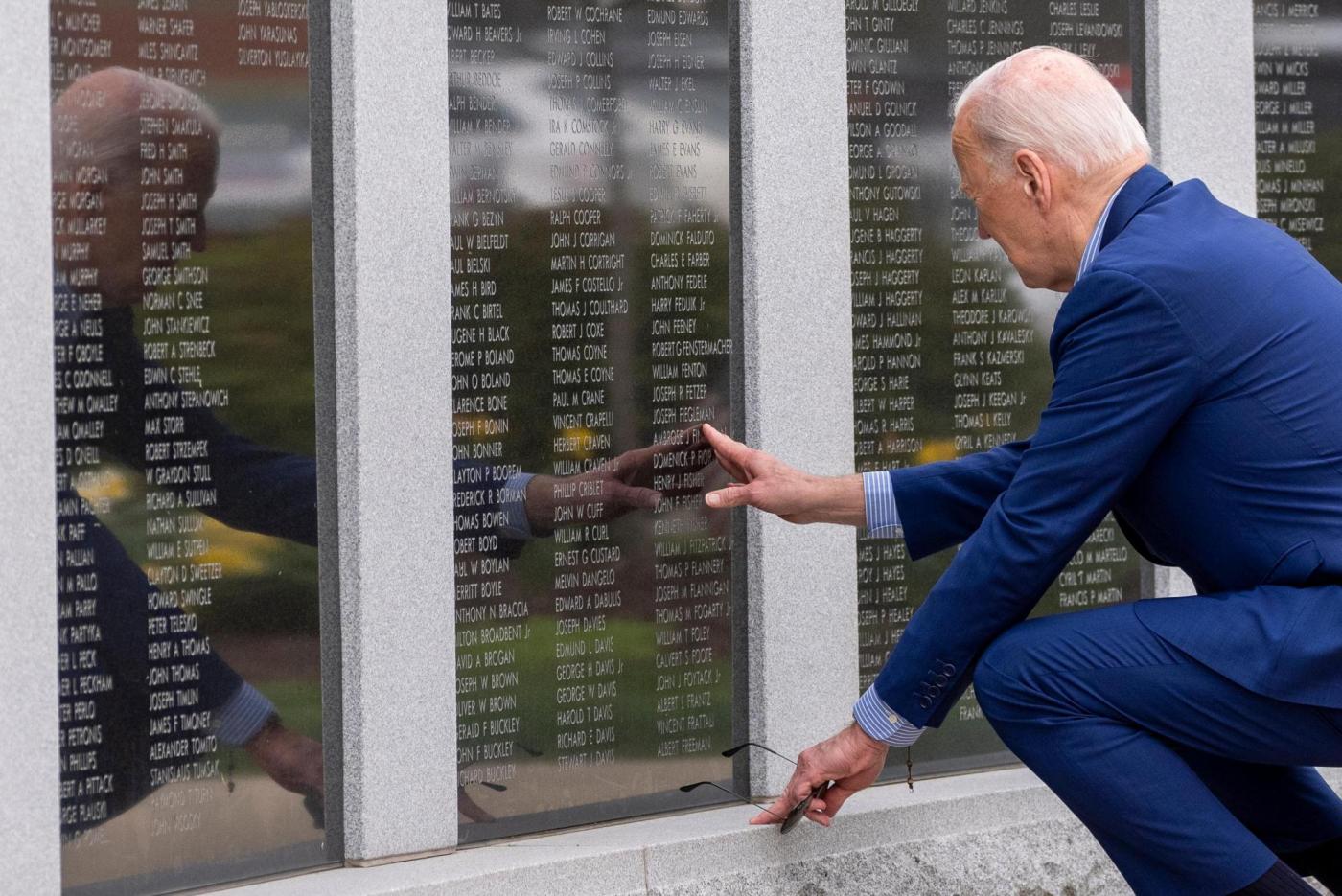
While in Pittsburgh, Biden spoke about his uncle, 2nd Lt. Ambrose J. Finnegan Jr., aiming to draw a contrast with reports that Trump, while president, had called fallen service members “suckers” and “losers.”

Finnegan, the brother of Biden’s mother, “got shot down in New Guinea,” Biden said. The president said Finnegan’s body was never recovered and “there used to be a lot of cannibals” in the area. Biden, who also relayed a version of the story earlier in the day after stopping by the memorial in Scranton, was off on the particulars.

The U.S. government’s record of missing service members does not attribute Finnegan’s death to hostile action or indicate cannibals were any factor.

“We have a tradition in my family my grandfather started,” said Biden, a toddler at the time of his uncle’s death in 1944. “When you visit a gravesite of a family member — it’s going to sound strange to you — but you say three Hail Marys. And that’s what I was doing at the site.”

Referring to Trump, the presumptive GOP presidential nominee, Biden said, “That man doesn’t deserve to have been the commander in chief for my son, my uncle.”

Biden’s elder son, Beau, died in 2015 of brain cancer, which the president has stated he believes was linked to his son’s yearlong deployment in Iraq, where the military used burn pits to dispose of waste.

Some former Trump officials have claimed the then-president disparaged fallen service members as “suckers” and “losers” when, they said, he did not want to travel in 2018 to a cemetery for American war dead in France. Trump denied the allegation, saying, “What animal would say such a thing?”

Related Articles

National Politics |


Poland’s president becomes the latest leader to visit Donald Trump as allies eye a possible return

National Politics |


Climate change concerns grow, but few think Biden’s climate law will help, an AP-NORC poll finds

National Politics |


The abortion debate is giving Kamala Harris a moment. But voters still aren’t sold

National Politics |


Republicans scrutinize voting rolls and ramp up for mass challenges ahead of election

National Politics |


Fact check: Biden is right about $35 insulin cap but exaggerates prior costs for Medicare enrollees

According to the Pentagon’s Defense POW/MIA Accounting Agency, Biden’s uncle, known by the family as “Bosie,” died on May 14, 1944, while a passenger on an Army Air Forces plane that, “for unknown reasons,” was forced to ditch in the Pacific Ocean off the northern coast of New Guinea. “Both engines failed at low altitude, and the aircraft’s nose hit the water hard,” the agency states in its listing of Finnegan. “Three men failed to emerge from the sinking wreck and were lost in the crash.”

The agency said Finnegan was a passenger on the plane when it was lost. “He has not been associated with any remains recovered from the area after the war and is still unaccounted-for,” according to the agency.

White House spokesman Andrew Bates did not address the discrepancy between the agency’s records and Biden’s account when he issued a statement on the matter.

“President Biden is proud of his uncle’s service in uniform,“ Bates said, adding Finnegan ”lost his life when the military aircraft he was on crashed in the Pacific after taking off near New Guinea.”

Biden “highlighted his uncle’s story as he made the case for honoring our ‘sacred commitment … to equip those we send to war and take care of them and their families when they come home,’ and as he reiterated that the last thing American veterans are is ‘suckers’ or ‘losers.’”

The Democratic president also misstated when uncles enlisted in the military, saying they joined “when D-Day occurred, the next day,” in June 1944, when they actually joined weeks after the Dec. 7, 1941, attack on Pearl Harbor.

After Finnegan’s death, a local newspaper published a telegram from Gen. Douglas MacArthur expressing condolences to Finnegan’s family:

“Dear Mr. Finnegan: In the death of your son, Second Lieutenant Ambrose J. Finnegan Jr., while in service of his country, you have my profound sympathy. Your consolation may be that he died in the uniform of our beloved country, serving in a crusade from which a better world for all will come. Very faithfully, Douglas MacArthur.”

Biden, in his 2008 book “Promises to Keep,” made only brief mention of his uncle, describing him as flyer who was killed in New Guinea.

Two shootings, two different responses — Maine restricts guns while Iowa arms teachers

posted in: Society | 0

By DAVID A. LIEB (Associated Press)

Six months after a deadly mass shooting by an Army reservist, Maine lawmakers this week passed a wide-ranging package of new gun restrictions.

Three months after a fatal school shooting, Iowa lawmakers this week passed legislation allowing trained teachers and staff to carry guns on school property.

Two states. Two tragedies. Two different approaches to improving public safety.

“We live in two different Americas, in essence,” said Daniel Webster, a health policy professor affiliated with the Johns Hopkins Center for Gun Violence Solutions.

“We see terrible acts of gun violence; no one wants them, of course,” Webster said. “But we see this through different lenses.”

Legislatures in about 20 states already have passed measures this year to expand gun rights or restrict access to firearms. Dozens more proposals are pending. The divide continues a trend seen last year, when more than half the states enacted firearms legislation, with Democrats generally favoring more limits and Republicans more freedoms for gun owners.

LIMITS ON GUNS IN MAINE

Maine has a tradition of hunting and gun ownership. But after an Army reservist killed 18 people and wounded 13 others in Lewiston, Democratic Gov. Janet Mills called for a variety of new laws aimed at preventing dangerous people from possessing guns and strengthening mental health services.

Before adjourning its 2024 session early Thursday, lawmakers approved measures imposing a 72-hour waiting period for gun purchases, expanding background checks on private gun sales and criminalizing sales to certain prohibited people. They also passed a ban on devices that convert semi-automatic firearms into rapid-firing weapons like machine guns, and enhanced an existing law that allows judges to temporarily remove guns from people during a mental health crisis.

A gun safety coalition praised it as a significant step forward in response to constituents’ concerns after the Lewiston shooting. But Republican state Sen. Lisa Keim criticized colleagues for “using the tragedy to advance legislation” that had been unable to pass previously.

GUNS IN IOWA SCHOOLS

In Perry, Iowa, a school principal and sixth-grade student died and several others were wounded when a 17-year-old student opened fire in January.

A 2021 state law already allowed schools to authorize individuals to carry firearms, though some districts have not done so because of concerns about insurance coverage.

The legislation given final approval Monday by the Republican-led Legislature builds upon the prior law by allowing teachers and staff who undergo gun safety training to get a professional permit to carry guns in schools. If they do, they would be protected from criminal or civil liability for use of reasonable force.

The legislation also requires large school districts to station a police officer or private security guard at each high school, unless the school board votes not to do so. Most of those school districts already have security staff.

DIVERGING STATE LAWS

Republican-led legislatures in Kentucky, Nebraska, South Dakota, Tennessee and Utah also passed measures this year that would expand the ability of some people to bring guns into schools. A bill passed in Wyoming allots $480,000 to reimburse schools for the cost of training employees to carry guns on school property.

Louisiana and South Carolina, led by Republican lawmakers and governors, each enacted laws allowing people to carry concealed guns without a permit. The National Rifle Association, which supported the measures, said similar laws now exist in 29 states.

By contrast, the Democrat-led Delaware Legislature passed legislation requiring people wanting to buy a handgun to first be fingerprinted, undergo training and obtain a state permit.

New Mexico Gov. Michelle Lujan Grisham, a Democrat, signed a pair of new laws imposing restrictions. One sets a seven-day waiting period to purchase firearms — more than double the three-day period required by the federal government for a background check.

Another new law in New Mexico prohibits carrying firearms within 100 feet (30 meters) of polling places, with an exemption for concealed-carry permit holders. Voting site restrictions on guns now exist in about one-third of the states and Washington, D.C., according to the gun-violence prevention group Giffords.

BUCKING PARTY TRENDS

Not all new gun policies diverge along partisan lines.

Republican Virginia Gov. Glenn Youngkin this year vetoed 30 gun-related bills passed by the Democratic-led General Assembly that he said would have trampled on constitutional rights. Yet Youngkin also signed some gun restrictions: One bans devices that convert semi-automatic handguns into automatic weapons. Another allows felony charges against parents who let a child have access to a firearm after being notified the child poses a threat of violence.

While signing several gun rights measures, Republican Gov. Mark Gordon of Wyoming also vetoed legislation that would have allowed people to carry concealed guns in public schools and government meetings. Gordon cited concerns the bill could have exceeded the separation of powers provision in the state constitution.

And in some cases, high-profile shootings have prompted lawmakers to avoid taking action on proposals they might otherwise have considered.

Missouri’s Republican-led House had been prepared to debate bills exempting guns and ammunition from sales taxes and allowing people with concealed-carry permits to bring guns onto public transportation. But after the deadly shooting at the Kansas City Chiefs Super Bowl celebration, House Majority Leader Jon Patterson said those bills would not be brought up this year.

___

Associated Press writers David Sharp in Augusta, Maine, and Hannah Fingerhut in Des Moines, Iowa, contributed to this report.