It’s not over for legal Minnesota sports betting this year, but chances still murky

posted in: News | 0

A bipartisan push to legalize sports betting in Minnesota still has momentum at the Legislature, but the odds it’ll succeed this year are still unclear.

Thirty-eight states have legalized gambling on sports in some way since 2018, including all of Minnesota’s neighbors.

Efforts in the Minnesota Legislature have failed despite optimism after the state’s tribal gaming association said it would back legalization two years ago — a key factor in gaining support from a wide swath of Democrats.

Headwinds

This year, proposals have advanced in both House and Senate committees, but face headwinds once again as lawmakers struggle to balance the disagreements between tribal casinos and horse tracks and address concerns from charitable gambling groups.

The two tracks — Canterbury Park in Shakopee and Running Aces in Columbus — say access to the biggest expansion of gambling in decades is key to their survival. But the Minnesota Indian Gaming Association wants to preserve its control over most gambling in the state.

And, this year there’s been an expanded debate involving gambling addiction.

Sports betting is not a party-line issue. Some Democratic-Farmer-Labor senators oppose legalization because of what they see as the harm it could do to vulnerable communities.

Since the DFL has a one-seat majority in the Senate, any proposal that gets to the finish line will need Republican backing. And in turn, the DFLers in control of state government will have to address concerns of the tracks and charitable organizations to get GOP votes.

Proposals

Concerns about problem gambling also have led to alternative proposals, including a sports betting bill from Sen. John Marty, a Roseville DFLer who chairs the Senate Finance Committee. The committee is a key hurdle any sports betting bill must clear before seeing a vote of the entire Senate.

Marty’s bill would ban betting on college sports, and place restrictions on sports betting apps including a ban on mobile push notifications. It also includes a 40% tax rate — much higher than any of the other proposals at the Capitol.

Sen. Matt Klein, DFL-Mendota Heights, is a sponsor of the Senate sports betting bill that is now just a committee stop away from making it to the Senate floor. Klein said with various proposals floating around there’s still work to be done before a final product can move forward. There’s about a month left before the close of the 2024 session.

“We continue our discussions and are trying to get the best product out there for Minnesotans,” said Klein, adding, “I’m still optimistic.”

In its current form, Klein’s bill taxes sports betting at 20%, which would bring in about $18 million annually. Of that amount, 5% goes to the racetracks and 10% goes to addressing problem gambling. Other amounts go to youth sports and the state tourism agency for sports and events grants.

That’s lower than the original projected revenue of $40 million, but the amount dropped because of an amendment adopted in March by the Senate Commerce Committee that placed limits on in-game bets.

The sports betting industry doesn’t support the ban on what are known as prop bets, where a person can place live bets on aspects of a competition that aren’t tied to the outcome, such as points scored by a certain time in a game.

Meanwhile, the tribes expressed concern about the ban at the time, but did not oppose it outright.

Charitable gaming

On the House side, Rep. Zack Stephenson, DFL-Coon Rapids, is advancing a bill that would address the concerns of charitable groups, who say they face significant revenue losses after the state changed rules on e-pulltabs last year.

In an agreement Stephenson announced in March, charities who lost revenue due to changes in e-pulltab rules would get $40 million in tax cuts which would be financed by a 20% tax on sports betting revenue.

The House measure has not adopted the same in-game betting restrictions as the Senate versions.

“The tax cuts in this agreement will be a major benefit to organizations ranging from American Legions, to youth hockey clubs, to organizations that serve people with disabilities,” Stephenson said in a news release at the time.

Gambling clashes

And as the sides try to find a solution, the tracks and tribal casinos are clashing on other fronts — two of which emerged just this month.

This week, Running Aces filed a federal racketeering lawsuit against three tribal casinos, alleging they offer gambling options beyond those permitted in their agreement with the state of Minnesota permitting them to offer gambling.

In the lawsuit, Running Aces alleges Grand Casino in Hinckley and Mille Lacs and Treasure Island Resort and Casino, which belongs to the Prairie Island Indian Community, offered Three Card Poker and Ultimate Texas Hold’Em, variants of poker not covered by their state-tribal gaming compacts.

Sen. Klein said he doesn’t think the lawsuit will have an effect on what happens at the Capitol. Though others said fights over other pieces of gambling turf could complicate negotiations.

“It makes it more challenging to have some of these conversations about working toward towards a solution,” said Sen. Jeremy Miller, a Winona Republican who also has a sports betting bill. “But again, I still think it can be done; I think there is a solution out there that benefits the tribes, it benefits the tracks and it benefits the charities.”

The tribes and tracks also are at odds over a new expansion to gaming at horse tracks approved by the Minnesota Racing Commission earlier this month. Under the new rule, Running Aces and Canterbury will be permitted to have 500 machines for historical horse racing, where bets can be placed on races from the past.

Minnesota Indian Gaming Association condemned the move, calling it an “extreme violation” of legislative authority as lawmakers had not directly authorized historical betting. They argue the betting terminals are essentially the same thing as slot machines, and therefore violate tribal monopoly on video gambling.

DFL lawmakers plan to take action on the issue before the end of this session, said Klein.

Related Articles

Politics |


Jordan Rodell: Proposed Minnesota social media legislation would undermine First Amendment protections

Politics |


Gov. Tim Walz says copper wire theft bills are ‘top priority,’ urges legislators to move them forward

Politics |


Jacob Wetterling Resource Center director honored with national award

Politics |


DFL disavows local endorsement of northwestern Minnesota candidate with assault conviction

Politics |


Other voices: Legal marijuana is making roads deadlier

Montreal scores twice in the final minutes to beat Minnesota in PWHL game

posted in: News | 0

MONTREAL >> Kristin O’Neill scored twice, and Montreal rallied in the final minutes to beat Minnesota 4-3 on Thursday night in the Professional Women’s Hockey League.

Trailing 3-2, Montreal pulled its goalie for an extra attacker with 2:49 left in the game, and the move paid off. Laura Stacey scored past Minnesota goaltender Maddie Rooney and tied the game with 2:23 left.

After Minnesota’s Maggie Flaherty took a minor penalty for holding, O’Neill scored her second of the game with 46 seconds remaining, completing the come-from-behind win.

Both teams returned to action after a nearly month-long break for the world championships. Montreal got significant contributions from Canadians who won gold.

Captain Marie-Philip Poulin and Stacey each had a goal and two assists, and Erin Ambrose had four assists for Montreal (8-3-4-5), which snapped a four-game skid. Elaine Chuli made 25 saves.

Poulin, who helped Canada win gold with two goals in the world championship final, returned to PWHL action after missing three games with an undisclosed injury.

Grace Zumwinkle, Kelly Pannek and Brooke Bryant scored for Minnesota (8-4-3-5), which had its five-game win streak snapped. Sophie Jaques had three assists. Rooney stopped 33 shots.

Montreal moved within one point of Minnesota for second place in the league standings. Both teams have four games remaining.

Related Articles

Minnesota Wild |


Women’s hockey: Minnesota beats New York for fourth straight win, takes over PWHL lead

Minnesota Wild |


PWHL: Minnesota’s new front line leads team into tie for first place

Minnesota Wild |


Elaine Chuli stays undefeated as Montreal holds off Minnesota 2-1 in battle of top teams

Minnesota Wild |


Women’s hockey: Boreen’s OT goal lifts Minnesota over New York

Minnesota Wild |


PWHL: Hilary Knight’s first goal earns Boston a 4-3 overtime win over Minnesota

Supplier of fentanyl-tainted pills is spared prison in 2022 death of West St. Paul girl, 15

posted in: Society | 0

Anastasia Shevtsova had many passions — playing the piano, singing, drawing and painting, among them. Although just 15, she was already talking about joining the Air Force someday, with the dream of becoming a pilot.

Anastasia Shevtsova, 15, of West St. Paul, died of a fentanyl overdose on April 20, 2022. The man who sold her the drug, Parker Jay Benson, 19, of Bloomington, was sentenced on March 18, 2024. (Courtesy of Olga Shevtsova)

Anastasia, of West St. Paul, also struggled with depression, with the onset in the early months of the pandemic.

The road was difficult, but she never stopped trying “and finally admitted to feeling better” in the spring of 2022, her mother told a judge Thursday in a Dakota County courtroom. She started a job at Crumbl Cookies in West St. Paul, and was about to return to in-person learning at Two Rivers High School.

“Things were looking good, hopeful,” said her mother, Olga Shevtsova.

But then Anastasia sought out Percocet from Parker Jay Benson, and bought four pills from him that contained fentanyl. The decision that ended her life on April 20, 2022, just over a month after her 15th birthday.

Benson, now 19, of Bloomington, sat in the courtroom with his head down while Anastasia’s mother and sister spoke about her life and how theirs will never be the same.

Looking back, Olga Shevtsova said, she can connect Anastasia’s attempt to “self-medicate” with her depression. “She looked for relief, what was dealt to her was death,” she said of her daughter, a second-generation Ukrainian American who was proud of her heritage.

When it came time for Judge Cynthia McCollum to sentence Benson on the third-degree murder charge, she prefaced her decision by saying it was not an easy one. She went on to spare him prison, giving him an additional six months in jail, which he will spend in a residential drug treatment program. She stayed a 7½-year prison term for 10 years, during which time he will be on probation.

McCollum, in departing downward from state sentencing guidelines, cited Benson’s amenability to treatment, his remorse and responsibility.

Benson pleaded guilty to the murder charge last month, admitting that he sold Shevtsova the pills, while also saying that he, too, believed they were Percocet. It was a straight plea, meaning an agreement on his time was not in place.

Benson, who’d never previously been trouble with the law, faced between six and 8½ years in prison. Assistant County Attorney Chris Zielinski asked for the six-year prison term.

“Today’s sentencing is unfortunate and a disappointment as a young girl lost her life due to the actions of Mr. Benson,” County Attorney Kathy Keena said in a statement. “Dakota County is not immune to illicit fentanyl poisoning and it’s taking too many young lives in our community.”

‘I failed’

Olga Shevtsova found her daughter unconscious and not breathing in her bedroom just before 1 a.m. on April 20, 2022. She saw a blue pill. She called 911 and started CPR on her daughter, who was pronounced dead at a hospital a short time later.

“I never imagined that I would be holding my little sister’s dead body in my arms,” Natalia Shevtsova told the court on Thursday. “I swore that I’d do everything as an older sister to protect her. I failed.”

She said she struggles to get the image of her dying sister out of her head, the “nausea feeling, the terror. Nothing felt real that night.”

An autopsy found that she died of fentanyl toxicity. She was among 922 people who died of fentanyl in Minnesota in 2022, according to state Department of Health data.

Parker Jay Benson (Courtesy of the Dakota County Sheriff’s Office)

Later, tests by the state Bureau of Criminal Apprehension of the two pills found in her bedroom showed they contained the potent synthetic drug.

Investigators searching the girl’s phone found Snapchat conversations between Anastasia and Benson, starting on April 16. That day, she asked him if he would come to West St. Paul and he responded the next day he would do so.

The conversation continued on April 19 with a discussion of “perks” and arrangements for Benson to sell the girl four pills for $60. The two discussed a meeting location — outside the Walgreens in West St. Paul — and at 9:06 p.m. Benson messaged, “pulling up.” The girl messaged that she was in front of the store, adding “thanks bro next time I’ll buy more.”

Later, about 9:50 p.m., Benson messaged the girl and said, “only take like less than a quarter of it.”

Several hours later, at 2:03 a.m., he sent a message asking, “they hitting?”

She didn’t respond.

Google searches on her phone on April 19 showed references to pills, “percs” and how to ingest “percs,” according to the complaint.

Benson was arrested about a month later by Bloomington police. Pills marked as oxycodone were found in his car, with BCA tests revealing one contained fentanyl.

‘This is my fault’

In arguing for a prison sentence, Zielinski said the presentence investigation showed that Benson tried to dissuade Anastasia from consuming too much of the substance. “That shows that he knew the dangers when he decided to sell the pills to Anastasia for profit,” he said.

Earlier, in her statement to the judge, Olga Shevtsova said selling “deadly pills to an unsuspecting child, who is vulnerable, is deplorable. I feel that the defendant’s actions showed disregard for human life.”

Benson’s attorney Christina Zauhar said Benson has spent nearly the past two years in custody both in a juvenile facility and adult jail. Prosecutors charged him as a juvenile, and he was certified to stand trial as an adult a year ago.

Benson completed a drug treatment program in jail, Zauhar said. She asked that he go to in-patient chemical health treatment instead of prison.

“Mr. Benson is fortunate to have family support and people who love him to talk to him every day,” she said. “Many of those people are in the courtroom today and have submitted letters to the court on his behalf.”

Zauhar said downward dispositional departures in third-degree controlled substance murder cases are common. She said state sentencing guidelines data shows that more than 58% of defendants with a criminal history score of zero like Benson received the departure.

Benson addressed Anastasia’s family, telling them he hopes “you can find it in your hearts to forgive.” He said he “likely will never be able to fully understand the amount of hurt I have caused them. I am so sorry. This is my fault.”

Benson said he was selling drugs because he was addicted to them, and said he didn’t know they contained fentanyl. He said he wants to be the “best version of myself” and asked the judge to “please give me the opportunity to show you I can do this. Thank you for giving me the time to speak. I will accept whatever decision the court makes.”

Related Articles

Crime & Public Safety |


Investigators ask for public’s help locating fugitive with southeast Minnesota connections

Crime & Public Safety |


N.D. senator’s son pleads not guilty in December crash that killed sheriff’s deputy

Crime & Public Safety |


Sentencing set for Nicolae Miu in fatal stabbing of Stillwater teen on Apple River

Crime & Public Safety |


Unlicensed St. Paul driver sentenced to 5 months plus probation for killing Burnsville priest riding bike

Crime & Public Safety |


Minneapolis man charged in friend’s fatal overdose at White Bear Lake hotel

Saints can’t finish rally in loss at Indianapolis

posted in: News | 0

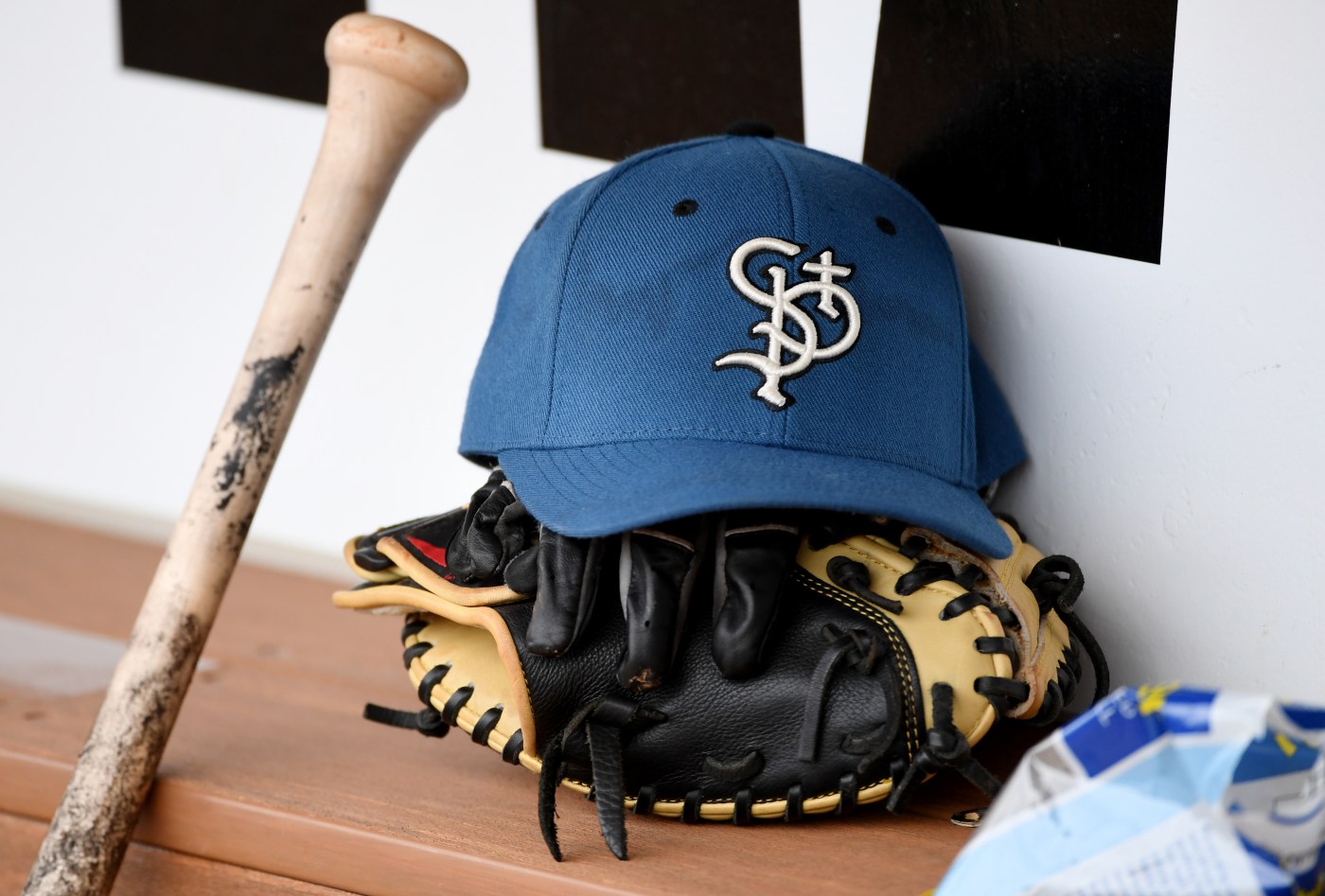
The St. Paul Saints trailed early Thursday while facing one of the top pitching prospects in baseball, right-hander Paul Skenes. St. Paul was down 1-0 after the first inning and 4-0 before rallying in the seventh in a 6-5 road loss to Indianapolis.

Skenes dominated again, tallying eight strikeouts in 3 1/3 scoreless. He gave up one hit and two walks.

With Skenes out, the Saints started to chip away at the deficit.

Matt Wallner beat out an infield single for an RBI in the seventh. Malcom Nunez and Gilberto Celestino had RBI singles in the eighth.

In the ninth, DaShawn Keirsey Jr. plated a run with a sacrifice fly and Wallner followed with a three-run homer.

Joe Gunkel (0-2) took the loss for St. Paul, giving up two runs in four innings.

Related Articles

Minnesota Twins |


Saints lose series opener in Indianapolis

Minnesota Twins |


Castillo’s hot hitting helps Saints roll over Iowa

Minnesota Twins |


Depleted Saints fall again to Iowa Cubs

Minnesota Twins |


Schlechter hoping to give Saints’ hitters a boost

Minnesota Twins |


Saints’ Jensen trying another team in journey to make majors