Movie review: Radio Silence brings maximalist style to vampire flick ‘Abigail’

posted in: News | 0

The filmmaking team known as Radio Silence, made up of directors Matt Bettinelli-Olpin and Tyler Gillett, and producer Chad Villella, struck black (comedy) gold with their 2019 horror thriller “Ready or Not,” about a young bride, played by Samara Weaving, who has to battle her way out of a murderous game hosted by her wealthy soon-to-be in-laws. The film demonstrated their mastery of coupling an irreverent tone with splashy violence, and netted the team the responsibility of making the next two “Scream” movies, the first without Wes Craven behind the camera.

With their latest feature “Abigail,” Universal gets into the Radio Silence business, hoping that their brand of female-driven horror can pay big dividends at the box office (and birth a franchise?). With a script by Stephen Shields and Guy Busick, who co-wrote “Ready or Not,” Radio Silence have delivered what is essentially a spiritual sequel to their breakout hit, this time with vampires rather than superstitious old-money sadists, and starring “Scream” queen Melissa Barrera.

Once again, the setting is an old creepy mansion filled with taxidermy and firelight. Once again our heroine is a steely, scrappy young woman who has a single vice — Weaving’s Grace had a penchant for cigarettes; Barrera’s Joey gobbles hard candy. Once again, a group has been assembled in this isolated location and given a task to be completed within a set amount of time.

In “Abigail,” the group is a band of sarcastic kidnappers, a team of strangers who have been hired to snatch and then guard Abigail (Alisha Weir), the 12-year-old daughter of a rich and powerful man. Their boss, Lambert (Giancarlo Esposito) gives them nicknames for anonymity — “Joey,” “Frank” (Dan Stevens), “Sammy” (Kathryn Newton), “Dean” (Angus Cloud), “Peter” (Kevin Durand) and “Don Rickles” (Will Catlett) — then bids goodbye to his “pack of rats.” They assume they’ll drink the night away with their hostage in the other room and collect their fee, but innocent Abigail is much, much more than meets the eye. She mournfully informs her keeper Joey that she’s sorry for what’s about to happen to them.

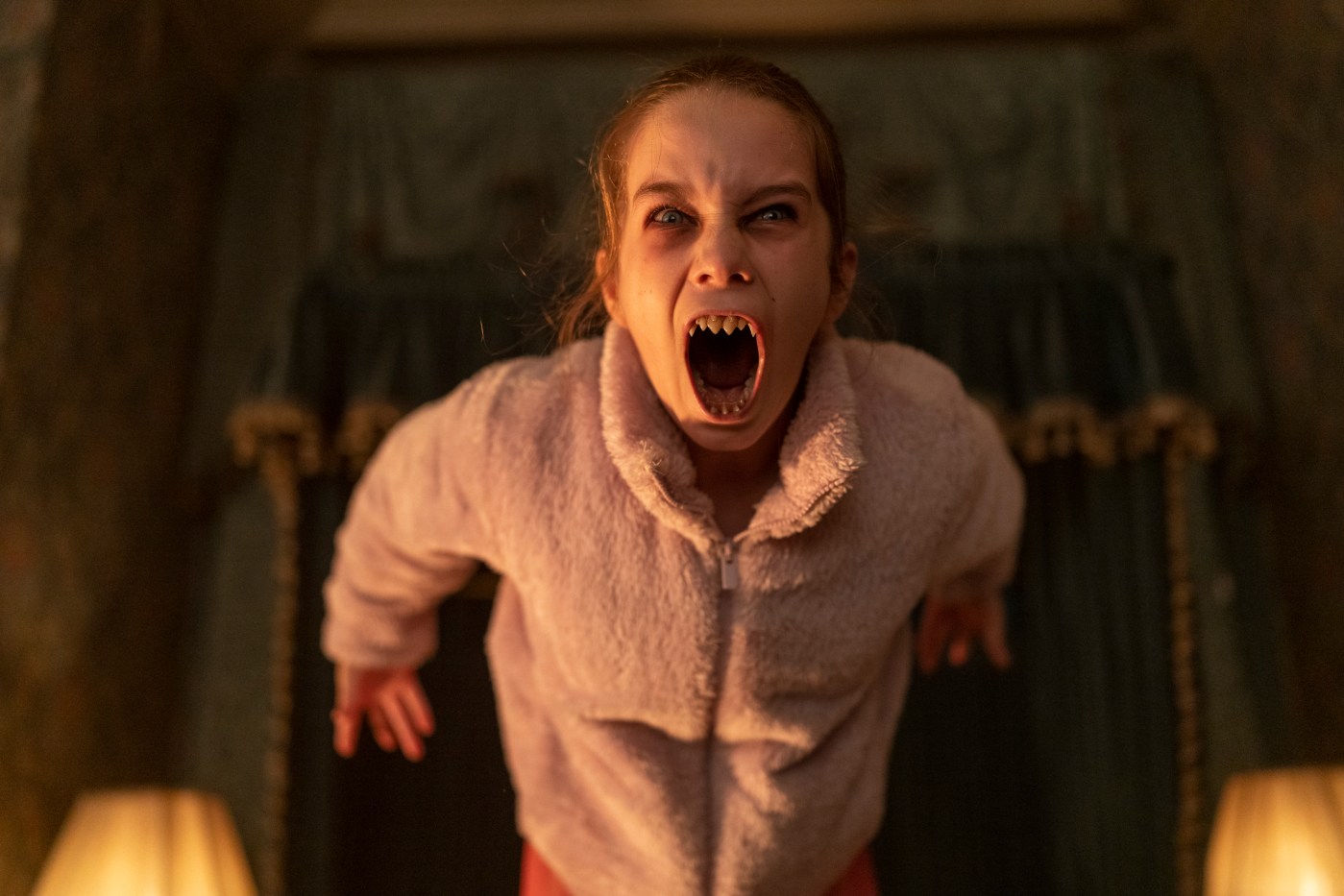
If you’ve seen the trailers, you already know that tiny ballerina Abigail is a ferociously terrifying vampire who starts to hunt and feast on each kidnapper. “I like to play with my food,” she taunts, baring rows of sharpened, yellowed teeth. Weir, who starred in “Matilda: The Musical,” cheerfully chomps into this role, which requires a tremendous physicality, blending ballet and brutal brawls, and she’s riveting, but also quite funny. There’s a grand tradition of terrible little girls in horror, from “The Bad Seed” to “The Exorcist,” and we can easily add “Abigail” to that canon.

The rest of the ensemble also capably pirouettes from jokes to terror, led by Stevens, sporting aviators and a Queens accent as the shifty, untrustworthy Frank. Newton has appeared in her fair share of horror flicks, always flirting with the monstrous side. Durand leans into his French Canadian roots playing a Quebecois muscle man who’s more brawn than brains. But Barrera holds the center as the savvy Joey whose rare vulnerability is her sympathy for kids.

There’s a parent-child theme that doesn’t so much as simmer below the surface as it drives the plot along, both Abigail and Joey finding something in each other that they lack. There’s not much subtext, everything remains on the surface, and the exceptionally wordy script relies on exposition dumps to inform the audience about rumors, twists, deals and double-crosses. The characters chatter and prattle about vampire lore and Anne Rice, “True Blood,” “Twilight” and “Nosferatu.”

Bettinelli-Olpin and Gillett have a gleefully maximalist horror style; blood is dark and sticky, it doesn’t just spurt, it geysers, projects and splatters. Bodies burst like water balloons under pressure, goopy viscera raining from wall to wall. It’s uniquely them, but they pay homage to the greats: Kathryn Bigelow’s “Near Dark,” the leaping vampires of “Blade” and an oblique script reference to the 1936 film “Dracula’s Daughter,” which offers a layered double meaning to the film.

“Abigail” is at times a bit too flippant, over the top and even protracted in its ridiculous Grand Guignol of exploding “meat sacks,” but it’s very much in line with the unique Radio Silence sensibility, which is en vogue with audiences right now.

The highlight of these films, from “Ready or Not” to “Scream” to “Abigail,” is their ability to tap into an emotional zeitgeist via their working class heroines, who capture the mood of the moment. Like Grace, and Barrera’s character Sam in “Scream,” Joey is weary and hardened by the world, but determined to survive, to make it through the day. Bloodied and battered, she manages to find a shred of solace in this godforsaken world, and that makes her the kind of final girl we can believe in.

‘Abigail’

2.5 stars (out of 4)

MPA rating: R (for strong bloody violence and gore throughout, pervasive language and brief drug use)

Running time: 1:49

How to watch: In theaters Friday

Related Articles

Entertainment |


Movie review: ‘The Ministry of Ungentlemanly Warfare’ pays stylized homage to WWII operatives

Entertainment |


‘Sasquatch Sunset’ review: You’ll wish you never spotted this Bigfoot

Entertainment |


‘The Beast’ review: In 2044, AI takes care of business, Léa Seydoux takes care of the movie

Entertainment |


Movie review: ‘Don’t Tell Mom the Babysitter’s Dead’ a surprisingly fun remake

Entertainment |


Movie review: ‘Civil War’ well-crafted but has nothing to say
‘Sasquatch Sunset’ review: You’ll wish you never spotted this Bigfoot

posted in: News | 0

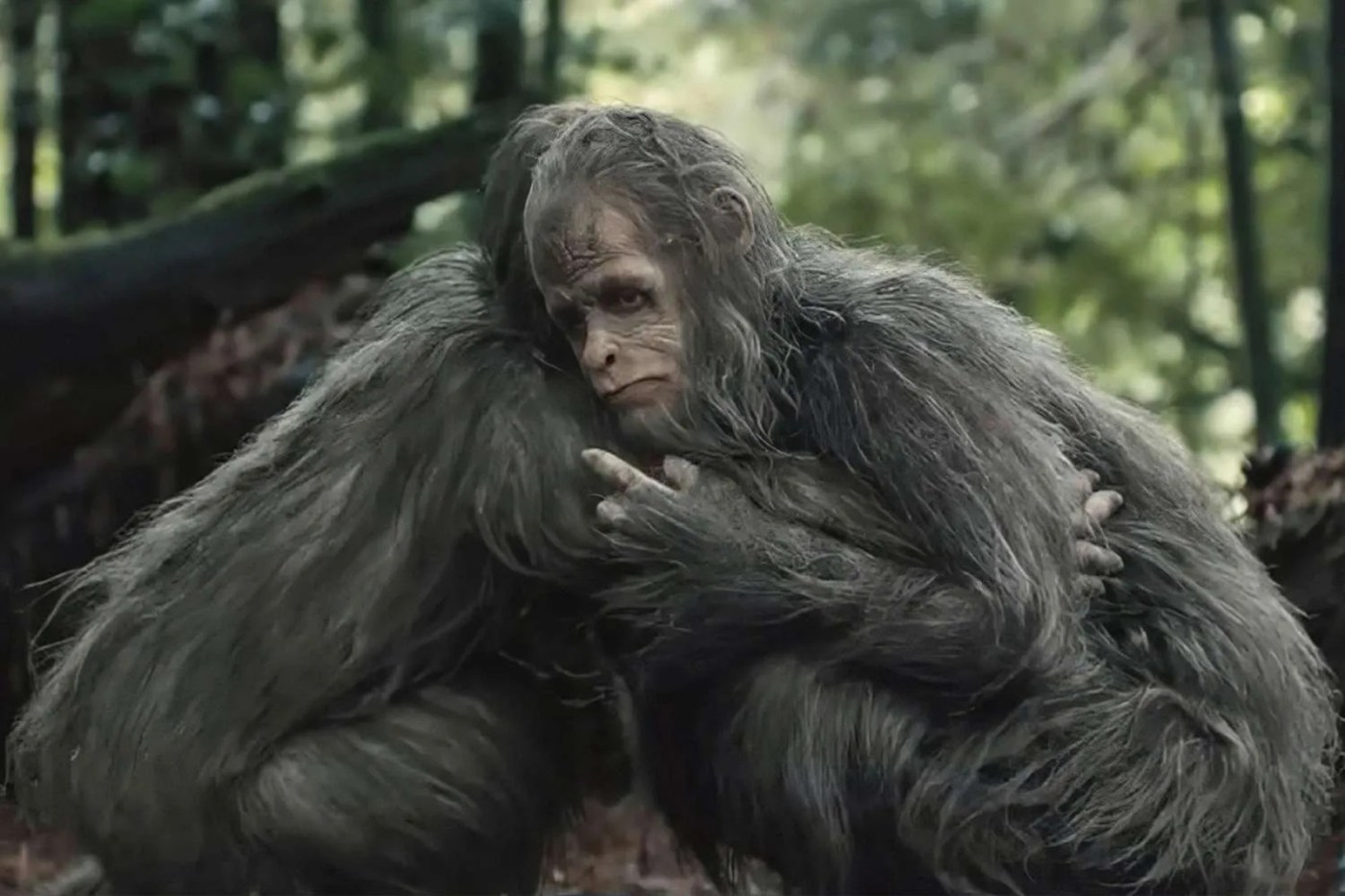
Jesse Eisenberg stars in “Sasquatch Sunset,” though you’d never know it by watching the movie. He plays one of four sasquatches in the frustratingly abstract drama, a dialogue-free experiment about a year in the life of a group of Bigfoots.

We track the hairy creatures — they’re played by Eisenberg, Riley Keough, Christophe Zajac-Denek and co-director Nathan Zellner, all completely unrecognizable — as they traipse through the forest, perform various rituals, mate, grunt, attempt to count, eat their own boogers, trip on mushrooms and smell each other’s (and their own) fingers. And you thought your weekend plans were exciting.

They’re not cuddly; they’re disgusting, feral beings. Any compassion or resignation in their eyes is assigned to them by the human actors, which makes this an entirely odd proposition for a film: Is the point to humanize the sasquatch? Or to empathize with it? Or are were merely observing a year in the life of a fictional beast, so as to better understand ourselves, and what makes us human?

There are more questions than answers in Zellner’s film, which he co-directed with his brother David. (David also wrote the script.) We see the circle of life play out, we watch as the group discovers human creature comforts, and we bare witness to all of the sasquatches. (Yes, all of them.) The Zellners present “Sasquatch Sunset” as a kind of riff on a nature documentary, fiction through the guise of a nonfictional lens.

But it’s a tedious, patience-trying exercise, and the film’s juvenile reliance on scatological and anatomical humor grows tiresome. Does it want to be a deep experience about the world around us, or is it a meta joke perpetrated on the audience? Either way, this “Sasquatch Sunset” fades quickly.

‘Sasquatch Sunset’

Grade: D+

MPA rating: R (for some sexual content, full nudity and bloody images)

Running time: 1:29

How to watch: In theaters Friday

Related Articles

Entertainment |


How to make Michael Twitty’s matzoh ball gumbo, a soup of Black and Jewish cuisines

Entertainment |


What the ‘Fallout’ show gets right about the post-apocalyptic video game series

Entertainment |


A weekend guide in Ouray, the country’s No. 1 vacation destination of 2024

Entertainment |


Michael Douglas has a knack for unforgettable roles — here are 7 of the best

Entertainment |


Jami Attenberg on her book ‘1000 Words: A Writer’s Guide to Staying Creative, Focused, and Productive All Year Round’

Lisa Jarvis: Birth control has a TikTok problem

posted in: News | 0

Myths about birth control are as old as the hills. But social media platforms, in particular TikTok and Instagram, are allowing false information to proliferate in new and dangerous ways.

The stakes are high. The twin forces of birth control-related misinformation, often from women sharing their personal experiences, and disinformation, typically posted by right-wing activists hiding their true agendas, is happening at a time of ever-shrinking access to abortion care in the U.S.

Physicians need to stay on top of what’s circulating so they know what might be influencing their patients’ views of contraception. The trend should also be a wake-up call: Women clearly feel their concerns aren’t being taken seriously by the medical establishment, and they are clamoring for more nuance in conversations about birth control. If doctors don’t step in to offer more knowledge and understanding — whether that’s in an exam room with a patient or as a trusted voice on social media — the void will be filled with potentially unreliable, biased and even downright dangerous information about contraception.

Women sharing their experiences about birth control isn’t a new phenomenon. They have always looked beyond their doctors for advice, and word of mouth, whether that’s an experience shared by a family member or friend, can be a powerful persuader.

But the women talking about it aren’t typically the ones who are happy with their birth control; it’s the ones who have had a bad experience that are more apt to share.

Social media, particularly TikTok, has amplified these anecdotes on a previously unfathomable scale. Once someone has interacted with one or two videos, the algorithm keeps pushing more, easily skewing perceptions of the risks of a particular form of birth control.

A group of family-planning researchers from Harvard Medical School recently analyzed the content of 700 videos tagged with some of the most popular birth control-specific search terms and found more than half touched on patients’ experience and the logistics of using a particular method of contraception. Those videos had received 1.18 billion views and had been shared 4.1 million times.

Another recent study, from researchers at Duke University Medical Center, found distrust in health care providers to be a common theme in the top 100 videos tagged with #IUD, which had 471 million views and 1 million shares. Creators often discussed the pain of having the device inserted, saying they felt gaslighted or lied to about the process, says Jonas Swartz, who led the Duke study.

The disconnect between patients’ experiences and doctors’ communication about IUD insertion is a problem. Since running the IUD study, as well as others that looked at topics like medication abortion and IVF, Swartz approaches interactions with patients differently. He asks his patients if they have seen anything on social media and how they feel about what they heard. “It really is important to start out the conversation if nothing else with an acknowledgement that a patient has some education about the device or treatment you’re going to offer,” he says.

The Duke and Harvard studies, as well as other efforts to understand how social media are influencing views of contraception, are critical to understanding the scope of the problem and crafting strategies to improve communication with patients.

When patients come in after absorbing content on social media, it’s important to “break down those walls,” says Michael Belmonte, an ob-gyn and complex family planning specialist and fellow with the American College of Obstetricians and Gynecologists. Don’t get defensive or simply spit out facts, “but really start a dialogue so we can come to the best decision for them.”

But there’s a problem: Doctors can only have those conversation with the patients they see. An unchecked narrative that hormonal contraception is “unnatural” or unsafe, or that IUDs are problematic, might dissuade women from even considering those forms of birth control, which are the most effective with typical use.

Social media trends suggest that already could be happening. In the past two years, posts on TikTok and Instagram from women abandoning IUDs and daily pills in favor of “natural” birth control have proliferated. In the worst-case scenario, “natural” means an unproven supplement, which could be not only ineffective but potentially harmful. In the best-case scenario, “natural” means using a fertility-awareness methods, tracking ovulation to avoid intercourse or use a backup method on days when a pregnancy is most likely to occur.

Women have always used cycle tracking, though the process has been modernized with a bevy of apps, including one with Food and Drug Administration clearance. But the approach requires significant rigor to get right and isn’t a good fit for everyone.

“I am unaware of a single person who has been able to use natural family planning in the long term,” meaning women either got pregnant or moved on to another contraceptive method, says Deborah Bartz, an obstetrician-gynecologist at Brigham and Women’s Hospital in Boston and lead author of the Harvard study. That’s backed up by the data: Fertility awareness has a 24% failure rate (put another way, that adds up to 24 pregnancies per year for every 100 users) with typical use.

One fact that family planning experts emphasized to me over and over again: Roughly half of the women who get an abortion say they had used some form of birth control during the month they got pregnant.

In other words, any drop in use of birth control increases the risk of unintended pregnancies. That’s a scary thought at a time when abortion is banned in 13 states and counting.

Birth control is a very personal decision, and identifying the method that works best for an individual can require some experimentation. That is best done when a doctor, not social media influencers, guides those choices.

Women, meanwhile, should remember to be smart consumers of social media. When fed a video about the dangers of hormonal birth control, ask whether the content comes with a hidden agenda — is it trying to sell a product or pushing a political agenda?

And even if the information is well-intentioned, women should always do their own vetting — the consequences of bad advice are too grave to put one’s health in the hands of an influencer.

Lisa Jarvis is a Bloomberg Opinion columnist covering biotech, health care and the pharmaceutical industry. Previously, she was executive editor of Chemical & Engineering News.

Related Articles

Opinion |


Thomas Friedman: How to be pro-Palestinian, pro-Israeli and pro-Iranian

Opinion |


Andreas Kluth: Even Republicans are now calling out Putin’s lies

Opinion |


Alison Schrager: The 4-day work week is decades away

Opinion |


James Stavridis: Putin’s new front in the Ukraine war is in the Balkans

Opinion |


Thomas Friedman: Iran made a big mistake. Israel shouldn’t follow. Now, isolate Iran.