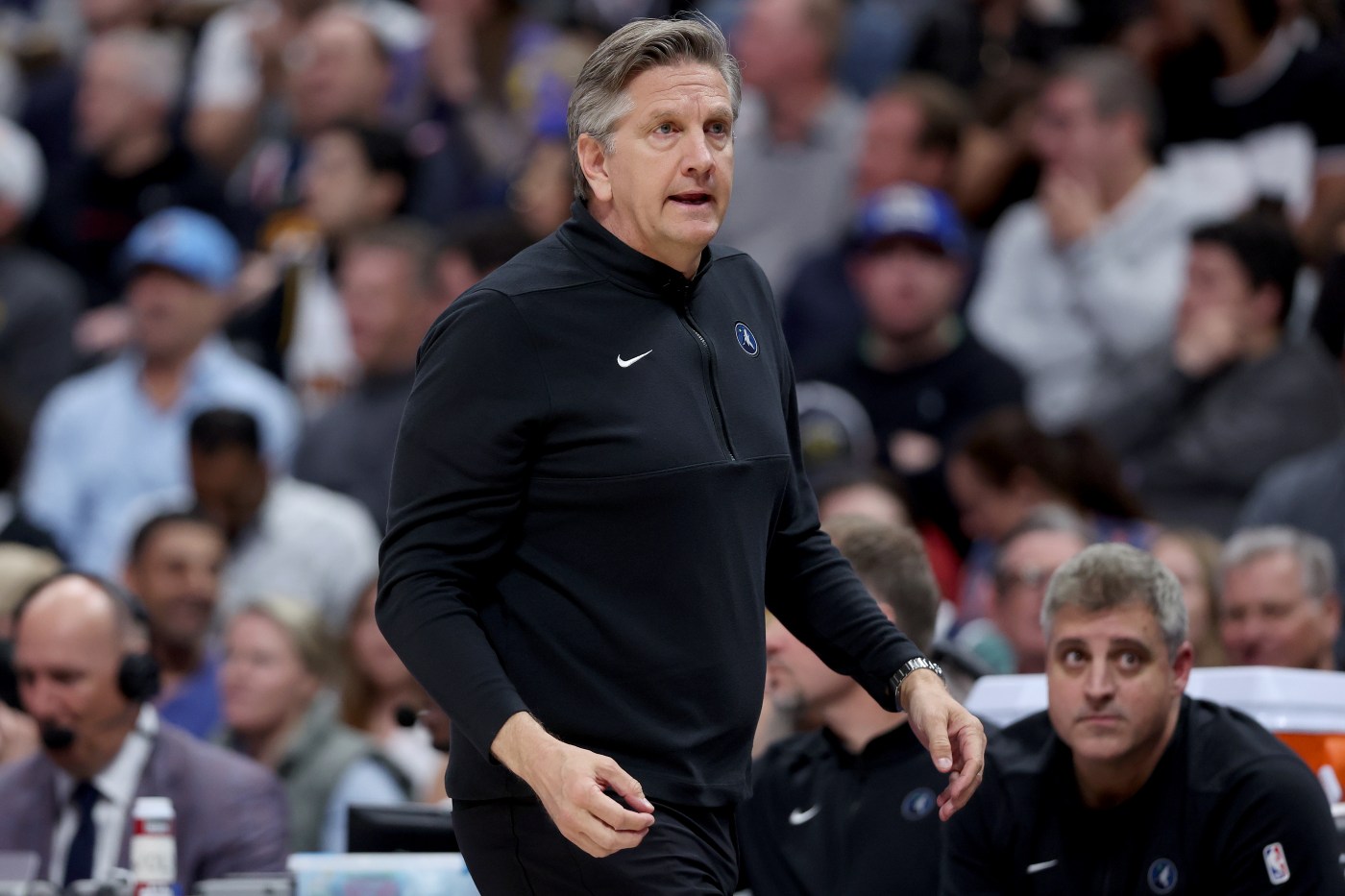
Timberwolves’ Anthony Edwards is quickly becoming face of the NBA

posted in: News | 0

His answers to questions in media availabilities have been viral sensations ever since he bragged about his ability to dominate any activity to local sports broadcaster Marney Gellner for a “Wolves +” podcast.

His highlights are just as enthralling, dating back to his epic dunk over then-Raptors forward Yuta Watanabe.

Since his rookie season, everything Anthony Edwards has done has screamed superstar. And there were moments when the Timberwolves guard would get his 15 minutes of fame. But then his name would again fade to the backdrop of the national basketball conversation in favor of the likes of LeBron James, Steph Curry and Kevin Durant.

His jersey sales have never threatened the top of the NBA store’s best-selling charts. He’s never received an exorbitant number of all-star votes.

The question always lingered: When would this made-for-TV 22-year-old star finally achieve high-end, sustained stardom?

The time has officially come.

There was a week between the Timberwolves finishing off a four-game sweep of Phoenix in Round 1 of the NBA playoffs and the opening of their Western Conference semifinal series Saturday in Denver. The official NBA social media accounts still managed to fill the feeds with Anthony Edwards content throughout the week. Edwards’ top 10 dunks of his career, his top 10 blocks of his career, his top 10 toughest shots of his career. Even his best “mic’d up moments” made an appearance.

You name it – if Anthony Edwards’ face was on it, it was going on an NBA account. Because people can’t get enough of him.

The Wolves guard was the seventh-most-viewed player on NBA social channels during the regular season, per the League. Over the first week of the playoffs, he generated 100 million video views across all NBA digital platforms, trailing only James.

A video of Edwards dancing his way out of Phoenix’s arena after Game 4 generated 6.6 million views on Twitter.

His new Adidas signature shoe flies off shelves. He has starred in recent commercials for Sprite and Bose.

“He’s the face of the league, I’ve been saying that,” Wolves forward Karl-Anthony Towns said. “He hates when I say it, but it’s true.”

That title for so long has been held by James. James, Durant and Curry have been the superstars on which the entire NBA centered. But they’re all in the back half of their 30s now. Curry didn’t make the playoffs, and Durant and James were each ousted in Round 1.

There have long been questions about who basketball fans would throw their support behind after those three were gone. International players such as Luka Doncic, NIkola Jokic and Giannis Antetokounmpo have emerged in recent years, but Edwards — whether he likes it or not — has thrown his hat into the ring.

“He is the future of American basketball,” ESPN’s Brian Windhorst said on NBA Today.

It’s partially because of his personality. Edwards has a magnetic quality to him, which quickly sucked in Timberwolves fans and teammates alike. He has a strong sense of humor and the charisma to take over any room. Even when he yells at teammates, they can’t help but smile back.

“I think that the people gravitated to him because he was just a likable dude,” Wolves assistant coach Micah Nori said. “I think anytime that you’re not putting on a front or you’re not faking, you don’t have to change who you are, whether you’re in front of the media, or you’re out doing commercials or playing a game. Anthony Edwards is who he is, he knows who he is, and I think that’s why he’s able to accept it so well.”

But that’s always been the case since Edwards entered the NBA as the No. 1 overall pick in 2020. What has changed between then and now is the winning.

It’s easy to overlook a young star playing up in Minnesota for a team that is scraping through the play-in, only to get bounced in the first round of the playoffs.

But there’s no ignoring a young guard who’s jawing in Durant’s face after burying a jumper over the future hall of famer, spiking his crotch after a full-court assist resulting in a Rudy Gobert and-1 and pouring in 31 points in the second half of a closeout game that sent Durant and Devin Booker home via a series sweep.

That’s the stuff of legends.

Wolves guard Mike Conley was asked this week on TNT’s pregame show who Edwards reminded him of. His answer: “A young Michael Jordan.”

“Honestly. He’s unbelievable. I think more than anything with him has been his mentality,” Conley said. “I’ve never met a guy or been a teammate with a guy who believes more in himself than Anthony Edwards. I think he thinks he’s the best player ever to play the game, to walk on earth. You can’t tell him any different. He’s going to go out there and he has a mean streak to him.”

That exact mean streak reminds NBA analyst and hall of famer Charles Barkley of Jordan and even the late Kobe Bryant.

“They would kill you to win a game. There’s not many players (like that) in today’s game — everybody wants to be buddy-buddy,” Barkley said on TNT after Edwards put the Wolves up 3-0 on Phoenix. “But man, Anthony Edwards is (putting) everyone on notice: ‘Yeah, I’m not going to wait for y’all to give me anything, I’m going to take it all.’ And I love it.”

“A superstar is official. He is here, do you understand? There was MJ. There was Kobe. And now there is Anthony Edwards,” ESPN’s Stephen A. Smith said recently on First Take. “It’s like that. Ladies and gentlemen, a superstar has officially arrived in the NBA.”

Yet this superstar often shies away from taking credit. He declined to even do local media in Minnesota on Thursday. He initially walked away from the chance to do a national postgame interview after the Wolves’ Game 1 victory over Phoenix, before circling back to fulfill the obligation.

Any interview Edwards does is opened with praise for those around him. Timberwolves president of basketball operations Tim Connelly said the young guard is just concerned about his teammates, family, friends and competition. It’s why the Wolves are so confident Edwards will take his newfound leap in fame in stride.

“There’s not a right or wrong approach. Some guys are really about the ancillary things — the brand. I think Ant’s about the competition,” Connelly said. “He’s got a great support system, wonderful people around him. He’s allowed himself to be coached hard, which is really a testament to both Ant and coach (Chris) Finch. I think for Ant, he’s just focused on Game 1 and the other stuff is just noise.”

Nori noted Edwards is flush with swagger. He knows how good he is.

“But the fact that he still doesn’t push people away, and … everybody talks about between confidence and arrogance — and he’s just a very, very confident person, and he puts in the work and he trusts his abilities,” Nori said. “And that’s fun.”

For teammates, coaches and spectators alike.

“Anthony Edwards has moved into that tier 1 of, if he’s on, I’m watching the T-Wolves,” NBA analyst and former player J.J. Redick recently said on the Pardon My Take podcast.

Redick noted whoever the “face of the league” is needs to be someone who wins at a high level. Edwards currently has one series victory, though even that has proven to be enough to thrust him into the discussion.

“He’s certainly going to be in that conversation for the next 10 years. He is entertaining as a player. He’s got the game that I think people gravitate to, the same way that Jordan had a certain game, Kobe had a certain game, AI had a certain game, Steph, right?” Redick said on Pardon My Take. “There’s the flash, the fundamentals. Some of the footwork stuff that he does is so underrated. And then he’s got the (edge) to him, because he’s brash, he’s competitive.”

And he might be just a few wins away from being the first name sports fans think of when the NBA comes to mind. After every Timberwolves playoff victory, a swarm of people race to social media to profess their fandom for their new favorite player.

“I think No. 5, that we have running around here in Minnesota, has a chance to be the face of this league,” Nori said to Chad Hartman on WCCO Radio on Thursday, “and be one of those guys that’s up there battling to take that MVP from a Nikola Jokic.”

“Right now, I’ll say Jokic,” Smith said on First Take when asked who’s the face of the league. “But if (Edwards) sends him home, it’s a different answer.”

Related Articles

Minnesota Timberwolves |


Timberwolves flew to Denver on Thursday. Head coach Chris Finch plans to join the team Friday

Minnesota Timberwolves |


Game times set for first four games of Timberwolves-Nuggets series

Minnesota Timberwolves |


Timberwolves have matured greatly over the past year. Denver series will show just how far they’ve come

Minnesota Timberwolves |


Jamal Murray is the Nuggets’ barometer. Here’s how Timberwolves plan to slow him down

Minnesota Timberwolves |


Timberwolves prepare for Nuggets without Chris Finch, who had successful surgery Wednesday

Will AI deepfakes and robocalls upset the 2024 election?

posted in: Politics | 0

By Jeffrey Fleishman, Los Angeles Times

In the analog days of the 1970s, long before hackers, trolls and edgelords, an audiocassette company came up with an advertising slogan that posed a trick question: “Is it live or is it Memorex?” The message toyed with reality, suggesting there was no difference in sound quality between a live performance and music recorded on tape.

Fast forward to our age of metaverse lies and deceptions, and one might ask similar questions about what’s real and what’s not: Is President Joe Biden on a robocall telling Democrats to not vote? Is Donald Trump chumming it up with Black men on a porch? Is the U.S. going to war with Russia? Fact and fiction appear interchangeable in an election year when AI-generated content is targeting voters in ways that were once unimaginable.

American politics is accustomed to chicanery — opponents of Thomas Jefferson warned the public in 1800 that he would burn their Bibles if elected — but artificial intelligence is bending reality into a video game world of avatars and deepfakes designed to sow confusion and chaos. The ability of AI programs to produce and scale disinformation with swiftness and breadth is the weapon of lone wolf provocateurs and intelligence agencies in Russia, China and North Korea.

Related Articles

National Politics |


RFK Jr. could be a spoiler in November. But will it help Biden or Trump?

National Politics |


Trump hush money trial prosecutors ask for more gag order sanctions

National Politics |


Trump says ‘a lot of people like it’ when he floats the idea of being a dictator

National Politics |


Abortion is still consuming US politics and courts 2 years after a Supreme Court draft was leaked

National Politics |


Jurors in Trump hush money trial hear recording of pivotal call on plan to buy affair story

“Truth itself will be hard to decipher. Powerful, easy-to-access new tools will be available to candidates, conspiracy theorists, foreign states, and online trolls who want to deceive voters and undermine trust in our elections,” said Drew Liebert, director of the California Initiative for Technology and Democracy, or CITED, which seeks legislation to limit disinformation. “Imagine a fake robocall [from] Gov. Newsom goes out to millions of Californians on the eve of election day telling them that their voting location has changed.”

The threat comes as a polarized electorate is still feeling the aftereffects of a pandemic that turned many Americans inward and increased reliance on the internet. The peddling of disinformation has accelerated as mistrust of institutions grows and truths are distorted by campaigns and social media that thrive on conflict. Americans are both susceptible to and suspicious of AI, not only its potential to exploit divisive issues such as race and immigration, but also its science fiction-like wizardry to steal jobs and reorder the way we live.

Russia orchestrated a wave of hacking and deceptions in attempts to upset the U.S. election in 2016. The bots of disinformation were a force in January when China unsuccessfully meddled in Taiwan’s election by creating fake news anchors. A recent threat analysis by Microsoft said a network of Chinese sponsored operatives, known as Spamouflage, is using AI content and social media accounts to “gather intelligence and precision on key voting demographics ahead of the U.S. presidential election.”

One Chinese disinformation ploy, according to the Microsoft report, claimed the U.S. government deliberately set the wildfires in Maui in 2023 to “test a military grade ‘weather weapon.’”

A new survey by the Polarization Research Lab pointed to the fears Americans have over artificial intelligence: 65% worry about personal privacy violations, 49.8% expect AI to negatively affect the safety of elections and 40% believe AI might harm national security. A poll in November by UC Berkeley found that 84% of California voters were concerned about the dangers of misinformation and AI deepfakes during the 2024 campaign.

More than 100 bills have been introduced in at least 39 states to limit and regulate AI-generated materials, according to the Voting Rights Lab, a nonpartisan organization that tracks election-related legislation. At least four measures are being proposed in California, including bills by Assemblymembers Buffy Wicks (D-Oakland) and Marc Berman (D-Menlo Park) that would require AI companies and social media platforms to embed watermarks and other digital provenance data into AI-generated content.

“This is a defining moment. As lawmakers we need to understand and protect the public,” said Adam Neylon, a Republican state lawmaker in Wisconsin, which passed a bipartisan bill in February to fine political groups and candidates $1,000 for not adding disclaimers to AI campaign ads. “So many people are distrustful of institutions. That has eroded along with the fragmentation of the media and social media. You put AI into that mix and that could be a real problem.”

Since ChatGPT was launched in 2022, AI has been met with fascination over its power to re-imagine how surgeries are done, music is made, armies are deployed and planes are flown. Its scarier ability to create mischief and fake imagery can be innocuous — Pope Francis wearing a designer puffer coat at the Vatican — and criminal. Photographs of children have been manipulated into pornography. Experts warn of driverless cars being turned into weapons, increasing cyberattacks on power grids and financial institutions, and the threat of nuclear catastrophe.

OpenAI Chief Operating Officer Brad Lightcap holds a press conference regarding the opening of their Japan office in Tokyo on April 15, 2024. ChatGPT creator OpenAI opened a new office in Tokyo on April 15, the first Asian outpost for the groundbreaking tech company as it aims to ramp up its global expansion. (STR/JIJI Press/AFP via Getty Images)

The sophistication of political deception coincides with the mistrust of many Americans — believing conspiracy theorists such as Rep. Marjorie Taylor Greene, R-Ga. — in the integrity of elections. The Jan. 6, 2021, insurrection at the Capitol was a result of a misinformation campaign that rallied radicals online and threatened the nation’s democracy over false claims that the 2020 election was stolen from Trump. Those fantasies have intensified among many of the former president’s followers and are fertile ground for AI subterfuge.

A recently released Global Risks Report by the World Economic Forum warned that disinformation that undermines newly elected governments can result in unrest such as violent protests, hate crimes, civil confrontation and terrorism.

But AI-generated content so far has not disrupted this year’s elections worldwide, including in Pakistan and Bangladesh. Political lies are competing for attention in a much larger thrum of social media noise that encompasses everything from Beyoncé’s latest album to the strange things cats do. Deepfakes and other deceptions, including manipulated images of Trump serving breakfast at a Waffle House and Elon Musk hawking cryptocurrency, are quickly unmasked and discredited. And disinformation may be less likely to sway voters in the U.S., where years of partisan politics have hardened sentiments and loyalties.

“An astonishingly few people are undecided in who they support,” said Justin Levitt, a constitutional law scholar and professor at Loyola Law School. He added that the isolation of the pandemic, when many turned inward into virtual worlds, is ebbing as most of the population has returned to pre-COVID lives.

“We do have agency in our relationships,” he said, which lessens the likelihood that large-scale disinformation campaigns will succeed. “Our connections to one another will reduce the impact.”

Rep. Marjorie Taylor Greene (R-GA) speaks at a news conference alongside Rep. Thomas Massie (R-KY) at the U.S. Capitol Building on May 01, 2024 in Washington, DC. (Anna Moneymaker/Getty Images)

The nonprofit TrueMedia.org offers tools for journalists and others working to identify AI-generated lies. Its website lists a number deepfakes, including Trump being arrested by a swarm of New York City police officers, a photograph of President Biden dressed in army fatigues that was posted during last year’s Hamas attack on Israel, and a video of Manhattan District Attorney Alvin L. Bragg resigning after clearing Trump of criminal charges in the current hush-money case.

NewsGuard also tracks and uncovers AI lies, including recent bot fakes of Hollywood stars supporting Russian propaganda against Ukraine. In one video, Adam Sandler, whose voice is faked and dubbed in French, tells Brad Pitt that Ukrainian President Volodymyr Zelenskyy “cooperates with Nazis.” The video was reposted 600 times on the social platform X.

The Federal Communications Commission recently outlawed AI-generated robocalls, and Congress is pressing tech and social media companies to stem the tide of deception.

In February, Meta, Google, TikTok, OpenAI and other corporations pledged to take “reasonable precautions” by attaching disclaimers and labels to AI-generated political content. The statement was not as strong or far-reaching as some election watchdogs had hoped, but it was supported by political leaders in the U.S. and Europe in a year when voters in at least 50 countries will go to the polls, including those in India, El Salvador and Mexico.

“I’m pretty negative about social media companies. They are intentionally not doing anything to stop it,” said Hafiz Malik, professor of electrical and computer engineering at the University of Michigan-Dearborn. “I cannot believe that multi-billion and trillion-dollar companies are unable to solve this problem. They are not doing it. Their business model is about more shares, more clicks, more money.”

Malik has been working on detecting deepfakes for years. He often gets calls from fact-checkers to analyze video and audio content. What’s striking, he said, is the swift evolution of AI programs and tools that have democratized disinformation. Until a few years ago, he said, only state-sponsored enterprises could generate such content. Attackers today are much more sophisticated and aware. They are adding noise or distortion to content to make deepfakes harder to detect on platforms such as X and Facebook.

But artificial intelligence has limitations in replicating candidates. The technology, he said, cannot not exactly capture a person’s speech patterns, intonations, facial tics and emotions. “They can come off as flat and monotone,” added Malik, who has examined political content from the U.S., Nigeria, South Africa and Pakistan, where supporters of jailed opposition leader Imran Khan cloned his voice and created an avatar for virtual political rallies. AI-generated content will “leave some trace,” said Malik, suggesting, though, that in the future the technology may more precisely mimic individuals.

“Things that were impossible a few years back are possible now,” he said. “The scale of disinformation is unimaginable. The cost of production and dissemination is minimal. It doesn’t take too much know-how. Then with a click of a button you can spread it to a level of virality that it can go at its own pace. You can micro-target.”

Technology and social media platforms have collected data on tens of millions of Americans. “People know your preferences down to your footwear,” said former U.S. Attorney Barbara McQuade, author of “Attack from Within: How Disinformation Is Sabotaging America.” Such personal details allow trolls, hackers and others producing AI-generated disinformation to focus on specific groups or strategic voting districts in swing states in the hours immediately before polling begins.

“That’s where the most serious damage can be done,” McQuade said. The fake Biden robocall telling people to not vote in New Hampshire, she said, “was inconsequential because it was an uncontested primary. But in November, if even a few people heard and believed it, that could make the difference in the outcome of an election. Or say you get an AI-generated message or text that looks like it’s from the secretary of State or a county clerk that says the power’s out in the polling place where you vote so the election’s been moved to Wednesday.”

The new AI tools, she said, “are emboldening people because the risk of getting caught is slight and you can have a real impact on an election.”

In 2022, Russia used deepfake in a ploy to end its war with Ukraine. Hackers uploaded an AI-manipulated video showing Ukrainian President Volodymyr Zelensky ordering his forces to surrender. That same year Cara Hunter was running for a legislative seat in Northern Ireland when a video of her purportedly having explicit sex went viral. The AI-generated clip did not cost her the election — she won by a narrow margin — but its consequences were profound.

“When I say this has been the most horrific and stressful time of my entire life I am not exaggerating,” she was quoted as saying in the Belfast Telegraph. “Can you imagine waking up every day for the past 20 days and your phone constantly dinging with messages?

“Even going into the shop,” she added, “I can see people are awkward with me and it just calls into question your integrity, your reputation and your morals.”

©2024 Los Angeles Times. Visit at latimes.com. Distributed by Tribune Content Agency, LLC.

Here’s what’s on the table for Israel and Hamas in the latest cease-fire talks

posted in: News | 0

By SAMY MAGDY and DREW CALLISTER (Associated Press)

CAIRO (AP) — Israel and Hamas appear to be seriously negotiating an end to the war in Gaza and the return of Israeli hostages. A leaked truce proposal hints at compromises by both sides after months of stalemated talks.

U.S. Secretary of State Antony Blinken this week praised Israel for offering what he described as significant concessions and saying “ the time is now ” for Hamas to seal the deal. Hamas leaders, meanwhile, say they are reviewing the proposal in a “positive spirit” and sending a team to Egypt in the coming days to continue the talks.

Hamas has been designated as a terrorist organization by the United States, Canada and the European Union.

Here’s what we know so far about the current proposal, confirmed by Egyptian and Hamas officials who spoke on condition of anonymity to discuss behind-the-scenes negotiations.

WHERE THE TWO SIDES STAND

Israeli leaders are weighing whether to accept a deal that would delay or prevent their planned ground invasion of the southern Gaza city of Rafah — a scenario that falls short of Prime Minister Benjamin Netanyahu’s pledges of “ total victory ” and the destruction of Hamas.

Hamas’ leaders must decide if giving up the hostages, the group’s biggest bargaining chip, is worth securing a long-term truce but not necessarily a permanent end to the war.

The plan offered by Egyptian mediators aims to stave off Israel’s Rafah offensive, which the U.S. says would have devastating consequences for over a million displaced Palestinians crowded against the border with Egypt. The Egyptians have also warned Israel against the operation, fearing a flood of Palestinian refugees driven into its territory.

DE-ESCALATE IN PHASES

The initial stage of the deal would last for 40 days. Hamas would start by releasing female civilian hostages in exchange for Palestinian prisoners held by Israel.

After this first batch, Israeli troops would withdraw from a coastal road in Gaza and head inland to facilitate the entry of humanitarian aid. This would also allow displaced civilians to return to their homes in the northern Gaza Strip. Hamas would provide a list of hostages who are still alive during that time. Israel estimates that Hamas is holding about 100 hostages and the remains of 30 others either killed in the Oct. 7 Hamas attack that sparked the war or who have died in captivity.

Within the third week, both sides would start indirect negotiations that aim to restore permanent calm. Three weeks into the first phase, Israeli troops would withdraw from central Gaza.

NEXT STEPS TOWARD PEACE

The second six-week phase would seek to finalize arrangements for a permanent calm, the release of all remaining hostages held by Hamas, both civilians and soldiers, in exchange for more Palestinian prisoners. The soldier hostages would not be released before the start of the calm.

The third and final stage would include the release of the remains of deceased hostages still in Gaza, more prisoners held by Israel, and the start of a five-year reconstruction plan. The plan says that Hamas would agree not to rebuild its military arsenal.

STICKING POINTS

Both sides want to end the war on their own terms.

Related Articles


Arrests of Israel-Hamas war protesters exceed 2,300 as police clear more US campus encampments


At least 2,000 people arrested at pro-Palestinian protests on US campuses, AP tally shows


UMN officials reach agreement with protesters to end encampment on Northrop Mall


Letters: Extremist protestors hurt the overall cause


Jill Gurvey: Post-Oct. 7, I’m finally questioning the narrative about Jewish inheritance

Hamas leaders have for months refused anything short of a full Israeli pullout from the Gaza Strip and a permanent end to the fighting. Hamas negotiators will be seeking clarification on these issues when they return to Cairo.

Israel wants to see all remaining hostages home safe, with Hamas and other militant groups crushed on the battlefield and expelled from power in Gaza — unable to launch another attack like the one on Oct. 7 that sparked the war.

Israel says the Rafah invasion is critical for these goals. Netanyahu says Israel will invade the town with or without a hostage deal.

Netanyahu also faces heavy domestic pressure. Thousands of people have joined weekly demonstrations calling on him to reach a hostage deal immediately. At the same time, hard-liners in his Cabinet have threatened to bring down the government if he ends the war.

The Biden administration, which provides Israel crucial military and diplomatic support, says it opposes a Rafah invasion unless Israel provides a “credible” plan for protecting civilians there.

POST-WAR UNCERTAINTY

It is not clear whether the cease-fire proposal addresses key questions about what happens in Gaza once the current round of fighting ends.

The United States has called for a plan that includes a return of the internationally recognized Palestinian Authority, which was ousted from Gaza by Hamas in 2007 and now administers parts of the occupied West Bank.

The Biden administration seeks eventual Palestinian governance in Gaza and the West Bank as a precursor to Palestinian statehood. Netanyahu and his right-wing government reject a role for the Palestinian Authority in Gaza and say they will never allow a Palestinian state.

Israel wants open-ended freedom of action for its military in Gaza, while the Biden administration says it won’t accept a return of Israeli military occupation of the Gaza Strip.

It also remains unclear who will run Gaza during the five-year reconstruction phase, what will happen to Hamas during that time and who will pay for the daunting job of rebuilding.

The stakes were underscored in a new U.N. report Thursday that estimated damage caused by the war in Gaza at over $18.5 billion. It said it would take until 2040 to rebuild all of the homes destroyed in nearly seven months of Israeli bombardment and ground offensives. Gaza was already grappling with a 45% unemployment rate before the war, according to the U.N. Development Program.

Callister reported from New York.

An AI-powered fighter jet took the Air Force’s leader for a historic ride. What that means for war

posted in: News | 0

By TARA COPP (Associated Press)

EDWARDS AIR FORCE BASE, Calif. (AP) —

With the midday sun blazing, an experimental orange and white F-16 fighter jet launched with a familiar roar that is a hallmark of U.S. airpower. But the aerial combat that followed was unlike any other: This F-16 was controlled by artificial intelligence, not a human pilot. And riding in the front seat was Air Force Secretary Frank Kendall.

AI marks one of the biggest advances in military aviation since the introduction of stealth in the early 1990s, and the Air Force has aggressively leaned in. Even though the technology is not fully developed, the service is planning for an AI-enabled fleet of more than 1,000 unmanned warplanes to be operating by 2028.

It was fitting that the dogfight took place at Edwards Air Force Base, a vast desert facility where Chuck Yeager broke the speed of sound and the military has incubated its most secret aerospace advances. Inside classified simulators and buildings with layers of shielding against surveillance, a new test-pilot generation is training AI agents to fly in war. Kendall traveled here to see AI fly in real time and make a public statement of confidence in its future role in air combat.

“It’s a security risk not to have it. At this point, we have to have it,” Kendall said in an interview with The Associated Press after he landed. The AP, along with NBC, was granted permission to witness the secret flight on the condition that it would not be reported until it was complete because of operational security concerns.

The AI-controlled F-16, called Vista, flew Kendall in lightning-fast maneuvers at more than 550 miles an hour that put pressure on his body at five times the force of gravity. It went nearly nose to nose with a second human-piloted F-16 as both aircraft raced within 1,000 feet of each other, twisting and looping to try force their opponent into vulnerable positions.

At the end of the hourlong flight, Kendall climbed out of the cockpit grinning. He said he’d seen enough during his flight that he’d trust this still-learning AI with the ability to decide whether or not to launch weapons.

There’s a lot of opposition to that idea. Arms control experts and humanitarian groups are deeply concerned that AI one day might be able to autonomously drop bombs that kill people without further human consultation, and they are seeking greater restrictions on its use.

“There are widespread and serious concerns about ceding life-and-death decisions to sensors and software,” the International Committee of the Red Cross has warned. Autonomous weapons “are an immediate cause of concern and demand an urgent, international political response.”

The military’s shift to AI-enabled planes is driven by security, cost and strategic capability. If the U.S. and China should end up in conflict, for example, today’s Air Force fleet of expensive, manned fighters will be vulnerable because of gains on both sides in electronic warfare, space and air defense systems. China’s air force is on pace to outnumber the U.S. and it is also amassing a fleet of flying unmanned weapons.

Future war scenarios envision swarms of American unmanned aircraft providing an advance attack on enemy defenses to give the U.S. the ability to penetrate an airspace without high risk to pilot lives. But the shift is also driven by money. The Air Force is still hampered by production delays and cost overruns in the F-35 Joint Strike Fighter, which will cost an estimated of $1.7 trillion.

Smaller and cheaper AI-controlled unmanned jets are the way ahead, Kendall said.

Vista’s military operators say no other country in the world has an AI jet like it, where the software first learns on millions of data points in a simulator, then tests its conclusions during actual flights. That real-world performance data is then put back into the simulator where the AI then processes its to learn more.

China has AI, but there’s no indication it has found a way to run tests outside a simulator. And, like a junior officer first learning tactics, some lessons can only be learned in the air, Vista’s test pilots said.

Until you actually fly, “it’s all guesswork,” chief test pilot Bill Gray said. “And the longer it takes you to figure that out, the longer it takes before you have useful systems.”

Vista flew its first AI-controlled dogfight in September 2023, and there have only been about two dozen similar flights since. But the programs are learning so quickly from each engagement that some AI versions getting tested on Vista are already beating human pilots in air-to-air combat.

The pilots at this base are aware that in some respects, they may be training their replacements or shaping a future construct where fewer of them are needed.

But they also say they would not want to be up in the sky against an adversary that has AI-controlled aircraft if the U.S. does not also have its own fleet.

“We have to keep running. And we have to run fast,” Kendall said.