
Jaylen Crocker-Johnson has been rock solid for Gophers

posted in: All news | 0

One foundational block in Niko Medved’s rebuild of the Gophers men’s basketball roster has proven to be rock solid all season, and especially strong the past two weeks.

Junior transfer Jaylen Crocker-Johnson, who followed Medved from Colorado State last spring, has scored at least 20 points in the last three games while corralling eight rebounds in each. These are upticks from his season averages of 14.2 points and 6.8 rebounds a game.

The San Antonio native will likely need to produce another huge game if the Gophers (10-9, 3-5 Big Ten) are to pull off an upset of No. 7 Nebraska (19-0, 8-0) at 11 a.m. Saturday at Williams Arena.

Crocker-Johnson is also performing under a stress test. Due to injuries, the 6-foot-9 forward has been called on to play out of position at center. That makes his production, including a career-high 26 points in the 82-74 loss to Ohio State on Tuesday, even more impressive.

Crocker-Johnson’s overall game has improved in the climb from a low-major program, Arkansas-Little Rock, in his freshman year to mid-major Colorado State as a sophomore a year ago and into the daunting Big Ten this winter. The speed of the game has slowed down, and he’s finding ways to prod for success.

“He played that (center) spot for us at Colorado State, but not as much as he’s playing it here,” Medved said Thursday. “ He’s realizing and building confidence in himself that, ‘Hey, even in the Big Ten, I can still do the things that I was able to do that allowed me to be successful in the Mountain West.’ … He’s understanding how people are guarding him, and he’s really, really taking advantage.”

In the 77-67 loss to Illinois last Saturday, he made a career-high five 3-pointers in 22-point outing. But when those treys weren’t falling (1 for 7) versus the Buckeyes, he drove to the basket with huge success (10 for 12).

“I’m just letting the game come to me, trying to find a rhythm early with us, getting to the basket or shooting a 3,” Croker-Johnson said.

Despite Crocker-Johnson’s load, the Gophers have lost four straight games, and off the court, he’s trying to lead his team out of the skid.

“Definitely just trying to communicate with all the guys, sending texts out, making sure everybody’s head space is right,” he said. “We’ve battled some tough adversity lately so, I mean, definitely just trying to make sure we stay together. We’ve still got (12) games left.”

Medved and Crocker-Johnson have formed a deep bond over the past two years. That relationship could come in handy when the U attempts to keep Crocker-Johnson in maroon and gold for his senior season in 2026-27.

“He’s about all the right things,” Medved said. “He’s humble, he’s tough, he competes. You know exactly what you’re going to get every day in practice and in the games. … He’s not some high-maintenance guy at all. He just comes to work every day. And I love seeing people like that be successful. So, he’s just really a great guy.”

Crocker-Johnson appreciates Medved pushing him.

“He definitely is challenging me to be better off the court, on the court, as a leader,” he said. “So, definitely just want someone to push me around, make sure I’m on my toes.”

As they have moved from Fort Collins, Colo., to Minneapolis, Medved’s wife and two daughters have gotten to know “Crock” and his family.

“My kids love him, wife does, so that’s another reason we’re really fortunate to have him,” Medved said. “So thankful that he came with us.”

Related Articles


Gophers’ Niko Medved disputes no-call in Ohio State loss


Men’s basketball: Gophers lose again in overtime, 82-74 to Ohio State


Gophers can’t keep up with No. 13 Illinois in 77-67 road loss


Hearing boos, ex-Gopher Braeden Carrington notes: ‘I gotta talk back’


Gophers lose to Badgers on last-second shot
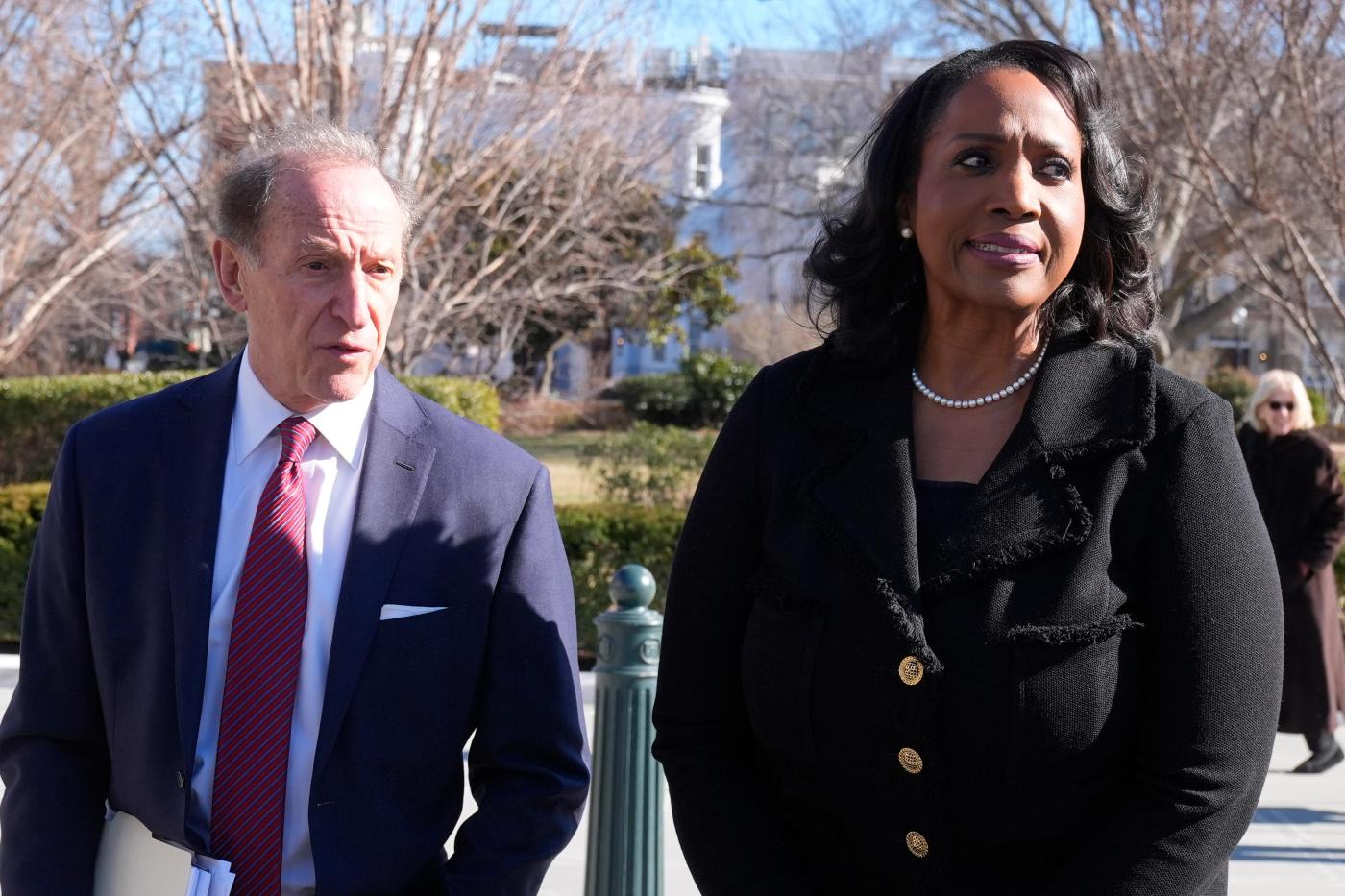
In the case of the Federal Reserve, Supreme Court appears to carve out a murky exception

posted in: All news | 0

By CHRISTOPHER RUGABER, AP Economics Writer

WASHINGTON (AP) — The Supreme Court for the past year has repeatedly allowed President Donald Trump to fire heads of independent agencies, but it appears to be drawing a line with the Federal Reserve.

Related Articles


Trump steals the show in Davos with a mixed bag of rhetoric and results at elite gathering


5 Democratic states asking judge to keep Trump from withholding money for child care


UK’s Starmer urges Trump to apologize for ‘insulting and frankly appalling’ NATO remark


Economic leaders at Davos say global growth is resilient despite Trump disruption


Kushner’s vision for rebuilding Gaza faces major obstacles

The court has signaled for months that it sees the Fed in a different light. It has said that the president can fire directors of other agencies for any reason, but can remove Fed governors only “for cause,” which is often interpreted to mean neglect of duty or malfeasance.

Last year, the court allowed President Donald Trump to fire — at least temporarily — Gwynne Wilcox, a member of the National Labor Relations Board, and Cathy Harris, a member of the Merit Systems Protection Board, but it carved out a distinction for the Fed. The two officials had argued that if Trump could fire them, he could also fire members of the Fed’s board of governors.

“We disagree,” the court said then. “The Federal Reserve is a uniquely structured, quasi-private entity that follows in the distinct historical tradition of the First and Second Banks of the United States.”

That is now being put to the test in a case in front of the Supreme Court involving Trump’s attempt to remove Fed governor Lisa Cook. On Wednesday during oral arguments, the court seemed inclined to keep Cook in her job.

Allowing Cook’s firing to go forward “would weaken, if not shatter, the independence of the Federal Reserve,” said Justice Brett Kavanaugh, one of three Trump appointees on the nation’s highest court.

But the court largely skirted a key issue: What, exactly, is the legal principle that protects the Fed, but not the other agencies?

Several legal experts say the justices are on shaky ground. The Fed, they argue, is similar in many ways to the Federal Trade Commission or the National Labor Relations Board, agencies Congress intended to be independent but whose officials Trump has been able to fire without pushback from the high court.

“There’s no historical grounds for distinguishing the Fed from other independent agencies that Congress has designed,” said Jane Manners, a law professor at Fordham University. “The whole argument was premised on the idea that the Fed is different. They haven’t explained exactly why.”

Peter Conti-Brown, a professor of financial regulation at the University of Pennsylvania, added, “I’ll say as a legal scholar and as a historian I think that differentiation is hocus pocus.”

Just last month, the court signaled in a separate oral argument that it would likely allow Trump to fire FTC Commissioner Rebecca Slaughter. The conservative majority on the court also suggested it would overturn a 90-year-old precedent that sharply limited the president’s ability to fire top officials at independent agencies.

Chief Justice John Roberts and many of his colleagues support the “unitary executive” theory, which holds that the president should have full sway over the staffing of agencies in the executive branch.

Agency directors, like Slaughter, “are exercising massive power over individual liberty and billion-dollar industries” without being accountable to anyone, Kavanaugh said at the December oral argument.

With the Federal Reserve, however, the Supreme Court’s conservative justices have applied a different view: that the Fed’s monetary policy — the setting of short-term interest rates and management of the money supply — historically hasn’t been overseen by the executive branch.

Some legal experts have likewise drawn a distinction between the Fed and other independent agencies. In a brief filed in the Cook case, Aaron Nielson, a law professor at the University of Texas, and formerly a top lawyer in Texas government, wrote that, “Whereas the modern FTC indisputably exercises executive power, the Fed’s core function is monetary policy, which need not and often does not require executive power.”

The First and Second Banks of the United States were nationwide banks that were the closest the United States had to a central bank in the first few decades after the nation’s founding, and both “conducted early monetary policy,” Nielson wrote, but weren’t executive branch agencies.

But Lev Menand, a law professor at Columbia University and author of a book about the Fed, argued that the Fed does exercise executive power when it regulates the banking system. And monetary policy, when it adjusts the money supply, is part of that regulation, he said.

There are also only three types of government authority, Menand argues: legislative, executive, and judicial, and the Fed belongs in the executive category.

“There is no fourth type of government power,” Menand said. “There is no other place to locate the Fed.”

Still, the justices mostly avoided addressing why the Fed is different during Wednesday’s oral argument, in part, Menand noted, because neither side pushed it. Cook’s lawyers had no reason to question a distinction that appeared to favor them.

And even the government’s own top Supreme Court lawyer, D. John Sauer, acknowledged that Trump could only fire Cook “for cause,” while in the other cases the White House had sought to remove officials for any reason, including policy differences. The distinction made it harder for the White House to argue that Cook should immediately be removed from office.

“There is a long tradition of having this exercise of monetary policy be exercised independent of executive influence,” Sauer said. “And we don’t dispute that that’s what Congress was doing.”

Paul Clement, one of Cook’s lawyers, told the justices, “it’s kind of why this case is, I think, problematic for the government because they could have come in here and said, you know, Fed, schmed, it’s not that different. This is just like the FTC.”

Instead, Clement added, “they come in and say, no, we’re going to accept that the Fed is different, at least for purposes of this case.”

The Supreme Court will initially rule on the narrow question of whether Cook can remain in her position while the larger dispute over her firing is fought in the lower courts. Still, at some point it may have to issue more comprehensive rulings that could include a fuller explanation of why the justices see the Fed as different.

For now, the Fed’s size and impact on the financial markets may be offering it a measure of protection.

“I don’t mean to denigrate any other agency, but there’s a reason that monetary policy has been treated differently, for lo these many years,” Clement said. “And there’s a reason that the markets watch the Fed a little more closely than they watch really any other agency of government.”

More than half the US threatened with ice, snow and cold in massive winter storm

posted in: All news | 0

By EMILIE MEGNIEN, JEFFREY COLLINS and JAMIE STENGLE

DALLAS (AP) — It was too cold for school in Chicago and other Midwestern cities Friday as a huge, dayslong winter storm began to crank up that could bring snow, sleet, ice and bone-chilling temperatures as well as extensive power outages to about half the U.S. population from Texas to New England.

Forecasters warned that the damage, especially in areas pounded by ice, could rival a hurricane. At least 177 million people were under watches or warnings for ice and snow and more than 200 million were under cold weather advisories or warnings and in many places they overlapped.

Maricela Resendiz went shopping Friday in Dallas ahead of the storm moving in there. She picked up chicken, eggs and some pizzas to get her, her 5-year-old son and her boyfriend through the weekend.

“It’s going to be a big storm,” she said, adding her weekend plans are “staying in, just being out of the way.”

Ice and snow could begin falling later Friday in Texas and Oklahoma. The storm was expected to slide into the South with freezing rain and sleet leaving behind a thick tree branch and power pole shattering layer of ice.

Then it will move into the Northeast, dumping about a foot of snow from Washington, D.C., through New York and Boston, the National Weather Service predicted. Boston declared a cold emergency through the weekend with wind chills predicted to dip well below zero.

Arctic air is the first piece to fall in place

The first factor to fall into place for the storm was Arctic air spilling down from Canada. Chicago Public Schools and others in the Midwest canceled classes Friday. With wind chills predicted to be as low as minus 40 degrees Fahrenheit frostbite could set in within 10 minutes, making it too dangerous to walk to school or wait for the bus.

The wind chill in Dickinson, North Dakota, was minus 52 Fahrenheit on Friday morning. It felt only about 10 degrees warmer in Bismarck as Colin Cross cleaned out an empty unit for the apartment complex where he works.

“I’ve been here a while and my brain stopped working,” said Cross, bundled up in long johns, two long-sleeved shirts, a jacket, hat, hood, gloves and boots.

Ice, snow and sleet will start later Friday in places like Oklahoma, where Department of Transportation workers pretreated roads with salt brine. The Highway Patrol canceled days off for troopers and was partnering with the National Guard to send teams out to help stranded drivers.

Texas was bracing too. Frigid temperatures closed Houston schools Friday with an e-learning day for public school students. Utility companies brought in thousands and employees to help keep the power on.

“It’s all hands on deck,” Houston Mayor John Whitmire posted online. “We’re hoping for the best, but prepared for the worst.”

Ice could take down power lines

More than 1,000 flights nationwide were delayed or canceled Friday in advance of the storm, including at airports in Dallas, Atlanta, and Oklahoma, according to the flight tracking website FlightAware. The website listed more than 1,400 cancellations for Saturday.

Once ice and snow end, the frigid air from the north will head south and east. It will take a while to thaw out, an especially dangerous prospect in places where ice and snow weighs down tree branches and power lines and cuts electricity, perhaps for days.

Related Articles


Ryan Wedding, a former Olympic snowboarder on the FBI’s ‘Most Wanted’ list, has been arrested


Immigrants often don’t open the door to ICE, but that may no longer stop officers


Wall Street drifts in mixed trading as Intel tumbles


Why freezing rain has millions at risk of losing power — and heat


Luigi Mangione is due in court as judge weighs legality of police seizing his backpack

Ice can add hundreds of pounds to power lines and branches and make them more susceptible to snapping, especially in windy weather.

At least 11 Southern states from Texas to Virginia have a majority of homes heated by electricity, according to the U.S. Census Bureau.

A severe cold snap five years ago took down much of the power grid in Texas, leaving millions without power for days and resulting in hundreds of deaths. Gov. Greg Abbott said Thursday that won’t happen again.

New York Gov. Kathy Hochul told her residents to expect the heaviest snow in years.

“We are heading into a very, very dangerous weather event,” Hochul said, pointing to the possibility for hypothermia and frostbite.

People are hunkering down

In Atlanta, Eliacar Diego was looking for a warm place after sleeping under a bridge to stay out of the rain. News of the storm hadn’t found its way to many of the homeless people with him. He planned to find one of the warming centers that the city opens during bitterly cold weather.

“I’ve just got to get through this weekend,” Diego said.

Groceries stores across the South were running out of items. Holly Lawson went shopping early Friday, buying bottled water in case her pipes freeze and sandwich meat and cheese in case electricity goes out.

“If we don’t use it, this will go into the snack bags for sports next weekend” for her 10-year-old son who plays basketball, she said.

Megnien reported from Atlanta and Collins reported from Columbia, South Carolina. Associated Press writers around the country contributed to this report.

Acquiring Quinn Hughes was expensive. It’s been a bargain

posted in: All news | 0

Over the course of nine years in Minnesota, defenseman Ryan Suter played 656 regular-season games in a Wild uniform. Among blueliners who played here, he holds the franchise record for games with three assists. He did it it five times.

On Thursday, Wild defenseman Quinn Hughes set up three of Minnesota’s four goals, including the overtime winner as they beat Detroit 4-3. It was the fourth time Hughes has recorded a trio of assists in a game for the Wild.

Minnesota Wild defenseman Quinn Hughes, left, skates with the puck as Detroit Red Wings left wing James van Riemsdyk (21) defends during the first period of an NHL hockey game Thursday, Jan. 22, 2026, in St. Paul, Minn. (AP Photo/Matt Krohn)

And he has been here for roughly five weeks.

By now, every Wild fan and every opponent scouting Minnesota has seen how it works: Hughes enters the offensive zone with the puck, often starting up the side wall, and draws the attention of an opposing forward. That’s when Hughes stops abruptly, spins away from the challenger while still solidly in possession of the puck and heads back toward the blue line to find either open ice or a teammate who is in position to shoot.

Everybody knows it’s coming, and nobody has, as of yet, found a way to stop it.

“Everyone see this,” said Kirill Kaprizov, the beneficiary of Hughes’ assists on both of the Russian’s goals versus Detroit. “He’s a great skater and helps so much everywhere, especially when we have (the) puck and he move around. Start attack first, go on offense; give you more space and stuff like that.”

Thursday night was Hughes’ 20th game in Minnesota since the mid-December blockbuster trade that brought him east from Vancouver. At his current pace, he will own the franchise mark for three-assist games before he heads to Italy to play for Team USA in the Milan Cortina Olympics next month.

For Hughes, the patented spin move is a result of natural talent and relentless practice, a rare ability to curl away from danger while maintaining possession. It is a high-risk, high-reward move, as losing the puck could spring an opponent on a breakaway. Those moments are rare.

“I feel like that’s kind of my MO a little bit. It’s things I work on in the summer, and it’s a work in progress,” Hughes said Thursday, after the Wild won at home for the first time in more than a month. “This is my seventh year in the league, so it’s obviously, you know, (I) continue to get better and better.”

Amid the normal pregame crush of Canadian media when the Wild visited Toronto earlier in the week, a reporter in the pregame scrum asked Hughes about his transition to a new team, new city and a new country. As has been his mantra in Minnesota since arriving and scoring a goal in a 6-2 home win over Boston on Dec. 14, Hughes hinted that there is even better stuff coming as he develops more and more familiarity with with defensive partner Brock Faber, and forwards like Kaprizov and Mats Zuccarello.

“You just don’t know anyone; like if you’re somewhere and you have a new job. If you’re working for a company for seven years and then you go to a new company, you don’t know anyone,” Hughes said. “I feel like I’m getting to my game now.”

Hughes also admitted that Minnesota was a team he didn’t like playing against during his time with the Canucks due to Minnesota’s coaching, skill, and “hard” game. For his new teammates, not having to try and foil Hughes’ spin moves is just another benefit of having the defenseman wearing green and red now.

“For other forwards, it’s probably tough,” Kaprizov said, after a 20-game sample watching myriad opponents challenge Hughes and fail. “Yeah, it’s probably tough. I don’t remember if he did against me like that, but it looks tough.”

With Hughes in the lineup, the Wild are 11-5-4, and after Thursday’s win were in a three-way tie with the Red Wings and Hurricanes for the second-most points in the NHL (67).

Acquiring Hughes wasn’t cheap; general manager Bill Guerin sent the Canucks forward Marco Rossi and Liam Ohgren, defenseman Zeem Buium and a first-round pick in this summer’s draft.

So far, it’s been a bargain.

Related Articles


Kaprizov plays the OT hero as Wild finally win at home


Wild still waiting for injured veterans


Vladimir Tarasenko hitting his stride at vital time for Wild


Late goal sinks Wild in Montreal


Wild shut down Jonas Brodin; he will miss Olympics for Sweden