

Icebreakers, the key tech to unlock Greenland, are only made by either US allies or adversaries

posted in: All news | 0

By SAM McNEIL

BRUSSELS (AP) — The cold, hard reality facing any U.S., NATO or European plans for Greenland is the ice. It chokes harbors, entombs minerals, and freezes shorelines into minefields of white and blue shards that threaten ships all year.

Related Articles


UK’s Starmer urges Trump to apologize for ‘insulting and frankly appalling’ NATO remark


Iranian prosecutor denies Trump’s claim 800 prisoners were spared execution


Kushner’s vision for rebuilding Gaza faces major obstacles


Today in History: January 23, Rock and Roll Hall of Fame inducts first members


UN warns of ‘catastrophic’ hunger crisis in Nigeria as food aid funding runs out

And the only way to break through all that is, well, with icebreakers: enormous ships with burly engines, reinforced hulls, and heavy bows that can crush and cleave ice.

But the United States has only three such vessels, one of which is so decrepit as to be barely usable. It has entered agreements to obtain 11 more, but can only source additional ships from adversaries — or allies it has recently rebuffed.

The key technology in the Arctic

Despite toning down his rhetoric, U.S. President Donald Trump seems set on the U.S. owning Greenland for security and economic reasons: to keep what he calls “the big, beautiful piece of ice” out of the hands of Moscow and Beijing, to secure a strategic Arctic location for U.S. assets, and to extract the island’s mineral wealth including rare earths.

Without specifying any plan, he told world leaders gathered in Davos, Switzerland, on Wednesday that “to get to this rare earth you got to go through hundreds of feet of ice.”

Yet there is no meaningful way to do that — or anything else in the semiautonomous Danish territory — without icebreakers’ crucial ability to cut trails through frozen seas.

Even if they decided to surge U.S. material into Greenland tomorrow, “they would have two or three years gap in which they’re not really able to access the island most of the time,” said Alberto Rizzi, a fellow at the European Council on Foreign Relations.

“On a map, Greenland looks surrounded by sea, but the reality is that the sea is full of ice,” he said.

FILE – Pieces of ice move through the sea in Qoornoq Island, near Nuuk, Greenland, on Feb. 17, 2025. (AP Photo/Emilio Morenatti, File)

If the U.S. wants more icebreakers, there are only four options: the shipyards of strategic adversaries China and Russia or longtime allies Canada and Finland, both of whom have recently weathered blistering criticism and threats of tariffs by Trump over Greenland.

Northern expertise in ice-capable ships

Icebreakers are expensive to design, build, operate and maintain and require a skilled workforce that can only be found in certain places like Finland, with expertise forged in the frigid Baltic Sea.

Finland has built roughly 60% of the world’s fleet of more than 240 icebreakers and designed half the remainder, Rizzi said.

“It’s very niche capabilities that they developed as a necessity first and then they have been able to turn it into geoeconomic leverage,” he said.

Russia has the world’s largest fleet with about 100 vessels, including colossal ships powered by nuclear reactors. Second comes Canada, which is set to double its fleet to around 50 icebreakers, according to a 2024 report by Aker Arctic, a Helsinki-based icebreaker design firm.

“Our design and engineering work order books are pretty full at the moment and the near future looks promising,” said Jari Hurttia, business manager at Aker Arctic, as he describes rising interest in the firm’s “unrivalled special competence which is not available anywhere else in the world.”

China currently has five compared to the U.S. three, and is rapidly building more as they expand their ambitions in the Arctic, said Marc Lanteigne, a professor at the University of Tromsø in Norway who teaches often at the University of Greenland in Nuuk.

“China is now in a position to develop indigenous icebreakers, and so the U.S. feels it must do the same,” he said.

Washington has to play catch up, and fast, said Sophie Arts, a fellow at the German Marshall Fund focused on Arctic security.

“President Trump has really bemoaned this lack of icebreakers, especially in comparison to Russia,” Arts said. The 2 of the 3 U.S. icebreakers are “basically past their life cycle already.”

So he turned to the undeniable expertise of the European Union’s northernmost nation and the U.S.’s neighbor to the north.

“Both Canada and Finland are really, really vital to this,” Arts said. “Cooperation is what makes this possible … the U.S. doesn’t really have a pathway to do this on its own at this time.”

During his first administration, Trump prioritized the U.S. military’s acquisition of ice-capable vessels, a strategy that the Biden administration followed up on by signing an agreement called the Ice PACT with Helsinki and Ottawa to deliver 11 icebreakers constructed by two corporate consortiums with Finnish designs.

Four would be built in Finland, while seven would be constructed in a Canadian-owned billion-dollar “American Icebreaker Factory” in Texas as well as a shipyard in Mississippi under joint U.S.-Canadian ownership.

Any mining of critical minerals would face high costs in the harsh conditions at sea and on land in Greenland. Investments there would take years if not decades to pay off, Lanteigne said.

Even with adequate icebreakers, the price to build and maintain mining or defensive facilities — like those envisioned in the yet-unfunded $175 billion Golden Dome missile defense network linking detectors and interceptors in space and on the ground — would be enormous.

That means U.S. allies in the Arctic might still welcome more investment by Washington in Greenland.

Danish Prime Minister Mette Frederiksen said in a statement that she would be open to strengthening Arctic security including the U.S. Golden Dome program “provided that this is done with respect for our territorial integrity.”

Market dominance and strategic leverage

While both the U.S. and the 27-nation European Union including Denmark and Finland have pledged to vastly increase investment in Greenland, it is clear who currently has the hard-power capability to actually reach the vast frozen territory roughly three times the size of Texas.

“It’s kind of absurd because I don’t think Finland would scrap the deal with the U.S. as a response to threatening to invade Greenland,” Rizzi said. “But if Europe wants to exercise significant leverage to the USA, they could say ‘We’re not going to give you any icebreakers and good luck reaching the Arctic, or projecting power there, with those two old ships that you have.’”

European Commission President Ursula von der Leyen reminded world leaders Tuesday at Davos of the key EU-technology base for any Arctic endeavors.

“Finland — one of the newest NATO members — is selling its first icebreakers to the U.S.,” von der Leyen said at the World Economic Forum.

“This shows that we have the capability right here, in the ice so to speak, that our northern NATO members have Arctic-ready forces right now, and above all, that Arctic security can only be achieved together.”

She announced after an emergency summit of the 27 EU leaders in Brussels on Thursday that the EU would surge defense spending in Greenland including an icebreaker.

Illinois surgeon charged in Ohio couple’s killings is due in court

posted in: All news | 0

By JULIE CARR SMYTH and PATRICK AFTOORA-ORSAGOS

COLUMBUS, Ohio (AP) — An Illinois doctor indicted on murder charges in the December killings of his ex-wife and her dentist husband in their Columbus home is due in an Ohio courtroom on Friday.

Related Articles


Former NFL player Kevin Johnson killed at homeless encampment, medical examiner says


More than half the US threatened with ice, snow and cold in massive winter storm


Ryan Wedding, a former Olympic snowboarder on the FBI’s ‘Most Wanted’ list, has been arrested


Immigrants often don’t open the door to ICE, but that may no longer stop officers


Wall Street drifts as Intel tumbles and gold’s price rises to another record

Michael David McKee, 39, is scheduled to be arraigned in Franklin County on four aggravated murder counts and one count of aggravated burglary while using a firearm suppressor in connection with the Dec. 30 shooting deaths of Monique Tepe, 39, and Dr. Spencer Tepe, 37.

The mystery that first surrounded the case — which featured no forced entry, no weapon and no obvious signs of theft, additional violence or a motive — drew national attention. McKee, of Chicago, was arrested 11 days later near his workplace in Rockford, Illinois. He was returned to Ohio on Tuesday to face the charges against him.

Who is Michael David McKee?

McKee attended Catholic high school in Zanesville, a historic Ohio city about 55 miles east of the capital, according to the Diocese of Columbus. He enrolled at Ohio State University in September 2005 — the same semester that his future wife, then Monique Sabaturski, enrolled, university records show. Both graduated with bachelor’s degrees in June 2009. Sabaturski earned a master of education degree from Ohio State in 2011 and McKee earned his medical degree there in 2014.

Sabaturski and McKee married in Columbus in August 2015 but were living apart by the time Monique filed to end in the marriage in May 2017, court records show. Their divorce was granted that June. McKee was living in Virginia at the time, court and address records show. He completed a two-year fellowship in vascular surgery at the University of Maryland Medical Center in October 2022, according to the school.

McKee also lived in and was licensed to practice medicine in both California and in Nevada, where he was among doctors named in a personal injury lawsuit in a Las Vegas court in 2023. OSF Saint Anthony Medical Center in Rockford, Illinois, where McKee was working at the time of his arrest, declined to provide specific information on the dates of his employment. His Illinois medical license became active in October 2024.

What is McKee accused of?

An Ohio grand jury indicted McKee in the double homicide last week.

This undated booking photo provided by the Winnebago County Sheriff’s Office Tuesday, Jan. 13, 2026, shows Michael David McKee, who was charged in the killing of his ex-wife, Monique Tepe, and her husband Spencer Tepe at their Columbus, Ohio, home on Dec. 30, 2025. (Winnebago County Sheriff’s Office via AP)

McKee is accused of illegally entering the Tepes’ home with a firearm equipped with a silencer, shooting the Tepes — whose bodies were found in a second-floor bedroom — and leaving the property along a dark alley alongside the house.

Columbus Police Chief Elaine Bryant has said that McKee was the person seen walking down that alley in video footage captured the night of the killings. She also said a gun found in his Chicago apartment was a ballistic match to evidence at the scene and that his vehicle’s movements were tracked from Columbus back to Illinois.

A message seeking comment was left with McKee’s attorney.

McKee is charged with two aggravated murder counts for each homicide, one for prior calculation and design and one for committing the crime, as well as facing the aggravated burglary count. If convicted, he faces a minimum of life in prison with parole eligibility after 32 years and a maximum term of life in prison without parole.

How were the killings discovered?

Columbus police conducted a wellness check on Spencer Tepe at around 10 a.m. on Dec. 30, after his manager at a dental practice in Athens, Ohio, reported that he had not shown up to work on that day, saying tardiness was very worrying and “out of character” for Tepe, according to a 911 call.

Someone else called to request a wellness check before a distraught man who described himself as a friend of Spencer Tepe called police and said, “Oh, there’s a body. There’s a body. Oh my God.” He said he could see Spencer Tepe’s body was off the side of a bed in a pool of blood.

The Franklin County Coroner’s Office deemed the killings an “apparent homicide by gunshot wounds.”

Who were the Tepes?

Family members said the Tepes were “extraordinary people whose lives were filled with love, joy and deep connection to others.”

They have described Monique as a “joyful mother,” avid baker and “thoughtful planner.” According to their obituaries, which were issued jointly, the pair were married in 2020.

Spencer Tepe got his bachelor’s degree from Ohio State University in 2012 and earned his doctor of dental surgery degree in 2017, according to school records. He was a member of the American Dental Association and had been involved with the Big Brothers Big Sisters organization.

They had two young children. Both were home at the time of the killings and left unharmed, as was the family dog.

Former NFL player Kevin Johnson killed at homeless encampment, medical examiner says

posted in: All news | 0

LOS ANGELES (AP) — Former Philadelphia Eagles defensive lineman Kevin Johnson died from “blunt head trauma and stab wounds” at a homeless encampment, according to the medical examiner.

The Los Angeles County Medical Examiner said Johnson, 55, was pronounced dead Wednesday morning after being found unconscious. His death was ruled a homicide and is being investigated.

A fourth-round draft pick by New England in 1993, Johnson spent time with the Patriots, Minnesota and Oakland before landing with the Eagles. He had 43 tackles, including seven sacks, and returned a fumble for a touchdown in two years with Philadelphia. He played 15 games for the Raiders in 1997.

Johnson later played in the Arena Football League for Orlando and Los Angeles. The L.A. native played collegiately at Texas Southern.

Investigators believe Johnson had been living at the encampment at the time of his death. Friends said Johnson had health issues later in life that contributed to his situation.

AP NFL: https://apnews.com/hub/nfl

Related Articles


More than half the US threatened with ice, snow and cold in massive winter storm


Ryan Wedding, a former Olympic snowboarder on the FBI’s ‘Most Wanted’ list, has been arrested


Immigrants often don’t open the door to ICE, but that may no longer stop officers


Wall Street drifts in mixed trading as Intel tumbles


Why freezing rain has millions at risk of losing power — and heat

The coming winter storm: There’s an app for that. But how reliable is it and what’s inside?

posted in: All news | 0

By SETH BORENSTEIN and TAMMY WEBBER

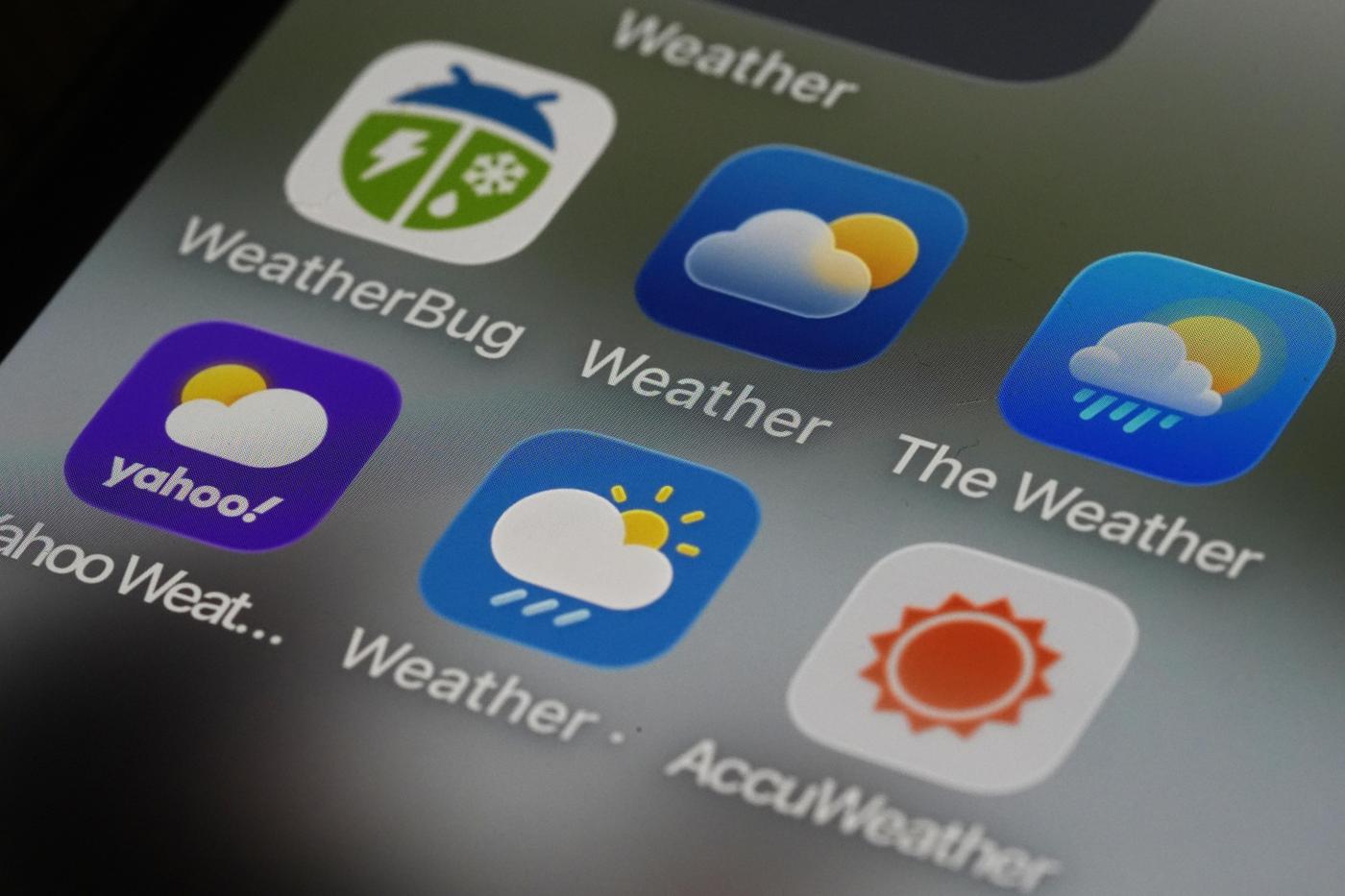
Smartphone weather apps that summarize their forecasts with eye-popping numbers and bright icons may be handy during mild weather, but meteorologists say it’s better to listen to human expertise during multi-faceted, dangerous winter storms like the one blowing through the U.S.

Related Articles


More than half the US threatened with ice, snow and cold in massive winter storm


Huge winter storm to bring crippling snow, sleet and ice from Texas to Boston


Trump administration scraps multimillion-dollar solar projects in Puerto Rico as grid crumbles


House Republicans vote to lift 20-year ban on mining near pristine Boundary Waters Canoe Area


Meteorologists blame a stretched polar vortex, moisture, lack of sea ice for dangerous winter blast

The multistate storm’s combination of heavy snow, treacherous ice and subzero temperatures shows why it’s best to seek out forecasters who can explain its nuances via local TV or radio newscasts, online livestreams or detailed websites, said meteorologists interviewed by The Associated Press. The data is changing rapidly before and during the storm, and the distance of a few miles can mean the difference between snow, sleet or dangerous freezing rain.

“Weather apps are really bad at storms that have multiple types of precipitation and it really makes messaging hard,” said University of Georgia meteorology professor Marshall Shepherd, a past president of the American Meteorological Society. “Apps don’t understand the details of why snow, sleet or freezing rain happens.”

University of Oklahoma meteorology professor Jason Furtado and other experts said humans are important in these cases, especially those with local expertise.

“For extreme weather events, it is especially important to know there are human forecasters interpreting the data and making the best localized forecasts for your area,” Furtado said. “Unfortunately, many of the weather forecast apps use AI methods to either make the forecast or ‘interpolate’ from larger grids to your hometown, introducing the potential for significant errors.”

But some apps can be useful, especially those that pair National Weather Service data with meteorologists’ expertise, forecasters said. And they are definitely getting used right about now.

The Weather Channel app, which is seeing booming traffic this week, uses numerous models, data sources, weather observers and staff, said James Belanger, vice president of its parent company, which also owns the Weather Channel and weather.com. That level of proficiency matters, he said.

“It’s an all-hands-on-deck kind of approach that we take,” Belanger said, adding that “not all weather apps are created equal.”

What apps can and can’t do

Apps get much of their information from the National Weather Service and some companies augment it with proprietary information and the well-regarded European forecast models. Many offer forecasts by ZIP code or geographic areas far from weather stations by using software that focuses broader regional forecasts to where the phone is located.

While there are good apps, especially those displaying National Weather Service warnings and information, many “oversimplify uncertainty and present highly precise-looking numbers that imply more confidence than actually exists,” said Northern Illinois University meteorology professor Victor Gensini. This type of storm is where apps are weakest because they don’t get nuances, he said.

Weather apps are good for forecasting nice warm summer days, but not days like much of the country is facing now, said Steven DiMartino of NY NJ PA Weather. The paid online subscription service touts its human expertise with the slogan “Meteorology Not Modelology.”

“The problem with the weather app is that it just provides data, but not explanation,” DiMartino said. “Anyone can look at data, but you need a meteorologist, you need that human touch to look at it and say, ‘Hmm, that looks like an error; we’re gonna tweak this.’”

Seeking quality sources of data

Cory Mottice, a National Weather Service meteorologist since 2014, developed the app EverythingWeather, which uses weather service data, as an easy place for the public to find the latest weather forecasts for their area without navigating the agency’s website. He said it’s “just for fun” and not affiliated with the weather service.

The strength of his app, he said, is that the information comes from professional meteorologists at the more than 125 weather service offices. Many apps just use raw computer modeling data – which aren’t always reliable in extreme events — with no human oversight, “which can really lead to some very misleading numbers or graphics depending on what you’re at,” he said.

With his approach, “you have actual meteorologists that are experts in their field at different places all over the country for that specific area, looking at the data, adjusting it, making the forecast as needed,” Mottice said.

Mixing decades of experience, 100 meteorologists and AI

The popular Weather Channel app uses information from many sources, including the weather service and more than 100 weather models, including those from the U.S. and Europe and their own distinct model. They augment it with input from over 100,000 citizens to help forecast weather events, said The Weather Company’s Belanger. And it’s all synthesized by artificial intelligence to come up with a forecast, he said.

That’s more accurate than relying on a single model or provider, he said, because AI is able to learn which models are the most accurate in different conditions to help “create that optimal forecast.”

Even so, humans, including a team of more than 100 meteorologists, always have the final say about what goes on the app, Belanger said.

“One of the things that has been a lesson and a principle that we’ve adopted is that it’s the combination of advancements in technology with the human oversight,” that allows the company to provide the best forecasts — especially in situations like the current winter storm, Belanger said.

Be careful with social media

Forecasters also warn against another quick fix for weather information: social media, where hype, misinformation and short takes can spread quickly.

While social media can help amplify official sources like the weather service, “it’s also where misinformation spreads fastest,” Gensini wrote in an email.

“Weather is complex, and social media tends to reward confidence and drama, not nuance,” Gensini said. “That mismatch is a real challenge during major events like this.”

Kim Klockow McClain, an extreme weather social scientist at the University Corporation for Atmospheric Research, said people are “getting misled by hyped forecasts.”

“When people are continually exposed to only worst-case forecasts, research suggests they will lose trust over time,” she said.

Borenstein reported from Washington, Webber from Fenton, Michigan.

The Associated Press’ climate and environmental coverage receives financial support from multiple private foundations. AP is solely responsible for all content. Find AP’s standards for working with philanthropies, a list of supporters and funded coverage areas at AP.org.