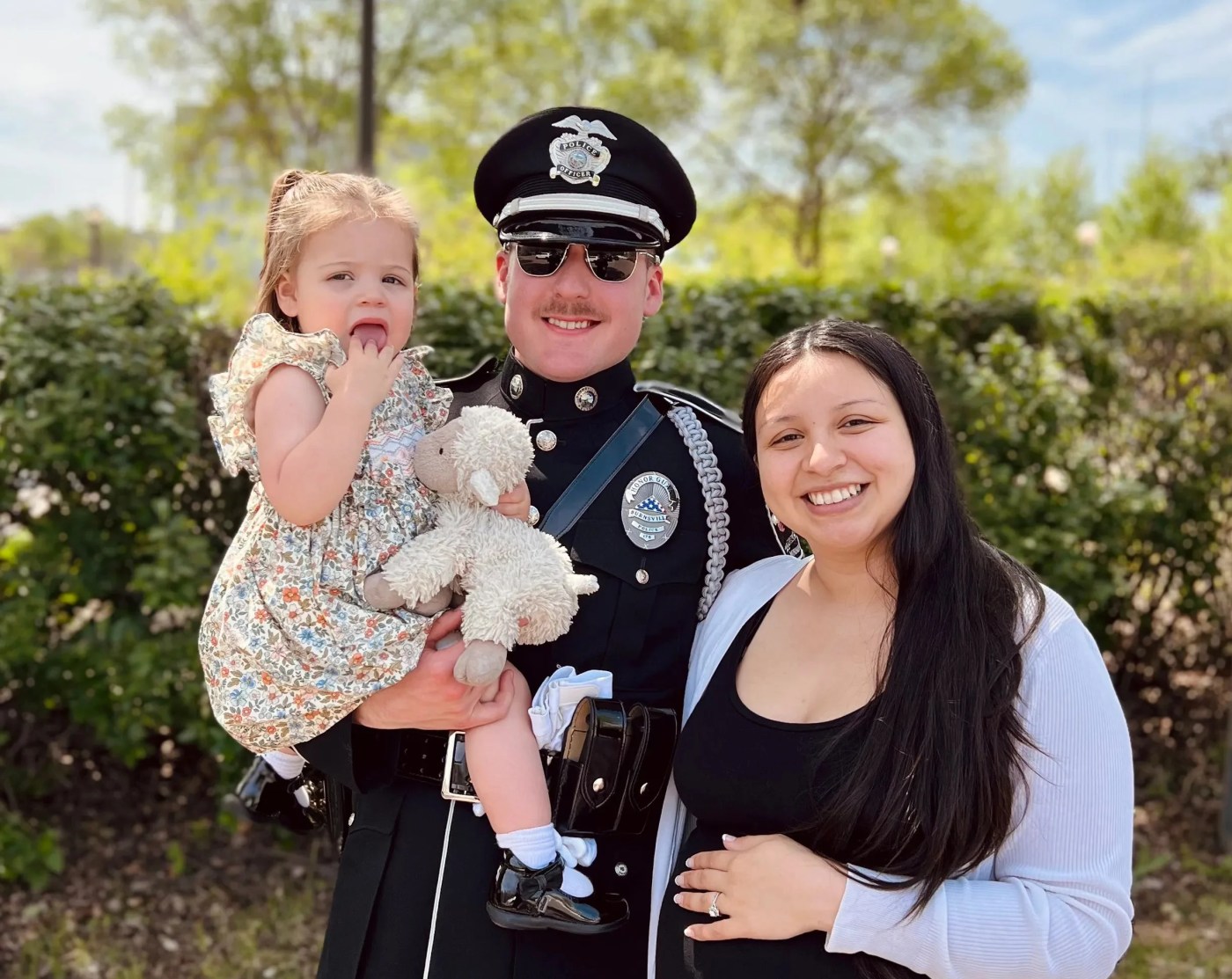
At last year’s Peace Officers Memorial Day, Burnsville police officer Paul Elmstrand joined his fellow officers in a silent standing of the guard at a memorial in St. Paul.
He was proud to be a member of the Burnsville Police Honor Guard, paying tribute to officers who died in the line of duty. His wife, Cindy Elmstrand-Castruita, and their then-1-year-old daughter, Maria, also were there. Elmstrand-Castruita was pregnant with the couple’s second child, Mateo.
“What I remember of that day is him being so excited to share something that he loved with us and to show us this familial side of law enforcement — that we’re family, we love each other, we take care of each other,” Elmstrand-Castruita said recently.
Though she understood the significance of the day, Elmstrand-Castruita said she “never thought that could possibly be us or someone that we knew.”
Cindy Elmstrand-Castruita, widow of Burnsville Officer Paul Elmstrand holds her late husband’s dress A police uniform cap while at Purgatory Creek Park in Eden Prairie on Saturday, May 11, 2024. Paul Elmstrand was killed along with fellow Burnsville police officer Matthew Ruge and firefighter/paramedic Adam Finseth by Shannon Gooden during a standoff at Gooden’s Burnsville home on Sunday, February 18. (John Autey / Pioneer Press)
This week, instead of standing guard at the annual memorial day for fallen officers, law enforcement from around the state will be honoring Elmstrand and his co-worker, Burnsville officer Matthew Ruge, who were both 27.
The two officers and Burnsville firefighter/paramedic Adam Finseth, 40, were shot and killed by a man in Burnsville on Feb. 18.
Now, as National Police Week starts Sunday — a time to remember officers who died in the line of duty — family and colleagues of the officers are opening up about their memories of the men and how they’ve been coping.
Elmstrand’s last day at home
During Elmstrand’s second-to-last shift, both of his children were sick and baby Mateo kept waking up. Elmstrand-Castruita hadn’t been able to get much sleep and asked Elmstrand if he could come home from work early to help. He took some vacation hours to do so.
“Even though he hated doing that to his partners, we were always his first priority,” said Elmstrand-Castruita, 27.
On the night of Feb. 17, with both of their children still sick, Elmstrand-Castruita thought about asking her husband if he could call out from work.
“But I knew he’d already sacrificed hours, and he never wanted to be the person to inconvenience people at work,” she said.
Instead, they went through their normal nightly routine at their Chaska home. That meant eating dinner together, then Elmstrand putting their son and daughter to bed while Elmstrand-Castruita cleaned the kitchen. Elmstrand walked their dog, and they’d have a few minutes to chat about their plans for the next day.
They said their goodbyes like always. Elmstrand gave her a kiss. “I always told him, ‘Stay safe,’” she said.
Cindy Elmstrand-Castruita, widow of Burnsville Officer Paul Elmstrand, pauses to look at a photo of her and late husband when they were teenagers while at Purgatory Creek Park in Eden Prairie on Saturday, May 11, 2024. (John Autey / Pioneer Press)
Ruge’s final shift called for negotiation skills
For Matt Ruge, his last day at work started two hours earlier than his regular 5 p.m. start time.
Burnsville officer Roy Gutzman had tickets to the Minnesota Wild game with his family, and Ruge offered to work the end of Gutzman’s shift so he could go. Gutzman was Ruge’s field training officer when he became a Burnsville officer in 2020 and they were on the department’s team of negotiators.
“I’ve thought often that I owe Matt two hours and a lot more,” Gutzman said.
Ruge’s shift usually ended at 3 a.m., but he and other officers kept working early Feb. 18 because a man had barricaded himself in a home with seven children. Ruge was negotiating with him.
Ruge became a negotiator last year and went through 40 hours of FBI training plus continued training at the police department. It was a role that fit his personality, said Ruge’s mother, Christi Henke.
He’d graduated with academic honors from the law enforcement program at Minnesota State University, Mankato and minored in psychology. His nickname at work was “The Book” because of his ability to absorb procedures and information.
“He had a great ability to be able to talk to people,” said Gutzman, an officer of 23 years. “You have to have a lot of patience and a calm presence when you’re negotiating with someone, and he had those skills.”
About 1:50 a.m. Feb. 18, Burnsville officers were dispatched to a home about an alleged sexual assault, according to the Minnesota Bureau of Criminal Apprehension. Officers went inside and negotiated with 38-year-old Shannon Gooden for about 3½ hours, trying to get him to surrender peacefully. Gooden said he was unarmed, but then, at 5:26 a.m., he opened fire on the officers inside the home.
Gooden ultimately shot more than 100 rifle rounds at law enforcement and first responders. He died by suicide. His girlfriend, Ashley Dyrdahl, has been charged federally with illegally providing him with firearms.
Ruge’s parents said they’ve been told by officers that their son was doing everything right in his negotiations.
“The fact that Paul had been injured and Matt risked his life to help him, I think that’s something he would do over and over and over again, even if he knew the result, and it gives me some peace that he tried so hard to help his friend,” his father, Sean Ruge, said.
Sean Ruge said he’s proud his son was able to negotiate long enough for other officers and support to get into place, which “helped prevent the loss of even more life.”
“I think what ultimately happened couldn’t be avoided,” he said. “This was an evil person with an agenda.”
High school sweethearts
Elmstrand and Elmstrand-Castruita grew up in Isanti, Minn. They were in the same class in third grade at Isanti Primary School, and she remembers him from back then. “He is pretty unforgettable,” she said.
They dated some during their freshman year at Cambridge-Isanti High School. Then, the summer before their junior years, Elmstrand-Castruita got a job working at Elmstrand’s parents’ business, Rod’s Berry Farm near North Branch. She and Elmstrand worked side by side, picking strawberries, sorting them and washing them.
By the end of the summer, “I was head over heels for him,” Elmstrand-Castruita said, and they started dating again. They were both 16 and were together from then on.
After high school, they went to the University of Northwestern in Roseville. They married in 2018, before they graduated — he with a criminal justice degree and she with a degree in Spanish education.
Overcame medical condition to become an officer
Ruge was raised in Reads Landing, Minn., a Mississippi River bluff village near Wabasha. He was the first grandson and the oldest cousin, and he took responsibility for looking after everyone. He played youth hockey and was on the golf and trap shooting teams at Wabasha-Kellogg High School. He was a lifelong outdoorsman.
Matt Ruge visited Sedona, Ariz., in late 2023 with his mother, Christi Henke, his sister and his sister’s significant other to see Henke’s mother in Arizona. (Courtesy of Christi Henke)
He was a smart kid who didn’t have to work hard to get good grades, his father said.
Ruge’s grandfather was a veteran and his uncle retired as an Air Force colonel. It was Ruge’s first dream to join the military, but he couldn’t enlist because of his autoimmune condition.
Very few people knew Ruge had Crohn’s disease, a chronic disease that causes inflammation of the digestive tract, which he was diagnosed with in middle school. He was later able to find that regular infusions allowed him to live a normal life.
“He had overcome so much to get to where he was,” his mother said. And he saw law enforcement “as a way to serve people and help,” his father said.
“I thought about some of the stereotypes of police — the ex-military or the big muscles — and Matt was none of those things,” Sean Ruge said. “He was the thoughtful, patient kid and he was always respectful,” never liking to be the center of attention. But his father said Matt Ruge found he fit right in — “to do that job right takes all different kinds” — and his confidence grew.
Husband and father
Elmstrand decided he wanted to be a police officer when he was young. Elmstrand-Castruita said she’s found letters he wrote to her in high school, “talking about his passion for serving people and protecting people.”
Elmstrand was a community service officer at Minneapolis-St. Paul International Airport before taking on the same role in Burnsville in 2017. He became a Burnsville police officer in 2019.
Elmstrand-Castruita said she initially felt “fear around his safety and the danger of the job, but he really reassured me a lot, and he had a lot of faith in his partners and in his department. Over time, it almost became just another thing in our life. It was his job that he went to and that he loved.”
Because of negative attention on law enforcement, Elmstrand-Castruita said she used to be hesitant to tell people her husband was a police officer. But she knew as soon as people met him, they’d want more police officers like him.
“Paul had a way of making everyone around him feel comfortable,” she said. “He was great at making people feel seen and heard, and I just loved that about him so much.”
When they had children, Elmstrand’s overnight schedule was good for their family because he got to see more of them during the day.
If their daughter had a “toddler tantrum, he was so patient with her and would usually find a way to bring humor into situations that were frustrating and then it would just calm everything down,” Elmstrand-Castruita said.
Their son Mateo is now 8 months old and Maria is nearly 2½ years old. He and Maria used to dance together, sing and play pretend. When she wanted to paint his face with makeup, he patiently sat still to allow his little girl to have fun.
Son and brother
Henke, Ruge’s mother, loves the official photo of her son in his police uniform, which has been widely distributed, but she also said he’d matured since it was taken about three years ago.
Other photos bring to mind more recent memories of him: There’s a picture of Ruge with his parents, his sister and her significant other for his sister’s birthday in October; another photo of Ruge when he was awarded Burnsville’s Life Saving Award in November; and Ruge with the red rocks of Sedona, Ariz., behind him during a family visit to see his grandma late last year.
Burnsville Officer Matt Ruge, right, with, from left, mother Christi Henke, father Sean Ruge, sister Hannah Ruge and Ezequiel Moran, Hannah’s significant other, at a gathering for Hannah’s birthday in Burnsville in October 2023. (Courtesy of Christi Henke)
Ruge usually shared funny stories from work with his mother because he didn’t want her to worry about him, but he told her about some serious situations he responded to and Henke has since heard more from his co-workers.
Since he became an officer in 2020, he was involved “in almost a career’s worth of extremely dangerous incidences,” Henke said.
“Now that he’s passed away, I get letter after letter” from people he helped, Henke said.
‘Miss you, babe’
Elmstrand started work at 9 p.m. on Feb. 17. Elmstrand-Castruita texted him to say Mateo was struggling to sleep, but then followed up to say the baby fell asleep and not to worry about them.
Elmstrand texted back: “Sleep well, my princess.” Elmstrand-Castruita told her husband she loved and missed him.
“The last thing he texted me, probably right before midnight, was saying, ‘Miss you, babe.’”
She woke up the morning of Feb. 18 and found it strange that Elmstrand wasn’t home and he hadn’t texted to say he was working late, which he would have done.
“Very shortly after, I heard pounding on my door,” she said. “It’s the type of pounding that I can’t forget.”
She looked out the window and saw a Minnesota State Patrol squad was outside.
“My heart sank because I knew that something terrible had happened to Paul and I just didn’t want to go downstairs to open the door. I hoped that maybe if I just waited, it wouldn’t be true,” Elmstrand-Castruita said.
She made herself go to open the door. Standing on the other side was a close friend of Elmstrand’s who is a state trooper.
“When I saw who it was, I asked him if Paul was alive. And he told me no,” she said. “I kept asking, ‘Is this a dream? Is this a dream?’ I just couldn’t believe what was happening.”
Terrible knock on another door
When officer Gutzman, who’d known Ruge since the start of his career, headed to work the morning of Feb. 18, he knew an incident was underway, but not the seriousness. At the police station, he learned two officers and a firefighter had been injured.
Gutzman said it was “by the grace of God” that he was designated as the officer to notify Ruge’s mother.
Related Articles
Walz names two women to fill vacancies on Ramsey County District Court bench
Myon Burrell is arrested for second time since sentence was commuted in 2008 slaying
St. Paul man charged with carjacking and shooting motorist in Cub Foods parking lot
Former St. Kate’s dean accused of swindling $400K from the school
Body-camera footage released in police shooting of St. Paul woman
He rushed to Henke’s home and knocked on her door. His phone was ringing but he thought it would be rude to answer in front of her. He explained to Henke that he needed to quickly get her to the hospital to see her son. But when Gutzman returned the missed call, he was informed by a Burnsville police captain that Ruge had died at the hospital.
“Matt’s mom comes back and sees the change in my demeanor and the look on my face and she knew,” Gutzman said. He still hurried her to the hospital and drove her in the procession of law enforcement vehicles accompanying the bodies to the medical examiner’s office.
Henke said Gutzman, along with other officers and friends of her son, have been a comfort to her. For Gutzman’s part, in a situation that ended with him feeling helpless, being able to assist Ruge’s family gave him purpose.
‘Where’s Dada?’
Almost from the moment that Elmstrand died, Elmstrand-Castruita started thinking about how to tell their 2-year-old daughter. She sought advice on how to talk to a toddler about death and was told that it’s best to be straightforward to avoid confusion.
Elmstrand-Castruita told the little girl: “Dada was at work and he got hurt bad enough that he died. Now he’s in heaven with Jesus. We won’t get to play with him or see him anymore.” She reminded Maria that he loved her.
In the first month especially, Maria kept asking, “Where’s Dada?”
“The amount of times I’ve had to repeat ‘He’s not coming back’ is more than anyone should ever had to repeat it, but I have made it my priority to make it very clear to her so she doesn’t have a false hope that someday he’ll come back,” Elmstrand-Castruita said. “I’ve also tried to make it really clear that he didn’t choose to leave. It was something that happened to him. I don’t want her to ever feel like she’s been abandoned by him.”
Maria has been resilient. She still asks about her dad and wants to see pictures and videos of him. “We definitely don’t shy away from talking about him,” Elmstrand-Castruita said.
When someone happened to ask Maria about her father recently, “She very confidently said, ‘My dad’s in heaven,’” Elmstrand-Castruita recalled.
Family members have been spending extra time with Maria, taking her to the zoo or the mall, and reminding her how loved she is.
Grief in waves
Henke, whose grief comes in waves, feels heartbroken that Ruge’s younger sister is now an only child. Hannah Ruge’s longtime boyfriend also doesn’t have siblings, and Henke thinks about the future: if they have children, they will have no cousins.
Burnsville Officer Matt Ruge, right, with Burnsville Officer Pete Mueller when Ruge received Burnsville’s Life Saving Award in November 2023. (Courtesy of Christi Henke)
“We didn’t only lose Matt, we lost the future of our family,” Henke said. “I just didn’t lose my 27-year-old son, I lost my 37-year-old son and my 47-year-old son and my 57-year-old son. I lost the kids that he was going to have, that I would have been the grandmother of. I lost all of that.”
Ruge had a dog since college. Henke has been caring for Ranger, who will soon go to live with Ruge’s sister in a house she and her boyfriend are moving into. It has a big yard and Ranger will also have Ruge’s sister’s dog to play with.
Praying for strength
Elmstrand and Ruge were in the same friend group, and Elmstrand-Castruita spent time with them at dinners and other nights out.
When she was pregnant with Mateo, she remembers Ruge asked her, “What’s it like being a mom?” She thought he was joking at first, but he was serious, saying, “I want to know, what’s that like for you?”
“I thought that was the sweetest thing ever because most single guys don’t really care about that,” she said. “That really left quite an impression on me.”
Elmstrand-Castruita never met Finseth. She’s seen his widow and Ruge’s family at events, and they’ve had some conversations, but Elmstrand-Castruita said it’s difficult for her when all three of their families are together.
“The thing that connects us is so terrible and sad that it’s hard to not feel it even more when we’re all together,” Elmstrand-Castruita said.
The number of Burnsville officers who have come to the Elmstrand’s home since Paul was killed “is just amazing,” Elmstrand-Castruita said.
Some of Elmstrand’s co-workers helped her go through his things. About 10 officers and their wives installed shelving in the garage and organized their belongings. Officers still show up to walk their dog.
“It’s really nice to feel all of their love,” Elmstrand-Castruita said. “It helps me feel connected to Paul and, as time passes, people begin to forget, but his partners of course are not forgetting. I like being with people who knew Paul, who have stories to tell me about Paul and who knew his sense of humor like I did.”
Their support and her faith have helped Elmstrand-Castruita make it through.
Losing Elmstrand to violence “feels like this senseless, cruel, bad luck that happened,” his wife said.
“Every day when I wake up, I pray for strength,” she said. “I ask God to give me strength for the next hour, the next day. When I’m facing difficult situations with the kids or they’re sick or just new situations that Paul and I normally would have dealt with together, prayer is something that I turn to.”
Elmstrand-Castruita has been dreading Mother’s Day because Elmstrand would always get her a huge bouquet of flowers for that day, on her birthday and their anniversary. “He was great at celebrating me,” she said.
Each monthly anniversary of Elmstrand’s death is also tough, but the hardest times are when she’s not expecting them.
“A memory comes up, or hanging out with some friends and remembering the last time it was Paul and I with them,” she said. “It’s those moments where I can feel that he’s missing.”
Memorial service on Wednesday
Burnsville police officer Paul Elmstrand, who was a member of his department’s honor guard, holds his then-1-year-old daughter Maria at Law Enforcement Memorial Day in St. Paul in May 2023. Elmstrand, who was killed in the line of duty in Burnsville on Feb. 18, 2024, will be memorialized at this year’s ceremony. (Courtesy of Cindy Elmstrand-Castruita)
Elmstrand became a Burnsville Honor Guard member because he “had a special place in his heart” to honor officers who died, Elmstrand-Castruita said.
When he saw the work of the Minnesota Law Enforcement Memorial Association’s Honor Guard, he knew “he wanted to be part of creating something special for families who are mourning,” his wife said.
He applied for the Minnesota LEMA Honor Guard and, after his interview, he kept checking his email because “he wanted to be on it so badly,” Elmstrand-Castruita said. He found out he was accepted soon before he was killed.
At this Wednesday’s Peace Officers Memorial Day ceremony, Elmstrand’s and Ruge’s names will be added to ribbons on the law enforcement memorial flag, as will the name of Pope County sheriff’s deputy Josh Owen, who was shot in the line of duty in April 2023.
Peace Officers Memorial Day in Minnesota
When: Ceremony is 7 p.m. Wednesday, May 15. Officers from around the state take turns standing in silent vigil at 6 p.m. Tuesday, May 14, until the ceremony the next evening.
Where: Minnesota Peace Officers Memorial on the state Capitol grounds, 6 E. 12th St., St. Paul.
Fundraising: Law Enforcement Labor Services Benevolent Fund continues to accept donations at lels.org/benevolent-fund for the families of Burnsville officers Paul Elmstrand and Matthew Ruge, and Burnsville firefighter/paramedic Adam Finseth.
Related Articles
Body-camera footage released in police shooting of St. Paul woman
Minnesota Senate OKs stiffer gun straw purchase penalties, binary trigger ban
Guns are being stolen from cars at triple the rate they were 10 years ago, a report finds
Stillwater prison tattoo parlor aims to create career opportunities – while reducing infections
Florida deputies who fatally shot US airman burst into wrong apartment, attorney says