Divided Supreme Court rules no quick hearing required when police seize property

posted in: News | 0

By MARK SHERMAN (Associated Press)

WASHINGTON (AP) — A divided Supreme Court ruled Thursday that authorities do not have to provide a quick hearing when they seize cars and other property used in drug crimes, even when the property belongs to so-called innocent owners.

By a 6-3 vote, the justices rejected the claims of two Alabama women who had to wait more than a year for their cars to be returned. Police had stopped the cars when they were being driven by other people and, after finding drugs, seized the vehicles.

Civil forfeiture allows authorities to take someone’s property, without having to prove that it has been used for illicit purposes. Critics of the practice describe it as “legalized theft.”

Justice Brett Kavanaugh wrote for the conservative majority that a civil forfeiture hearing to determine whether an owner will lose the property permanently must be timely. But he said the Constitution does not also require a separate hearing about whether police may keep cars or other property in the meantime.

In a dissent for the liberal members of the court, Justice Sonia Sotomayor wrote that civil forfeiture is “vulnerable to abuse” because police departments often have a financial incentive to keep the property.

“In short, law enforcement can seize cars, hold them indefinitely, and then rely on an owner’s lack of resources to forfeit those cars to fund agency budgets, all without any initial check by a judge as to whether there is a basis to hold the car in the first place,” Sotomayor wrote.

The women, Halima Culley and Lena Sutton, filed federal lawsuits arguing they were entitled to a prompt court hearing that would have resulted in the cars being returned to them much sooner. There was no suggestion that either woman was involved in or knew anything about the illegal activity.

Sutton had loaned her car to a friend. Police in Leesburg, Alabama seized it when they arrested him for trafficking methamphetamine.

Sutton ended up without her car for 14 months, during which she couldn’t find work, stay current with bills or keep her mental-health appointments, her lawyers wrote in court papers.

Culley had bought a car for her son to use at college. Police in Satsuma, Alabama stopped the car and found marijuana and a loaded hangun. They charged the son with marijuana possession and kept the car.

The Supreme Court decision means months or years of delay for people whose property is taken, said Kirby Thomas West, co-director of the National Initiative to End Forfeiture Abuse at the libertarian Institute for Justice.

“Meanwhile owners of seized vehicles will scramble to find a way to get to work, take their kids to school, run errands, and complete other essential life tasks,” West said in an email.

Justice Neil Gorsuch was part of Thursday’s majority, but in an opinion also joined by Justice Clarence Thomas, Gorsuch said larger questions about the use of civil forfeiture remain unresolved.

Noting that civil forfeiture has become a “booming business,” Gorsuch wrote the court should use a future case to assess whether the modern practice of civil forfeiture is in line with constitutional guarantees that property may not be taken “without due process of law.”

Asteroids, Myst, Resident Evil, SimCity and Ultima inducted into World Video Game Hall of Fame

posted in: News | 0

ROCHESTER, N.Y. (AP) — The World Video Game Hall of Fame inducted its 10th class of honorees Thursday, recognizing Asteroids, Myst, Resident Evil, SimCity and Ultima for their impacts on the video game industry and popular culture.

The inductees debuted across decades, advancing technologies along the way and expanding not only the number of players, but the ages and interests of those at the controls, Hall of Fame authorities said in revealing the winners. The Hall of Fame recognizes electronic games of all types — arcade, console, computer, handheld, and mobile.

The Class of 2024 was selected by experts from among a field of 12 finalists that also included Elite, Guitar Hero, Metroid, Neopets, Tokimeki Memorial, Tony Hawk’s Pro Skater and You Don’t Know Jack.

The honor for Atari’s Asteroids comes 45 years after its 1979 debut in arcades, where it was Atari’s bestselling coin-operated game. The game’s glowing space-themed graphics and sound effects made their way from more than 70,000 arcade units into millions of living rooms when a home version of Asteroids was made available on the Atari 2600.

“Through endless variants and remakes across dozens of arcade, home, handheld, and mobile platforms, Asteroids made a simple, yet challenging game about blasting rocks into one of the most widely played and influential video games of all time,” said Jeremy Saucier, assistant vice president for interpretation and electronic games at The Strong museum, where the World Video Game Hall of Fame is located.

The next inductee to debut was Ultima, not necessarily a household name but a force in the development of the computer role-playing genre, digital preservation director Andrew Borman said in the news release. Designed by Richard Garriott and released in 1981, Utima: The First Age of Darkness inspired eight sequels and is credited with inspiring later role-playing games like Dragon Quest and Final Fantasy.

The urban design-inspired SimCity was released by Maxis in 1989 and found an audience among adults as well as children who were challenged to build their own city and respond to problems. Among the sequels and offshoots it inspired was 2016 World Video Game Hall of Fame inductee The Sims.

“At a time when many people thought of video games in terms of arcade shooters or console platformers, SimCity appealed to players who wanted intellectually stimulating fun on their newly bought personal computers,” Aryol Prater, research specialist for Black play and culture, said.

The adventure game Myst sold more than 6 million copies, making it a best-selling computer game in the 1990s. The 1993 Broderbund release used early CD-ROM technology and allowed for a level of player immersion that until then had not been available in computer games, the Hall of Fame said.

“Few other games can match Myst’s ability to open imaginative worlds,” collections manager Kristy Hisert said. “It was a work of artistic genius that captured the imagination of an entire generation of computer game players, and its influence can be seen in many of today’s open-world games.”

The final honoree, Resident Evil’s “cheesy B-movie dialogue, engrossing gameplay, and chilling suspense” helped popularize the “survival horror” genre following its release by Capcom in 1996 and offered mature entertainment for older teenagers and adults, video game curator Lindsey Kurano said. Created by game director Shinji Mikami, it also inspired an action horror film series that as of 2022 had grossed more than $1.2 billion, according to the Hall of Fame.

Anyone can nominate a game to the World Video Game Hall of Fame. Members of an international selection advisory committee submit their top three choices from the list of finalists. Fans also are invited to weigh in online. The public as a whole is treated as a single committee member.

Harvey Weinstein won’t be sent back to California while he awaits New York rape retrial

posted in: Politics | 0

By PHILIP MARCELO (Associated Press)

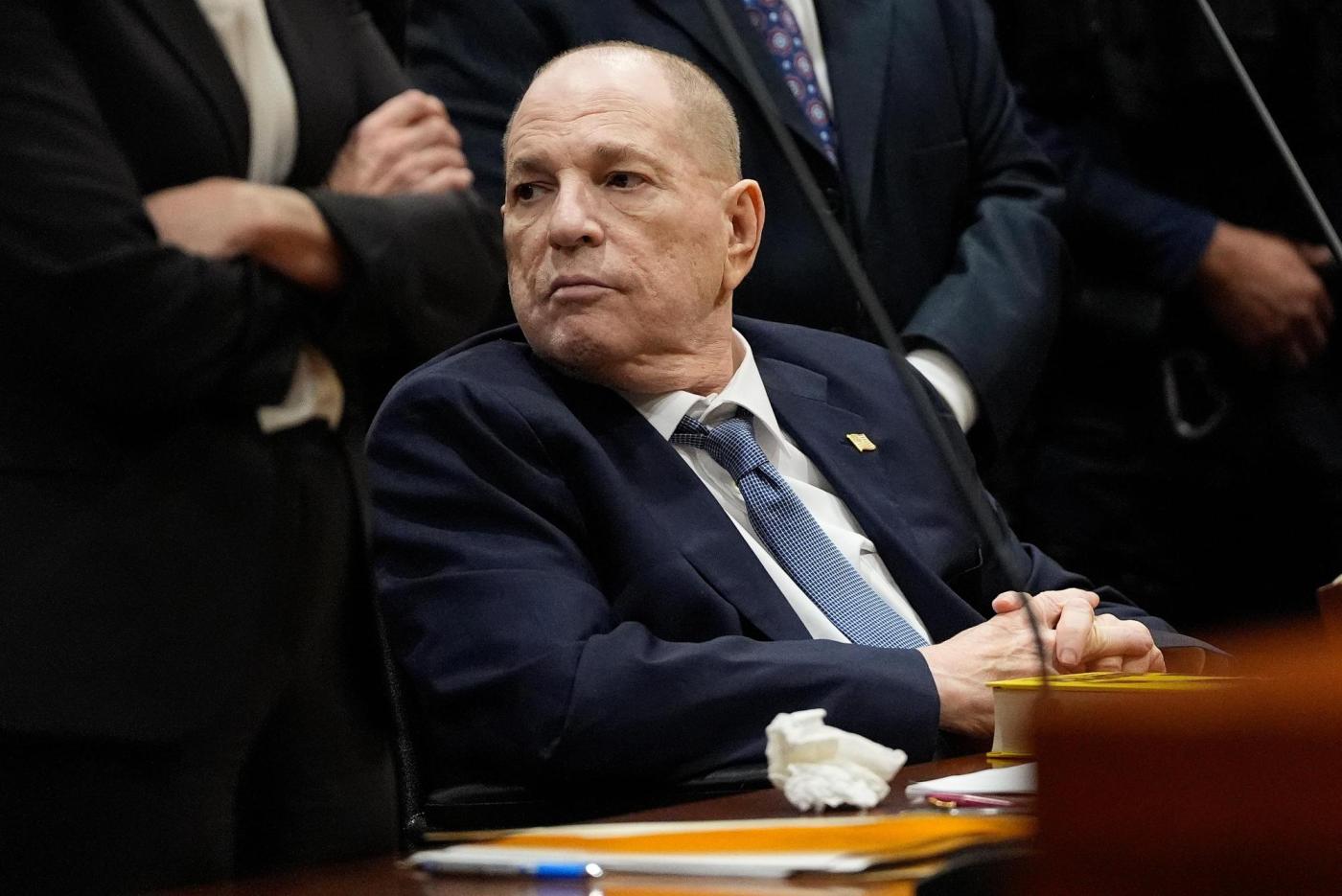
NEW YORK (AP) — Harvey Weinstein will remain locked up in New York as a court works out whether he should stay in a city jail while he awaits a retrial in a rape case, or be sent back to California to continue serving a prison sentence.

The fallen movie mogul denied his consent for an extradition request from California related to a separate rape conviction during a brief court hearing Thursday. Weinstein will continue to be held in New York as the extradition process plays out.

Weinstein, released from a city hospital days ago, showed up for the hearing in a wheelchair and wearing a dark suit. Defense attorney Diana Fabi Samson said later outside of court that their main concern was making sure Weinstein gets needed medical care while he remains in custody in New York.

“He’s holding up the best he can,” she said.

Samson described the court appearance Thursday as normal procedure and said California first needs to produce a warrant signed by the governor.

“They are not in a position to extradite Mr. Weinstein because they have not done what they need to do,” attorney Diana Fabi Samson said outside court.

His next appearance is set for Aug. 7.

The 16-year sentence Weinstein received in 2023 for raping a woman at a 2013 Los Angeles film festival had been on ice while he served time behind bars in New York after being found guilty of rape in Manhattan in 2020. But the Empire State conviction was overturned late last month, negating its 23-year sentence.

The 72-year-old has nevertheless remained in New York custody while Manhattan’s district attorney works to retry him. At a hearing last week, prosecutors said they could be ready as soon as September, and that at least one of two alleged victims was willing to testify again.

In that case, the once powerful former movie executive is accused of raping an aspiring actor in 2013 and sexually assaulting a TV and film production assistant in 2006. He denies the charges.

In vacating the conviction, New York’s highest court found that the trial judge prejudiced Weinstein with improper rulings, including by letting other women testify about allegations he wasn’t charged with.

The 2020 conviction was heralded at the time as a milestone in the #MeToo movement, an era that began in 2017 with a flood of allegations against Weinstein.

Weinstein was sent to serve his sentence in an upstate New York state prison. After being transferred to city custody following the appeals court decision, he was sent to Manhattan’s Bellevue Hospital, where his publicist says he was treated for pneumonia and other medical issues. He was moved to the city’s Rikers Island jail complex on Monday.

Trump-affiliated group releases new national security book outlining possible second-term approach

posted in: Politics | 0

By LYNN BERRY, DIDI TANG, JILL COLVIN and ELLEN KNICKMEYER (Associated Press)

WASHINGTON (AP) — Making future military aid to Ukraine contingent on the country participating in peace talks with Russia. Banning Chinese nationals from buying property within a 50-mile radius of U.S. government buildings. Filling the national security sector with acolytes of Donald Trump.

One of several groups trying to lay the groundwork for a second Trump administration if the former Republican president wins in November is out with a new policy book that aims to articulate an “America First” national security agenda.

The book, shared with The Associated Press before its release Thursday, is the latest effort from the America First Policy Institute. Like the Heritage Foundation’s “Project 2025,” the group is seeking to help Trump avoid the mistakes of 2016, when he entered the White House largely unprepared.

Beyond its policy efforts, the institute’s transition project has been working to draft dozens of executive orders and developing a training program for future political appointees. Heritage has been building an extensive personnel database and offering its own policy manuals.

Both groups stress they are independent from Trump’s campaign, which has repeatedly tried to distance itself from such efforts, insisting that the only Trump-backed policies are those the candidate articulates himself.

Still Fred Fleitz, the book’s editor, noted that he and retired Lt. Gen. Keith Kellogg, who served for a time as Trump’s acting national security adviser and wrote several of the chapters, have been in frequent touch with the former president, soliciting feedback and discussing topics such as Ukraine at length.

“We hope this is where he is. We’re not speaking for him, but I think he will approve,” said Fleitz, who formerly served as the National Security Council’s chief of staff.

He said he hopes the book will serve as “a guidebook that will be an intellectual foundation for the America First approach” to national security “that’s easy to use.”

“It’s a grand strategy,” added Kellogg. “You don’t start with the policies first. You start with the strategies first. And that’s what we’ve done.”

The group casts the current trajectory of U.S. national security as a failure, thanks to a foreign policy establishment it accuses of having embraced an interventionist and “globalist” approach at the expense of America’s national interests.

While short on specifics, the book offers some guideposts to how a future Trump administration could approach foreign policy issues such as Russia’s war against Ukraine. Trump has said, that if elected, he would solve the conflict before Inauguration Day in January, but has declined to say how.

The book’s chapter on the war spends more time discussing how the conflict unfolded than how to end it. But it says the U.S. should make future military aid contingent on Ukraine participating in peace talks with Russia.

It predicts the Ukrainian army will likely lose ground over time and advises against the U.S. continuing “to send arms to a stalemate that Ukraine will eventually find difficult to win.” But once there is a peace agreement, it says the U.S. would continue to arm Ukraine as a deterrent to Russia.

The authors seem to endorse a framework in which Ukraine “would not be asked to relinquish the goal of regaining all its territory” but would agree to diplomacy “with the understanding that this would require a future diplomatic breakthrough which probably will not occur before (Russian President Vladimir) Putin leaves office.”

It acknowledges that Ukrainians “will have trouble accepting a negotiated peace that does not give back all of their territory or, at least for now, hold Russia responsible for the carnage it inflicted on Ukraine. Their supporters will also. But as Donald Trump said at the CNN town hall in 2023, ‘I want everyone to stop dying.’ That’s our view, too. It is a good first step.”

The book blames Democratic President Joe Biden for the war and repeats Trump’s claim that Putin never would have invaded if Trump had been in office. Its main argument in defense of that claim is that Putin saw Trump as strong and decisive. In fact, Trump cozied up to the Russian leader and was reluctant to challenge him.

The bulk of the chapter is spent laying out an at times erroneous timeline of Biden’s handling of the war.

Going forward, it suggests Putin could be persuaded to join peace talks if Biden and other NATO leaders offer to put off NATO membership for Ukraine for an extended period. It suggests that the U.S. instead establish a “long-term security architecture for Ukraine’s defense that focuses on bilateral security defense.” It provides no explanation of what this would entail. It also calls for placing levies on Russian energy sales to pay for reconstruction in Ukraine.

The book is critical of Trump’s transition efforts in 2016, bemoaning a broad lack of preparation before Trump took office.

“The tumultuous transition of 2016/2017 did not serve President Trump and the nation well and slowed the advancement and implementation of his agenda,” the authors wrote. For instance, they note that before the election, Democrat Hillary Clinton’s transition team had submitted more than 1,000 names for future security clearance. Trump’s team submitted just 25.

The group says it has identified roughly 1,200 national security-related positions that the next administration will need to fill and urges it to be ready on Day 1 with Trump loyalists who adhere to the “America First” approach.

“It’s not about retaliating against people or trying to politicize government positions. It’s about making sure government workers do their job and keep politics out of their work,” Fleitz said.

The book describes China as the nation’s most pressing national security threat, eager to displace the U.S. as the world’s premier power. It proposes a hawkish policy that builds on approaches from both the Trump years and the Biden administration with the goal of making Beijing’s policies “largely irrelevant to American life.”

It elevates economic concerns with China to those of national security and proposes a reciprocal approach that would deny Beijing access to U.S. markets in the same way American companies have been denied in China.

The book also recommends more rigorous screening of cyber and tech companies owned by U.S. adversaries, especially China, to make sure they are not collecting sensitive information. It also recommends that Chinese nationals be banned from buying property within a 50-mile radius of any U.S. government property.

It calls for visa restrictions on Chinese students wishing to study in the United States and for the banning of TikTok and other Chinese apps out of concerns for data privacy. Trump, however, has spoken out against a law that would force TikTok’s sale or block U.S. access.

The analysts’ views of what an “America First” policy looks like often reflect the writers’ personal focuses.

For Ellie Cohanim, a former Trump deputy State Department envoy charged with monitoring and combating antisemitism, “America First” looks a lot like a shopping list for the Israeli military.

The U.S. should rush Israel a squadron of “25 Lockheed Martin F-35s, one squadron of Boeing’s F-15 EX, and a squadron of Apache E attack helicopters,” Cohanim wrote.

The U.S. should give some of its billions of dollars in military funding to Israel in Israeli currency so Israel can spend it at home, and Washington should push Arab states to foot the bill for the rebuilding of Gaza and accept Israel’s shelving any political talks with the Palestinians pending an indefinite period of compulsory deradicalization for the Palestinian people, she wrote.

___

Colvin reported from New York. Associated Press writer Rebecca Santana contributed to this report.