Gophers football: Important offensive players gather for extra work in Georgia

posted in: News | 0

If the Gophers football team’s passing game takes off this fall, the group of skill-position players responsible might point to a launching pad located in Georgia.

New starting quarterback Max Brosmer is behind a volunteer get-together with his new teammates over the next week. The Roswell, Ga., native started hosting retreats at his home base in the Atlanta suburbs during his five-year run at the University of New Hampshire, and he kept it going during spring break of his first semester at the U in early March.

“(When) you are talking about most people’s spring break — you hear Panama City (Fla.), you hear Miami, you hear all these things,” Gophers head coach P.J. Fleck said to kick off spring practices in late March. “Nope, he took a bunch of players back with him and they worked out during the spring break.”

In March, a much smaller gaggle of Gophers receivers with Georgia ties joined Brosmer for a few days of work and bonding, but now that spring semester classes and exams are finished, a dozen key offensive players are expected to convene for a week’s worth of workouts and hangouts through next Friday.

No. 1 receiver Daniel Jackson headlines the list; the all-Big Ten receiver was sidelined during spring practices and could use some time in the chemistry lab with QB1. Brand-new transfer receiver Tyler Williams, a four-star Floridian who spent his freshman season with the powerhouse Georgia Bulldogs, will catch his first balls from Brosmer. And U wideouts Le’Meke Brockington and Kenric Lanier are making return visits.

Top tailback Darius Taylor and three tight ends — Jameson Geers, Nick Kallerup and Pierce Walsh — will round out the pass catchers present.

The Gophers’ two-deep offensive roster is well covered on that guest list, and that level of attendance speaks to Brosmer’s leadership. He was named a team captain during spring practices.

Before practices began, Jackson was asked about his first impression of Brosmer; he offered one word instead — a “general.”

“He takes over the offense; he constructs the offense,” Jackson said. “You know he brings in his own little flair to it, something that we’ve never seen before.”

Maybe the biggest sign of Brosmer’s encompassing leadership is that all four Gophers quarterbacks are along for the trip to Georgia: true freshman Drake Lindsey, new Virginia Tech transfer Dylan Wittke and walk-on Max Shikejanski of Stillwater.

Fleck often talks about competing with, not against, teammates, so the entire QB group in Georgia must have the head coach nodding approvingly in Minnesota.

Brosmer said the spring break trip was more “spur of the moment,” but still “a blast” to do. He called it a “mock retreat.” The intention in March was always to have a larger group join in May, the month between the end of mandatory spring practices and summer workouts starting in Minneapolis in early June.

Brosmer first joined his new team during the week leading up to the Quick Lane Bowl in December, and he impressed teammates and coaches with how he quickly absorbed the playbook during that time in Detroit.

At that time, the Gophers were coming off a letdown 5-7 regular season that saw redshirt sophomore quarterback Athan Kaliakmanis transfer out days after loss to Wisconsin in the regular-season finale.

“I’ve never seen a person (Brosmer) walk into a situation, probably more uncomfortable of a situation,” Fleck reflected. “Because you are the new guy and connect as many people as quickly as he has.”

Fleck immediately saw Brosmer “on a mission.”

“He knows what he wants,” Fleck said of a chance to play at the Power Five level and set himself up for the NFL. “Him even coming here and getting all his goals and objectives out of (what he wants) in a program. I think this place fit, not just Minnesota, our coaching staff, our culture. but the situation he was walking into. We talked about how we needed a quarterback that could walk into here and connect the entire football team. That was going to be a tall task for anybody.”

Gophers offensive coordinator Greg Harbaugh said Brosmer was his “first real experience with recruiting a high-profile portal guy.”

Instead of giving his spiel, Harbaugh was listening to what Brosmer, a finalist for FCS player of the year, wanted in a new program.

“Then thinking about how I can put that into place to fit his needs, into what we want to do,” Harbaugh said. “It’s different than other relationships I have with players. Max and I look at it as a partnership. It’s one of those things we are working together constantly to put the best product out there.”

During the NFL playoffs, Brosmer sent Harbaugh a screenshot from a telecast of one of the Detroit Lions playoff games. It was a quote from quarterback Jared Goff on offensive coordinator Ben Johnson: “He listens to his players and adapts to what we do well.”

“He’s challenged me; he’s changed me,” Harbaugh said of Brosmer. “I think that is the coolest thing about our relationship that I hope you will be able to see on the field.”

In Harbaugh’s first season in charge in 2023, the Gophers passing game was outside the top 120 (out of 133) teams in the nation in passer rating (112.6), yards per attempt (6.0), attempts per game (24) and yards per game (143).

“We are taking a vested interest in attacking people and throwing the football,” Harbaugh said. “That’s always part of the plan. We want to be balanced. We wanted to be balanced last year. We did our best at certain times during the course of the year.”

But that fell well short of anything resembling a 50-50 balance a year ago, and the Gophers’ passing game turtled as the season finished.

During open spring practices in March and April, Brosmer found himself on a steeper learning curve, given the faster speed, bigger size of linemen and smaller passing windows at the Big Ten level.

Brosmer acknowledges he doesn’t have the strongest arm and has had to step up in other ways.

“I’ve always felt behind,” he said in comparison to other QBs. “Just because they’ve been able to throw the ball farther and harder than me.”

Brosmer said for years he’s worked on the proper anticipation of throws, knowing when and where those holes will open inside the defense and building a foundation of preparation with pass-catchers to thread them.

“I can’t throw the ball to a spot if the receiver is not going to be there, and vice versa,” Brosmer said. “So without training with the guys for hours and hours and hours on end, there’s no way that it can happen anyway.”

The Gophers are working in Georgia this spring to be able to make it happen in Minnesota this fall.

Related Articles

College Sports |


Gophers football adds Michigan State transfer Jaren Mangham via transfer portal

College Sports |


Gophers football: An emotional Tyler Nubin called it ‘unbelievable’ to join New York Giants

College Sports |


Gophers men’s basketball adds New Mexico State wing Femi Odukale

College Sports |


Gophers’ turnover at receiver continues with Dallas Sims transferring out

College Sports |


Gophers football: Jaylen Varner reenters NCAA transfer portal before playing for the U
Biden administration won’t conclude Israel violated terms of US weapons agreement, AP sources say

posted in: Politics | 0

By AAMER MADHANI, ELLEN KNICKMEYER, MIKE BALSAMO and ZEKE MILLER (Associated Press)

WASHINGTON (AP) — A soon-to-be-released Biden administration review of Israel’s use of U.S.-provided weapons in its war in Gaza does not conclude that Israel has violated the terms for their use, according to three people who have been briefed on the matter.

The report is expected to be sharply critical of Israel, even though it didn’t conclude that Israel violated terms of U.S.-Israel weapons agreements, according to one U.S. official.

The Biden administration’s first-of-its-kind assessment of its close ally’s conduct of the war comes after seven months of airstrikes, ground fighting and aid restrictions that have claimed the lives of nearly 35,000 Palestinians, mostly women and children.

A presidential directive agreed to by the White House under pressure from congressional Democrats and others mandated the review of whether Israel had complied with international law in its use of U.S.-provided weapons and other security support during the course of the war.

Two U.S. officials and a third person briefed on the findings of the national security memorandum to be submitted by Secretary of State Antony Blinken to Congress discussed the matter before the report’s release. They spoke on condition of anonymity because the information was not yet public.

A senior Biden administration official said the memorandum is expected to be released later Friday, but declined to comment on the findings.

Axios first reported on the memorandum’s finding.

Lawmakers and others who advocated for the review said President Joe Biden and previous American leaders have followed a double standard when enforcing U.S. laws governing how foreign militaries use U.S. support, an accusation the Biden administration denies. They had urged the administration to make a straightforward legal determination of whether there was credible evidence that specific Israeli airstrikes on schools, crowded neighborhoods, medical workers, aid convoys and other targets, and restrictions on aid shipments into Gaza, violated the laws of war and human rights.

Their opponents argued that a U.S. finding against Israel would weaken it at a time it is battling Hamas and other Iran-backed groups. Any sharply critical findings on Israel are sure to add to pressure on Biden to curb the flow of weapons and money to Israel’s military and further heighten tensions with Prime Minister Benjamin Netanyahu’s hard-right government over its conduct of the war against Hamas.

Any finding against Israel also could endanger Biden’s support in this year’s presidential elections from some voters who keenly support Israel.

The Democratic administration took one of the first steps toward conditioning military aid to Israel in recent days when it paused a shipment of 3,500 bombs out of concern over Israel’s threatened offensive on Rafah, a southern city crowded with more than a million Palestinians, a senior administration official said.

The presidential directive, agreed to in February, obligated the Defense and State departments to conduct “an assessment of any credible reports or allegations that such defense articles and, as appropriate, defense services, have been used in a manner not consistent with international law, including international humanitarian law.”

T he agreement also obligated them to tell Congress whether they deemed that Israel has acted to “arbitrarily to deny, restrict, or otherwise impede, directly or indirectly,” delivery of any U.S.-supported humanitarian aid into Gaza for starving civilians there.

At the time the White House agreed to the review, it was working to head off moves from Democratic lawmakers and independent Sen. Bernie Sanders of Vermont to start restricting shipments of weapons to Israel.

Israel launched its offensive after an Oct. 7 assault into Israel, led by Hamas, killed about 1,200 people. Two-thirds of the Palestinians killed since then have been women and children, according to local health officials. U.S. and U.N. officials say Israeli restrictions on food shipments since Oct. 7 have brought on full-fledged famine in northern Gaza.

Human rights groups long have accused Israeli security forces of committing abuses against Palestinians and have accused Israeli leaders of failing to hold those responsible to account. In January, in a case brought by South Africa, the top U.N. court ordered Israel to do all it could to prevent death, destruction and any acts of genocide in Gaza, but the panel stopped short of ordering an end to the military offensive.

Israel says it is following all U.S. and international law, that it investigates allegations of abuse by its security forces and that its campaign in Gaza is proportional to the existential threat it says is posed by Hamas.

Biden in December said “indiscriminate bombing” was costing Israel international backing. After Israeli forces targeted and killed seven aid workers from the World Central Kitchen in April, the Biden administration for the first time signaled it might cut military aid to Israel if it didn’t change its handling of the war and humanitarian aid.

Presidents Ronald Reagan and George H.W. Bush, in the 1980s and early 1990s, were the last presidents to openly hold back weapons or military financing to try to push Israel to change its actions in the region or toward Palestinians.

A report to the Biden administration by an unofficial, self-formed panel including military experts, academics and former State Department officials detailed Israeli strikes on aid convoys, journalists, hospitals, schools and refugee centers and other sites. They argued that the civilian death toll in those strikes — such as an Oct. 31 strike on an apartment building reported to have killed 106 civilians — was disproportionate to the blow against any military target.

The best days to fly around the Fourth of July in 2024

posted in: Society | 0

By Sally French | NerdWallet

For folks planning July Fourth vacations, prepare for crowds. The Transportation Security Administration (TSA) screened a record number of passengers in 2023, and those records are likely to be broken in 2024. In fact, in the first two months of 2024, travel volumes were roughly 6% higher than the same period in 2023, according to the TSA.

With the expected big crowds in mind, are some days better for air travel than others?

In 2024, July Fourth falls on a Thursday, which puts a wrench in predicting travel crowds. Will folks take the Friday after off to enjoy the long weekend? Or will they decide their vacation time is best used for another holiday?

Here’s some guidance around booking July Fourth weekend air travel in 2024, how you might be able to avoid the crowds — and potentially save money on airfare.

The best and worst days to fly July Fourth weekend

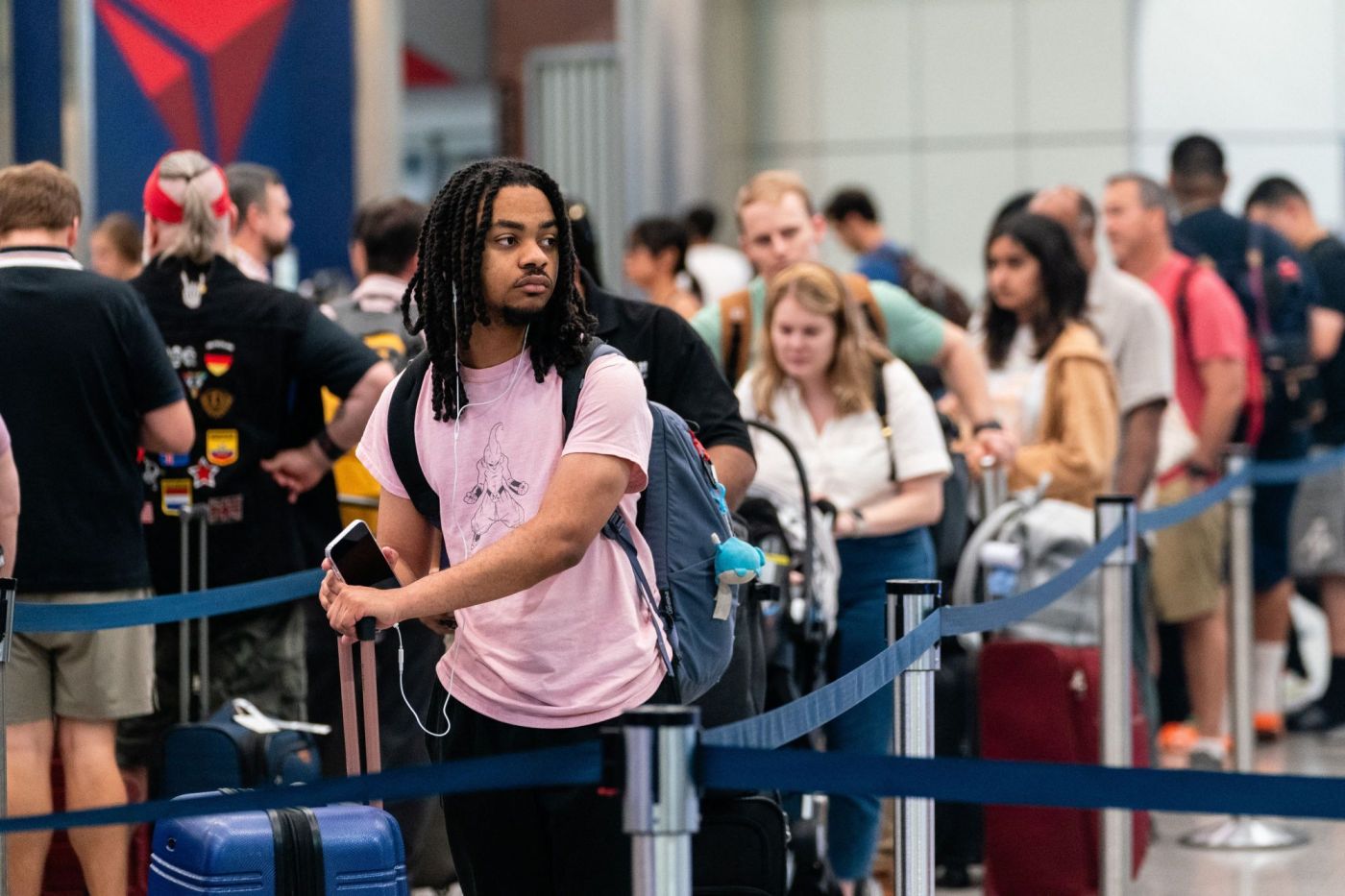
Are airports busy on July Fourth? NerdWallet analyzed TSA data showing the number of passengers screened at its U.S. checkpoints over the past three years, homing in on the seven days before and after July Fourth, to find the busiest days to fly.

The worst days to fly: To avoid crowds, don’t fly the Friday before July Fourth. In each of the past three years, the Friday before July Fourth was the busiest travel day before the Fourth of July weekend.

For post-holiday travel, the Sunday after ranks as the busiest day to fly.

The best days to fly: Typically, July Fourth is the least busy day to fly. On July Fourth of last year, airport crowds averaged just 70% of what they were relative to the busiest travel day, which was the Friday before July Fourth (June 30, 2023).

But if you’d rather spend July Fourth celebrating — and not in an airport — turn to Tuesday. The Tuesdays before and after the holiday rank among the least busy days to fly during July Fourth week.

The rankings of best and worst days to fly for July Fourth follow year-round travel patterns. No matter when you’re traveling, Fridays are, on average, the busiest day to fly, and Tuesdays are, on average, the least busy days to fly.

How this year’s Thursday holiday might impact long weekends

July Fourth falls on a Thursday, so people intending to travel for the holiday will likely take the next day, Friday, off and make it a long weekend. But given how few people are willing to travel on Independence Day, when will people actually fly?

The last time July Fourth fell on a Thursday was in 2019. Here’s a look at travel crowds by day in 2019, ranked from most to least crowded:

Sunday after, July 7 (most crowded).
Monday after, July 8.
Friday before, June 28.
Thursday before, June 27.
Sunday before, June 30.
Thursday after, July 11.
Wednesday before, July 3.
Wednesday after, July 10.
Tuesday after, July 9.
Monday before, July 1.
Saturday before, June 29.
Tuesday before, July 2.
Saturday after, July 6.
Friday after, July 5.
Thursday, July Fourth (least crowded).

In 2019, the July Fourth holiday was the least busy day to fly. Meanwhile, July 5, the day after the holiday, wasn’t busy either. That bucks the usual trend of Friday being the busiest travel day of the week. When it comes to July Fourth weekend travel, most people are already set in their locations by Friday.

But there’s one day that people are definitely crowding airports, and that’s the Sunday after July Fourth. Flying this day will cost you, too. According to travel booking app Hopper’s 2024 Travel Booking Hacks report, Sunday is the most expensive day to fly in the U.S., with airfares averaging 15% more than midweek departures.

The smarter, cheaper Fourth of July travel itinerary in 2024

Following typical July Fourth holiday travel patterns could mean costs in terms of airfare and time spent waiting in line at the airport. Deviate from that schedule to find lighter crowds and perhaps better July Fourth flight deals, too. Try these travel days instead:

Fly on July Fourth

If you don’t mind traveling on the holiday, you’re looking at the single emptiest air travel day of the period analyzed.

Do one better by flying early on the holiday. Hopper’s spring 2023 Flight Disruption Outlook found that flights that depart from 5 a.m. to 8 a.m. are half as likely to be delayed as flights with scheduled departure times after 9 a.m.

Plus, a morning flight improves your odds of catching the fireworks at your final destination.

Embrace Saturday travel

Rather than rush out from work on the Friday afternoon before the holiday to jump on a flight, relax at home that evening and depart Saturday morning before instead. Simply shifting your trip by one day could likely result in going from one of the busiest to lightest travel days of the July Fourth travel period.

The same goes for returning home. While it can be tempting to extend your trip as long as possible before you have to get back to work on Monday, skip the Sunday flight and fly home on Saturday instead. Bonus: You’ll have a day at home to rest and recover before the new workweek. How responsible of you.

Fly on July 5

Though Friday is typically one of the most expensive days to fly year-round, that’s unlikely to be the case this particular week.

So another option is to fly home on July 5. This allows you to still spend the holiday in your destination of choice. By returning on Friday, you’ll still have the full weekend at home to take a vacation from your vacation before Monday.


Sally French writes for NerdWallet. Email: sfrench@nerdwallet.com. Twitter: @SAFmedia.

Heavy fighting in Gaza’s Rafah keeps aid crossings closed, sends 110,000 civilians fleeing

posted in: News | 0

By WAFAA SHURAFA and JOSEPH KRAUSS (Associated Press)

RAFAH, Gaza Strip (AP) — Heavy fighting between Israeli troops and Palestinian militants on the outskirts of the southern Gaza city of Rafah has left crucial nearby aid crossings inaccessible and driven more than 110,000 people to flee north, U.N. officials said Friday.

With nothing entering through the crossings, food and other supplies were running critically low, aid agencies said.

The World Food Program will run out of food for distribution in southern Gaza by Saturday, said Georgios Petropoulos, an official with the U.N. Office for Coordination of Humanitarian Affairs in Rafah. Aid groups have said fuel will also be depleted soon, forcing hospitals to shut down critical operations and bringing to a halt trucks delivering aid across south and central Gaza.

The U.N. and other agencies have warned for weeks that an Israel assault on Rafah, on the border with Egypt near the main aid entry points, would cripple humanitarian operations and cause a disastrous surge in civilian casualties. More than 1.4 million Palestinians — half of Gaza’s population — have been sheltering in Rafah, most after fleeing Israel’s offensives elsewhere.

Heavy fighting was also underway in northern Gaza, where Hamas appeared to have once again regrouped in an area where Israel has already launched punishing assaults. Hamas has been designated as a terrorist organization by the United States, Canada and the European Union.

Israel’s move into Rafah has been short of the full-scale invasion that it has planned. The United States is deeply opposed to a major offensive and stepping up pressure by threatening to withhold arms.

But the heavy fighting has shook the city and spread fear that a bigger assault was coming. Artillery shelling and gunfire rattled throughout the night into Friday, an Associated Press reporter in the city said.

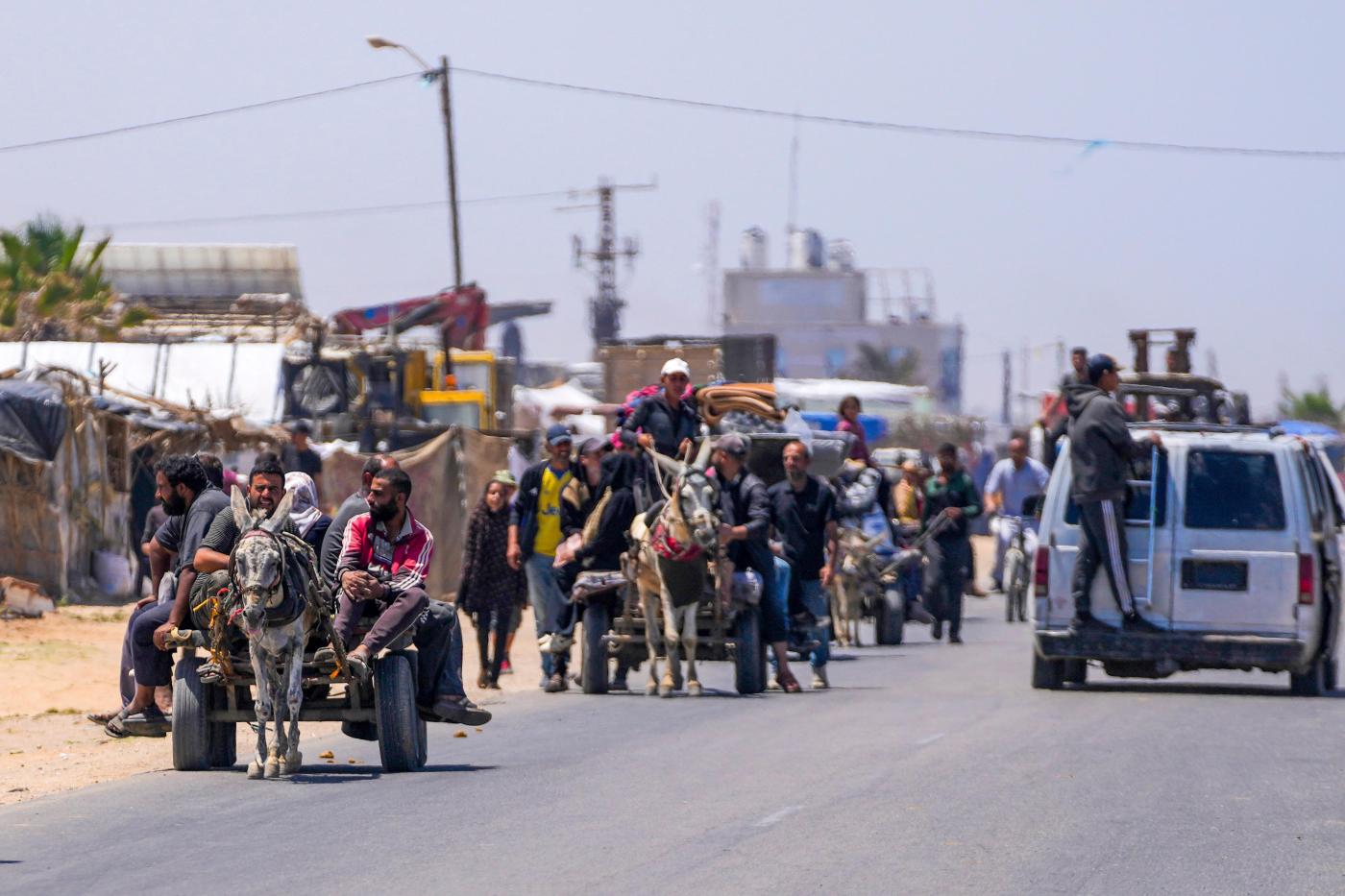
The U.N. agency for Palestinian refugees, known as UNRWA, said more than 110,000 people have fled Rafah. Families who have already moved multiple times during the war packed up to go again. One woman held a cat in her arms as she sat in the back of a truck piled with her family’s belongings about to head out.

The full invasion hasn’t started “and things have already gotten below zero,” said Raed al-Fayomi, a displaced person in Rafah. “There’s no food or water.”

Those fleeing erected new tents camps in the city of Khan Younis — which was half destroyed in an earlier Israeli offensive — and the town of Deir al-Balah, straining infrastructure.

The international charity Project Hope said its medical clinic in Deir al-Balah had seen a surge in people from Rafah seeking care for blast injuries, infections and pregnancies. “People are evacuating to nothing. There are no homes or proper shelters for people to go to,” said the group’s Gaza team leader based in Rafah, Moses Kondowe.

Petropoulos said humanitarian workers had no supplies to help them set up in new locations. “We simply have no tents, we have no blankets, no bedding, none of the items that you would expect a population on the move to be able to get from the humanitarian system,” he said.

Israeli troops captured the Gaza side of the Rafah crossing with Egypt on Tuesday, forcing it to shut down. Rafah was the main point of entry for fuel.

Israel says the nearby Kerem Shalom crossing — Gaza’s main cargo terminal — is open on its side, and that aid convoys have been entering. It said trucks carrying 200,000 liters of fuel were allowed to enter the crossing Friday.

But the U.N. said it is too dangerous for workers to reach the crossing on the Gaza side to retrieve the aid because of Israel’s incursion and the ensuing fighting with Hamas.

Israeli troops are battling Palestinian militants in eastern Rafah, not far from the crossings.

The military said it had located several tunnels and eliminated militants in close combat and with airstrikes.

Hamas’ military wing said it struck a house where Israeli troops had taken up position, an armored personnel carrier and soldiers operating on foot. There was no comment from the Israeli military,

It is not possible to independently confirm battlefield accounts from either side.

Hamas also said it launched mortar rounds at troops near the Kerem Shalom crossing. The military said it intercepted two launches. The crossing was initially closed after a Hamas rocket attack on nearby forces last weekend that killed four Israeli soldiers.

Israel says Rafah is the last Hamas stronghold in Gaza and key to its goal of dismantling the group’s military and governing capabilities and returning scores of hostages captured in Hamas’ Oct. 7 attack that triggered the war.

But Hamas has repeatedly regrouped, even in the hardest-hit parts of Gaza.

Heavy battles erupted this week in the Zeitoun area on the outskirts of Gaza City in the northern part of the territory. Northern Gaza was the first target of the ground offensive, and Israel said late last year that it had mostly dismantled Hamas there.

The north remains largely isolated by Israeli troops, and the U.N. says the estimated 300,000 people there are experiencing “full-blown famine.”

Israeli Prime Minister Benjamin Netanyahu has vowed to proceed with the Rafah offensive with or without U.S. arms, saying “we will fight with our fingernails” if needed in a defiant statement late Thursday. The U.S. has stepped up weapons deliveries to Israel throughout the war, and the the Israeli military says it has what it needs for Rafah operations.

Related Articles

World News |


Ivana Stradner: U.S. must stop Putin

World News |


Mixing games and education, Prince Harry and Meghan arrive in Nigeria to promote mental health

World News |


Thomas Friedman: Why the campus protests are so troubling

World News |


Dogs entering US must be 6 months old and microchipped to prevent spread of rabies, new rules say

World News |


Stephen Mihm: Comparing Gaza protests to the ’60s is wrong — and dangerous

The war began with Hamas’ surprise attack into southern Israel last year, in which it killed some 1,200 people, mostly civilians, and took another 250 hostage. Hamas is still holding some 100 captives and the remains of more than 30 after most of the rest were released during a cease-fire last year.

Israel’s bombardment and ground offensives in Gaza have killed more than 34,800 Palestinians, mostly women and children, according to the Gaza Health Ministry, which does not distinguish between civilians and combatants in its figures. Much of Gaza has been destroyed and some 80% of Gaza’s population have been driven from their homes.

Israel’s incursion into Rafah complicated what had been months of efforts by the U.S., Qatar and Egypt to broker a cease-fire and the release of hostages. Hamas this week said it had accepted an Egyptian-Qatari cease-fire proposal, but Israel says the plan does not meet its “core” demands. Follow-up talks appeared to end inconclusively on Thursday.

Hamas has demanded guarantees for an end to the war and a full Israeli withdrawal from Gaza as part of any deal — steps Israel has ruled out.

Krauss reported from Jerusalem. Associated Press writer Stephen Graham in Berlin contributed.