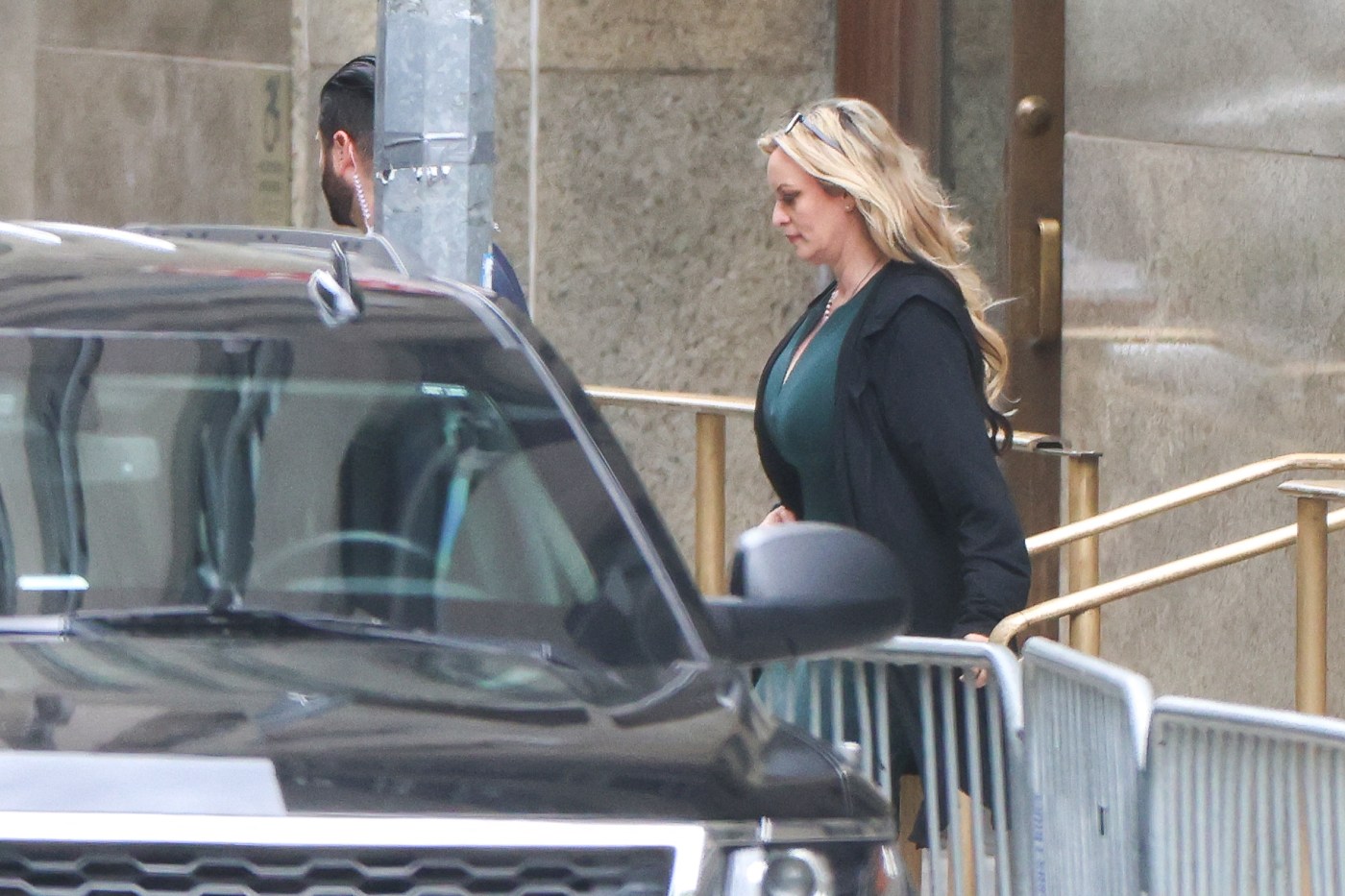
Stormy Daniels unfavorably compares Trump to ‘real men’ after hush-money trial testimony

posted in: News | 0

David Matthews | New York Daily News

Stormy Daniels blasted Donald Trump on social media Thursday night, just a few hours after she finished testifying against the former president in his Manhattan hush-money trial.

“Real men respond to testimony by being sworn in and taking the stand in court. Oh…wait. Nevermind,” she wrote in a post on X — a taunting reference to Trump not testifying in the case and using his own social media accounts to rail against the proceedings.

The zinger came after Trump’s lawyers unsuccessfully requested a mistrial based on Daniels’ testimony.

If Trump were to testify, he would open himself up to cross-examination by prosecutors.

Earlier in the day, Daniels pushed back during a tense, hour-long cross-examination by Trump’s attorney Susan Necheles.

Related Articles


Jamelle Bouie: The one thing Trump knows he wants in a running mate


Prosecutors focus on phone records in Trump’s hush money trial as Michael Cohen’s testimony awaits


Most of Trump’s kids, including Barron, named presidential convention delegates for Florida


Judge denies bid to modify gag order so Trump can respond to Stormy Daniels’ tryst testimony


Stormy Daniels delivers shocking testimony about Trump, but trial hinges on business records

Daniels, whose real name is Stephanie Clifford, said she had sex with Trump in a Lake Tahoe hotel room in 2006. Trump has denied the two had any such encounter. The alleged tryst is at the center of Manhattan District Attorney Alvin Bragg’s case alleging Trump covered up a $130,000 reimbursement to fixer Cohen for paying Daniels into silence days before the 2016 election.

The presumed Republican presidential nominee scowled and crossed his arms during her testimony.

Trump was charged with 34 felony counts of falsifying business records for purportedly buying Daniels’ silence.

After Daniels’ testimony, Trump lawyer Todd Blanche argued unsuccessfully for a mistrial, claiming Daniels’ comments were “a dog whistle for rape” and went far beyond the scope of the charges Trump’s facing.

“He’s a corrupt judge, and he’s totally conflicted,” Trump told reporters outside the courtroom.

‘Birthing friendly’ label requires little effort by hospitals

posted in: Society | 0

Jessie Hellmann | (TNS) CQ-Roll Call

WASHINGTON — Six months after the launch of the Biden administration’s “birthing friendly” designation for hospitals, advocates are questioning the next steps for the tool aimed at incentivizing better care for patients.

Beginning last fall, hospitals that achieved the designation received an icon on Care Compare, a federal website aimed at helping consumers pick health care providers.

But it’s not difficult for hospitals to receive the designation, with 2,225 — that is, most eligible hospitals — having received it as of April.

Of the nearly 1,000 acute care hospitals that didn’t get the designation, more than 800 said they didn’t provide delivery or labor care.

And only 135 didn’t get the designation because they didn’t meet the requirements of participating in a statewide or national perinatal quality improvement collaborative program.

What’s more, many of the hospitals that have received the designation perform cesarean sections above the recommended levels, which could indicate overuse of the procedure. C-sections are considered riskier than vaginal birth, with a longer recovery time.

“Right now, it falls short in terms of what pregnant people would need,” said Sinsi Hernández-Cancio, vice president of health justice at the National Partnership for Women and Families.

While many people typically don’t have much of a choice on where they give birth because of insurance limitations or living in areas with few providers, for those with choices, the designation currently is of little use, she said.

“Given that the majority of hospitals have gotten the designation because the requirements for it are a pretty low bar, it’s not really a useful distinction even for those consumers that do have a choice,” Hernández-Cancio said. “Because if the majority of the hospitals have it, and all the ones in your area do, it doesn’t make a difference.”

The designation is part of the Biden administration’s efforts to improve maternal health amid concerns about persistent inequities in health outcomes.

It was rolled out last November with much fanfare, touted by Vice President Kamala Harris as an important step to increasing “high-quality maternity care.”

But all a hospital has to do to receive the designation is attest to participating in a statewide or national perinatal quality improvement collaborative program and implementing evidence-based interventions to improve maternal health, sometimes called bundles.

While the Centers for Medicare and Medicaid Services has said it will work toward including other factors in the designation, when that will happen is unclear. The designation was not mentioned in the 2025 proposed hospital inpatient payment rule, which would typically be the vehicle for such changes.

While there is evidence that participating in high-quality collaboratives and implementing evidence-based practices can improve birth outcomes, the designation currently doesn’t probe into how meaningful those efforts are.

“It is kind of a low bar for hospitals to self-describe that they have implemented it without defining what implementation of a bundle is,” said Elliott Main, former medical director of the California Maternal Quality Care Collaborative, a stakeholder organization that aims to improve maternal health outcomes in the state.

Main, who advised CMS on the designation, said it is typical for designations to begin with a soft launch to get hospitals involved in the process.

“What does it mean to be engaged, to become a member (of a collaborative)— those kinds of terms are still being defined, but it gets hospitals to sit up and pay attention,” he said.

For example, The Joint Commission, which accredits health care organizations, has a checklist for evidence-based safety practices that should be implemented in maternity units to reduce the risk of harm from hemorrhage and hypertension.

“I think that’s likely a direction CMS may go,” Main said.

Improving care

While hospital designations may have little utility for patients, they have evolved to become powerful ways to get hospitals to improve patient care, experts say.

For example, California’s Cal Hospital Compare awards the “maternity care honor roll” to hospitals that have C-section rates below 23.6%, a goal that aligns with the Department of Health and Human Services’ “Healthy People 2030” initiative to reduce C-section births among low-risk, first-time mothers.

“It’s really a great carrot for hospitals and other facilities to improve,” said Alex Stack, director of programs and strategic initiatives at Cal Healthcare Compare.

Cal Healthcare Compare is working on revamping the model to include data on severe complications, access to doula care and breastfeeding.

“The great thing about an honor roll is it gives additional emphasis and helps facilities to prioritize further what the collective state or region is trying to work towards together,” Stack said.

The honor roll in California is part of a multifaceted effort to reduce C-section rates. According to provisional data from the Centers for Disease Control and Prevention, California’s rate of C-sections in low-risk mothers was 25.9%, below the national average of 26.6%.

Throughout the country, there is extreme variability between different hospitals and different regions that can’t be explained solely by patient characteristics, Main said. The culture of a hospital and the training of the people who work there likely have more of an impact.

Better data collection could be part of the solution.

This is the first year CMS will require acute care hospitals report rates of severe obstetric complications and C-sections, which will give a fuller picture of the issue at individual hospitals. Currently, that data is not collected in a widespread manner.

“We intend to propose a more robust set of criteria for awarding the designation in future notice-and-comment rulemaking,” a CMS spokesperson said in a statement. “CMS is considering how to build upon the Maternal Morbidity Structural measure through the future inclusion of clinical outcome and patient experience measures.”

As CMS puts more requirements on the measure, hospitals could lose the designation if their care does not improve.

Of more than 1,300 birthing-friendly hospitals surveyed by the Leapfrog Group, a nonprofit focused on health care transparency, 58% — 782 hospitals —did not meet the Healthy People 2030 goal of a C-section rate of 23.6%, according to a CQ Roll Call analysis.

While there are still six years to meet that goal, 56% of those hospitals are also not meeting the Healthy People 2020 goal of 23.9%.

And nearly 21% of the birthing-friendly hospitals — 279 hospitals — had C-section rates of 30% or higher.

Main said adding disqualifiers to the designation could be an option.

“One thing that’s been discussed… is to be an awarded hospital you can’t have a high C-section rate. A C-section rate over 30, that would disqualify you,” he said. “There’s no reason for hospitals to have over 30% C-section rate.”

For example, Harrison Memorial Hospital in Kentucky had the highest rate of all of the “birthing friendly” hospitals at 58% of births done through C-section. The hospital did not respond to a request for comment.

Still, that doesn’t stop hospitals from touting their designation on social media without explaining to patients what that really means.

While Hernández-Cancio said she understands the intent behind making it simple for hospitals to initially achieve the designation, she said nothing is stopping a hospital from advertising the award in the future even if it loses that award as standards ramp up.

“If it’s being used for marketing and PR, that’s a bit problematic,” she said.

___

©2024 CQ-Roll Call, Inc., All Rights Reserved. Visit cqrollcall.com. Distributed by Tribune Content Agency, LLC.

US pledges money and other aid to help track and contain bird flu on dairy farms

posted in: News | 0

By JONEL ALECCIA and MIKE STOBBE (Associated Press)

U.S. health and agriculture officials pledged new spending and other efforts Friday to help track and contain an outbreak of bird flu in the nation’s dairy cows that has spread to more than 40 herds in nine states.

The new funds include $101 million to continue work to prevent, test, track and treat animals and humans potentially affected by the virus known as Type A H5N1, the U.S. Department of Health and Human Services said. And they include up to $28,000 each to help individual farms test cattle and bolster biosecurity efforts to halt the spread of the virus, according to the U.S. Department of Agriculture.

In addition, dairy farmers will be compensated for the loss of milk production from infected cattle, whose supply drops dramatically when they become sick, officials said. And dairy farmers and farm workers would be paid to participate in a workplace study conducted by the USDA and the CDC.

So far, farmers have been reluctant to allow health officials onto their farms to test cattle because of uncertainty about how it would affect their business, researchers have said. Also, farm workers, including many migrant workers, have been reluctant to be tested for fear of missing work or because they didn’t want to be tracked by the government.

The incentives should help increase farmers’ willingness to test their herds, said Keith Poulsen, director of the Wisconsin Veterinary Diagnostic Laboratory, who has been monitoring the outbreak.

“It provides the latitude and capacity to start going in the right direction,” he said.

The new spending comes more than six weeks after the first-ever detection of an avian bird flu virus in dairy cattle — and one confirmed infection in a Texas dairy worker exposed to infected cows who developed a mild eye infection and then recovered. About 30 people have been tested, with negative results, and another 220 are being monitored, according to the CDC.

As of Friday, 42 herds in nine states have confirmed infections in dairy cows. But Agriculture Secretary Tom Vilsack said that the outbreak has not spread more widely.

“It’s still in the same nine states and that’s the most positive thing about where we are,” he told reporters.

Remnants of the virus have been found in samples of grocery store dairy products, but tests by the U.S. Food and Drug Administration confirmed that pasteurization, or heat-treating, killed the virus. The USDA found no evidence of the virus in a small sample of retail ground beef.

“The risk to the public from this outbreak remains low,” Health and Human Services Secretary Xavier Becerra said.

The Associated Press Health and Science Department receives support from the Howard Hughes Medical Institute’s Science and Educational Media Group. The AP is solely responsible for all content.

One man was a Capitol Police officer. The other rioted on Jan. 6. They’re both running for Congress

posted in: Society | 0

By JOHN RABY (Associated Press)

CHARLESTON, W.Va. (AP) — For Derrick Evans, being part of the mob that stormed the U.S. Capitol wasn’t enough. The former West Virginia lawmaker wants to make his path to the halls of Congress permanent.

On the other side of the metal barricades that day, Police Officer Harry Dunn couldn’t stand what he saw as he defended the Capitol and its inhabitants from rioters on Jan. 6, 2021. Ultimately, the Maryland resident watched lawmakers he had protected vote to acquit former President Donald Trump and deny the violence and trauma that led to the deaths of some of his fellow officers.

On Tuesday, Evans and Dunn will make bids for U.S. House seats in their respective state primaries. They come into the election with dramatically different interpretations about what happened that day, and their performance in Tuesday’s primaries in West Virginia and Maryland could hint at whether voters’ opinions about the attack and its meaning have changed over time.

In terrorizing the Capitol for an entire afternoon, rioters wielded pipes, bats and bear spray. They used flagpoles as weapons, brutally beat police officers, chanted that they wanted to hang Vice President Mike Pence, broke through the glass and busted through doors as lawmakers frantically evacuated. A Georgia man bragged that he “fed” a police officer to the mob. More than 100 police officers were injured, many beaten and bloodied. At least nine people who were there died during and after the rioting, including a female rioter who was shot and killed by police.

More than 1,350 people have been charged with federal crimes related to the Capitol riot. Over 850 of them have been sentenced — roughly two-thirds received prison terms ranging from a few days to 22 years.

The two candidacies “symbolize a shift on the part of the two big parties regarding their commitment to law and order,” said Timothy Naftali, a senior researcher at Columbia University’s School of International and Public Affairs.

It’s remarkable, Naftali said, that on the same day, a former police officer could become a Democratic nominee while Republicans could “select an unrepentant felon” in Evans, who “proudly displays the fact that he violated the law on Jan. 6.”

“That is a split screen that one might not have been able to imagine 15 years ago,” he said.

Related Articles

National Politics |


Analysis: Rating change. Nevada a Toss-up in presidential race

National Politics |


Most of Trump’s kids, including Barron, named presidential convention delegates for Florida

National Politics |


Judge denies bid to modify gag order so Trump can respond to Stormy Daniels’ tryst testimony

National Politics |


Lawyers’ coalition provides new messengers for Black voter engagement

National Politics |


Netanyahu on US threat to withhold arms: Israel will fight with its ‘fingernails’ if needed

While Evans is seen as a longshot to unseat an established incumbent and doesn’t have the fundraising advantage Dunn enjoys in Maryland, their candidacies at least raise the possibility that they could serve together while holding starkly different views of the violence and destruction of Jan. 6. But even if Dunn wins and Evans loses, he’d be serving alongside dozens of Republicans who have come to view the defendants as “hostages.”

Dunn, a 40-year-old Democrat, resigned last December from the Capitol Police after more than 15 years of service. He was four years short of pension eligibility.

“I’m running for Congress because the forces that spurred that violent attack on January 6th are still at work in our country today, and as a patriotic American, I believe it is my duty to step up and defend our democracy,” Dunn said.

Dunn leads all candidates in fundraising by wide margins in Maryland’s 3rd District race, with $4.6 million raised and $714,000 cash on hand, according to his latest campaign finance report with the Federal Election Commission.

Evans, a 39-year-old Republican and avid Trump supporter, calls himself the only elected official who “had the courage” to stand behind efforts to temporarily halt certification of President Joe Biden’s 2020 election victory. He livestreamed himself on Facebook cheering on what he described as a “revolution.”

Evans was arrested two days after the riot and resigned from his West Virginia House of Delegates seat a month before the 2021 legislative session. He pleaded guilty to a felony civil disorder charge and served three months in prison. At his sentencing hearing, Evans apologized for his actions, but he did an about-face upon leaving prison. He began portraying himself as a victim of a politically motivated prosecution.

Evans once called himself a Democrat, finishing sixth out of seven candidates in a state House primary in 2016. He then switched to the Libertarian Party in the general election and finished last among five candidates.

Evans is taking on West Virginia 1st Congressional District Rep. Carol Miller, also a big Trump backer. In 2022, Miller received 66% of the vote in a five-candidate GOP primary en route to winning her third term in Congress.

Miller is focused on her own accomplishments and endorsements, not any criticism from Evans or his status as a Jan. 6 defendant.

“I don’t think about him at all,” she said.

Dunn is among nearly two dozen Democrats running in Maryland’s 3rd Congressional District, where incumbent Democrat John Sarbanes is not seeking reelection. The heavily Democratic jurisdiction stretches between Baltimore and the nation’s capital.

Trump and New York Rep. Elise Stefanik have referred to Jan. 6 defendants who went to prison as “hostages,” reflecting a shifting tone among some conservatives toward the violent attempt to overturn the election result. Evans wrote a 2023 book titled “Political Prisoner: The Untold Story of January 6th.”

“I kind of think it fits into the general theme of what’s viewed as accepted political behavior among some Republicans in the 2020s that probably wouldn’t have been the case 10-20 years ago,” said Scott Crichlow, an associate political science professor at West Virginia University. “Specifically, I think it fits into the general Derrick Evans sphere of behavior. But also that seems to more and more kind of fit, with at least among some Republicans, what you want to see candidates doing and saying today.”

Later this month, another convicted Jan. 6 defendant, construction superintendent Chuck Hand, is running in a GOP U.S. House primary in southwest Georgia’s 2nd District. Hand faces three other Republicans on May 21 for the right to take on longtime Democratic incumbent Sanford Bishop. Hand and his wife, Mandy Robinson-Hand, were convicted of misdemeanor parading and picketing at the Capitol. Both were sentenced to 20 days in federal prison.

Both Hand and Evans echo false claims still made by Trump that the 2020 election was stolen.

Dunn is repulsed by such rhetoric.

“I won’t sit on the sidelines while Donald Trump and his MAGA allies in Congress try to tear our country apart,” he said, referring to Trump’s “Make America Great Again” slogan.

How much legitimacy there is to rioters’ candidacies remains to be seen. None of those seeking public office have gained much traction with voters so far.

In New Hampshire, Capitol riot defendant Jason Riddle plans to run in a crowded GOP primary for the state’s 2nd District U.S. House seat. The candidate filing period for the Sept. 10 primary is in early June. Incumbent Democratic Rep. Annie Kuster announced in March that she won’t seek a seventh term. Riddle was sentenced to 90 days in prison for helping himself to some wine from a lawmaker’s liquor cabinet and stealing a Senate procedure book that he later sold.

In Arizona, Jacob Chansley, the spear-carrying rioter whose horned fur hat, bare chest and face paint made him one of the riot’s more recognizable figures, served about 27 months of a 41-month sentence. He hoped to run as a Libertarian in Arizona’s 8th Congressional District seat but failed to meet a deadline to turn in required petition signatures to get his name on the ballot.

Tuesday’s primaries in Maryland and West Virginia will offer a more tangible test.

“On the one hand, Evans is looking at it as something to be proud of. Dunn’s looking at it as something that should never happen again,” said Crichlow. “And in that way, these two campaigns really do kind of capture fundamentally different perspectives about the last few years in politics and what politics will look like going forward.”