St. Paul: University of St. Thomas neighbors rebuffed in efforts against D1 hockey/basketball arena

posted in: News | 0

When Jerome Abrams, a retired abdominal surgeon, learned that the University of St. Thomas planned to install a Division I hockey and basketball arena near his St. Paul home, he pulled out a tape measure.

A light snowfall had accumulated along Fairmount Avenue. By his calculation, in areas where cars were parked on both sides of the street, the travel lanes had been reduced to 8 feet in width in each direction.

“A fire engine is 10 feet, and so is an ambulance,” said Abrams, who lives with his wife near Woodlawn Avenue and Fairmount, two blocks south of the St. Paul campus. “I view it as a serious problem since I’m getting on in years.”

Demolition and site prep continue at the future site of the University of St. Thomas hockey and basketball arena across the street from the new Schoenecker Center on Thursday, Feb. 8, 2024. (John Autey / Pioneer Press)

University officials maintain those concerns haven’t fallen on deaf ears. They’re actively working on traffic mitigation strategies, such as online ticket sales with assigned parking spots and possible shuttle bus arrangements that could pick up sports fans by Allianz Field in the Midway on especially busy game days.

“They’re worried about traffic and parking,” said Amy McDonough, chief of staff in the office of university president Rob Vischer, in a recent interview. “So are we. We’re not saying there’s not going to be impacts.”

Still, McDonough noted, the arena’s most popular events will likely top out at 5,300 attendees a handful of times each year, and seating capacity will be roughly one-fourth that of Allianz Field, or 1,000 seats larger than James Griffin Stadium at Central High School. Most events, she said, will be managed like current football games at the O’Shaughnessy Stadium on campus, which also has capacity for more than 5,000 fans.

“It’s not the Xcel Energy Center,” McDonough said.

Committees rebuff efforts to halt construction

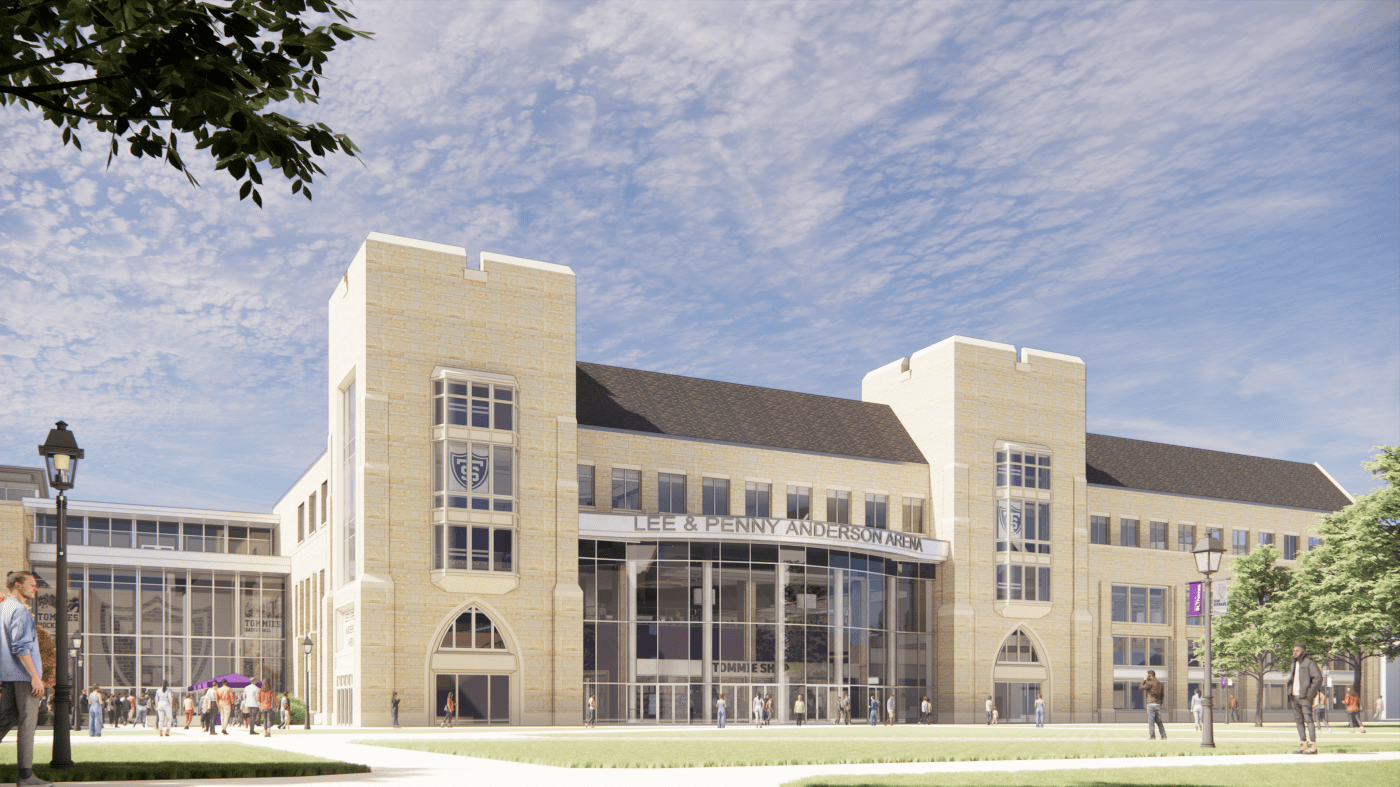
Twice in as many weeks, Abrams and other Macalester-Groveland homeowners living near Minnesota’s largest private university have approached officials at St. Paul City Hall, demanding that they put a halt to the Lee and Penny Anderson Arena, a 5,500-seat hockey and basketball sports facility whose construction is already underway off Cretin and Grand avenues.

They’ve cited access concerns for public safety vehicles, parking, traffic, pollution runoff to the Mississippi River, zoning controls and even the possibility of ammonia spills related to ice coolant.

And twice in as many weeks, key city committees have rebuffed their efforts, signaling a disinterest in blocking the project, which the university maintains needs no zoning variances. A conditional site plan approved by city staff last October had allowed the university to do some initial excavation work. The McCarthy Gymnasium and a service center were demolished in March to make room and the arena’s footings and foundation have already been installed.

Arena construction was poised to get fully underway this season but was put on hold last month after residents filed two appeals of the final site plan, which had been approved by city staff on April 4.

The St. Paul Planning Commission’s zoning committee held a public hearing on May 3 that was heavily attended by opponents, stretching public testimony to almost four hours, but the committee then voted unanimously to recommend denial of both appeals.

The full Planning Commission took up the question last Friday, and then voted almost unanimously to deny both efforts, with three abstentions.

The Planning Commission, in its published resolution, noted “having destinations close to where people who access those destinations live reduces emissions and vehicle miles traveled. … The arena is conducive to walking, biking and using public transit as alternatives to driving.”

Opponents, many of them senior residents of one of the city’s wealthiest neighborhoods who have banded together under the title Advocates for Responsible Development, have the right to file further appeals within 10 days of the Planning Commission’s May 10 decision, which could land the arena’s site plan before the St. Paul City Council in June.

“There will definitely be an appeal,” said Dan Kennedy, an attorney who lives on Summit Avenue.

Here are some key questions:

What will the arena be used for?

University officials said in addition to D1 hockey and basketball games and practices, the facility also will host team rooms, lockers, weight rooms and coaches’ offices for soccer and softball. The facility also could be a boost for the school’s burgeoning Sports Science Institute, a department of exercise science within the new College of Health. “That is a real potential growth area within St. Thomas,” McDonough said.

Has the arena been approved by requisite environmental and zoning authorities?

Yes, mostly. The city published an Environmental Assessment Worksheet in June 2023, though residents have filed legal action attempting to force a more elaborate environmental review. The Minnesota Court of Appeals heard oral arguments on April 11 and has 90 days from that date to issue a decision, meaning a legal finding could be made public in early July.

The city’s Heritage Preservation Commission signed off on the project in November after reviewing how the arena’s north wall juts into a historic preservation district along Summit Avenue. The Capitol Region Watershed District, the city’s Department of Safety and Inspections and city planning staff have offered their approvals.

How many seats?

The city’s Environmental Assessment Worksheet, which includes a transportation study, identifies a seating capacity of 5,500 attendees. University officials say they’ll limit seating to even less than that, for a maximum of 5,300 visitors for a men’s basketball game. Hockey, which has a different seating configuration around the ice, will top out around 4,000 visitors. They’ve agreed to limit commencement events to 4,500 visitors, down from an initial projection of 6,000.

What does that translate to in terms of ticket sales?

Based on experience, university officials expect about four events per year — most notably men’s basketball games against North Dakota State University — would reach capacity, but most games would otherwise draw 2,000 to 3,000 visitors. Basketball games are currently played at the Schoenecker Arena, which can hold more than 1,800 fans, so officials note that much of that traffic already exists. “We currently do play basketball on campus,” said McDonough, predicting just a handful of tough parking days annually. “We’re just moving across the street. … We’re not expecting that many more people.”

Opponents believe the school will want to show off its new facility more than it is letting on, drawing more fans to large alumni fundraising events. They also point out that the teams have moved up to Division I, which is sure to attract added fan attention, including St. Thomas alumni and fans of rival teams driving in from the suburbs. University officials acknowledge that currently, only about one-fourth of attendees at games are students.

“They’re not just building this for students,” said Marian Biehn, a 45-year resident of Otis Avenue. “Arenas like this are usually built in more commercial areas that have better access to public transit and freeways.”

What does that translate to in terms of cars?

St. Thomas officials have estimated that each carload of visitors will average 2.7 people. If more than 4,000 fans drive in for a well-attended event, that adds up to more than 1,500 cars. The university can accommodate 750 cars in on-campus ramps and surface parking, leaving at least 750 cars overflowing into the neighborhood.

Opponents believe those numbers are too conservative. “I know of no law that says you have to have 2.7 passengers per car,” said Abrams, the retired surgeon. The Federal Highway Administration uses 1.7 passengers as an average occupancy per vehicle for many of its calculations, which could translate to a total of more than 2,300 cars, and a net overflow of more than 1,600 cars in the neighborhood.

University officials note most events will not draw 4,000 fans, let alone 4,000 fans in cars. A residency requirement that took effect in 2021 requires some 3,000 students to spend their first two years living on campus, so many fans will simply walk. A pedestrian walkway will traverse the new south campus green in front of the arena diagonally, leading visitors from the intersection of Cretin and Summit avenues, across the quad and right up to the arena’s front door.

“How many maximum-capacity events are there going to be?” Abrams countered. “We’ve heard two, we’ve heard five, the Environmental Quality Board Monitor has said 35. Well, pick a number.”

Is the university planning any street improvements or traffic mitigation?

St. Thomas officials say their traffic and event management plan is due to the city within a year. After more than 17 community meetings and outreach events, they’ve set their sights on certain street improvements, some of which have been required by the city. A new access drive has been added for truck traffic along Cretin Avenue, on the south side of the arena. Also planned is a pedestrian bump-out at Cretin and Goodrich avenues, and traffic signal improvements at Grand and Cretin, with a new left-turn signal controlling traffic heading northbound on Cretin.

In addition, a new online ticket system being rolled out as a pilot project will assign on-campus parking.

Still, based on the experience of Allianz Field, it’s clear that there will be parking overflow into the surrounding residential areas. The heaviest foreseeable traffic is likely on a Thursday night when the men’s basketball team plays North Dakota State University. That evening could benefit from a proposed shuttle system from the parking surrounding Allianz Field, an arrangement still in the works.

What about residential views and tree impacts?

The university is planning to replace every tree removed for construction on a one-to-one basis. From Summit or Cretin avenues, they’ve said residential views of the arena will be blocked by existing structures of comparable height, such as the new Schoenecker Center or the Goodrich parking facility. The arena steps down to the west and south. “Where we are siting the arena on campus is as far away from residents as it can be,” McDonough said.

How does zoning come into play?

St. Paul eliminated minimum parking requirements for real estate development in 2021. Still, construction on the St. Thomas campus is governed by a conditional-use permit first granted by the city in 1990 and then amended twice, most recently in 2004 following a legal settlement. It allows a 75-foot maximum height in the center of campus. The arena would be about 60 feet tall and is therefore in compliance, according to the Planning Commission resolution.

A site plan for the Lee and Penny Anderson Arena on the St. Paul campus of the University of St. Thomas. (Courtesy of the University of St. Thomas)

The permit requires a 50-foot setback from the university’s seminary property, as well as two feet for every 10 feet of construction above 50 feet. In other words, that translates to a 70-foot required setback, said Kennedy, the attorney. The setback, as best as he can tell, will in reality be 45 feet, leaving the arena out of compliance by 25 feet, he said. City staff, however, found no issue with setbacks.

The permit also requires that a drive be constructed between Goodrich Avenue and the Binz Refectory if any substantial remodeling occurs. The university completed some $1 million in improvements to the refectory’s basement and ground floor in 2022 and 2023, but did not install the drive. “At night, all the headlights are facing directly into your house,” Kennedy said. “Over there, it’s mostly truck headlights.”

On May 10, senior city planner Tia Anderson told the Planning Commission that the refectory question will be addressed through a separate complaint process and is not directly related to the arena.

Nate Hood, a member of the Planning Commission, took to social media later to acknowledge the overlapping regulatory controls involved.

“Views on a new UST hockey arena aside, this was actually a complex set of appeals that highlighted various (and confusing) issues regarding how valid a (conditional-use permit) is (in light of) other policy changes and the extent to which the Mississippi River Corridor Critical Area program rules apply,” Hood wrote.

What about emissions and river runoff?

St. Paul has made a goal to cut carbon emissions, in part by reducing vehicle miles driven in the city. Arena opponents maintain the structure will do just the opposite by attracting drivers. “Then you get fan buses, team buses,” Biehn said.

University officials point out that the men’s and women’s hockey teams currently practice and play games at St. Thomas Academy, a Catholic high school in Mendota Heights, increasing each teams’ carbon footprint and that of on-campus students who drive there as fans. Both the city and the Capitol Region Watershed District have signed off on stormwater runoff controls, and emissions are reviewed at length in the EAW.

Officials also point out they’re removing three energy-inefficient structures and some surface parking to install an energy-efficient arena that will offer students pedestrian access. “The current site is a plethora of asphalt,” said Jim Brummer, vice president of facilities management.

Is St. Thomas still going to build sports facilities in Highland Park?

University officials said they still intend to build planned D1 softball and baseball facilities in Highland Park, near the site of the Highland Bridge development, but that will be years away. In Highland, “nothing will happen until we do fundraising,” McDonough said. “Right now, the arena is the priority.”

Related Articles

Local News |


Cheese curds, beer and … houseplants? A mobile plant shop’s debut at Kickoff to Summer at the Fair

Local News |


Man fatally shot at Green Line station in St. Paul

Local News |


Joe Soucheray: We’ve been burned before. So, some questions about that $100 million, Governor

Local News |


In St. Paul speech, Trump claims he can win Minnesota if GOP leaders ‘guard’ vote in Minnesota

Local News |


Man pleads guilty to St. Paul sober house killings

Diddy admits beating ex-girlfriend Cassie, says he’s sorry, calls his actions ‘inexcusable’

posted in: News | 0

LOS ANGELES — Sean “Diddy” Combs admitted that he beat his ex-girlfriend Cassie in a hotel hallway in 2016 after CNN released video of the attack, saying in a video apology he was “truly sorry” and his actions were “inexcusable.”

“I take full responsibility for my actions in that video. I was disgusted then when I did it. I’m disgusted now,” the music mogul said in a video statement posted Sunday to Instagram and Facebook.

The security video aired Friday shows Combs, wearing only a white towel, punching and kicking Cassie, an R&B singer who was his protege and longtime girlfriend at the time. The footage also shows Combs shoving and dragging Cassie, and throwing a vase in her direction.

Cassie, whose legal name is Cassandra Ventura, sued Combs in November over what she said was years of sexual, physical and emotional abuse. The suit was settled the next day, but spurred intense scrutiny of Combs, with several more lawsuits filed in the following months, along with a federal criminal sex-trafficking investigation that led authorities to raid Combs’ mansions in Los Angeles and Miami.

He had denied the allegations in the lawsuits, but neither he nor his representatives had responded to the newly emerged video until Sunday.

“It’s so difficult to reflect on the darkest times in your life, but sometimes you got to do that,” Diddy says on the video. He adds, “I went and I sought out professional help. I got into going to therapy, going to rehab. I had to ask God for his mercy and grace. I’m so sorry. But I’m committed to be a better man each and every day. I’m not asking for forgiveness. I’m truly sorry.”

Combs is looking somber and wearing a T-shirt in the selfie-style apology video, and appears to be on a patio. It is the hip-hop mogul’s most direct response and first apology after six months of allegations that have threatened his reputation and career.

Meredith Firetog, who represents Ventura and other women who have sued Combs, said the apology was “more about himself than the many people he has hurt.

“When Cassie and multiple other women came forward, he denied everything and suggested that his victims were looking for a payday,” the lawyer said in a statement. “That he was only compelled to ‘apologize’ once his repeated denials were proven false shows his pathetic desperation, and no one will be swayed by his disingenuous words.”

In December, after Ventura and at least three other women had filed lawsuits against him, Combs posted a statement on Instagram broadly denying the truth of all of them.

“Let me absolutely clear. I did not do any of the awful things being alleged,” that post said.

The security camera video, dated March 5, 2016, closely resembles the description of an incident at an InterContinental Hotel in the Century City area of Los Angeles described in Ventura’ lawsuit.

The suit alleges that Combs paid the hotel $50,000 for the security video immediately after the incident. Neither he or his representatives have addressed that specific allegation. CNN did not say how it obtained the footage.

The suit said Ventura had been trying to get away from a sleeping Combs, who had already punched her in the face before the video began.

Combs is not in danger of being criminally prosecuted for the beating. The statutes of limitations for the assault and battery charges he would be likely to face expired years ago.

The same is true of many of the allegations in the lawsuits, but the federal investigators following Combs are likely looking for potential crimes they can bring under the law.

Ventura signed to Diddy’s label in 2005. The two had an on-again-off-again romantic relationship for more than a decade starting in 2007.

Related Articles

National News |


Willow Smith, daughter of Jada and Will, becomes third author in her family

National News |


Column: Kids like to swear. Do I blame Olivia Rodrigo? Or do I blame myself?

National News |


Donald Glover to headline Xcel Energy Center as his musical alter ego Childish Gambino

National News |


‘Judge Judy’ Sheindlin sues for defamation over National Enquirer, InTouch Weekly stories

National News |


Mixing games and education, Prince Harry and Meghan arrive in Nigeria to promote mental health


Loons’ win over Timbers gets spicy with a first-half skirmish

posted in: News | 0

MLS wrapped up its two-legged “Rivalry Week” on Saturday, and to show how Minnesota United can be a nomad this time of the year, the Loons played the Los Angeles Galaxy and Portland Timbers. Not exactly border battles.

United’s deepest rival is supposed to be Sporting Kansas City, but the league has over-served that matchup on a yearly basis and K.C. now has newcomer St. Louis City taking up its time.

However, the Loons’ 2-1 win over Portland on Saturday at Allianz Field did get spicy.

In the 42nd minute, Timbers forward Jonathan Rodriguez and Caden Clark exchanged words and Rodriguez gave him two forearm shivers. Dayne St. Clair intervened with a chest bump to Rodriguez, followed by some more comments. St. Clair likes to cook, but no dinner invites were offered.

Micky Tapias then gave a slight push to Rodriguez and the two touched foreheads as if they were bulls locking horns. Timbers teammates came to back up Rodriguez before it was quickly broken up by Loons coach Eric Ramsay and others.

Tapias and Rodriguez were booked with yellow cards for the incident.

Loons defender D.J. Taylor said MNUFC was trying to stay focused on seeing out the match, but took a verbal shot after the win was wrapped up.

“It is definitely something we were trying to focus on, not getting caught up in the game against Portland,” Taylor said postgame. “You know they like to fight and get dirty. So, it is about keeping your composure and just staying together, and we were able to do that, keep our focus, especially with us going with a man down. It makes you focus even more.”

Immediately after matches, Ramsay is often reluctant to discuss controversial calls  — before he has a chance to fully digest replays and context the following day.

“But it was one of those games, the nature of it,” Ramsay said. “Often games are like that with Portland.  We were really conscious of trying not to get drawn into that but as the game goes on, the nature of it, the added time, and the intensity of the occasion. …”

It was Ramsay’s first game against the Timbers, but even he felt a different energy.

Clark also is in his first season for the Loons, and St. Clair wanted to act as if he has played with the Wayzata native forever.

“Even a moment like the little fight shows Caden I’m someone who has his back and he can trust in me,” St. Clair said.

Tapias was given a second yellow for taking out the legs of Nathan Fogaca in the 91st minute. That added up to a red card. He was sent off and will serve a one-game suspension for Saturday’s match at Colorado Rapids.

Ramsay said Tapias’ bookings were “collateral damage in a sense. I won’t dwell on it too much.”

Tapias shared a few Instagram stories post-match and the pictures included him in the face of Rodriguez, a player he knows after they both played in Mexico’s Liga MX. But Tapias didn’t comment on the incident, turning his attention to the Loons.

“Great effort from the entire team,” Tapias wrote.

Real World Economics: The nuances of NIMBY nuisances

posted in: News | 0

Edward Lotterman

The Fifth Amendment to our constitution is vital in several respects. We all know of its guarantee of a right against self-incrimination. But its final clause, “nor shall private property be taken for public use, without just compensation” is equally important.

Unfortunately, making that constitutional right operational on a day-to-day basis inevitably raises knotty problems that never can be fully resolved. That is evident in the current public hubbub in my neighborhood about Ramsey County’s decision to move a 64-bed “Safe Space Shelter” nearby.

Hardly anyone would disagree with the validity and importance of the guarantee against uncompensated takings of private property; and most people would probably agree there is a societal need to care of homeless people, to some extent.

But to the first part, there are huge controversies over what, exactly, constitutes a “taking,” and what levels and forms of “compensation” really are “just.” Practical governing requires relatively simple and straightforward rules, but applying simple rules to complex situations inevitably results in someone being harmed — or unjustly benefiting.

Some takings are relatively straightforward. If MNDOT determines a new interchange is needed on Highway 60 at Madelia, in southern Minnesota, the necessary real estate for ramps is acquired. Landowners are compensated. Rules for determining compensation in bread-and-butter situations like this are long established by legislation and court decisions. There may be hard feelings, and even lawsuits, but the procedure is straightforward and the interchange will get built.

Things get more complicated when property rights are imperfectly defined. For centuries, some pouring of noxious substances, as waste from tanneries, into streams was prohibited but runoff from common farm or business activities was not. Does the fact that these streams flow through private property constitute a “taking?” If so, by whom? And what of the property rights of the ones doing the pouring?

Consider also that over time, technology changes. In 1950, animal manure was the worst farm pollutant. By 2000, synthetic fertilizers and chemical pesticides posed far greater risks. Allowing these to be used, and dumped, harmed others who also had rights to water resources. Government had not only the right but the responsibility to protect a public resource. But farmers saw the regulation as the taking of a historically established right and they were offered no compensation. Other environmental and natural resource policy is replete with such disputes.

Problems continuously plague how government actions adversely affect a few while also helping many.

The interstate highway system is vital to our economy and facilitates people traveling as their needs and wants may indicate. When the U.S. built I-90 across southern Minnesota, farmers were paid for actual land taken. But hundreds of township roads were closed off, thousands of farmers who owned land on both sides now had to drive five or 10 miles over an overpass to reach some fields instead of a mile or less. This made them worse off, but extra time and fuel were not “takings” that merited compensation.

Consider also the ongoing pain caused by the construction of I-94 through St. Paul. Elusive “just” compensation is still being sought for the once economically vibrant predominantly Black Rondo neighborhood that it destroyed. Adequate reparations in this situation might never be reached, and the racial component might never be healed. Yet thousands drive the interstate everyday, giving scant thought to the people who once lived there.

With “takings” there also are “givings.” Consider that bypassing Highway 60 around Mountain Lake hurt main street gas stations and cafes, but suddenly boosted the value of land where new fuel and convenience stores could go up. The losing property owners were not compensated while those benefiting paid nothing. This also was a huge issue with the new Highway 36 bridge over the St. Croix River at Stillwater, which environmentalists opposed — the easier access to that area of Wisconsin, bypassing the old Stillwater lift bridge, boosted the value of land there by tens of millions of dollars.

This brings us back to the county’s plan of placing a 64-bed homeless shelter on the grounds of Luther Seminary in the St. Anthony Park neighborhood of St. Paul — my neighborhood.

The plan clearly serves a public purpose. Homelessness is a serious and growing problem. Facilities must be sited somewhere. There also is no overt “taking” of private property since Luther Seminary needs money and is very willing to rent its space. But people with homes in the proximity foresee harm to themselves, their property values, and don’t want the shelter established.

St. Anthony Park is a high-income, high-education, politically liberal neighborhood with a great deal of social cohesion and an ethos of social responsibility. So skeptics may chortle at do-gooder liberals’ NIMBY uproar as being hoisted on their own petards, so to speak. Ha ha! And yes, St. Anthony Park residents would think nothing of the facility going into Frogtown or Payne-Phalen, and even maybe hypothetically decry those residents’ hesitance.

So while cynics may snicker, the basic fact is that homeless shelters create negative externalities, as do landfills for trash, nuclear waste depositories, street department asphalt plants or halfway houses. We all need these things, we just want them to be somewhere else. Can any of us say we would be completely indifferent if any of these began operating 200 or 500 feet from where we eat and sleep or from where our children play?

Moreover, these negative nuisances do lower property values. A house that is worth $400,000 may suddenly be hard to sell at $350,000 if an adjacent residence becomes a halfway house needing twice-weekly police visits. Regardless of how well-managed, having a homeless shelter instead of a seminary office 500 feet from one’s door will be a negative factor when it comes time to sell.

Yet like Shakespearean characters who die a thousand times before their deaths, the reality of having a feared facility in a neighborhood well may be much less harmful than it is in anticipation. In a year after the hand-wringing, it may be evident that there are few actual problems. Yet the effects will not be zero, even if only in seeing less demand for one’s house upon some eventual sale.

So what to do? Shelters, transitional residences and solid-waste facilities all fill vital public needs. All impose implicit costs on neighbors. So fully implementing the Fifth Amendment in these cases would include paying neighbors who are harmed.

Moreover, such payments might lower the total cost of some undesired facilities. It takes tens of millions of dollars and many years to open a new sanitary landfill. Indeed, existing ones are operated at higher and higher expense and physical capacity because new ones are so problematic. This is not because of physical lack of land but because of opposition by municipalities and landowners around newly proposed sites. Some studies show that simply paying high compensation to such opponents would reduce overall costs to society as a whole.

That could be done in neighborhoods where objectionable facilities are sited. Yet that also opens multiple Pandora’s boxes.

If we pay residents to keep quiet when we plan a new site, what about those on whom similar facilities were forced previously? How do we determine just levels of compensation, 300 feet distance vs. 500 feet away, number of residents, historic levels of adverse events, statistical models of declines in resale values? Do we make lump-sum payments, as in eminent domain, or pay an annual “nuisance-rent?” Who administers all this and from which budget does the money come, especially when local taxpayers already complain?

There is no answer that will satisfy everyone. Opposition airs legitimate concerns and motivates responsible officials to take effective measures to minimize impacts on neighboring households. They will pay an implicit tax in kind. But society needs to care for the homeless, the addicted, the recently incarcerated as well as dispose of waste, build highways and patch potholes.

Related Articles

Business |


Real World Economics: Big corn crop is bad news for farmers

Business |


Real World Economics: Time to overhaul health care sector

Business |


Real World Economics: Why would we reduce the value of a dollar?

Business |


Real World Economics: Reflections on cancer and GDP’s limitations

Business |


Real World Economics: Econ 101 explains district budgeting dilemmas

St. Paul economist and writer Edward Lotterman can be reached at stpaul@edlotterman.com.