Want to Build a Wall? Don’t Try It in Her Town.

posted in: Society | 0

On a Wednesday evening last February, Tricia Cortez stood before a crowd gathered for an emergency meeting at a community center in the tiny South Texas border town of El Cenizo. “How many of you have heard about the border wall in general?” Cortez asked. Almost everyone raised their hand. “How many of you have heard that the Texas governor wants to build a wall here? No los federales, este es el gobernador de Tejas.” Only a few hands were raised.

That was understandable. Cortez herself had only recently learned the state awarded contracts to build several miles of 30-foot-tall steel fencing along the Rio Grande in Webb and Zapata counties, cutting through towns downriver of Laredo like El Cenizo and Rio Bravo. Shocked, Cortez did what she does best: get organized. 

Cortez, 49, grew up in downtown San Antonio, raised by a single mother who was a Chicana activist. A high achiever, Cortez went on to study public policy at Princeton University and later took a job in journalism. In the early aughts, she moved to Laredo to report for the Laredo Morning Times and fell in love with the city, its binational culture, quirky politics, and complex policy issues. 

Since 2010, Cortez has helmed the Rio Grande International Study Center (RGISC), a scrappy environmental nonprofit founded 30 years ago by two biology professors to clean up the Rio Grande—Laredo’s lifeblood.

Under Cortez’s leadership as executive director, RGISC (pronounced “risk”—the group’s informal motto: “The ‘G’ may be silent, but we aren’t”) has expanded its focus to include clean air, land conservation, and climate change adaptation.

Cortez has put down deep roots in Laredo, where she’s raising two young children with her husband. She’s built a network of friends, allies, and sources—from city hall to Congress, within Border Patrol and local businesses—whom she won’t hesitate to ply, prod, or pressure to advance RGISC’s mission. “I know I can be a pain in the ass,” Cortez told the Texas Observer. “You have to be tenacious to do this work; you have to have a little bit of crazy.” 

Tom Vaughan is one of the former biology professors who co-founded RGISC in 1994 and first hired Cortez. “I don’t know very many people that work harder and longer than Tricia,” he said. “I don’t know if she sleeps at night—I don’t think so.”

As the Western hemisphere’s largest land port, Laredo is an international trade boomtown. A Democratic stronghold, the 95-percent Hispanic city of 250,000 has long been controlled by a conservative political machine with levers pulled by big business, wealthy ranchers, U.S. Border Patrol, and the oil and gas industry. That machine hasn’t naturally worked on behalf of the city’s working-class Latino population—and certainly not on behalf of the environment. 

(Courtesy/Tricia Cortez)

But, with Cortez at the helm, RGISC has become a mighty organizing vehicle and trusted voice because “we’re not beholden to any interests,” she said.

Cortez and RGISC have been at the forefront of the city’s biggest policy battles for years, including a campaign a decade ago to enact a municipal plastic bag ban (since struck down in state court) against opposition from powerful retail lobbyists. More recently, RGISC mobilized against a commercial sterilizer plant that was spewing toxic chemicals into the air.

But Cortez’s most high-profile work has come since ex-President Donald Trump’s border wall came knocking in Webb County five years ago. With RGISC as the catalyst in the Laredo area, the No Border Wall Coalition assembled a motley crew of environmentalists, birders, immigration activists, and artists—along with wealthy riverfront ranch owners, often big GOP donors—who found common cause in battling the wall. 

“[Cortez] is a force of nature,” said Melissa Cigarroa, who served as the board president of RGISC before getting elected in 2022 to the Laredo City Council. “She’s very politically savvy in the sense of drawing [together] different people in different sectors of our community by looking for shared interests. That’s why the No Border Wall movement was so successful.” 

Though she likely wouldn’t take credit (Cigarroa called her “ego-less”), it was Cortez’s idea to enlist well-heeled landowners in the coalition, helping bring funding and national media attention. 

Trump at one point planned about 70 miles of wall for Webb and neighboring Zapata County. But unlike farther south in the Rio Grande Valley, he never managed to build a foot in Cortez’s backyard. By October 2021, President Joe Biden’s administration canceled the last wall contracts in the area. (As of May, a legal battle was still playing out over the unspent funding.)

Groups like RGISC are often dismissed by politicians as gadflys. But Cortez favors a honey-over-vinegar approach that gets her group in the door, and at the table, without selling out the mission. “We may not always align,” she said, “but they know we’re always gonna be straight about how we’re assessing things.”

Take her relationship with the powerful Laredo Congressman Henry Cuellar, a contact since her reporting days. The conservative Democrat and border security hawk has long rankled environmental and immigration advocacy groups, along with liberals in his own party. He also has a mixed record on wall funding in South Texas. But with some diplomatic pressure, he became a firm ally of RGISC against the Trump wall in the Laredo area. 

Cortez attributes Cuellar’s position to repeated primary challenges from his left but also to the strength of the No Wall coalition. “I think he had to evolve on this issue,” Cortez said. “He ended up playing an important role.” 

In a statement to the Observer, Cuellar said: “I’ve had the pleasure of working with Tricia Cortez and RGISC for years in advocating against a border wall. … Tricia is a good friend and a great leader.” 

RGISC’s win over border fencing, however, would prove short-lived. Starting in 2021, Governor Greg Abbott made finishing Trump’s wall part of his sprawling border militarization scheme, Operation Lone Star. Unlike the feds, who often use eminent domain to seize land for the wall, the state of Texas pledged only to buy property from willing owners. 

“It’s clear they pick on the little guy. They go after places where they think people aren’t smart enough, or [aren’t] gonna talk back.”

In the weeks before that town hall back in El Cenizo, Cortez had heard state agents were offering significant sums to landowners. The coalition urged residents, “¡No firmen nada!” and offered free legal consultations. Cortez and Cigarroa also secured a meeting with Abbott’s newly appointed border czar to express concerns.

In the year since, the state has not acquired much land for its wall in El Cenizo and Rio Bravo—a testament to the rapid response that Cortez’s coalition organized. But the wall has continued elsewhere, mainly on big remote ranches and farmland, including a riverfront stretch in Zapata County popular among birders. 

At some point, Cortez knows, the state will turn back to residential areas near Laredo—likely with ever-more enticing offers. But Cortez and her coalition won’t be caught sleeping, she said, and they won’t be used as political pawns. 

“It’s clear they pick on the little guy. They go after places where they think people aren’t smart enough, or [aren’t] gonna talk back, or … where people should know their place,” Cortez said. “Well, that ain’t Laredo.”
Israeli officials seize AP equipment and take down live shot of northern Gaza, citing new media law

posted in: News | 0

JERUSALEM (AP) — Israeli officials seized a camera and broadcasting equipment belonging to The Associated Press in southern Israel on Tuesday, accusing the news organization of violating a new media law by providing images to Al Jazeera.

The Qatari satellite channel is among thousands of clients that receive live video feeds from the AP and other news organizations. The AP denounced the move.

“The Associated Press decries in the strongest terms the actions of the Israeli government to shut down our longstanding live feed showing a view into Gaza and seize AP equipment,” said Lauren Easton, vice president of corporate communications at the news organization. “The shutdown was not based on the content of the feed but rather an abusive use by the Israeli government of the country’s new foreign broadcaster law. We urge the Israeli authorities to return our equipment and enable us to reinstate our live feed immediately so we can continue to provide this important visual journalism to thousands of media outlets around the world.”

Officials from the Communications Ministry arrived at the AP location in the southern town of Sderot on Tuesday afternoon and seized the equipment. They handed the AP a piece of paper, signed by Communications Minister Shlomo Karhi, alleging it was violating the country’s foreign broadcaster law.

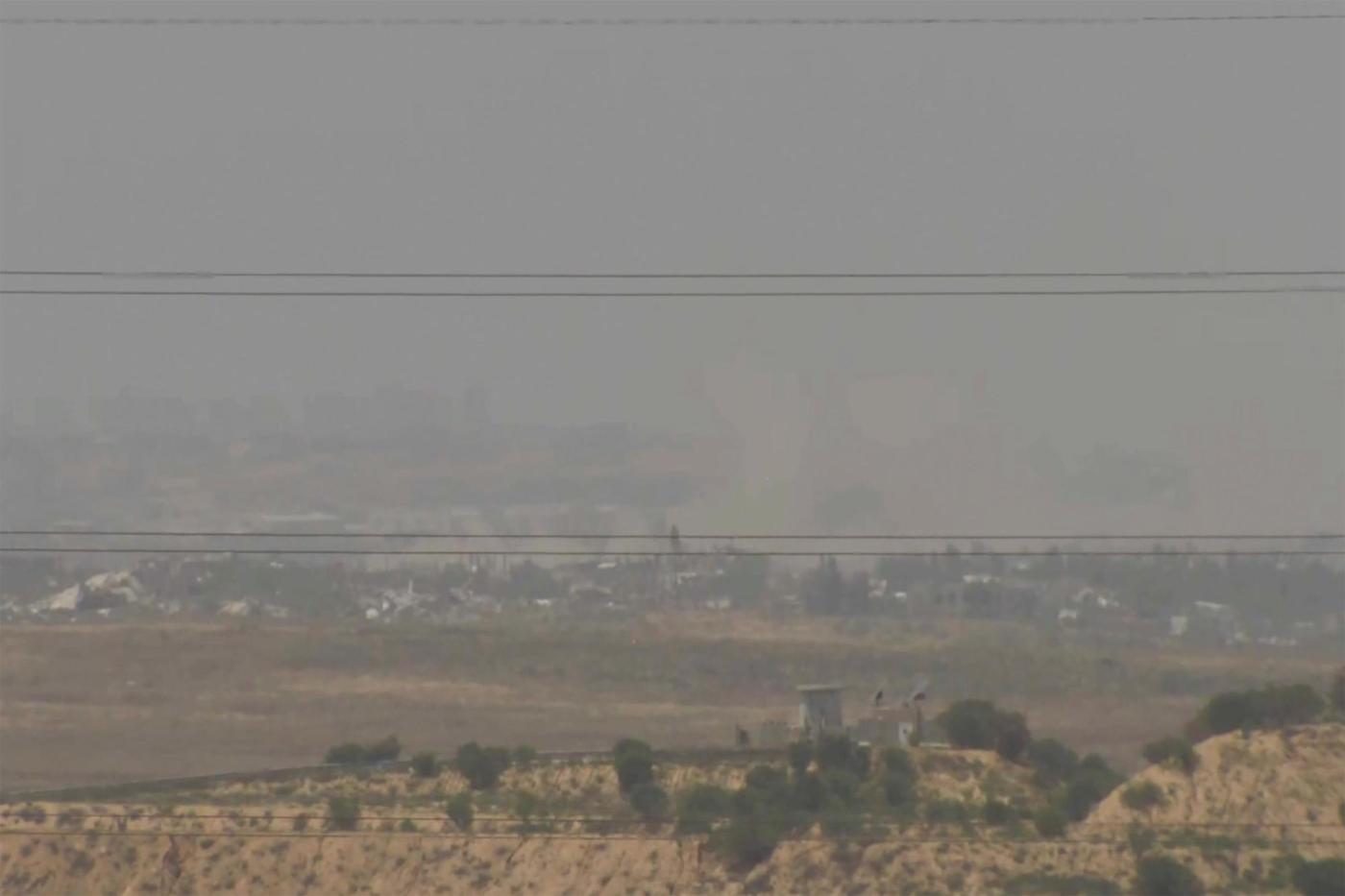
Shortly before the equipment was seized, it was broadcasting a general view of northern Gaza. The AP complies with Israel’s military censorship rules, which prohibit broadcasts of details like troops movements that could endanger soldiers. The live shot has generally shown smoke rising over the territory.

The seizure followed a verbal order Thursday to cease the live transmission — which the news organization refused to do.

“In accordance with the government decision and the instruction of the communications minister, the communications ministry will continue to take whatever enforcement action is required to limit broadcasts that harm the security of the state,” the ministry said in a statement.

Israeli officials used the law to close down the offices of the Qatar-based broadcaster on May 5 as well as confiscating the channel’s equipment, banning its broadcasts, and blocking its websites.

Israel has long had a rocky relationship with Al Jazeera, accusing it of bias against the country. Israeli Prime Minister Benjamin Netanyahu has called it a “terror channel” that spreads incitement.

Al Jazeera is one of the few international news outlets that has remained in Gaza throughout the war, broadcasting scenes of airstrikes and overcrowded hospitals and accusing Israel of massacres.

The war in Gaza began with a Hamas attack in Israel that killed 1,200 people and saw 250 others taken hostage. More than 35,000 Palestinians have been killed since then, according to Gaza’s Health Ministry, which doesn’t distinguish between civilians and combatants in its count.

___

Follow AP’s war coverage at https://apnews.com/hub/israel-hamas-war

Trudy Rubin: Netanyahu moves toward military reoccupation of Gaza with no exit strategy

posted in: Politics | 0

Watching Benjamin Netanyahu blunder into Rafah with no plan for “the day after” is like watching a Greek tragedy whose end is foreseen but can no longer be blocked.

Netanyahu’s push into the city at Gaza’s southern edge — with no strategy for an endgame — will force Israeli troops to reoccupy the entire strip. It will ensure Hamas’ political and military survival, and trap Israeli troops in an unending insurgency.

It will probably doom most of the remaining Israeli hostages. It may also doom thousands more Palestinian civilians, including children.

Worst of all, it will hand both Hamas terrorists and Israeli extremists a devastating win that will continue to wreak havoc on the Palestinian people and on the Jewish state.

Netanyahu’s focus on total victory over Hamas blindly mistakes the Gaza war for a conventional 20th-century land war that can be ended solely by military means. He falsely compares Israel to the Allied forces that defeated Adolf Hitler in World War II.

Supposed allies of Israel such as GOP Sen. Lindsey Graham encourage Netanyahu’s delusions when they cite the nuclear strikes on Hiroshima and Nagasaki as a template for bombing Gaza. Not only is such talk morally repugnant, but it shows zero grasp of how to defeat Hamas.

President Joe Biden was absolutely correct to ban a shipment of 2,000-pound bombs that can wipe out whole neighborhoods in pursuit of a single Hamas commander. Such actions only increase support for Hamas globally and in the Arab world (even in moderate Arab states whose leaders despise Hamas).

The Gaza war is a nontraditional struggle with an unconventional force — Hamas — that is fighting a guerilla war from underground tunnels. The civilian population of 2 million is trapped in a territory no bigger than Philadelphia, with no possibility to escape. Yes, Hamas uses civilians as a shield, but Israel’s indifference to civilian casualties plays into the terror group’s hands.

The proper military comparison for the Gaza war is the situation the United States faced in Afghanistan after 9/11 — or what Israel faced in Lebanon after 1983. Both countries got mired for years in trying to defeat an insurgency. In both cases, the military alone couldn’t win because there was no concurrent political strategy to isolate the Islamist militias. Continued military attacks further alienated civilians.

Smashing into Rafah, to which half the Gazan population has fled, won’t destroy Hamas — many of its leaders and fighters will survive in tunnels or houses, blend into the remaining population, or even escape to Sinai. Israeli bombs will doom many of the hostages who are still alive.

After tens of thousands more Palestinian civilian deaths, even Gazans angered at Hamas for their plight will adopt its ideology of a one-state Palestinian solution minus Israel. A continued insurgency will bubble under the surface and expand into the West Bank.

Israel will be trapped in Gaza, endlessly trying to crush insurgents.

Israeli Defense Minister Yoav Gallant gets it. He has publicly protested his government’s lack of a Gaza endgame, telling a news conference last week that he wouldn’t allow the establishment of military rule in the Gaza Strip.

“(Netanyahu’s) not taking a decision on a ‘day after strategy’ is tantamount to a dangerous decision to install Israeli military and civil rule in the Gaza Strip,” Gallant said.

“The end of the military campaign must be a political act,” he warned. “The day after Hamas will only be achieved through the rule of Palestinian elements that form an alternative to Hamas. Above all, this is an Israeli interest. Unfortunately, no such plan has been brought for debate.”

In other words, the only way to doom Hamas is to provide Palestinians with an alternative option that separates civilians from Hamas fighters. That would leave Hamas politically and physically exposed.

The Biden administration, along with moderate Gulf Arab states, has put forward the only plausible alternative: plans that would involve a possible Arab peacekeeping force, along with Arab and international funding to rebuild from Israeli bombing.

But such plans were contingent on two steps by Israel — the first being putting a stop to the reckless killing of civilians.

Had Netanyahu thought strategically, he would have made every effort to establish real safe zones for civilians with water and sanitation that would have separated noncombatants from fighters. This strategy would have given Israel more time and more leeway to destroy Hamas terrorists in tunnels and above ground.

Instead, Israel let vengeance rule, bombing indiscriminately and blocking aid. After the horrors of Hamas’ Oct. 7 rampage, this may be understandable from an emotional standpoint, but was strategically stupid and morally ugly. Even today, after Israel has closed almost all entry points of humanitarian aid to Gaza, Netanyahu permits followers of his right-wing political allies to block the few food shipments still headed there via Israeli roads.

Second, the Biden plan is contingent on Israel facilitating the return to Gaza of rule by a rejuvenated Palestinian Authority, or PA, the governing body that exercises partial control over the West Bank. The PA’s return depends, in turn, on Israel endorsing a political path forward toward the end of occupation, a path that ultimately would lead to a two-state solution.

Yet, Netanyahu has vehemently opposed any role for the PA. He has fantasized that apolitical Palestinians or tribal leaders will somehow emerge to run daily life in Gaza, and Israeli forces will continue to police Gaza, which will be “demilitarized” and “de-radicalized.”

That is a pipe dream, as Hamas will survive in the wings, and no tribal leaders will help Israel maintain a military occupation. Moreover, with most of Gaza’s housing destroyed or broken, the majority of Palestinians will be living in rubble, unable to function or feed themselves.

Israel will be left ruling over the ruins. Moderate Arab states will not finance the rebuilding of the strip if the war there continues; no international force will police those ruins.

Continued Israeli military occupation of Gaza will seriously undermine Israel’s peace treaties with Egypt and Jordan, and prevent any future normalization with Saudi Arabia. It will alienate large segments of the public in Europe and the United States, and make the country an international pariah.

It will undercut one of Israel’s closest friends ever, who tried and failed to force Israel’s leaders to face reality: President Biden.

It may be too late to reverse Netanyahu’s self-defeating course, even with more U.S. pressure. Yet, the road he has chosen — in order to retain power and avoid jail time for corruption — will keep Hamas alive and intimidate any nascent opposition. It will cause too many more Israelis and Palestinians to die.

Related Articles

Opinion |


Bruce Yandle: When Biden and Trump agree, consumers should worry

Opinion |


Other voices: The rematch is set: Biden vs. Trump debates have the right balance

Opinion |


David Brooks: The authoritarians have momentum, and here’s partly why

Opinion |


F.D. Flam: It’s officially hotter than anytime since the birth of Jesus

Opinion |


Lisa Jarvis: A shocking number of doctors don’t understand menopause

Defense rests without Trump taking the witness stand in his New York hush money trial

posted in: Politics | 0

By MICHAEL R. SISAK, JAKE OFFENHARTZ, JENNIFER PELTZ and COLLEEN LONG (Associated Press)

NEW YORK (AP) — Donald Trump’s lawyers rested their defense Tuesday without the former president taking the witness stand in his New York hush money trial.

The jury was sent home until May 28, when closing arguments are expected. Trump did not stop to speak as he left the courthouse and ignored a question about why he wasn’t testifying.

After more than four weeks of testimony, jurors could begin deliberating as soon as next week to decide whether Trump is guilty of 34 felony counts of falsifying business records.

Prosecutors have accused Trump of a scheme to bury negative stories to fend off damage to his 2016 presidential campaign and then falsifying internal business records to cover it up.

Trump, the first former American president to be tried criminally, has pleaded not guilty and denied any wrongdoing in the case, which he has slammed as politically motivated.

THIS IS A BREAKING NEWS UPDATE. AP’s earlier story follows below.

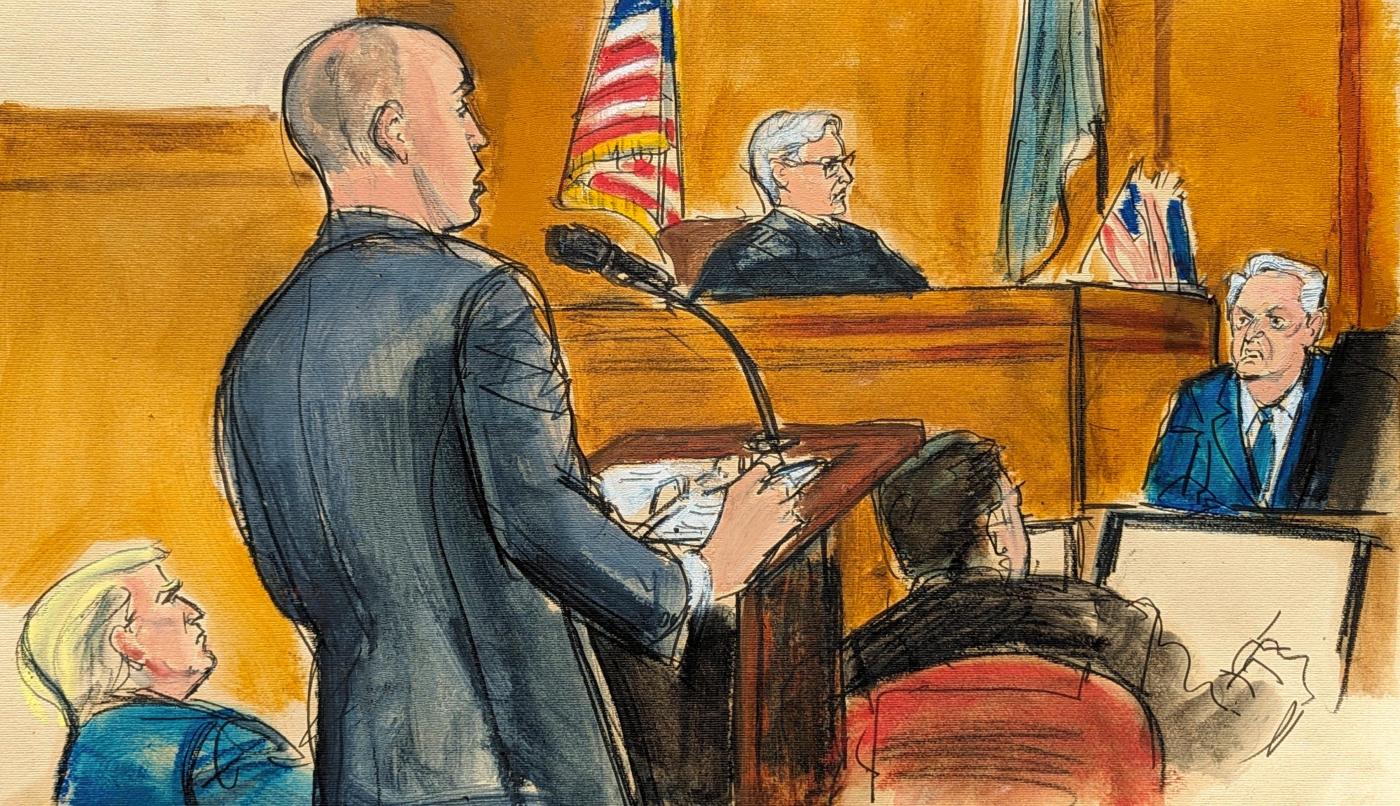
NEW YORK (AP) — A defense witness in Donald Trump’s hush money case whom the judge threatened to remove from the trial over his behavior returned to the stand Tuesday as the trial nears its end.

Trump’s lawyers hope Robert Costello’s testimony will help undermine the credibility of a key prosecution witness, Trump fixer-turned-foe Michael Cohen.

Costello turned to Judge Juan M. Merchan before the jurors arrived to the court, speaking quietly. The judge acknowledged him and nodded, a much more cordial scene than the drama that unfolded during Monday’s proceedings, when Costello made comments under his breath during testimony, rolled his eyes and called the whole exercise “ridiculous.” The antics angered Merchan, and the judge briefly kicked reporters out of the courtroom to admonish him.

The judge told Costello, a former federal prosecutor, he was being “contemptuous,” adding, “If you try to stare me down one more time, I will remove you from the stand,” according to a court transcript.

The defense was expected to rest its case later Tuesday, clearing the way for the trial to move on to decisions about how to instruct the jury on deliberations. Prosecutors on Monday rested their case accusing Trump of falsifying business records as part of a scheme to bury stories that he feared could hurt his 2016 campaign. The criminal trial, the first of a former U.S. president, is in the final stretch, with closing arguments expected the Tuesday after Memorial Day.

The charges stem from internal Trump Organization records in which payments to Cohen were marked as legal expenses. Prosecutors say they were really reimbursements for a $130,000 hush money payment to porn actor Stormy Daniels to keep her from going public before the 2016 election with claims of a sexual encounter with Trump. Trump says nothing sexual happened between them.

Trump, a Republican, has said he did nothing illegal and has slammed the case as an effort to hinder his 2024 bid to reclaim the White House.

“They have no case,” Trump said outside the courtroom Tuesday. “There’s no crime.”

After jurors left for the day Monday, defense attorneys pressed the judge to throw out the charges before jurors even begin deliberating, arguing prosecutors have failed to prove their case. The defense has suggested that Trump was trying to protect his family, not his campaign, by squelching what he says were false, scurrilous claims.

Defense attorney Todd Blanche argued that there was nothing illegal about soliciting a tabloid’s help to run positive stories about Trump, run negative stories about his opponents and identify potentially damaging stories before they were published. No one involved “had any criminal intent,” Blanche said.

“How is keeping a false story from the voters criminal?” Blanche asked.

Prosecutor Matthew Colangelo shot back that “the trial evidence overwhelmingly supports each element” of the alleged offenses and said the case should proceed to the jury.

The judge didn’t immediately rule on the defense’s request. Such long-shot requests are often made in criminal cases but are rarely granted.

The defense called Costello because of his role as an antagonist to Cohen since their professional relationship splintered in spectacular fashion. Costello had offered to represent Cohen soon after the lawyer’s hotel room, office and home were raided and as Cohen faced a decision about whether to remain defiant in the face of a criminal investigation or to cooperate with authorities in hopes of securing more lenient treatment.

Costello in the years since has repeatedly maligned Cohen’s credibility and was even a witness before last year’s grand jury that indicted Trump, offering testimony designed to undermine Cohen’s account. In a Fox News Channel interview last week, Costello accused Cohen of lying to the jury and using the case to “monetize” himself.

Costello contradicted Cohen’s testimony describing Trump as intimately involved in all aspects of the hush money scheme. Costello told jurors Monday that Cohen told him Trump “knew nothing” about the hush money payment to Daniels.

“Michael Cohen said numerous times that President Trump knew nothing about those payments, that he did this on his own, and he repeated that numerous times,” Costello testified.

Cohen, however, testified earlier Monday that he has “no doubt” that Trump gave him a final sign-off to make the payments to Daniels. In total, he said he spoke with Trump more than 20 times about the matter in October 2016.

Trump lawyer Emil Bove told the judge that the defense does not plan to call any other witnesses after Costello, though it may still call campaign-finance expert Bradley A. Smith for limited testimony. It has not said definitively that Trump won’t testify, but that’s the clearest indication yet that he will waive his right to take the stand in his own defense.

___

This story has been corrected to fix the time element to Tuesday, not Monday.

___

Long reported from Washington. Associated Press writers Jill Colvin and Michelle Price in New York; Meg Kinnard in Columbia, S.C.; and Eric Tucker and Alanna Durkin Richer in Washington contributed to this report.