The city plans to close a longtime homeless services center called Mainchance, where locals go for food, support in their housing searches, and relief from the elements.
Adi Talwar
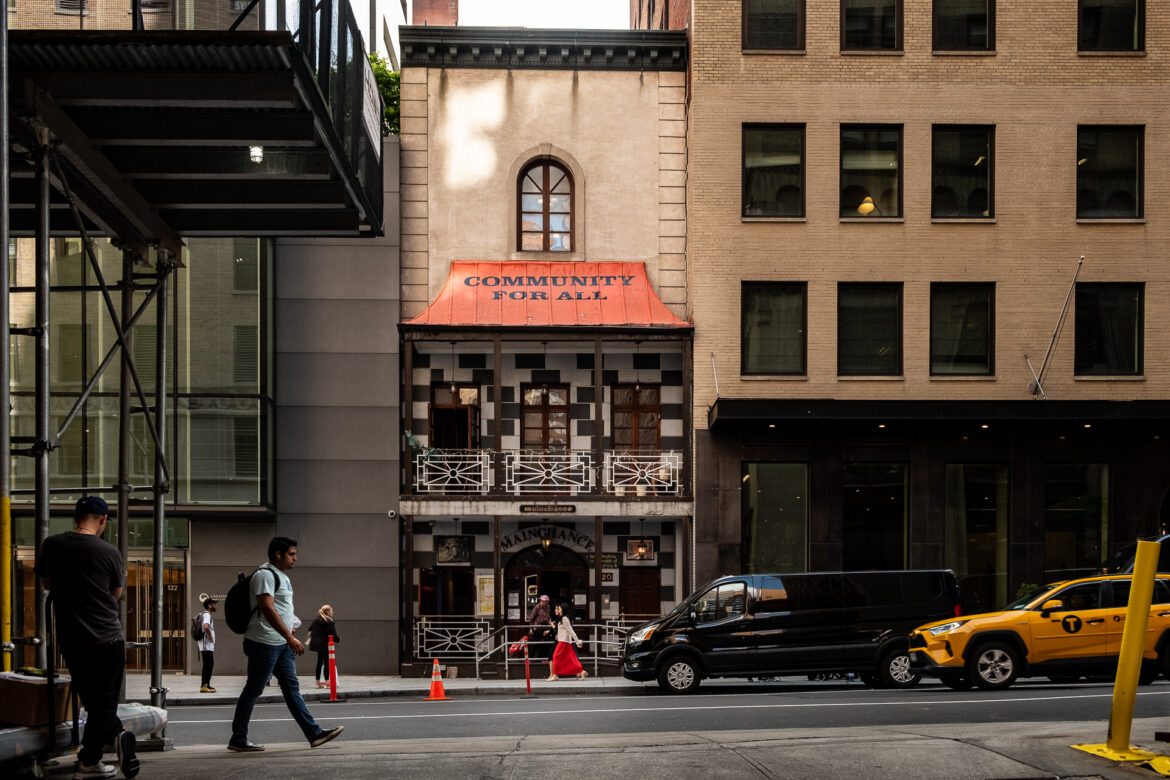
The Mainchance Drop-in Center, located on East 32nd Street between Park and Lexington avenues in Manhattan, has been there for the last 20 years. It’s expected to close at the end of June.
“I was trying to have hope that the city would reconsider. They’re not.”
Brady Crain, executive director of the Mainchance drop-in homeless center in Midtown East, had just been handed a letter from the Department of Homeless Services (DHS) dated May 8, 2024. It said that the city will terminate the center’s contract on June 30.
“We get 95 percent of our funding from the city,” said Crain. “This will devastate us.”
Mainchance was founded in 1989, and has operated for the last 20 years in a skinny four-story building wedged between a five-star hotel and New York’s gleaming glass Korean Cultural Center. It’s a busy block right off Park Avenue, with high rise office buildings, hotels, and residential towers swallowing up 32nd Street.
Drop-in centers like Mainchance play an important role in the city’s homeless infrastructure, providing a place to stay for one night at a time for those who don’t seek a traditional shelter placement. They also offer services to meet immediate needs, like housing-related counseling and medical care.
Unlike other types of shelters, drop-in centers don’t have beds. At Mainchance, overnight guests can sleep in large plastic adirondack-style chairs on the second floor, in a high-ceilinged room with a balcony that overlooks 32nd Street.
Mainchance is open 24 hours a day, seven days a week. But unless something changes, the center will close its doors for good at the end of June.
DHS is terminating the contract as part of a broader January Program to Eliminate the Gap (PEG), or spending reduction, a spokesperson for the Department of Social Services (DSS), which contains DHS, confirmed. They added that no other drop-in center closures are planned.
Budget documents describe the center as “underperforming” and state that it will be replaced with new sites. The closure would save $3.7 million in Fiscal Year 2025, and an additional $10.2 million in the out-years, documents show.
Adi Talwar
Brady Crain, director of the Mainchance Drop-in Center, reviewing a letter he’d just received from the city informing him that his site’s contract had been terminated.
As Crain received confirmation of his fears on May 8, a range of patrons were visiting Mainchance, including homeless people getting a meal—the center offers three per day—or finding a safe place to rest.
Jermaine Burton started sleeping at Mainchance when his mother moved to Florida in October, leaving him with no place to stay. After bouncing between friends’ houses, he found the drop-in site, which he said was crucial in helping him get what he needed, whether that was a meal, somewhere to spend the night, or connections to housing.
He worked with a case manager to secure a CityFHEPS rental assistance voucher; now he’s finalizing his search for an apartment that will accept it and hopes to move into his own place in the coming weeks.
Burton doesn’t want the center to close. “We need the funding for stuff like this because they really help us out. I came here and they treat me like I’m at home,” he said.
In a statement, a Department of Social Services (DSS) spokesperson emphasized an increased investment in resources for those experiencing unsheltered homelessness since Mayor Eric Adams took office. These include new drop-in centers and different low-barrier options known as Safe Havens and stabilization bed sites, where clients can sleep in beds and may even get a semi-private room.
Adi Talwar
Jermaine Burton started sleeping at Mainchance when his mother moved to Florida in October, leaving him with no place to stay. “I came here and they treat me like I’m at home,” he said.
The city has also more than doubled its street outreach staff, the spokesperson added. “And these investments are clearly having an impact, with nearly 1,000 New Yorkers making the transition from the streets and subways to subsidized permanent housing last year alone,” they said.
During City Limits’ visit to Mainchance earlier this month, community members were lining up with rolling carts for the center’s monthly grocery distribution.
Kristen Hodge, who lives nearby, was grabbing food with her young daughter. “This is what I need to get by for the next couple of months,” she said. She’s been to a number of service providers, but hasn’t found them as warm as the staff and volunteers at Mainchance. “There’s not a lot of places that have good people plus what you need,” said Hodge.
Theresa McNamara lives in the Straus Houses on 28th Street, part of the New York City Housing Authority, and has been coming by Mainchance’s food pantry for two years. “Around here everything is expensive,” she said. “This is the only thing we got in Midtown. Instead of going all the way to the west side, it’s right here.”
The city opened a drop-in center at Paul’s Place on 14th Street in 2022 and will open another on Ninth Avenue later this summer, additions a spokesperson for DSS said will ensure substantial services after Mainchance’s closure. There’s also the Antonio Olivieri Drop-In Center on West 30th Street.
DSS referenced three Safe Haven and stabilization bed sites in the area, and said another is scheduled to open in Manhattan this summer.
But advocates wonder why the city is closing a drop-in center when need remains high. DHS’ eight drop-in centers saw 420 clients a day, with 150 people staying overnight on average in the past year, according to data from City Limits’ Shelter Count.
Mainchance served a total of 45,435 people in the 12 months that ended last July, and another 25,867 from July through February, according to internal numbers.
“They should be opening many of them because we need more shelters at this point. It shouldn’t be a zero sum here,” said Marc Gross, a lawyer who sits on Mainchance’s board.
The center has had its share of complaints from local businesses over the years, according to board members. But while many communities resist shelters, Mainchance has the support of several key community groups, including elected officials and the Grand Central Neighborhood Business Improvement District.
“To me it’s just insane to close,” said City Councilmember Gale Brewer in a recent phone interview with City Limits.
“Where are those people gonna go?” she said. “They’re gonna go back to the streets in many cases.”
In an early March email between DHS and Mainchance shared with City Limits, a representative for DHS wrote that the agency “does not want to operate a drop-in at this site.”
Adi Talwar
Kristen Hodge with her daughter. Hodge comes to the Mainchance Drop-in Center every month for the food pantry.
Leaders at Mainchance have bristled at suggestions that they underperformed, pointing to the past three years’ internal evaluations by DHS where they received “good” or “excellent” ratings.
A spokesperson from DSS said that they are grateful for the service of the provider and committed to working with community stakeholders to help connect people to services.
DSS did not respond to specific questions about the center’s location or performance, but emphasized that decisions about site closures are carefully considered and may take into account budget, expansion plans for other locations, the physical condition of buildings, and provider capacity.
The city’s May 8 letter states that Mainchance’s contract is being terminated “without cause.”
“They’re moving me around like a puppet, with nobody giving me a definite answer on why I have to close down,” said Crain.
Center leadership suggested Mainchance’s prime location near Grand Central and their status as a small organization makes them an easy target. Unlike many larger DHS shelter operators, they manage just one site.
“It’s precarious when you’re a small [organization] and you’ve got luxury tenant neighbors,” said William Kornblum, chair of Mainchance’s board.
When asked about Mainchance before the City Council earlier this month, Agency Administrator Joslyn Carter testified that DHS has found success with Safe Haven and stabilization models, which have the beds that drop-in centers lack.
According to DSS, the Adams administration has added over 1,100 Safe Haven and stabilization beds for a total of about 3,900, with another 1,100 in the pipeline.
Adi Talwar
Mainchance Director Brady Crain outside the Midtown East building earlier this month.
In April, five Manhattan elected officials wrote a letter to Adams and DSS Commissioner Molly Park urging them to maintain Mainchance’s contract and work with them to find the right mix of services.
Converting to a Safe Haven would be no simple task, requiring renovations to transform the building, a process that would take time. But the center wants the chance to try.
“What I can do now with the time I have left is to gather a lot of support,” Crain said.
He has a few allies in the community ready to go to bat for Mainchance.
“I would be in a whole lot of trouble if they have to close it down,” said Dorothy Simon, who lives on Second Avenue and visited the food pantry this month with her home health aide. “Imma have to call [Mayor] Adams and get him over here.”
Additional reporting by Emma Whitford.
To reach the editors, email Emma@citylimits.org and Jeanmarie@citylimits.org.
Want to republish this story? Find City Limits’ reprint policy here.
The post Midtown Homeless Drop-In Center May Be Among City Budget Casualties appeared first on City Limits.