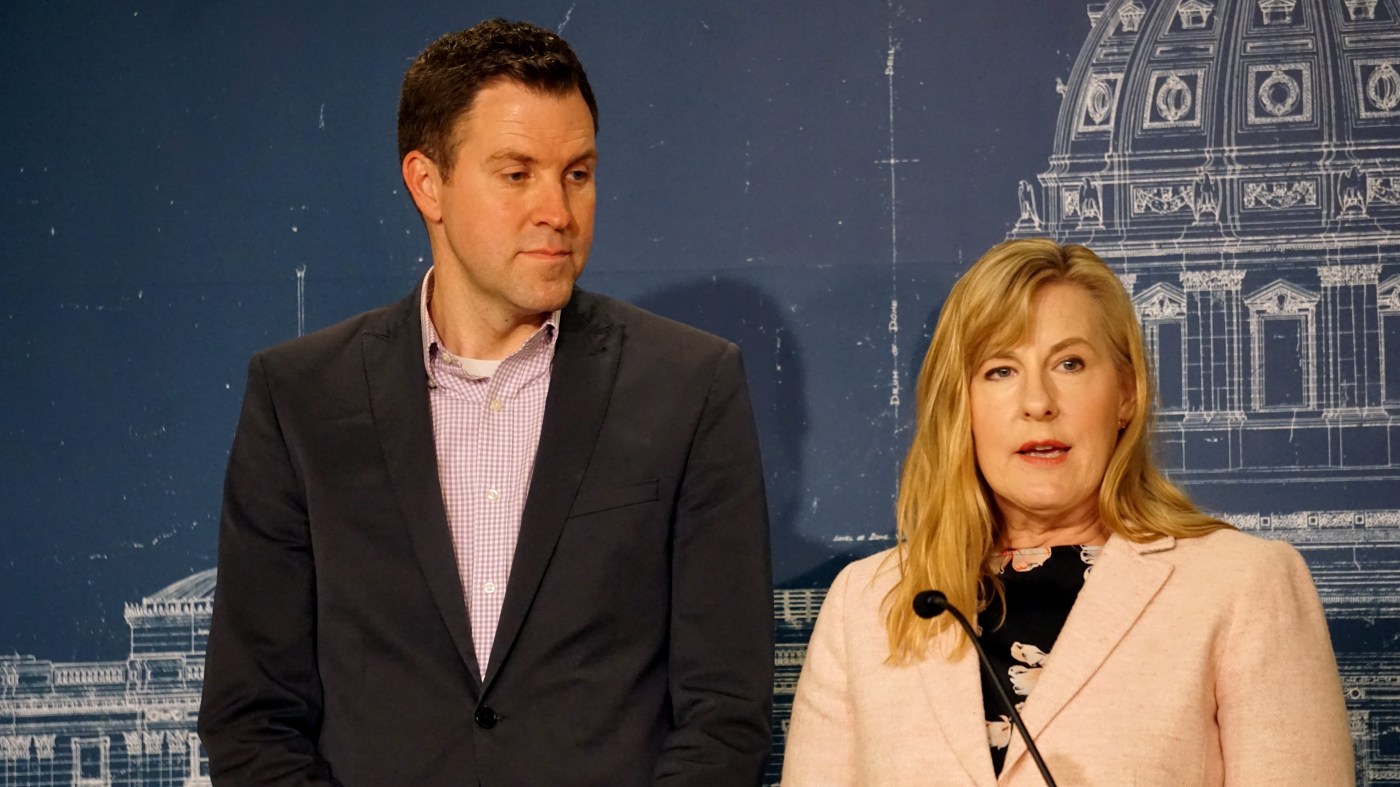
MN Legislature: GOP bonding threats won’t stop abortion measure, DFL leaders say

posted in: News | 0

Democratic-Farmer-Labor lawmakers say they won’t let speeches about fast food or Republican threats to kill a bonding deal derail their efforts to advance a bill that would plot a path for abortion rights in Minnesota’s Constitution.

After House Republicans delayed votes in two floor sessions with lengthy speeches that sometimes veered into seemingly unrelated topics, House Speaker Melissa Hortman shut down an eight-hour debate at midnight Wednesday so the chamber could vote on a paid leave bill. The move prompted loud protests from Republicans, who said it violated norms of the chamber.

On Thursday, Hortman said she and her DFL colleagues will continue to entertain some debate on bills in the final days of the session, but won’t hesitate to stop “deleterious” speeches and questions from Republicans.

“At a certain point, it’s very obvious when Republicans are filibustering. I mean, I don’t know how many of you tuned in on Monday, but there was a lot of conversation about cheeseburgers and also hamburgers, maybe French fries,” she said. “That’s not what the voters of the state of Minnesota engage in an election to do.”

The fast food comments were tied to a seven-hour debate on a bill to force businesses to disclose hidden last-minute charges that ultimately got bipartisan support in the House when the vote happened at midnight on Monday.

ERA amendment

A version of the Equal Rights Amendment that would put the right to an abortion and protections for LGBTQ people in the state Constitution has been delayed — and not yet scheduled — after extended debate on other bills. If passed by the House and Senate, the question would be put to voters in the 2026 election.

There are just three more days for the House and Senate to vote before the end of the 2024 session, and even as each chamber works late hours, the odds are dimming for bills to legalize sports betting, borrow money for roads and bridges, and even on a minimum wage deal to keep rideshare services Uber and Lyft from making good on their threats to leave Minnesota.

Hortman said cutting off debate was a sort of “nuclear option” for Democrats, as there are technically no time limits for debate in the Minnesota House, but called the move warranted as Republicans were “lying on the tracks.”

Minority Leader Rep. Lisa Demuth, R-Cold Spring. (John Autey / Pioneer Press)

House Minority Leader Lisa Demuth, R-Cold Spring, called the shutdown of debate Wednesday “shameful” and disputed DFL claims that her party is deliberately delaying votes in the final week of the session. She added the majority has had two years to get its work done, and can’t place blame on Republicans for expecting full debate on bills.

“It is not the responsibility of the minority to pass the majority’s bills,” she told reporters Tuesday. “It is the responsibility of the minority to make sure that the voices of our constituents are heard and represented.”

Republicans earlier this week rolled out a list of demands to DFLers tied to the passage of a roughly $900 million dollar infrastructure bill, including dropping a gun control proposal and a version of the Equal Rights Amendment that includes abortion as a right.

Obstacles to an infrastructure bill

Despite being in the minority in both the House and Senate, borrowing money for infrastructure, which traditionally happens in even-numbered years, requires a three-fifths majority in both chambers in order to pass.

That’s one of the few leverage points available to Republicans — though it doesn’t just inconvenience DFLers. If Republicans kill a bonding bill it means they won’t be able to deliver local projects in their districts either.

GOP lawmakers also are pushing to remove gun control language from a bill increasing criminal penalties for people who buy guns for others who are ineligible to do so, such as felons.

While both parties support increasing penalties for what’s known as straw purchasing, Republicans oppose DFLers inclusion of language banning binary triggers, a modification that allows a semi-automatic weapon to fire both when the trigger is pulled and released — greatly increasing its rate of fire.

Republicans used their leverage with bonding to get $300 million in aid for struggling nursing homes last year, but the tactic didn’t get much else from Democrats.

Hortman told reporters the House DFL is willing to give more funding to emergency medical services, a Republican request, but won’t allow threats on bonding to make them budge on the ERA, the binary trigger ban, or anything else.

Even if the House passes the ERA with abortion rights, the version already passed by the Senate version does not include that language, so the two versions would have to be reconciled.

The last day to vote on bills is Sunday.

Related Articles

Politics |


Jerome Johnson: Save Summit parking … the cheap EVs are coming

Politics |


Tax for paid leave would grow under changes approved by Minnesota House

Politics |


MN Legislature: GOP won’t pass infrastructure bill if DFL moves on ERA, gun control, other measures

Politics |


MN Secretary of State announces new location for candidate filings

Politics |


Anderson, Lunneborg, Donaldson: State law needs a tweak this year so Lakeview Hospital project can proceed


‘An enormous mess’: White Bear Lake man receives nearly 8-year prison sentence for fire that killed mother

posted in: Society | 0

Everything was great at her White Bear Lake townhome for the first 12 years, Beverly Gutowski told a Ramsey County judge Thursday.

But then Christian Thomas Dahm entered the picture five years ago, moving into his parents’ Aspen Court townhome in the same complex. “It’s been a nightmare,” Gutowski, 73, said, adding that police were called to the four-plex dozens of times because of Dahm’s violent and lewd behavior and drug use.

Christian Thomas Dahm (Courtesy of the Ramsey County Sheriff’s Office)

Things turned deadly the night of May 14, 2023. Dahm, while high on meth, accidentally started a fire in his parents’ garage. When responders got on scene around 11:30 p.m., the Dahms’ townhome was fully engulfed in flames, which were spreading to Gutowski’s unit and the two others.

Firefighters located Dahm’s 79-year-old mother, Patricia Dahm, in critical condition inside her townhome. She died four days later in the burn unit at Regions Hospital.

Judge Jacob Kraus sentenced Dahm to nearly eight years in prison Thursday after he pleaded guilty to second-degree manslaughter for the death of his mother, a retired elementary schoolteacher.

Dahm, who’s been imprisoned since June on an unrelated case, faced between 7½ years and 11 years in prison as part of a February plea agreement. Prosecutors asked for the 95-month sentence that Dahm was given.

The plea agreement also included paying restitution to the townhome owners. Kraus left restitution open for 60 days.

The sentence will run concurrent with a 5-year term Dahm received June 15 for violating his probation relating to a 2022 conviction for possessing ammunition by an ineligible person.

Patricia Dahm had taught in the White Bear Lake Area School District for 34 years, according to her obituary. In addition to her son, she is survived by her husband of 54 years, Les. On Thursday, the 83-year-old was in the courtroom gallery and wiped tears as his son read a statement before receiving his sentence.

Dahm expressed remorse for what happened to his mother — noting the fire occurred on Mother’s Day — and for what his father and neighbors have endured because of him.

“Before you pronounce your sentence,” Dahm told the judge, “I want you to know that I’ve already been sentenced forever. I am going to serve a life sentence for my actions. Every second of every day until my own life ends I will have to live with knowing what I did, not only to my mother, but what I did to my own father and the effects that my neighbors have felt.”

‘Lost everything’

Shortly after firefighters got to the townhome in the 2600 block of Aspen Court, just north of County Road D, Dahm’s father pointed at Dahm, who was on the back patio, and said, “He started the fire,” according to the criminal complaint.

Related Articles

Crime & Public Safety |


Crookston police say officers fatally shot a man swinging a hatchet at them

Crime & Public Safety |


Southwestern Minnesota man dies after becoming trapped in grain bin

Crime & Public Safety |


Murder trial set for September for Minnesota trooper who shot motorist during freeway stop

Crime & Public Safety |


Families of two fallen Burnsville officers add their names to memorial flag

Crime & Public Safety |


Fridley man pleads guilty to murdering infant son

Dahm’s father said he and his wife decided to check on their son before going to bed because they believed he was high on meth and they were concerned. He said when he opened the service door to the garage, it appeared as though “everything exploded.” He saw his son run out of the garage.

When firefighters pulled Patricia Dahm from the fire, she had smoke coming from her mouth, the complaint says. An autopsy showed she died of complications of multiple burns and smoke inhalation.

Christian Dahm told police he was in the garage working on his fishing pole over a car hood before the fire started. He said he was using an oil pan and lit a cigarette with a torch and then “all of a sudden, there was a fire,” the complaint says.

The fire spread from one townhome to another, where KARE-TV anchor Rena Sarigianopoulos’ parents live, and she wrote on GoFundMe that their home was destroyed.

Another resident, Denise Cook, told Judge Kraus on Thursday that the fire displaced her and her family for nine months, that they were forced to stay in hotels and then at an apartment. She said she’s incurred out-of-pocket expenses after her insurance and will seek restitution.

Gutowski said she has “lost everything.” Before the fire her townhome was worth $300,000, she said, and now it’s estimated at $80,000. “So all the equity, everything we put into our home is gone,” she said. “And I’m angry.”

‘I created an enormous mess’

Dahm has an extensive criminal history dating back to 2005, when he got his first of five DWI convictions. He has four burglary convictions.

This week, Dahm’s attorney, Zach Van Cleve, asked Kraus for a downward departure from state sentencing guidelines, contending the offense was “less onerous” than typical second-degree manslaughter offenses, and that Dahm has shown remorse.

Van Cleve said in a court document that Dahm has struggled with substance abuse and mental health issues since his teenage years, and that he’s been in chemical dependency treatment at least seven times.

After Dahm’s brother was killed in an August 2022 motorcycle accident in North St. Paul, he turned to meth and other substances to cope, Van Cleve said. He was high on meth at the time of the fire, Van Cleve said.

“What everyone in this room knows,” Van Cleve said, “is that the punishment that Mr. Dahm is going to receive for the rest of his life, knowing that he started this fire that caused his mom’s death, is worse than anything that our court system can hand him.”

Dahm told Kraus that he now realizes how he’s been negligent throughout most of his adult life and created risk to others, whether it was with his DWIs or the fire.

“My actions have created victims directly and indirectly,” he said. “My mom is the primary victim here. There is nothing that I, nor anyone else can do to help her now. The real victim today is my father, who’s in court today. … I created an enormous mess everywhere. Complete destruction.”

Related Articles

Crime & Public Safety |


Crookston police say officers fatally shot a man swinging a hatchet at them

Crime & Public Safety |


Southwestern Minnesota man dies after becoming trapped in grain bin

Crime & Public Safety |


Murder trial set for September for Minnesota trooper who shot motorist during freeway stop

Crime & Public Safety |


Fridley man pleads guilty to murdering infant son

Crime & Public Safety |


Charges: Slain off-duty Eagan firefighter was caught in crossfire between two groups of shooters

PWHL: Minnesota has momentum for decisive Game 5 in Toronto

posted in: News | 0

After being shut out in the first two games of its Professional Women’s Hockey League semifinal playoff series in Toronto, the sad refrain of “You can’t win if you can’t score” was being tossed around Xcel Energy Center prior to Game 3.

Two wins —and two shutouts —later, Minnesota’s spirits and its chances of pulling off the series upset have been lifted by the fact that you can’t lose if you don’t give up a goal.

Goaltender Maddie Rooney, whose postseason goals-against average stands at 0.29, has emerged as the face of the turnaround that has set up a deciding Game 5 Friday night in Toronto. But Rooney is the first one to acknowledge that she’s gotten a lot of help.

Team defense and timely goal scoring has been Minnesota’s successful combination, and if it can pull it off one more time, a meeting with Boston in the PWHL championship series will be the reward.

The home team has won each of the four games in the series, with Toronto goaltender Kristen Campbell earning shutouts in the first two games. But Minnesota is buoyed by the fact that it played well enough to win in Game 2, which was scoreless until the final two minutes.

“Once we got into that Game 2, we had the discussion that we had to be comfortable winning 1-0,” Minnesota coach Ken Klee said. “Because we have good goaltending, they play the right way and we play the right way.

“It’s going to be tight. That’s the way playoff hockey is.”

Home-ice advantage could prove to be the X factor, but along with Rooney’s heroics, Minnesota can call on an offense that looks to be a bit more dangerous than Toronto’s at this point.

While Minnesota’s top line of Taylor Heise, Grace Zumwinkle and Abby Boreen didn’t produce any points in Game 4, it was responsible for 11 of Minnesota’s 29 shots on goal — a number of them quality scoring chances.

“I thought their line was outstanding,” Klee said. “I thought it was Taylor Heise’s best game — by far — that she’s had in the playoffs. Zum was good, and Abby Boreen is that energy ball for us. She’s mixing things up and helping her linemates.”

But there remains the fact that Toronto has yet to surrender a goal at home in the series.

“Campbell’s played well,” Klee said. “She’s been one of the top goalies in the league all year. Her confidence is high. It’s going to take a shot rebound or a screen to beat her. For us, we need shot volume, when it’s there — we don’t want to shoot into blocks. They sacrifice a lot, they block a lot of shots. They’re a winning team for a reason, they do a lot of little things well. We’ve just got to stay with it.”

Toronto will be without leading scorer Natalie Spooner for the second straight game after a knee injury in Game 3 ended her season.

“There’s no replacing Natalie Spooner,” Klee said. “She’s got 21 goals, she’s outstanding. But they’re a resilient team. They know if they play their system they will give themselves a chance to win. We expect another tight battle.”

Toronto coach Troy Ryan said his team talked about the need to find a way to score “dirty” goals, which would describe Butorac’s ability to pounce on a loose puck in the Toronto crease for the game winner on Wednesday.

“In playoffs you probably work a little bit more to get those greasy kind of goals,” Ryan said. “There were a few opportunities (in Game 4) I think we could have buried a shoulder and widened out our stance and drove the puck.”

Toronto has been one of the most physical teams in the league all season, and this series has provided more of the same. With the Coca-Cola Center likely to be sold out, the home team figures to get the house rocking, as well.

“Our start is going to be really important,” Toronto forward Renata Fast said. “We need to be really on our toes at the start of the game. As soon as we were playing with that attack mentally (in Game 4) and we were getting pucks below their goal line, we were getting chances and hemming them in.”

Minnesota soon will find out if it has enough tenacity and grit come all the way back from an 0-2 hole.

“We’re confident in how we’re playing right now,” Butorac said. “Game 2 was a good showpiece of how we can play on the road. I think (it’s) just taking the momentum from these last two games and bringing it up there, and just giving it all we can.”

Opinion: Why NYC Needs a Five-Borough Cultural Festival

posted in: Society | 0

“Creating a citywide cultural festival of global proportions would give locals and visitors a powerful new reason to explore the five boroughs each year, while sharpening the city’s creative edge amid an increasingly packed international calendar of must-do experiences.”

Adi Talwar

The Mazarte Dance Company practicing in Central Park in December 2020.

CityViews are readers’ opinions, not those of City Limits. Add your voice today!

New York is home to a rich diversity of annual arts and culture events, from Lunar New Year festivals and the West Indian Day Parade to the Tribeca Film Festival and the Armory Show art fair. But New York still doesn’t have a globally renowned citywide arts and culture festival on the scale of South by Southwest in Austin, the Venice Biennale, or the Edinburgh Fringe Festival—the latter of which generates as many as 3 million ticket sales annually and $630 million in economic impact in the small city of Edinburgh alone.

New York City deserves its own turn in the global spotlight. Now is the time for the Adams administration to launch the city’s first annual five-borough cultural festival—helping the city tackle several challenges at once.

Even viewed through the optimistic glow of spring, one key facet of the city’s economic and social fabric has struggled to regain its former strength: the city’s arts and culture sector. New York City is home to fewer actors, dancers, and musicians now than before the pandemic. Broadway attendance this season is 16 percent below where it was pre-COVID, several arts and nightlife venues have shut down, and numerous working artists have left for more affordable locations. Indeed, the broader arts and entertainment industry has only recovered 84 percent of its pre-pandemic jobs.

There’s a lot that city leaders should do to strengthen the city’s cultural sector, from boosting investment in affordable spaces for artists to live and work to fully funding the Department of Cultural Affairs. But the city also needs fresh ideas that can breathe new life into its arts ecosystem—and help create a more vibrant and resilient post-pandemic economy.

New York City’s first annual five-borough cultural festival can help achieve this, boosting international tourism and regional visitation, and giving New Yorkers an exciting new reason to celebrate.

One of New York City’s greatest competitive advantages in the hybrid work era is the magnetic pull of culture and the arts. This festival would build on these advantages by enlisting hundreds of venues across all five boroughs and open streets, parks, plazas, historic buildings, city-owned properties, and other spaces for music, dance, theater, visual art, cultural performances, and immersive experiences.

Creating a citywide cultural festival of global proportions would give locals and visitors a powerful new reason to explore the five boroughs each year, while sharpening the city’s creative edge amid an increasingly packed international calendar of must-do experiences. By attracting new audiences, facilitating collaboration, easing red tape, and directly supporting artists, this major new festival could also help nurture a full recovery for the arts and culture sector and demonstrate a new level of support going forward.

Inspired by citywide arts events around the globe, New York policymakers should work with cultural and community partners citywide to cultivate an annual cultural festival of unprecedented size, scale, and significance. The key first step is mayoral leadership to make this idea a priority, identify a target week in the annual calendar, and enlist a small group of cultural leaders and civic-minded entrepreneurs to help develop the festival’s operational structure, agenda, and logistics.

While much of the costs of programming the festival could be offset by corporate sponsorships, sales of individual tickets and week-long passes, as is the case in Edinburgh and Austin, the city can help in other ways. For instance, it can offer up city-owned buildings and public spaces for concerts, performances, installations, and parades—closing streets to traffic and allowing performances to take place in parks, plazas, and other public land. The city should also coordinate preparations for a festival of this scale with partners at the state level, with a focus on leveraging state capital grants to help support accessibility and facilities upgrades for cultural venues across all five boroughs. 

New York still has work to do to keep pace with a vastly changed post-pandemic landscape. Creating an annual five-borough cultural festival would help bring the city together around the shared language of creative expression—and strengthen the city’s magnetism for people seeking experiences and connection.

Eli Dvorkin is the editorial and policy director of the Center for an Urban Future. Winston Fisher is a partner at Fisher Brothers and CEO of AREA15.