The ‘Appeal to Heaven’ flag evolves from Revolutionary War symbol to banner of the far right

posted in: News | 0

BY GARY FIELDS, LISA MASCARO and FARNOUSH AMIRI (Associated Press)

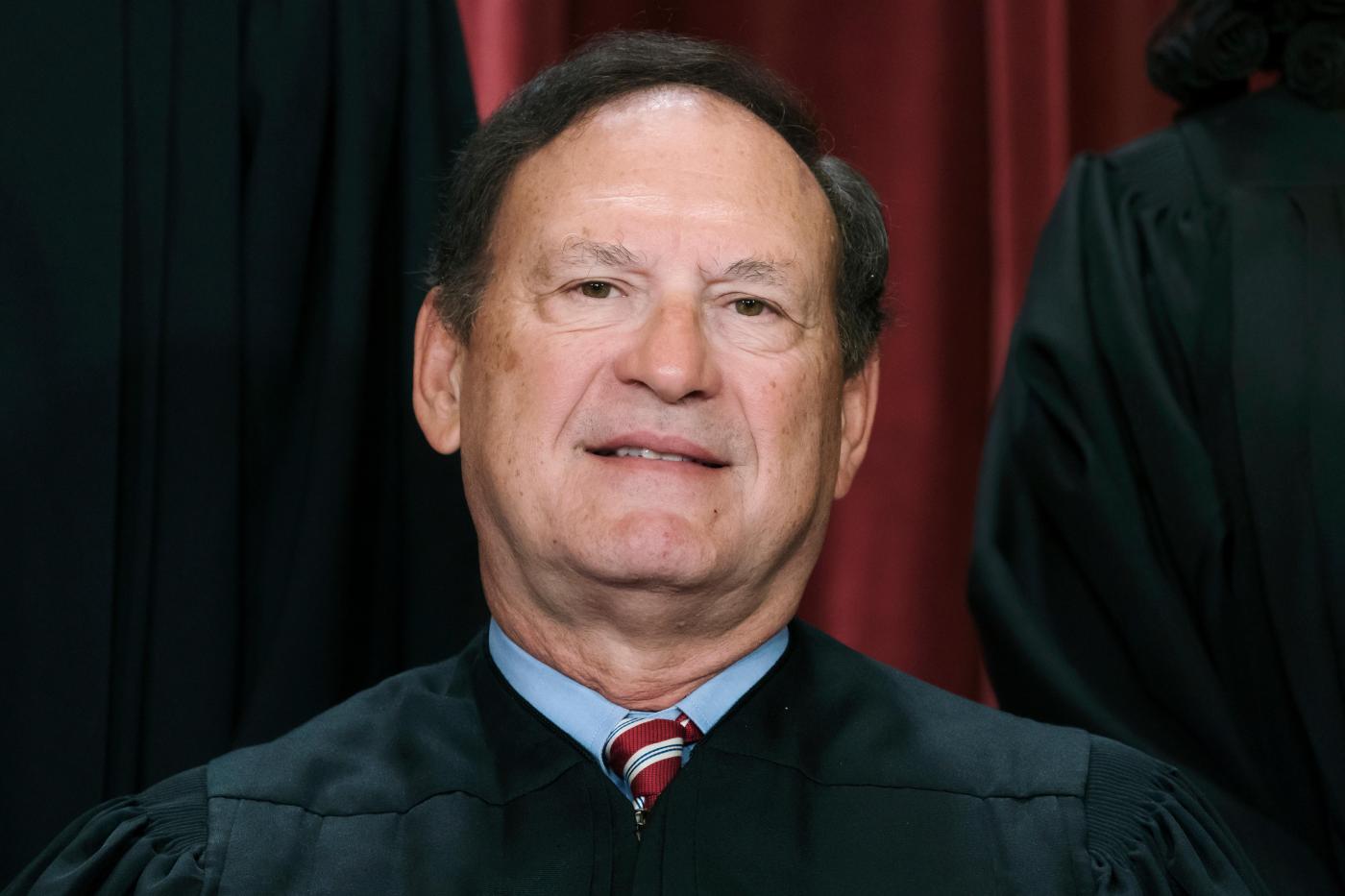
WASHINGTON (AP) — U.S. Supreme Court Justice Samuel Alito is embroiled in a second flag controversy in as many weeks, this time over a banner that in recent years has come to symbolize sympathies with the Christian nationalist movement and the false claim that the 2020 presidential election was stolen.

An “Appeal to Heaven” flag was flown last summer outside Alito’s beach vacation home in New Jersey, according to The New York Times, which obtained several images showing it on different dates in July and September 2023. The Times previously reported that an upside down American flag — a sign of distress — had flown outside Alito’s Alexandria, Virginia, home less than two weeks after the violent Jan. 6, 2021, attack on the U.S. Capitol by supporters of former President Donald Trump.

Some of the rioters carried the inverted American flag or the “Appeal to Heaven” flag, which shows a green pine tree on a white field. The revelations have escalated concerns over Alito’s impartiality and his ability to objectively decide cases currently before the court that relate to the Jan. 6 attackers and Trump’s attempts to overturn the results of the 2020 election. Alito has not commented on the flag at his summer home.

Here is the history and current symbolism of the “Appeal to Heaven” flag.

WHAT ARE ITS ORIGINS?

Ted Kaye, secretary for the North American Vexillological Association, which studies flags and their meaning, said the “Appeal to Heaven” banner dates to the Revolutionary War.

Six schooners outfitted by George Washington to intercept British vessels at sea flew the flag in 1775 as they sailed under his command. It became the maritime flag of Massachusetts in 1776 and remained so until 1971, he said.

According to Americanflags.com the pine tree on the flag symbolized strength and resilience in the New England colonies while the words “Appeal to Heaven” stemmed from the belief that God would deliver the colonists from tyranny.

HOW HAS ITS SYMBOLISM CHANGED?

There are a few different reasons people fly “Appeal to Heaven” flags today, said Jared Holt, a senior analyst at the Institute for Strategic Dialogue, a London-based think tank that tracks online hate, disinformation and extremism.

Some fans of it identify with a “patriot” movement that obsesses over the Founding Fathers and the American Revolution, he said. Others adhere to a Christian nationalist worldview that seeks to elevate Christianity in public life.

“It’s not abundantly clear which of those reasons would be accurate” in this situation, Holt said. But he called the display outside Alito’s home “alarming,” saying those who do fly the flag are often advocating for “more intolerant and restrictive forms of government aligned with a specific religious philosophy.”

The “Appeal to Heaven” flag was among several banners carried by the Jan. 6 rioters, who also favored religious banners symbolizing the white Christian nationalist movement., the Confederate flag and the yellow Gadsden flag, with its rattlesnake and “Don’t Tread on Me” message, said Bradley Onishi, author of “Preparing for War: The Extremist History of White Christian Nationalism.”

“That’s the family,” he said.

WHAT ABOUT MIKE JOHNSON?

House Speaker Mike Johnson displays the flag in the hallway outside his office next to the flag of his home state, Louisiana. He said he has flown it “for as long as I can remember.”

Johnson, a Republican, told The Associated Press he did not know the flag had come to represent the “Stop the Steal” movement.

“Never heard that before,” he said.

The speaker, who led one of Trump’s legal challenges to the 2020 election, defended the flag and its continued use despite the modern-day symbolism around it.

“I have always used that flag for as long as I can remember, because I was so enamored with the fact that Washington used it,” Johnson said. “The Appeal to Heaven flag is a critical, important part of American history. It’s something that I’ve always revered since I’ve been a young man.”

He added: “People misuse our symbols all the time. It doesn’t mean we don’t use the symbols anymore.”

Johnson said he had never flown the U.S. flag upside in distress, as Alito did, and he declined to assess the justice’s situation and whether raising the flags at his home was appropriate.

But he called the criticism of the “Appeal to Heaven” flag “contrived.”

“It’s nonsense,” he said. “It’s part of our history. We don’t remove statues and we don’t cover up things that are so essential to who we are as a country.”

SHOULD ALITO RECUSE?

House Democratic Whip, Katherine Clark of Massachusetts said in a statement that the display of the “Appeal to Heaven” flag at an Alito home was “not just another example of extremism that has overtaken conservatism. This is a threat to the rule of law and a serious breach of ethics, integrity and Justice Alito’s oath of office.”

She called for Alito to recuse himself from any cases related to Jan. 6 and the former president.

There’s a clear difference between the House speaker displaying the flag outside his office and a Supreme Court justice flying it and the upside down American flag outside his homes as the court is deciding cases involving issues those flags have come to symbolize, said Alicia Bannon director of the Judiciary Program at the Brennan Center for Justice at New York University.

Alito’s actions don’t “just cross the line,” she said. “They take you out of the stadium and out of the parking lot.”

Alito and the court declined to respond to requests for comment on how the “Appeal to Heaven” flag came to be flying and what it was intended to express.

Alito has said the upside down American flag was briefly flown by his wife during a dispute with neighbors and that he had no part in it.

ANOTHER BLOW TO THE COURT’S REPUTATION

The Supreme Court already was under fire as it considers unprecedented cases against Trump and some of those charged for the attack on the Capitol.

An issue at the center of the controversy is that the high court does not have to adhere to the same ethics codes that guide other federal judges. The Supreme Court had long gone without its own code of ethics, but it adopted one in November 2023 in the face of sustained criticism over undisclosed trips and gifts from wealthy benefactors to some justices, including Alito. The code lacks a means of enforcement, however.

The federal code of judicial ethics does not universally prohibit judges from involvement in nonpartisan or religious activity off the bench. But it does say that a judge “should not participate in extrajudicial activities that detract from the dignity of the judge’s office, interfere with the performance of the judge’s official duties” or “reflect adversely on the judge’s impartiality.”

Jeremy Fogel, executive director of the Berkeley Judicial Institute at the University of California, Berkeley Law School, said the flag revelations lead to questions about whether Alito can be impartial in any case related to Jan. 6 or Trump.

“Displaying those particular flags creates the appearance at least that the justice is signifying agreement with those viewpoints at a time when there are cases before the court where those viewpoints are relevant,” he said.

A March AP/NORC poll found that only about one-quarter of Americans think the Supreme Court is doing a somewhat or very good job upholding democratic values. About 45% think it’s doing a somewhat or very bad job.

Tony Carrk, executive director of Accountable.US, a progressive watchdog organization, said the controversy shows that further steps are needed to put teeth into the court’s ethics code.

“There’s a reason why the confidence in credibility among the American people for the Supreme Court has plummeted to an all-time low,” he said.

___

Associated Press writer Ali Swenson in New York contributed to this report.
NY Assembly Could Stall ‘Polluters Pay’ Bill For Second Year in a Row

posted in: News | 0

The Climate Change Superfund Act is in the spotlight now that a similar law passed in Vermont’s legislature, putting pressure on the Assembly to get New York’s version across the finish line before session ends in early June.

Ayman Siam/Office of NYC Comptroller

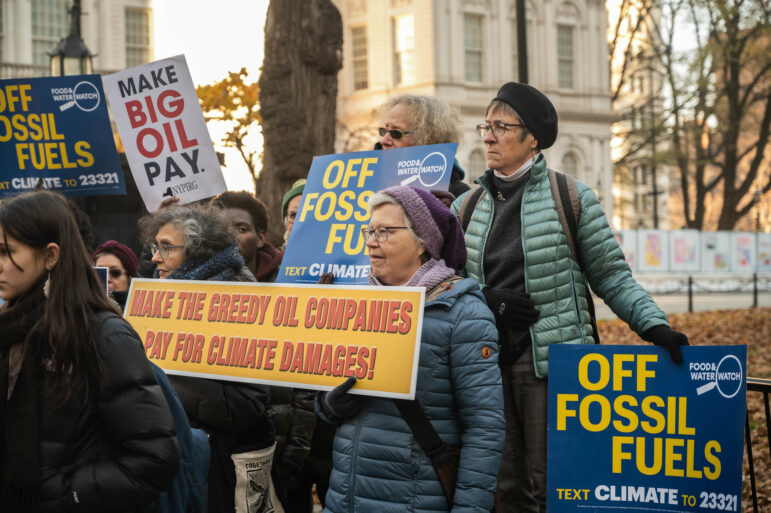
Climate activists with NYPIRG and Food & Watch Watch rallying for the bill with City Comptroller Brad Lander in December 2023.

The NY Heat Act isn’t the only big ticket climate bill that environmental groups are pushing lawmakers to pass before the legislative session comes to an end in early June.

The Climate Change Superfund Act is having its own moment in the spotlight now that a similar law passed both houses in Vermont‘s legislature, mounting the pressure on lawmakers to get New York’s version across the finish line.

The bill applies the “polluters pay” principle to climate change: if a company spills oil and pollutes a river, it’s required to pay for the clean up. The legislation proposes the same for those that wrecked the atmosphere and contributed to climate change.

The idea is to make the most prolific oil and gas producers that have business ties to New York pay $3 billion a year for the next 25 years for the total share of greenhouse gasses they emitted between 2000 and 2018. The funds, $75 billion in total, would be poured into infrastructure adaptation projects to protect the state from the effects of global warming.

But as is the case with the Heat Act, the fate of the Climate Change Superfund bill now hangs with the Assembly. The Senate passed the bill earlier this month, and while it’s making its way through the necessary committees within the Assembly—the Environmental Conservation Committee passed it on May 14—it’s yet to make it to the floor for a vote. 

“The bottom line that I think assembly members need to consider is: whose side are they on? Are they on the side of New Yorkers or are they on the side of the fossil fuel industry?” said Eric Weltman, a senior organizer at Food & Water Watch who is advocating for the bill.

The fossil fuel industry’s trade association, the American Petroleum Institute, has been pushing back. In an email to City Limits, a spokesperson for the group said charging companies for polluting the atmosphere is “unnecessary” and will only “stall” progress in meeting the world’s energy needs as fossil fuels are still needed as society transitions to cleaner sources of energy.

Some opponents take the argument a step further by saying it will cause petroleum prices to rise, driving up costs for consumers and impacting local businesses.

But supporters dispute that assertion.

“It’s utter nonsense,” said the bill’s sponsor, Assemblymember Jeffery Dinowitz. “That’s the type of scare tactic that [the fossil fuel industry] typically uses when they try to stop good legislation because it may ever so slightly eat into their bottom line.”

“But the real bottom line is that they caused much of the damage of climate change, and they should have to pay for the harm of the cost of addressing it,” Dinowitz added.

Could the bill drive up the price of oil?

The American Petroleum Institute, a trade organization representing nearly 600 fossil fuel companies, registered to lobby the legislation and spent over $100,000 dollars last year pushing back against it and a series of other environmental bills.

“America’s natural gas and oil industry is working to address climate change and build a lower carbon future, while simultaneously meeting the world’s growing energy needs,” Scott Lauermann, a spokesperson for API, said in an email. 

In a memorandum that API sent to New York state lawmakers and shared with City Limits, the association says the “bill is arguably discriminatory because it singles out certain companies.”

Jeanmarie Evelly

The document also claims “the bill places an unfair burden on domestic companies.” API says that if international companies can successfully argue in court that they have no business ties in New York, then local companies would be left to pick up the tab.

But the bill was designed to only impact the world’s largest oil producers as it covers companies whose total greenhouse gas emissions worldwide exceed 1 billion metric tons. Only major global oil companies like ExxonMobil, Chevron, Shell, and British Petroleum have that big of a carbon footprint and would be expected to pay up. 

Still, the argument that local businesses will take a hit has resonated with the Business Council of Westchester, which recently penned an op-ed against the bill. 

“Once these large corporations start footing the bill they are going to have to raise their rates. So that means that all of a sudden businesses in New York and consumers in the state are going to have higher energy rates because of this type of legislation,” said John Ravitz, vice-president and chief operating officer at the Council.

But a study by the Institute for Policy Integrity at NYU says the idea that oil companies could pass on increases in fixed costs to consumers is “unlikely.”

“It is an international market and the price is not set in the United States, let alone New York State,” said the economist Peter Howard, director at the institute and co-author of the study. 

“If these companies started trying to manipulate prices, the market would respond and other firms would enter the market. So there’s really no ability for these companies to manipulate prices,” Howard added.

The bill, Howard also points out, would charge companies different amounts according to how much carbon they emit. A scientific peer-reviewed method devised by the Climate Accountability Institute will be used to estimate how many metric tons of greenhouse gasses from each fuel company ended up in the atmosphere on an annual basis.

So if one company raises its prices to compensate for losses incurred from paying into the superfund, competitors on the market will actually benefit from keeping their prices low to attract customers. That’s just how capitalism works, he explained. 

Howard does point out, however, that if every state were to follow in New York’s footsteps and start charging oil companies for pollution, it could potentially dent individual company profits. But the economist says it’s “far-fetched” to assume every U.S state will pass a similar law, and notes that the industry is doing better than ever.

In 2022, the U.S fossil industry amassed record earnings. Last year it was reported that profits for companies like Exxon Mobil and Chevron remained the strongest in recent history. 

The damage climate change has caused to local businesses, some say, far outweighs the damage the bill could bring to oil industry profits.

“Unless you are in the fossil fuel industry, your business model is not supported by a climate that is rapidly becoming less and less stable, where year after year states are seeing numbers in the billions in terms of the load on taxpayers from climate disasters,” said Kate Ogden, head of advocacy at the eco-friendly product company, Seventh Generation.

Seventh Generation is part of  New York Businesses for Climate Justice, a coalition of companies that fight for environmental legislation. 

“It’s about recognizing that these businesses knew they were driving climate change, they had data on this and kept it to themselves,” said Bob Rossi, executive director of the New York Sustainable Business Council, another member of the coalition.

An investigation published nearly a decade ago uncovered internal company memos that revealed oil giant Exxon was aware of climate change and its role in driving it, as early as 1977.

“It’s the same thing that happened to the tobacco industry: they knew what was happening and they were lying to the public, that’s what we’re talking about,” Rossi added.

Marc A. Hermann / MTA

Flooded roads in Gowanus, Brooklyn on Sept. 29, 2023. The money collected by the Climate Change Superfund would be poured into infrastructure adaptation projects to protect the state from the effects of global warming. 

What now?

Earlier this year, both the Senate and the Assembly signaled support for the Climate Change Superfund Act in their budget resolutions, although the Assembly did not name the bill directly.

“The Assembly is supportive of holding fossil fuel polluters accountable for costs related to climate change via a cost-recovery method; however, any such approach cannot impact consumers who are already overburdened by adverse price increases,” the chamber’s recommendation reads.

The governor did not include any mention of it in her own budget proposal, which left advocates wondering if that’s part of the reason the legislation has stalled. 

“Governor Hochul will review all legislation that passes both houses of the legislature,” a spokesperson said in an email.

But the Superfund Act can’t make it onto her desk to be signed into law unless it gets the stamp of approval from the Assembly first. 

Last year, it didn’t pass the chamber. But advocates believe it has more of a shot this year, noting that the bill has 76 co-sponsors out of 150 in the Assembly and that unlike last year, it passed the Assembly’s Environmental Committee this time around.

“The ball really is in the speaker of the Assembly’s court to put it up for a vote because clearly the supporters are there. If the leadership wants to move it, it will move fast,” said Blair Horner, executive director of the New York Public Interest Group and an advocate for the bill.

Assembly Speaker Carl Heastie did not immediately respond to a request for comment, nor did Assemblymember Helene Weinstein, who chairs the Ways and Means Committee where the bill currently sits.

Advocates fear that two of their big climate priorities for this year, the NY Heat Act and the Climate Change Superfund, will meet a similar demise. 

“I think it’s politically stupid. It’s certainly to the detriment of New York’s future, if the Assembly were to block two of the top priorities that we have this session,” said Weltman from Food & Water Watch. 

“It sounds like a political miscalculation to potentially block progress on the greatest threat facing New York and the nation: climate change.” 

To reach the reporter behind this story, contact Mariana@citylimits.org. To reach the editor, contact Jeanmarie@citylimits.org

Want to republish this story? Find City Limits’ reprint policy here.

HPV vaccines prevent cancer in men as well as women, new research suggests

posted in: Society | 0

New research suggests the HPV vaccine is preventing cancer in men, as well as in women, but fewer boys than girls are getting the shots in the United States.

The HPV vaccine was developed to prevent cervical cancer in women and experts give it credit, along with screening, for lowering cervical cancer rates. Evidence that the shots are preventing HPV-related cancers in men has been slower to emerge, but the new research suggests vaccinated men have fewer cancers of the mouth and throat compared to those who didn’t get the shots. These cancers are more than twice as common in men than in women.

For the study, researchers compared 3.4 million people of similar ages — half vaccinated versus half unvaccinated — in a large health care dataset.

As expected, vaccinated women had a lower risk of developing cervical cancer within at least five years of getting the shots. For men, there were benefits too. Vaccinated men had a lower risk of developing any HPV-related cancer, such as cancers of the anus, penis and mouth and throat.

These cancers take years to develop so the numbers were low: There were 57 HPV-related cancers among the unvaccinated men — mostly head and neck cancers — compared to 26 among the men who had the HPV vaccine.

“We think the maximum benefit from the vaccine will actually happen in the next two or three decades,” said study co-author Dr. Joseph Curry, a head and neck surgeon at the Sidney Kimmel Cancer Center in Philadelphia. “What we’re showing here is an early wave of effect.”

Results of the study and a second were released Thursday by the American Society of Clinical Oncology and will be discussed next month at its annual meeting in Chicago. The second study shows vaccination rates rising but males lag behind females in getting the HPV shots.

HPV, or human papillomavirus, is very common and is spread through sex. Most HPV infections cause no symptoms and clear up without treatment. Others develop into cancer, about 37,000 cases a year, according to the Centers for Disease Control and Prevention.

In the U.S., the HPV vaccine has been recommended since 2006 for girls at age 11 or 12, and since 2011 for boys the same age. Catch-up shots are recommended for anyone through age 26 who hasn’t been vaccinated.

In the second study, researchers looked at self- and parent-reported HPV vaccination rates in preteens and young adults in a large government survey. From 2011 to 2020, vaccination rates rose from 38% to 49% among females, and among males from 8% to 36%.

“HPV vaccine uptake among young males increased by more than fourfold over the last decade, though vaccination rates among young males still fall behind females,” said study co-author Dr. Danh Nguyen at the University of Texas Southwestern Medical Center in Dallas.

Parents of boys, as well as girls, should know that HPV vaccines lower cancer risk, said Jasmin Tiro of the University of Chicago Medicine Comprehensive Cancer Center who was not involved in the research. And young men who haven’t been vaccinated can still get the shots.

“It’s really important that teenagers get exposed to the vaccine before they’re exposed to the virus,” she said.

The Associated Press Health and Science Department receives support from the Howard Hughes Medical Institute’s Science and Educational Media Group. The AP is solely responsible for all content.

Related Articles

Health |


Could current COVID vaccines protect against future outbreaks? New study offers hope

Health |


Hastings seeks PFAS funding after Legislature sinks bonding bill. But why isn’t 3M paying?

Health |


The invisible power of ‘nudging’ is leading diners to cut back on meat

Health |


Hims & Hers to sell inexpensive Ozempic alternative

Health |


Women’s heart risk spikes after menopause, study shows

Loons bracing for possibility of 10 or more players going on international duty in June

posted in: News | 0

Eric Ramsay came to Minnesota United for the opportunity to be a first-division head coach and navigate the challenges within a new-to-him league in a foreign country.

One obstacle course Ramsay will continue to have to navigate is how, unlike in England, MLS plays through FIFA international windows and during the summer, when major confederation tournaments take place. This combo will present a mix of impediments for him in June.

MNUFC is preparing for the possibility that 10 or more players will be called into their respective national teams next month, leaving the riding-high Loons shorthanded for a handful of league games.

“I’m trying not to get bogged down in frustration, and find some silver linings because we’ve mapped out roughly what we will have,” Ramsay told the Pioneer Press, without sharing details.

The exact amount of call-ups is not yet known and will be made official by specific federations. Some players might be named to provisional squads before that specific roster is finalized, while others might be called up for friendlies and perhaps not report, so the full number is a bit of a moving target as well. There also might be compromises made on how long certain players are away from MNUFC.

The official FIFA window is June 3-11, with MNUFC playing FC Dallas at Allianz Field on June 8, but there are other tournaments, in particular Copa America, which runs into July.

MNUFC has deployed 25 total players in MLS this season and 16 across the recent double-game week. Ramsay envisions calling on more depth pieces and members of the developmental team, MNUFC2, when international players are called up.

“It’s making sure we are training at a high level and making sure that we are really pushing the guys, making sure that we are really consistent with the messages we give, so anyone coming into our system, I suppose, is really familiar with what we are asking of them and the principles are really clear,” Ramsay said. “Then we are making sure that players have enough minutes across the games. I think we are in a really good place in that sense. Hopefully next week is another step.”

MNUFC has three games over an eight-day stretch starting Saturday at Colorado and an extended road trip to Los Angeles FC on May 29 before coming home to play Sporting Kansas City on June 1.

Ramsay, who was briefly an assistant coach with the Wales men’s national team in 2023, knows the sense of pride to be involved with one’s national team and he doesn’t want to take that opportunity away from players.

“The other side of the coin, and it’s a point I will make to the group, I feel like this group and this situation that we are in now can really serve everyone’s individual agendas, for lack of a better phrase,” Ramsay said. “The better we do, the more interest there is in (MNUFC), the more likely players are going to go play for their national team.”

The best example of that is striker Tani Oluwaseyi, who has a team-high five goals for the Loons (7-2-3, 24 points). His 1.01 goals per 90 minutes has helped push MNUFC to second place in the Western Conference.

Oluwaseyi’s name has been mentioned for a potential call-up to the Canadian men’s national team. Canada plays two friendlies in early June followed by Copa America from June 20 to July 14.

“If, in the future, (Oluwaseyi) goes away with Canada, he comes back with a bit more weight and a bit more stronger sense of self, I think that is a good thing for us,” Ramsay said. “I want to make sure we don’t deprive players of that.”

Loons goalkeeper Dayne St. Clair already has been named to Canada’s Copa America team and will get a chance to win the starting job for this summer. Longtime mainstay Milan Borjan is not in the team and St. Clair will compete with Maxime Crepeau of the Portland Timbers.

“Now it’s going to be little bit of a competition” St. Clair said. “The respect we both have for each other is definitely very high. Of course we both want our name to be the No. 1, but I think whoever does get called will definitely support (the other). I think the whole union with Team Canada is probably the strongest I’ve been around. Credit to (former head coach) John Herdman, the brotherhood was definitely real.”

Canada named Jesse Marsh its new head coach on May 13, and the American will start immediately. The uncertain leadership St. Clair felt with the Loons to begin 2024 had carried over to Canada as they started the year with interim head coach Mauro Biello.

“It’s clarity — similar to the situation was here (in Minnesota),” St. Clair said. “Interim for so long, but nobody knew what the direction is. Now you hear the name. I’ve never worked with (Marsch) in the past, so … once we get to camp, being able to hear his ideas. … It’s someone that seems motivated and happy to be a part of moving the country forward.”

Related Articles

Minnesota United FC |


Loons player Emanuel Reynoso seen in troubling video

Minnesota United FC |


Loons midfielder Emanuel Reynoso linked in move to Club Tijuana

Minnesota United FC |


Loons’ win over Timbers gets spicy with a first-half skirmish

Minnesota United FC |


Loons come back to beat Portland Timbers 2-1

Minnesota United FC |


Minnesota United vs. Portland Timbers: Keys to the match, projected starting XI and a prediction