High price of popular diabetes drugs deprives low-income people of effective treatment

posted in: Society | 0

By Renuka Rayasam, KFF Health News

For the past year and a half, Tandra Cooper Harris and her husband, Marcus, who both have diabetes, have struggled to fill their prescriptions for the medications they need to control their blood sugar.

Without Ozempic or a similar drug, Cooper Harris suffers blackouts, becomes too tired to watch her grandchildren, and struggles to earn extra money braiding hair. Marcus Harris, who works as a Waffle House cook, needs Trulicity to keep his legs and feet from swelling and bruising.

The couple’s doctor has tried prescribing similar drugs, which mimic a hormone that suppresses appetite and controls blood sugar by boosting insulin production. But those, too, are often out of stock. Other times, their insurance through the Affordable Care Act marketplace burdens the couple with a lengthy approval process or an out-of-pocket cost they can’t afford.

“It’s like, I’m having to jump through hoops to live,” said Cooper Harris, 46, a resident of Covington, Georgia, east of Atlanta.

Supply shortages and insurance hurdles for this powerful class of drugs, called GLP-1 agonists, have left many people who are suffering from diabetes and obesity without the medicines they need to stay healthy.

One root of the problem is the very high prices set by drugmakers. About 54% of adults who had taken a GLP-1 drug, including those with insurance, said the cost was “difficult” to afford, according to KFF poll results released this month. But it is patients with the lowest disposable incomes who are being hit the hardest. These are people with few resources who struggle to see doctors and buy healthy foods.

In the United States, Novo Nordisk charges about $1,000 for a month’s supply of Ozempic, and Eli Lilly charges a similar amount for Mounjaro. Prices for a month’s supply of different GLP-1 drugs range from $936 to $1,349 before insurance coverage, according to the Peterson-KFF Health System Tracker. Medicare spending for three popular diabetes and weight loss drugs — Ozempic, Rybelsus, and Mounjaro — reached $5.7 billion in 2022, up from $57 million in 2018, according to research by KFF.

The “outrageously high” price has “the potential to bankrupt Medicare, Medicaid, and our entire health care system,” Sen. Bernie Sanders (I-Vt.), who chairs the U.S. Senate Committee on Health, Education, Labor and Pensions, wrote in a letter to Novo Nordisk in April.

The high prices also mean that not everyone who needs the drugs can get them. “They’re kind of disadvantaged in multiple ways already and this is just one more way,” said Wedad Rahman, an endocrinologist with Piedmont Healthcare in Conyers, Georgia. Many of Rahman’s patients, including Cooper Harris, are underserved, have high-deductible health plans, or are on public assistance programs like Medicaid or Medicare.

Related Articles

Health |


Anoka County siblings confirmed to have measles after overseas visit

Health |


Tribal nations invest opioid settlement funds in traditional healing to treat addiction

Health |


If you’re living with a drug or mental health problem, here’s where to look for help

Health |


HPV vaccines prevent cancer in men as well as women, new research suggests

Health |


Could current COVID vaccines protect against future outbreaks? New study offers hope

Many drugmakers have programs that help patients get started and stay on medicines for little or no cost. But those programs have not been reliable for medicines like Ozempic and Trulicity because of the supply shortages. And many insurers’ requirements that patients receive prior authorization or first try less expensive drugs add to delays in care.

By the time many of Rahman’s patients see her, their diabetes has gone unmanaged for years and they’re suffering from severe complications like foot wounds or blindness. “And that’s the end of the road,” Rahman said. “I have to pick something else that’s more affordable and isn’t as good for them.”

GLP-1 agonists — the category of drugs that includes Ozempic, Trulicity, and Mounjaro — were first approved to treat diabetes. In the last three years, the Food and Drug Administration has approved rebranded versions of Mounjaro and Ozempic for weight loss, leading demand to skyrocket. And demand is only growing as more of the drugs’ benefits become apparent.

In March, the FDA approved the weight loss drug Wegovy, a version of Ozempic, to treat heart problems, which will likely increase demand, and spending. Up to 30 million Americans, or 9% of the U.S. population, are expected to be on a GLP-1 agonist by 2030, the financial services company J.P. Morgan estimated.

As more patients try to get prescriptions for GLP-1 agonists, drugmakers struggle to make enough doses.

Eli Lilly is urging people to avoid using its drug Mounjaro for cosmetic weight loss to ensure enough supplies for people with medical conditions. But the drugs’ popularity continues to grow despite side effects such as nausea and constipation, driven by their effectiveness and celebrity endorsements. In March, Oprah Winfrey released an hourlong special on the medicines’ ability to help with weight loss.

It can seem like everyone in the world is taking this class of medication, said Jody Dushay, an assistant professor of medicine at Harvard Medical School and an endocrinologist at Beth Israel Deaconess Medical Center. “But it’s kind of not as many people as you think,” she said. “There just isn’t any.”

Even when the drugs are in stock, insurers are clamping down, leaving patients and health care providers to navigate a thicket of ever-changing coverage rules. State Medicaid plans vary in their coverage of the drugs for weight loss. Medicare won’t cover the drugs if they are prescribed for obesity. And commercial insurers are tightening access due to the drugs’ cost.

Health care providers are cobbling together care plans based on what’s available and what patients can afford. For example, Cooper Harris’ insurer covers Trulicity but not Ozempic, which she said she prefers because it has fewer side effects. When her pharmacy was out of Trulicity, she had to rely more on insulin instead of switching to Ozempic, Rahman said.

One day in March, Brandi Addison, an endocrinologist in Corpus Christi, Texas, had to adjust the prescriptions for all 18 of the patients she saw because of issues with drug availability and cost, she said. One patient, insured through a teacher retirement health plan with a high deductible, couldn’t afford to be on a GLP-1 agonist, Addison said.

“Until she reaches that deductible, that’s just not a medication she can use,” Addison said. Instead, she put her patient on insulin, whose price is capped at a fraction of the cost of Ozempic, but which doesn’t have the same benefits.

“Those patients who have a fixed income are going to be our more vulnerable patients,” Addison said.

This article was produced by KFF Health News and also ran on CBS News. Renuka Rayasam: rrayasam@kff.org@renurayasam

KFF Health News is a national newsroom that produces in-depth journalism about health issues and is one of the core operating programs of KFF — the independent source for health policy research, polling and journalism.

Chris Finch explains his coaching decisions in Timberwolves’ Game 2 loss to Dallas

posted in: News | 0

Minnesota dropped Game 2 of the Western Conference Finals to Dallas by the narrowest of margins — one point — in a contest where Luka Doncic hit a triple with three seconds to play and Naz Reid’s potential game winner rimmed out at the horn.

Naturally, after such a tight bout, every minute detail and decision will be analyzed and debated.

Timberwolves coach Chris Finch isn’t immune to such discourse. Many of his decisions were questioned on social media during and after the game. Here’s what Finch had to say about his most pertinent calls:

On not calling a timeout when the Wolves gained possession of the ball up two with 32 seconds remaining to sub Mike Conley back into the game and call a play (the possession ended in Anthony Edwards throwing the ball out of bounds): “That’s on me in the sense that I should have called a timeout to get Mike back in the game on that second to last possession for us, or whatever. So I’ll take that one, it’s on me. But yeah, ball got static and turned it over. Same story as the other night, turnovers in the guts of the game, not gonna get it done.”

Finch was again asked about the decision to not take a timeout.

“I just said I shoulda called it,” Finch said. “But we thought the ball was in Ant’s hands, the differential on the clock wasn’t huge. But initially wanted to call it, but I didn’t.”

On the defensive plan on Dallas’ last offensive possession (the Wolves elected not to double team Doncic, instead switching a pick and roll that left Rudy Gobert on an island to guard Doncic): “The idea was switch up (and) press him inside the 3-point line.”

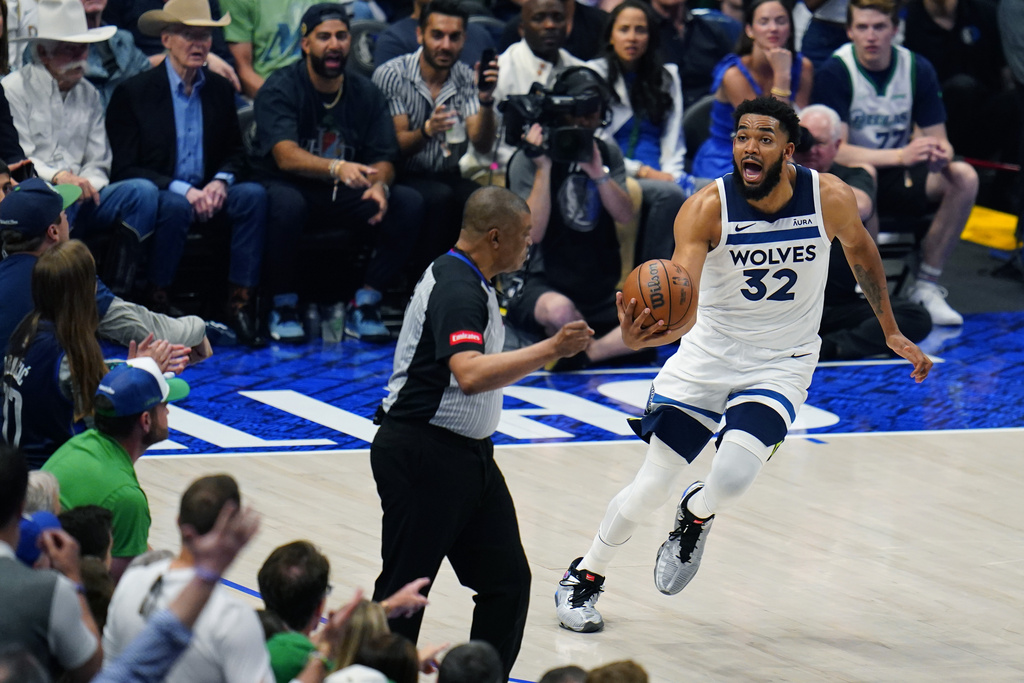
On leaving Karl-Anthony Towns on the bench for the final eight minutes of the contest in favor of Naz Reid (Towns went 4 for 16 from the field while Reid hit seven triples): “Naz was playing well, real well and gave us some switchable combinations out there and stuff like that.”

Finch said he didn’t converse with Towns about the decision during the game.

“No, I didn’t really have time to have that conversation,” he said.

Related Articles

Minnesota Timberwolves |


Officials say they missed a late foul call on play that ended in Timberwolves turnover

Minnesota Timberwolves |


John Shipley: Luka Doncic closed the door, but Kyrie Irving made it happen for Dallas

Minnesota Timberwolves |


Luka Doncic drills late triple to put Timberwolves down 2-0 in West Finals

Minnesota Timberwolves |


John Shipley: Wolves’ Luka Garza watching, waiting and playing Nikola Jokić

Minnesota Timberwolves |


Timberwolves’ Rudy Gobert juggling new fatherhood and a championship chase

Officials say they missed a late foul call on play that ended in Timberwolves turnover

posted in: News | 0

It was one of the turnovers that helped doom Minnesota’s late-game collapse in Game 2 of the West Finals on Friday.

Minnesota was leading by two when Anthony Edwards found himself in traffic on the perimeter and fired a pass high down to Jaden McDaniels on the baseline. McDaniels jumped up to snatch the ball while keeping his feet in bounds. Then Dallas guard Kyrie Irving came smacked the ball out of McDaniels’ hands and out of bounds.

The on-court ruling was the ball was out of bounds off Irving, meaning Minnesota would’ve retained possession with 47 seconds to play and five ticks left on the shot clock.

But Irving pled with Mavericks coach Jason Kidd to challenge the out of bounds ruling. He signaled that he hit McDaniels’ wrist, not the ball.

“It looks like it was also a foul, right? Of course,” Wolves coach Chris Finch said. “It looked like he was fouled, but they can’t – or didn’t – account for that in the call.”

Irving was right. Dallas challenged and, sure enough, replay confirmed the ball went out of bounds off McDaniels. It was Dallas’ ball.

“Postgame review we did see illegal contact from (Kyrie) Irving to the forearm of McDaniels that should have been called a foul,” Game 2 crew chief Zach Zarba told a pool reporter after the game.

Zarba also noted it’s not within NBA rules for the officials to tack on a foul call after reviewing a play. The Wolves couldn’t have challenged that, either, because you cannot challenge a foul that was not whistled.

The Mavericks did not score on their ensuing possession. But had Minnesota maintained possession in that moment, it could’ve potentially scored. And, had the officials called a foul, McDaniels would’ve gone to the free-throw line with a chance to put Minnesota up four with 47 seconds to play.

It’s possible the Mavericks would’ve won, anyway. The Wolves certainly didn’t do much to help themselves in the game’s closing moments. But Minnesota would’ve been in a more advantageous position to hold onto the victory at that point.

Related Articles

Minnesota Timberwolves |


John Shipley: Luka Doncic closed the door, but Kyrie Irving made it happen for Dallas

Minnesota Timberwolves |


Luka Doncic drills late triple to put Timberwolves down 2-0 in West Finals

Minnesota Timberwolves |


John Shipley: Wolves’ Luka Garza watching, waiting and playing Nikola Jokić

Minnesota Timberwolves |


Timberwolves’ Rudy Gobert juggling new fatherhood and a championship chase

Minnesota Timberwolves |


Twenty years ago, Timberwolves captivated Minnesota. That group is living vicariously through this playoff run.

But that’s irrelevant now.

John Shipley: Luka Doncic closed the door, but Kyrie Irving made it happen for Dallas

posted in: News | 0

Before Game 2 of his team’s Western Conference final series against the Timberwolves on Friday, Dallas coach Jason Kidd was asked how Luke Doncic overcame a poor-shooting start to play the starring role in the Mavericks’ 108-105 Game 1 victory on Wednesday.

“That’s Ky,” Kidd said.

No, the reporter said, Luka.

“Yeah. That’s having Ky,” Kidd repeated.

While Doncic was struggling early, it was Kyrie Irving who kept the Mavericks close in Game 1, scoring 24 first-half points to single-handedly keep the Timberwolves from running away with it early. Doncic took over late, and Dallas had a 1-0 lead in this best-of-seven series.

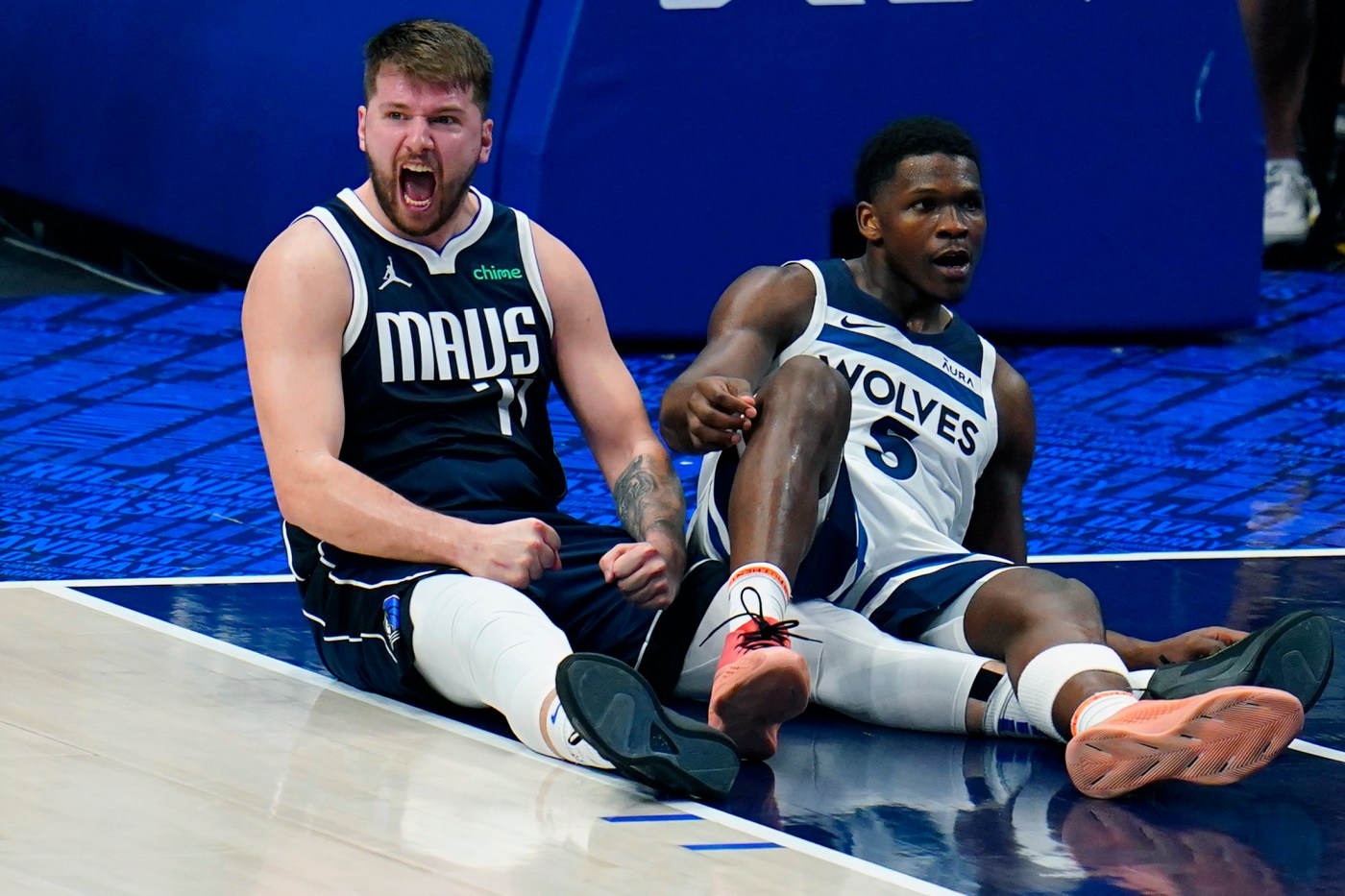
The script was flipped on Friday, but the result was the same, a Dallas victory in Game 2. Doncic was a handful all night, finishing with 32 points and 10 rebounds as the Mavericks edged the Timberwolves 109-108 at Target Center. But it was Irving — who had only five points in the first half — who finally pushed the Mavericks into the lead late.

The TImberwolves had a 58-40 lead with 2 minutes, 47 seconds left in the first half and a golden opportunity to take the life out of the Mavericks before the half. Now they’d better hope the Mavericks haven’t taken the life out of them after winning the first two games in this best-of-seven series in Minneapolis.

Irving has disappeared a few times in this postseason, and it appeared that Friday might be another of those. Instead, he finished with 20 points, six assists and four boards to send the Mavericks into Game 3 at American Airlines on Sunday with a 2-0 series lead.

The Nuggets forced a Game 7 after losing twice to the Timberwolves in Denver in the last round, but this Mavericks team — despite not having three-time MVP Nikola Jokic — is a tough out, and so far it’s because of Irving, an NBA champion in Cleveland and veteran of three NBA finals series.

Naz Reid missed a potential game-winner, a 3-pointer that bounced in and out as the clock expired, but Doncic essentially won the game after creating space against Rudy Gobert behind the arc and draining a fall-away 3-pointer. He was magnificent, adding a game-high 13 assists for a triple-double.

Doncic has been terrific, but he can’t will the Mavericks to victory without another reliable scorer, and it’s been Irving so far in this series, the Timberwolves’ first conference final since 2004. Dallas executed when the game was close and the Timberwolves didn’t on Friday, and it was Irving — a veteran of 89 NBA postseason games — who turned a 12-point halftime deficit into a lead early in the fourth quarter.

The Mavericks had pulled within a bucket a couple of times and trailed 86-80 after three quarters. In the first 97 seconds of the fourth, Irving hit a 3-pointer to make it 86-83, drove to set up a hook shot by P.J. Washington that made it 86-85, and drilled another 3 to put Dallas up, 88-86 — the Mavericks’ first lead since they were up 7-6 just 2:24 into the game.

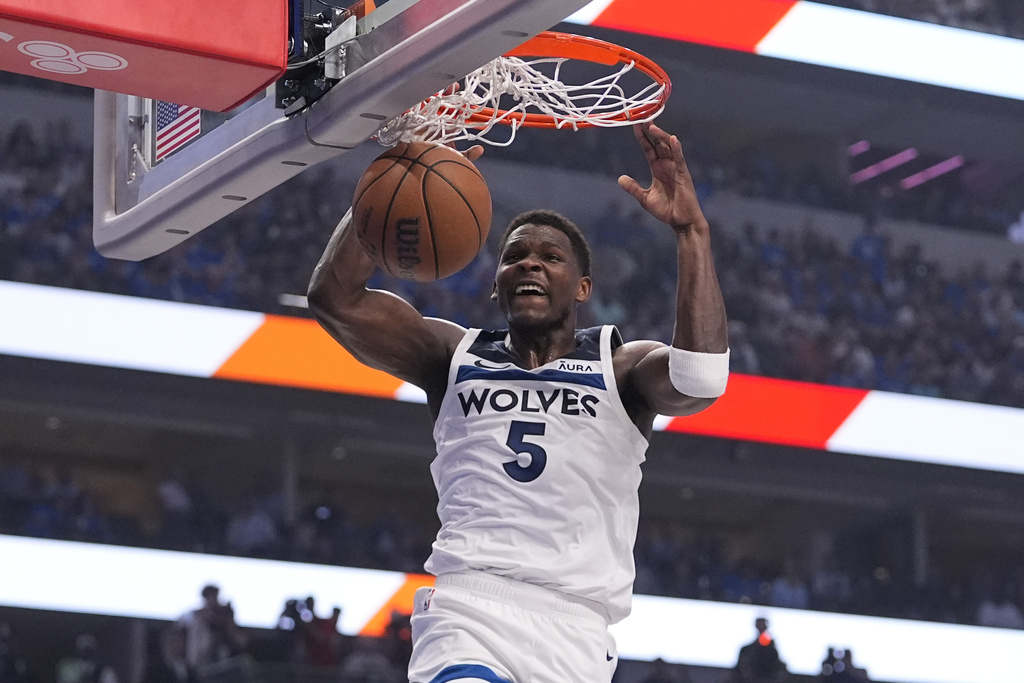
Washington, by the way, was instrumental in the Mavericks’ ability to rein in Anthony Edwards, who finished with 21 points and a game-high seven assists but shot poorly (5 of 17 from the floor), complained to a referee while the Mavericks scored 5-on-4 and committed a giant turnover with 12 seconds left and the Wolves up 108-106.

The next basket was Doncic’s game-winner, although Irving cut the Wolves’ lead to 108-106 on a 3-pointer with 1:05 left.

Edwards was held to 19 points on 6-for-16 shooting in Game 1, and before Friday’s game, head coach Chris Finch noted, “He’s entitled to have a game like that once in a while.”

Is two in a row a bad sign? Karl-Anthony Towns finished with 15 points and seven rebounds and barely played in the fourth quarter.

Reid finished with a team-high 23 points and scored some big baskets late to give the Wolves a chance to win, and Mike Conley was Minnesota’s best player early. But the Timberwolves won’t advance to their first NBA Final without Edwards going big.

Not with Doncic and Irving making big buckets for Dallas.