Gretchen McKay | Pittsburgh Post-Gazette (TNS)
Rie McClenny grew up in southwestern Japan with family members who not only loved to cook but, as the owners of a tearoom and cafe in their small seaside city, were pretty darn good at it.
Recipes: Celebrate spring by making these dishes with asparagus
This Asparagus, Sorrel and Pine Nut Salad is easy, bright and delicious
Recipe: Steven Raichlen’s Italian-inspired Grilled Artichokes
Recipe: Make Cola Barbecue Sauce for that Cola-Can Chicken
Recipe: How to make Steven Raichlen’s Cola-Can Chicken
The simple, home-cooked meals her mother, Yoko, and maternal grandmother, Kiyoko, prepared for their rural customers, using seasonal local ingredients and traditional recipes, were far from fancy. Yet their skillful mix of salty, sweet, sour and bitter — key elements in authentic Japanese cuisine — were rich with umami flavor.
The women were particularly good at making one beloved Japanese comfort food: the ground pork- and cabbage-filled, pan-fried dumplings known as yaki-gyoza.
As McClenny recalls in her first cookbook “Make it Japanese” (Clarkson Potter, $30), they were absolute whizzes at folding dough wrappers around the savory filling to create tasty bundles that were juicy and tender on the inside and crispy, golden-brown on the outside. So good, in fact, that she never felt the urge to learn to make them herself.
“I enjoyed baking, and also enjoyed reading recipes in cookbooks and magazines,” she says from her home in Los Angeles, “but my mom was such a great cook I didn’t feel I needed to do it.”
Instead, she watched her mother for “hours on end as she folded gyoza faster than my eyes could follow and never measured ingredients — one circular pour of soy sauce, a handful of bonito flakes, a dash of sake,” she writes in the book’s intro.
While her mom imparted a few basics before she left the house to go to university in Osaka, it wasn’t until McClenny landed in a rural town in West Virginia during a year abroad that she realized reading about cooking is a sad substitute for actually doing it.
Also, being away from Japan for so long made her more aware of her heritage as well as homesick for her mom’s cooking. So pulling herself up from her non-cooking bootstraps, she started re-creating those recipes — gyoza included — using a “mishmash” of three ingredients found in every Japanese pantry: soy sauce, sake and mirin.
“There was only one Asian market, so I used what was available,” she says.
The Post-Gazette’s Gretchen McKay shows the process for making Japanese gyoza, fried dumplings at her home in Ben Avon Friday, April 12, 2024. (Sebastian Foltz/Pittsburgh Post-Gazette/TNS)
She found herself compromising once again with ingredients in her chase to conjure the flavors of her childhood during a post-college job at Disney World’s Japan Pavilion in Orlando, Florida. But at least she was honing her skills as a cook, which would prove useful in her next job working for a Japanese culinary school.
When the school asked her to open a patisserie cafe in New York in 2007, it proved to be a turning point in her career. Being surrounded by ambitious people who were following their dreams, she realized it was now or never.
“I just thought the food industry was so interesting,” she says, “so I started learning more and more. Students were so passionate about restaurants and bakeries.”
At age 33, she enrolled at the French Culinary Institute (now the Institute of Culinary Education), thinking she might become a food stylist. She had so much fun and loved cooking so much that, after graduating, she became a chef instead, moving to Los Angeles with her husband to work as a chef at two Santa Monica restaurants.
She cooked professionally for three years before burning out one night after working more than 300 meals. Deciding that a food media job would be less stressful (but still fun), in April 2016 she applied for a position as a recipe developer at Tasty Japan, the Japanese edition of BuzzFeed’s food media brand Tasty.
Three months later, she was hired as a full-time video producer and she soon was also appearing in videos on YouTube for BuzzFeed, though she admits to being very self-conscious about her English skills and Japanese accent.
“But the more I did it, the more I realized people didn’t care so much,” she says. “They just want to learn how to cook. They are not learning English from me, but Japanese culture and food from a person from Japan.”
Despite the long hours to get there, she says, “it was exhilarating to finally pursue what I loved.”
Showcasing the beauty of Japanese cuisine on camera made her realize she wanted to show that “Japanese home cooking can be for everyone.” So when a publisher reached out to her in 2021 to do a cookbook, she said yes, and started writing that same year, drawing on the nourishing food her mom cooked throughout her childhood for inspiration.
“There are a lot of Japanese cookbooks, but I wanted one [that focused] on very approachable Japanese cooking, where you can make it if you have some of the basic items,” she says of the book, which took two years to complete.
As she discovered in West Virginia so many years ago, with salt from soy sauce, acidity from sake and sweetness from mirin, “you can basically cook anywhere.”
While some of her offerings require time, many of the dishes in “Make it Japanese” will easily come together on a busy weekend night. Most recipes are based on food she grew up eating or learned to cook once she moved to the U.S., using ingredients you can get at any Trader Joe’s or Whole Foods instead of a specialty store.
Geared to those new to Japanese cooking, the book also includes instructions on how to stock a Japanese pantry and has a short chapter on essential Japanese cooking tools.
It’s not only very traditional, she says, but demonstrates exactly how she cooks at home. That includes a step-by-step recipe for her mother’s gyoza that discloses the secret ingredient that makes them so incredibly tasty — nira, or garlic chives. (They’re also known as Chinese leeks.)
“You definitely don’t want to go on a date after eating them. They’re so stinky,” McClenny says with a laugh.
Eaten in Japan since ancient times, the long, grass-like blades are more pungent and garlicky than regular chives. In addition to dumplings, they’re a go-to flavor-booster for everything from soup to kimchi, stew to green onion pancakes, after trimming off the root end and white tips.
Her mom’s recipe also includes seasoning the ground pork filling with grated ginger, soy sauce and sake and adding fresh shiitake mushrooms and lots of finely chopped cabbage for a bit of silky heft. “But every home has a different recipe,” she says.
She also makes the gyoza with a lacy, crispy crust on the bottom called “wings,” or hane in Japanese — created by adding a cornstarch slurry to the pan while the dumplings are steam-frying. They’re served, with golden-brown aplomb, upside down on the plate, with a dipping sauce made from soy sauce, rice vinegar and sesame and chili oils.
While gyoza originated in China, where they are called jiaozi, they’re actually very different, says McClenny. For starters, Chinese potstickers boast a thicker dough. They’re also boiled, whereas “when we say ‘gyoza,’ we usually mean pan-fried.”
Though you can (and just might) make a meal of them, gyoza in Japan are almost always a side dish, says McClenny. They’re also made with super-thin premade wrappers in Japanese homes because they’re easy to find in any grocery store. Plus, a recipe makes so many of them, and stuffing and folding the dumplings just so — gathered on one side and flat on the other — takes time. So why complicate matters by adding homemade dough to the equation?
That said, even with premade wrappers, it might take beginners a lot of practice before their fingers develop the requisite muscle memory to fill, fold and pleat at a record pace.
“But don’t stress,” says McClenny. “It’s just practice. Channel your inner grandmother or mother, try your best and, if it doesn’t look great, it still tastes good anyway.”
Her one tip is to go kind of skimpy on the filling, with less than a tablespoon. “You feel like you want to fill a lot, but if you overfill it will come out.”
Once you get the hang of it, you’ll find gyoza are incredibly fun to make, even if they’re not perfect.
“It’s just home cooking,” says McClenny. “Your family won’t judge you. They’ll be impressed you’re making [dumplings] from scratch.”
Ingredients for Japanese gyoza, fried dumplings. Photo: Friday, April 12, 2024. (Sebastian Foltz/Pittsburgh Post-Gazette/TNS)
Gyoza with Crispy ‘Wings’
PG tested
For the prettiest pleats, be careful not to overfill the wrappers. Adding a little cornstarch slurry to the pan while cooking the dumplings will create a lacy, crispy crust on the bottom called “hane” — Japanese for wings.
Unless you’re an overachiever, don’t worry about making dough from scratch for these pan-fried dumplings. Even in Japan, most home cooks use premade wrappers, which you can find in any Asian market.
Japanese gyoza are meant to be very garlicky, so if you can’t find nira chives at your local Asian market, use the same amount of scallions or chives, but also add 2 grated garlic cloves to the filling.
For dipping sauce
1/4 cup soy sauce
1/4 cup rice vinegar
1 tablespoon toasted sesame oil
1 teaspoon chili oil
For filling
8 ounces ground pork
1 cup finely chopped green cabbage (about 3 ounces)
3/4 cup finely chopped nira chives (about 1 1/2 ounces)
1/4 cup finely chopped fresh shiitake mushrooms (about 3/4 ounce)
1/2 teaspoon finely grated fresh ginger
1 1/2 teaspoons soy sauce
1 1/2 teaspoons toasted sesame oil
1 1/2 teaspoons sake
1/2 teaspoon kosher salt
1/2 teaspoon freshly ground black pepper
For dumplings
Cornstarch or potato starch
35-40 gyoza wrappers
2 teaspoons neutral oil, such as canola or grapeseed
Kosher salt
Toasted sesame oil
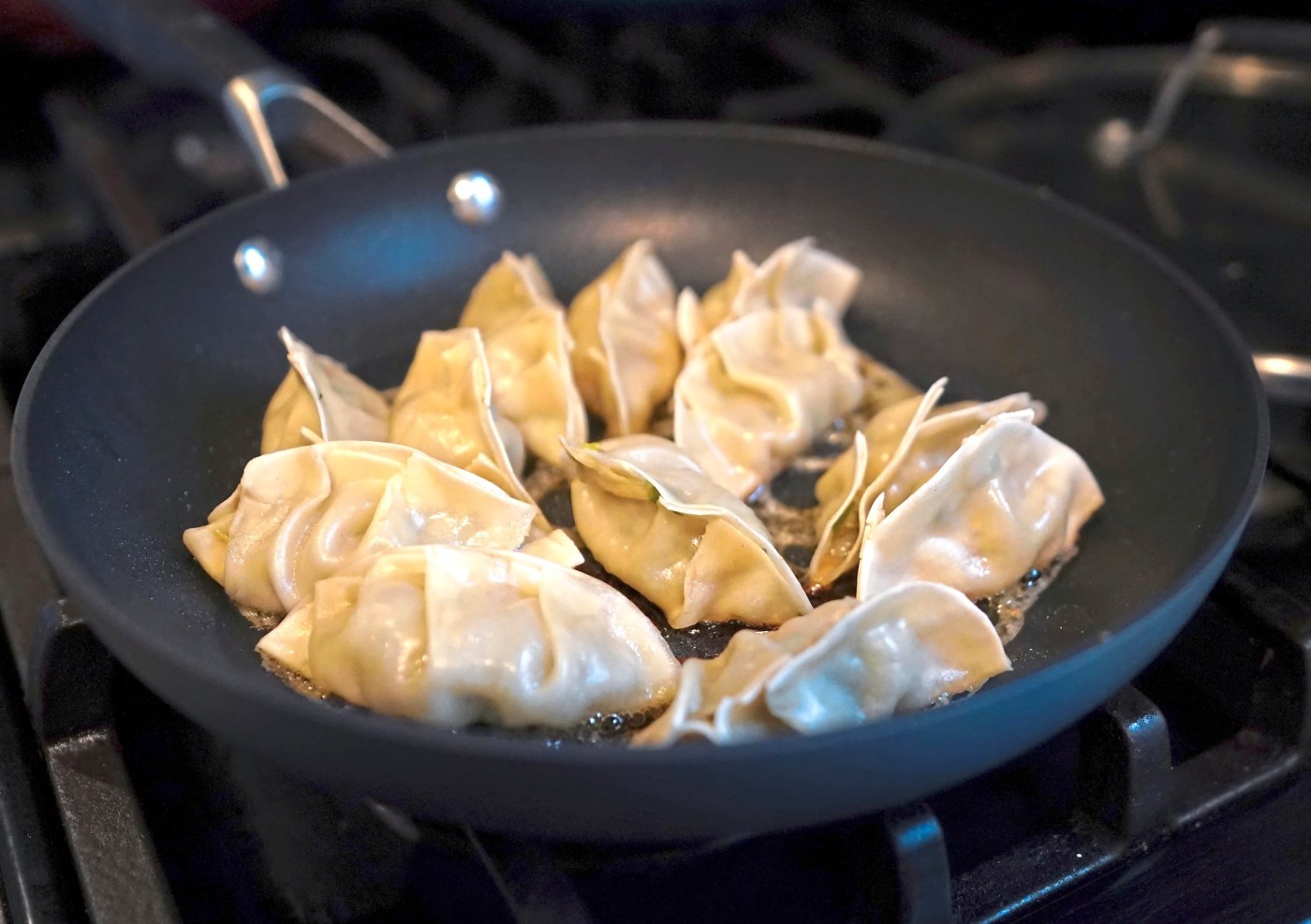
Japanese gyoza are steam-fried with a cornstarch slurry to create crispy “wings,” or hane in Japanese. (Sebastian Foltz/Pittsburgh Post-Gazette/TNS)
Make dipping sauce
In small bowl, whisk together soy sauce, vinegar, sesame oil and chili oil. The sauce will keep in an airtight container in the refrigerator for up to 3 weeks.
Make filling
In a large bowl, combine ground pork, cabbage, nira chives, shiitake, ginger, soy sauce, sesame oil, sake, salt and pepper. Using your hands, mix well to combine.
Make dumplings
Dust a baking sheet with cornstarch. Fill a small bowl with water.
Place a gyoza wrapper in the palm of your nondominant hand. Using the other hand, place a scant 1 tablespoon filling in the center of the wrapper.
Dip your fingers in water and lightly wet one half of the wrapper’s rim. Fold the wrapper in half.
Using your fingertips, pleat only the top half of the wrapper, pressing against the bottom half to seal the gyoza. (The bottom half of the wrapper remains flat; you only fold one side of the wrapper.)
Place gyoza on the prepared baking sheet. Repeat with the remaining wrappers and filling. Sprinkle with more cornstarch if the gyoza seem to be sticking together. Uncooked gyoza will keep in the freezer in a resealable plastic freezer bag for up to 3 months.
In a 10-inch nonstick skillet with a lid, heat 2 teaspoons neutral oil over medium heat. Add enough gyoza to fit in a single layer (about 12), arranging them in a circular pattern.
Cook until slightly golden on the bottoms, 1-3 minutes.
In a small bowl or measuring cup, combine 1/3 cup water, 1 1/2 teaspoons cornstarch and a pinch of salt. Pour cornstarch mixture into the skillet.
Cover with lid and steam the gyoza until most of the water has evaporated, 6-8 minutes.
Uncover and continue cooking until the water has completely evaporated and the cornstarch has thickened to a gel-like web at the bottom of the skillet, about 2 minutes.
Drizzle some sesame oil around the edges of the gyoza. Increase the heat to medium-high and cook, uncovered, until the cornstarch dissolves and dries, forming “wings” that are lacy and crispy, 2-4 minutes. Remove skillet from heat and let the gyoza rest in the skillet until any bubbling subsides, 1-2 minutes.
Using chopsticks or a spatula, loosen the “wings.” Place a large plate on top of the gyoza. Flip the skillet upside down to invert the gyoza onto the plate. Wipe the skillet clean and repeat with remaining gyoza.
Serve hot with dipping sauce.
Serves 6-8.
— “Make it Japanese: Simple Recipes for Everyone” by Rie McClenny (Clarkson Potter $30)
©2024 PG Publishing Co. Visit at post-gazette.com. Distributed by Tribune Content Agency, LLC.