
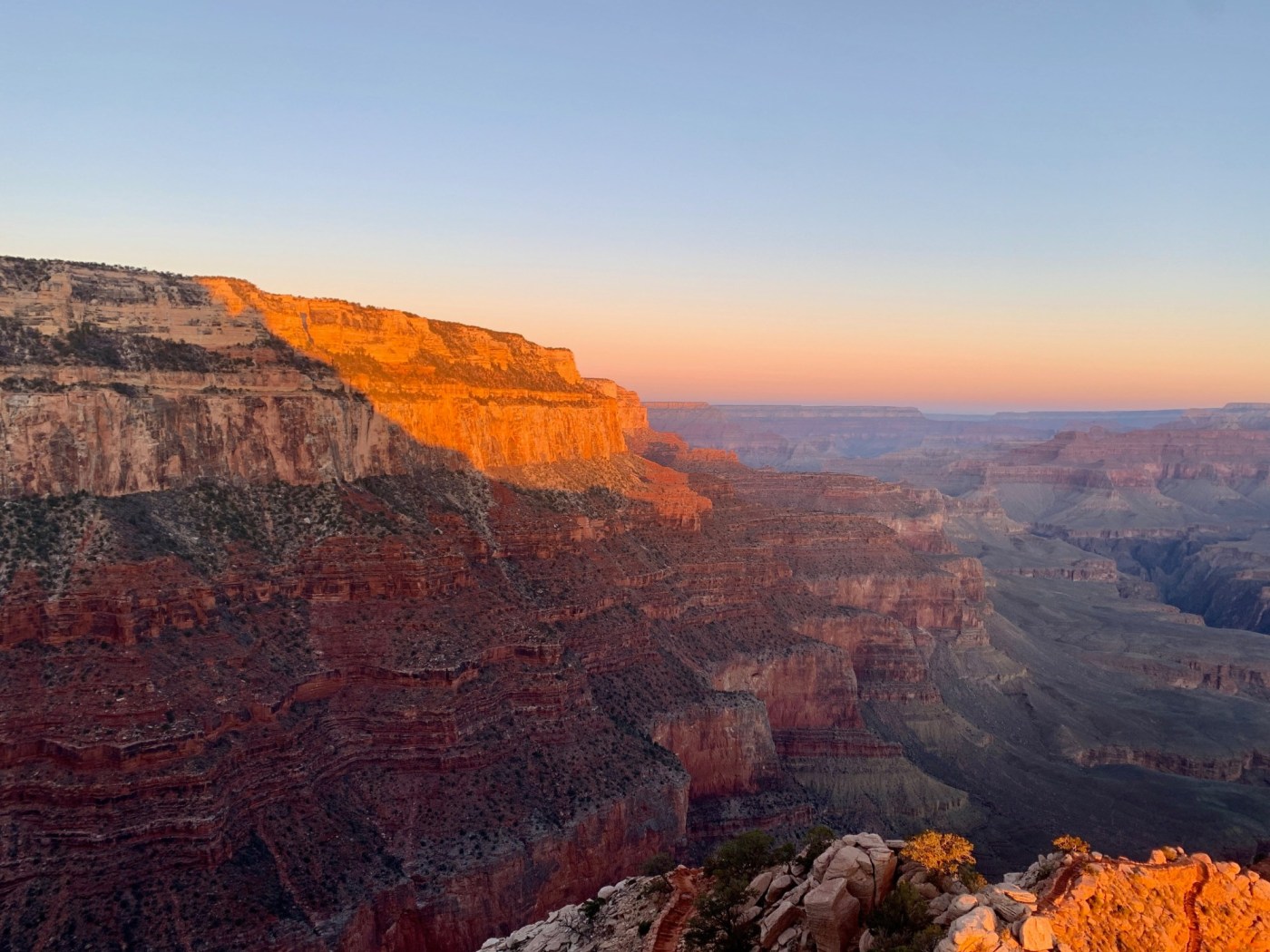
Rafting through the Grand Canyon is every bit as magical as it sounds

posted in: Adventure | 0

Nearly a year ago, when my friend Nina told me she’d scored a noncommercial permit to raft through the Grand Canyon, I had no idea how lucky she was – or how lucky I would be, after she invited me to join her Colorado River expedition.

The National Parks Service uses a weighted lottery system each February to award these noncommercial rafting permits, just 495 of them last year. (There are also, of course, park-approved commercial raft trips through portions of Grand Canyon National Park that last anywhere from 1 to 18 days). Nina’s permit authorized her to rally a group of 16 people at a time — more on that in a sec — to traverse the 225 miles between Lees Ferry and Diamond Creek in 16 days.

Hailing from across the U.S., our group of rafters convened in snowy Flagstaff just before St. Patrick’s Day, packed up our gear with our outfitters, Moenkopi Riverworks, and headed for Lee’s Ferry. It was remarkable how much food and gear could be crammed into four, inflatable 18-foot rafts and one 15-footer. We even brought a propane-fueled fire pit. Each raft had a seasoned captain, and four had rafted through the Grand Canyon several times.

Designated campsites of various sizes dotted the route along the Colorado River. (Courtesy Nina Frankel)

We quickly fell into a rhythm, starting each morning with coffee and breakfast, before packing up our gear and paddling off to our next destination 10 to 20 miles downriver. The atmosphere felt a bit like summer camp for adults, a little wilderness expedition-meets-vacation, complete with DIY meal kits ready to be cooked up on our heavy-duty outdoor kitchen.

About 33 miles down the Colorado River from Lee’s Ferry, Redwall Cavern offers a shady destination for lunch — and cartwheels. (Courtesy Jennifer Sparks)

Without internet or cell service tethering us to our outside lives, friendships quickly developed, and new discoveries awaited around every bend in the river. There were the Roaring Twenties, a series of splashy and fun rapids that felt like nature’s version of a roller coaster. There was Nautiloid Creek, where a quick side hike yielded views of nautilus fossils embedded in the rocks, and Nankoweap, a side hike to a set of Native American granaries.

A little after mile 61, we passed the point where the flooded Little Colorado River met the Colorado. The water took on a milky chocolate color, fine sediment blending into the water source that’s critical to a wide swath of the western U.S.

Our first few days flew by in a rush to make it to Phantom Ranch (mile 89) by day 5 and swap out four members of our party for four other friends, who had hiked in to meet us. There, we experienced the closest thing to civilization available at the bottom of the Grand Canyon — outhouses and a gift shop with ice-cold lemonade and postcards you can send out of the canyon via mule.

The author traveled on a 16-day rafting expedition down the Colorado River through the Grand Canyon and spent time at the oars learning to row. (Courtesy Samuel Streeter)

Then it was onward down the river, with the current propelling us along. Rafters took turns rowing, sitting forward or backward at the oars, depending on preference. It took me several days of frustrated practice, but once I got it down, there was something delightfully meditative about pulling and pushing the boat along the river. I even got to row some of the smaller rapids, which felt pretty thrilling.

As we plunged deeper into the canyon, new layers of rock emerged. There was grey and yellowish Muav limestone, greenish Bright Angel shale and Tapeats sandstone, which looked like walls of layered 500-million-year old pancakes. The Vishnu schist — the Grand Canyon’s 1.7 billion-year-old “basement layer” — was veined with pink stripes of Zoroaster granite.

Near miles 117, we came to Elves Chasm, a stunning side canyon oasis with a swimming hole and trickling waterfall. It was a perfect spot for cooling down as the days started to warm.

At Blacktail Camp, we passed a slot canyon with a little cavern, where a couple of friends put on an impromptu ukulele and guitar performance. Just behind them at eye level, we could see the Great Uncomformity – a horizontal break in the rocks where about a billion years of geologic time has disappeared. Time is captured in the rocks throughout the canyon, but here, there is nothing. It felt sacred and a little eerie to be singing along to the group’s rendition of Noah Kahan and Caamp songs in an ancient slot canyon where a billion years can disappear without a trace.

The towering ancient rock walls of the Grand Canyon were on view from the granaries at Nankoweap. (Kate Bradshaw/Bay Area News Group)

And the journey continued. We stopped to explore the Doll’s House (mile 131), a schist ridge polished by the river into a maze that welcomed exploration. (It was also the scouting spot for one of the more treacherous rapids we faced, the Class 7 Bedrock. Rapids on the Grand Canyon are categorized on a scale of 1-10 rather than the more standard 1-6 scale.)

A couple of miles down the river, we camped near Tapeats Creek and took a hiking trail up and over to Deer Creek. It was one of the more maintained trails; many of our outings felt like rock scrambles over unmarked terrain

One of the trip highlights was a stop at Havasu Canyon, where the water suddenly turned turquoise. We waded through chest-deep water, as the slot canyon opened up into a mini-paradise with lush greenery, cool shade and the bluest water I’d ever seen.

It was a mellow moment as we prepared for the final large rapid — the biggest and most dangerous — of the journey: Lava.

One of the best-maintained hiking trails from the Colorado River in the Grand Canyon was the Tapeats Creek to Deer Creek hiking route. (Courtesy Jennifer Sparks)

Anxiety about these Class 9 rapids had built up for days. The Grand Canyon inspires a certain sense of reverence and superstition toward the river gods, so we held a goofy group ceremony — just in case — to give our thanks to the river and honor its power. It seemed an especially good idea moments later, as the landscape suddenly changed, the water roiling through canyon walls studded with black basalt chunks and the remnants of volcanic flows — and our rafts passed through safely.

Afterward, we indulged in the time-honored river tradition of a visit to Tequila Beach, nicknamed for reasons that certainly don’t involve the consumption of questionable quantities of celebratory alcohol.

Two days later, on Easter Sunday, we awoke to a camp filled with hidden Easter eggs containing slips of paper with dares. Hijinks ensued.

Surrounded by ancient and majestic landscapes on the Colorado River, rafters enjoyed each other’s company, including one day when all the women in the group crowded onto a single raft. (Courtesy Emily Blackmer)

Soon, we’d made it to Diamond Creek and the take-out — and the first place since the journey began 225 miles ago with a road out, albeit a bumpy dirt one.

After unloading and disassembling our boats, we traveled out to Route 66, where I had a cathartic encounter with an A&W. After so many days off-grid, I’d never been more excited to experience flushing toilets and milkshakes. But what I gained on this journey — new friends, new arm muscles (sort of), new skills and whitewater lingo – was unforgettable.

If You Go

Whitewater rafting in Grand Canyon National Park generally requires advance planning, whether you’re on a guided commercial trip or a private one. Learn more at https://www.nps.gov/grca/planyourvisit/whitewater-rafting.htm. The park also works with concessioners to offer single and half-day smooth water trips from Page, Arizona; nps.gov/grca/planyourvisit/one-day-river-trip.htm.

Tour seven gardens designed by master gardeners in Washington County

posted in: News | 0

The University of Minnesota Extension Washington County Master Gardener Volunteer Program will host their annual Garden Tour to showcase maintenance and design of seven gardens in central Washington County from 9 a.m. to 4 p.m. on July 20. The tour will be held rain or shine.

Volunteers of Master Gardeners will be at each of the gardens featured in White Bear Lake, Stillwater, Lake Elmo and Oakdale to educate on topics such as native plants and proper plant care.

Tickets are $15 in advance and will cost $20 the day of the tour. Children under 12 are free with a paying adult. Tickets are nonrefundable. To order in advance, visit https://z.umn.edu/WCMGTour by 3 p.m. on July 19. Or, order by phone at 612-301-1210.

The tour proceeds will go toward support of educational activities in Washington County.

For more information and to get a printable list of tour locations, visit www.washingtoncountymg.org. 

Related Articles

Local News |


‘You should serve … because you love the city,’ longtime Stillwater city council member says in announcing retirement

Local News |


‘Eternally grateful for the kindness’: Russian transgender refugee reunited with husband at MSP Airport

Local News |


Planning begins for trail from Hugo to Marine on St. Croix. Where should it run?

Local News |


Stillwater Lift Bridge to close Tuesday for electrical work, MnDOT says

Local News |


Washington County officials cancel alert for missing, vulnerable woman

New book explores the life and cultural impact of film icon Joan Crawford

posted in: News | 0

For decades she was one of Hollywood’s biggest stars.

She was a powerful female figure in the male-dominated film industry, and while she had her demons, Joan Crawford fascinated award-winning writer and playwright Samuel Garza Bernstein, whose latest book deeply explores the life of this icon.

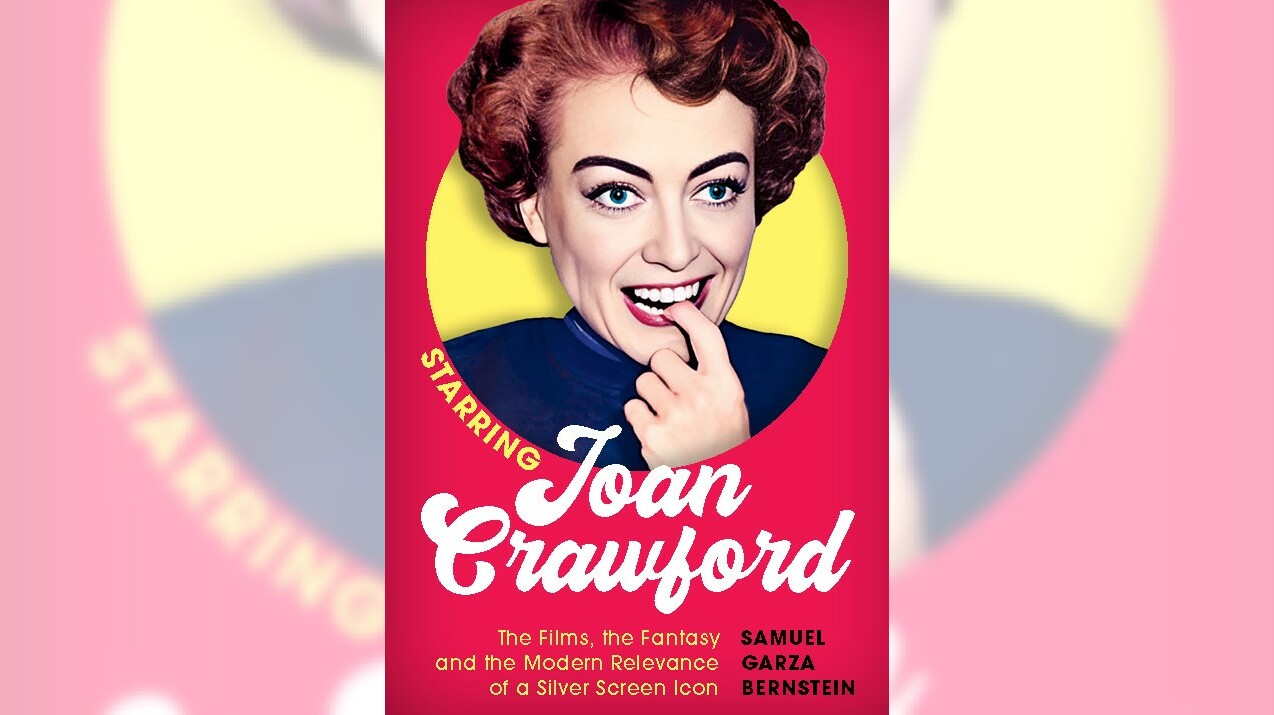
“The book is about her cultural impact. It’s completely about her but in a lot of ways is about how we respond to her, how we react to her,” said Garza Bernstein, author of “Starring Joan Crawford: The Films, the Fantasy, and the Modern Relevance of a Silver Screen Icon.”

Samuel Garza Bernstein’s new book is titled “Starring Joan Crawford: The Films, the Fantasy, and the Modern Relevance of a Silver Screen Icon.” The author will sign copies of his book June 4 in Santa Monica. (Photo by Joshua Michael Shelton)

It will be released Wednesday, June 5, but before that Garza Bernstein, who is a Stonewall Book Award-winning writer, will attend a book signing event at Diesel bookstore in Santa Monica on Tuesday, June 4, where he’ll talk about his 360-page book that looks at Crawford’s impact as a cultural force and a model of feminist self-determination for women even today.

“Nobody would have used the word feminism in the 1920s, ’30s and ’40s, but that’s really what she was doing,” he said.

Joan Crawford was born Lucille Fay LeSueur on March 23, 1906, in San Antonio, Texas. She began her acting career in the 1920s and by the 1930s Crawford was a well known star who had made a successful career for herself, later winning her sole Oscar in 1945. She was known for often playing the role of a hardworking young woman who is able to juggle romance and find financial success.

Garza Bernstein’s fascination with Crawford was driven not only by the actress’s talent, but in large part by his own unique upbringing.

He was born to an undocumented Mexican mother who passed as white by using a fake name, and a Jewish father who moved the family to Cairo for a year while Israel and Egypt were still at war. According to Garza Bernstein, who now splits his time living with his husband in Portugal and Los Angeles, he had no idea what his father did for a living, but the rumors were that he was in the arms business. .

“According to my grandmother, she said he was selling arms to the Palestinians. I don’t know if that was true. I think he was more involved in supporting the underdog,” he said.

His family later moved around a lot to places like Honolulu, Austin, Phoenix, New York, Los Angeles, and Colorado.

“I grew up amidst a lot of secrets and very strange family situations and everything just felt very heightened. And definitely I think that sense of heightened reality is part of what draws me to Joan Crawford, who is nothing if not full of drama and a heightened sense of reality,” he said.

Garza Bernstein first saw Crawford in her 1928 film “Our Dancing Daughters.”

“It was just amazing. She was this entirely modern woman. You can imagine her being successful right now, you could imagine her on TikTok doing videos and dancing. She was so modern and I just found that really fascinating,” he said.

Five phases

In his new book he breaks down her decades-long career into five phases and begins by writing about her as an “Influencer and It Girl.”

“Teenage girls all over America for years after her first big movie ‘Our Dancing Daughters’ thought of her as the ideal woman. Girls all over the country wanted to grow up and be just like her, wear what she wears, look like her,” he said.

The other phases he explores in the book are her as ”Queen of the Movies,” “Mother and Martyr,” “Dragon Lady,” and “Survivor,” where he talks about the final phase of her career and her drive to star in the 1962 horror thriller “What Ever Happened to Baby Jane?,” which is one of her best known films.

While her career was remarkable, Garza Bernstein acknowledges that many people will likely remember Crawford from the 1981 movie “Mommie Dearest,” which was adapted from the book written by her adopted daughter Christina Crawford. The book and film paint Crawford as a demanding and abusive mother.

While Garza Bernstein does touch on this topic, it’s not something he dwells on in his new book.

“I definitely explore the phenomena of their relationship. What I don’t do is try to take a side. I’m not here to prove or disprove the idea of whether Joan was a great mother,” he said.

“What I do is take a deep dive into all of her work, because that’s really what I hope she is most remembered for,” Garza Bernstein said.

‘Star Wars: The Acolyte’ review: Latest series a middling mystery to start

posted in: News | 0

If you’ve seen any of the advanced footage for “Star Wars: The Acolyte,” you’ve witnessed part of the confrontation between a Jedi knight, Carrie-Anne Moss’ Master Indara, and a would-be assassin, Amandla Stenberg’s Mae Aniseya.

Upon starting the series — which gets underway with two episodes dropping at 9 p.m. June 4 on Disney+ — you almost immediately will be pulled into this martial arts-heavy fight, during which Moss shows she still has plenty of chops from her time portraying fierce heroine Trinity in “The Matrix” saga and “The Hate U Give” star Stenberg more than holds her own.

Carrie-Anne Moss’ Jedi Master Indara holds her lightsaber in a scene from “Star Wars: The Acolyte.” (Christian Black/Disney+/Lucasfilm Ltd./TNS)

Mae encourages her to attack, but Indara resists, sticking with defensive moves.

It is a thrilling, well-choreographed start to the show’s eight-episode debut season, the first half of which was made available for review.

Related Articles


Call it ‘McStreamy’: After 20 seasons, ‘Grey’s Anatomy’ is a hit on Netflix and Hulu


What to watch: ‘Violent Nature’ more than lives up to its name


‘Couples Therapy’ review: The least cynical reality show on TV. This time there’s a throuple.


What to stream: Embark on guided tour of world cinema with Mubi


What to stream: Catch up with Zendaya’s big 2-movie start for 2024

Disappointingly, the series never quite recaptures that level of excitement in those first four chapters. On the other hand, the Leslye Headland-created show does a solid job of keeping its intrigue alive, as it is, at its core, a mystery.

Considering that “Star Wars” releases take place in various spots on a vast timeline, some background for “The Acolyte” is in order.

The series is set 100 years, give or take, before the events of 1999’s “Star Wars: Episode I – The Phantom Menace,” which launched the “Skywalker Saga.”

“The Acolyte” occurs late in “The High Republic” era. In this time of initially great prosperity — which has been fleshed out in recent years in media such as young adult novels and comic books, with an overall storyline still being penned — the Force-wielding Jedi Knights are many and, in essence, they are guardians of the galaxy.

In this first slice of High Republic live action, Mae is out to kill four of them, including Sol (“Squid Game” star Lee Jung-jae), who is tapped to lead the investigation into her by Master Vernestra Rwoh (Rebecca Henderson), a fan-favorite High Republic character.

In “Star Wars: The Acolyte,” Vernestra Rwoh, portrayed by Rebecca Henderson, and Sol, portrayed by Lee Jung-jae, are Jedi masters, In the High Republic era, Jedi often wear more brightly colored robes than the Force wielders who will follow them a century later. (Courtesy of Lucasfilm)

Why is the Mae — who wields the Force but not a lightsaber, the traditional weapon of a Jedi — out for vengeance? That will be revealed by the third installment, an episode set 16 years earlier that introduces us to a coven of Force-sensitive witches on the planet Brendock who are led by Mother Aniseya (Jodie Turner-Smith).

A more closely held secret is the identity of the dark-side Force user who has trained her, a masked figure we meet — briefly — at the end of the first episode. Even Mae may not know. Is he a Sith Lord? The Sith haven’t been seen in ages, but we know they will return at some point before the events of the Prequel Trilogy. (Of course, you can find theories as to whom this menage may be online.)

“The Acolyte” introduces myriad other characters, including Jecki (Dafne Keen), Sol’s rigid Padawan, aka apprentice; Yord (Charlie Barnett’), another Jedi Knight taking part in the investigation; Jedi Wookie Kelnacca (Joonas Suotamo, no stranger to being one of the big, hairy creatures after having portrayed Chewbacca for much of the Sequel Trilogy and in 2018’s “Solo: A Star Wars Story”); and Qimir (Manny Jacinto of “The Good Place”), an apothecary owner and associate of Mae.

As with many a “Star Wars” show or film, “The Acolyte” isn’t exactly a showcase for topnotch acting, but Stenberg and Lee are reasonably compelling as the show’s central figures.

Amandla Stenberg’s Mae faces an uncertain future in “Star Wars: The Acolyte.” (Courtesy of Lucasfilm)

And although he doesn’t appear in the first half of the season, it’s possible we’ll see a younger version of Jedi Master Yoda, whose species, as we know, enjoys lengthy lifespans. That would be nice.

“Nice” is a rather appropriate word for what we’ve seen so far of “The Acolyte.” The enthusiasm for “Star Wars” from showrunner Headland, best known for co-creating the largely enjoyable and often trippy series “Russian Doll,” translates to the screen, especially in the first episode, which she both wrote and directed. However, like other “Star Wars” efforts — most notably the previous live-action series, “Ahsoka” — it frequently stagnates thanks to too many instances of characters talking without anything all that interesting to say.

We do not want to be too quick to judge it, however. In 2022, we found the first four episodes of “Andor” to be a slog, only to conclude after seeing all 12 first-season installments that it was the best “Star Wars” project of the Disney era to date.

It’s tough to envision “The Acolyte” reaching that level of quality, but at the end of the fourth episode — by which time just about every key moment from the trailers have played out — we certainly are left wanting to see what comes next.

That’s a good place to be.

‘Star Wars: The Acolyte’

What: Eight-episode debut season of live-action series set in High Republic era.

Where: Disney+.

When: First two episodes debut at 9 p.m. June 4; subsequent episodes debut Tuesday evenings.

Rated: TV-14.

Stars (of four): 2.5.