UN secretary-general calls for ‘windfall’ tax on profits of fossil fuel companies

posted in: News | 0

By JAMEY KEATEN (Associated Press)

GENEVA (AP) — U.N. Secretary General António Guterres called Wednesday for a “windfall” tax on profits of fossil fuel companies to help pay for the fight against global warming, decrying them as the “godfathers of climate chaos.”

Guterres spoke from the American Museum of Natural History in New York in a bid to revive focus on climate change at a time when many national elections, and conflict in places like Ukraine, Gaza and Sudan this year have seized much of the international spotlight.

In a bare-knuckled speech timed for World Environment Day, Guterres drew on new data and projections to trumpet his case against Big Oil: The European Union’s climate watching agency reported that last month was the hottest May ever, marking the 12th straight monthly record high.

The EU’s Copernicus climate change service, a global reference for tracking world temperatures, cited an average surface air temperature of 15.9 C (60.6 F) last month — or 1.52 C higher than the estimated May average before industrial times.

The burning of fossil fuels — oil, gas and coal — is the main contributor to global warming caused by human activity.

Meanwhile, the U.N. weather agency predicted an 80% chance that average global temperatures will surpass the 1.5 Celsius (2.7 Fahrenheit) target set in the landmark Paris climate accord of 2015.

The World Meteorological Organization, or WMO, said that the global mean near-surface temperature for each year from 2024 to 2028 is expected to range between 1.1 and 1.9 degrees Celsius hotter than at the start of the industrial era.

It also estimated that there’s nearly a one-in-two chance — 47% — that the average global temperatures over that timeframe could top 1.5 C, an increase from just under a one-in-three chance projected for the 2023-2027 span.

“This forecast is affirmation that the world has entered a climate where years that are as hot as 2023 should no longer be a surprise,” Noah Diffenbaugh, a professor at Stanford’s Doerr School of Sustainability, said in an email of the WMO forecast.

Waleed Abdalati, who heads an environmental sciences institute at the University of Colorado Boulder, said the WMO report was “sobering – but not surprising” and noted the prospect of changes like higher costs for farm products, higher insurance rates, and greater public health risks linked to high heat or scarcity of water.

“The implications of this warming range from drought, to flooding, to fires, to health issues, to climate migration, and more,” he wrote in an email. “While some individuals may escape direct consequences, we will all be affected.”

Guterres took particular aim at the carbon-spewing industry and appealed to media and technology companies to stop taking advertising from its biggest players, as has been done in some places with Big Tobacco.

He repeated concerns about subsidies paid out in many countries for fossil fuels, which help keep prices low for consumers.

“Climate change is the mother of all stealth taxes paid by everyday people and vulnerable countries and communities,” he said. “Meanwhile, the godfathers of climate chaos — the fossil fuel industry — rake in record profits and feast off trillions in taxpayer-funded subsidies.”

Guterres said that global emissions of carbon dioxide must fall 9% each year to 2030 for the 1.5 C-degree target under the Paris climate accords to be kept alive.

But temperatures are “heading in the wrong direction,” he said: They rose 1 degree last year.

“We are playing Russian roulette with the planet. We need an exit ramp off the highway to climate hell,” Guterres said, while adding: “The truth is, we have control of the wheel.”

Guterres called on advanced Group of 20 countries — which are holding a summit in Brazil next month and are responsible for about 80% of all emissions — to lead. The richest 1% of people on Earth emit as much as two-thirds of all humanity, he said.

“We cannot accept a future where the rich are protected in air-conditioned bubbles, while the rest of humanity is lashed by lethal weather in unlivable lands,” Guterres said.

He appealed to “global finance,” alluding to banks and international financial institutions, to help contribute money, saying “innovative sources of funds” are needed.

“It’s time to put an effective price on carbon and tax the windfall profits of fossil fuel companies,” Guterres said.

But all countries — and people — must join the fight, he said, including the developing world, such as by ending deforestation and meeting targets to double energy efficiency and triple renewables by 2030.

Some critics say Guterres, which such alarmist speeches, puts too much a focus on stirring emotions than focusing on science that lays out the actual threat.

But U.N. officials and nongovernmental groups acknowledge that the secretary-general has little power beyond the “bully pulpit” — his perch at the head of the world body — to stir people, governments and business to change.

Bill Seeks to Boost NYC’s Composting Capacity With More Borough-Based Sites

posted in: News | 0

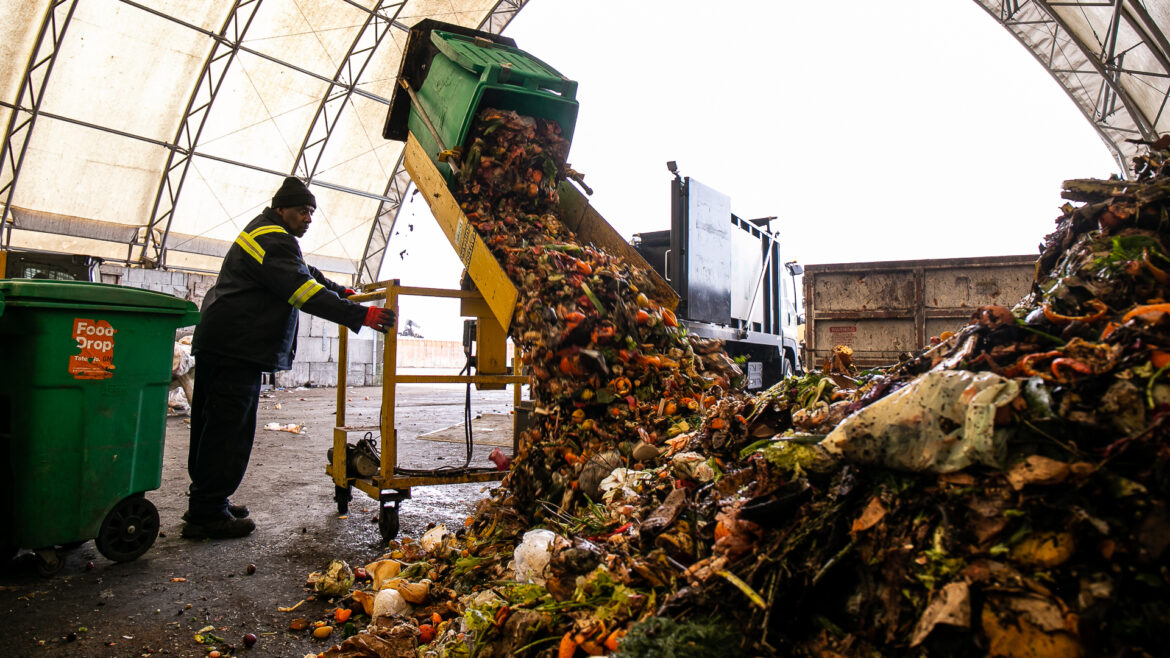
Most of the food scraps and yard waste collected by the city isn’t getting composted. Instead, it’s being turned into fuel to heat people’s homes—and that’s not actually great for the environment, climate advocates say. 

Adi Talwar

Green waste being dumped from a 64 gallon toter.

New Yorkers might be surprised to learn that only 20 percent of the food scraps and yard waste that the city collects from the curb is actually turned into compost, according to the Department of Sanitation (DSNY).

But a bill introduced this spring, and the subject of a City Council hearing on Monday, would change that by requiring DSNY to establish at least one organic waste composting facility in each borough between 2026 and 2027.

“The goal is to generate more compost for local use,” Councilmember Sandy Nurse, the bill’s sponsor, told City Limits. “Compost is an important input for our local ecosystem. And producing that locally and using it locally is beneficial to the environment.” 

More than a third of the city’s waste—36 percent—is suitable for composting, which turns food scraps and yard waste into a dark, nutrient-rich soil that can be used to fertilize plants.

That’s good for the environment, since organic waste that’s thrown into a landfill gets suffocated by trash and as it decomposes, releases greenhouse gas emissions that drive climate change. Mayor Eric Adams says he is committed to diverting all organic garbage away from landfills by 2030, and sorting of this waste will become mandatory citywide this fall. 

But right now, 80 percent of the food scraps and yard waste collected is being fed to wastewater treatment plants, where the organic material is broken down through a process called anaerobic digestion. A biogas, primarily methane, is extracted from the digested material and turned into energy to heat businesses and homes.

While converting organic waste into energy is a better alternative to throwing it in a landfill, environmentalists say it’s not without pitfalls. 

The scarps-to-fuel approach emits its own share of greenhouse gasses, and the process has the potential to leak methane into the atmosphere. Methane has more than 80 times the warming power of carbon dioxide over the first 20 years after it reaches the atmosphere.

Another issue is that once the methane has been extracted, a leftover sludge known as “digestate” ends up getting thrown into the landfill anyway. 

“The digestate is being landfilled because the organic waste is mixed with sewage waste during the process, and it becomes so contaminated that it loses the quality it needs to turn into finished compost that can be applied to agriculture,” said Eric Goldstein, New York City environment director at the Natural Resources Defense Council (NRDC).

“From an environmental and sustainability standpoint, the best approach is to compost that organic waste and return it to soil where it can serve as a soil enhancer,” he explained.

Adi Talwar

February 16, 2023: Compost bagging machine at DSNY’s 33 acre composting facility in the Fresh Kills section of Staten Island.

Goldstein calls Nurse’s bill to boost the city’s composting capacity “the most important piece of solid waste legislation that the City Council will be considering this year.”

New York City is currently home to two facilities that can process food waste for both composting and anaerobic digestion; one is located on Staten Island and the other in Brooklyn. DSNY does note, however, that it is looking to diversify where the city’s organic material goes, and have an active procurement for vendors that has the potential to change the number of facilities churning out compost.

Nurse told City Limits that the goal of her bill is to encourage the build out of sites solely dedicated to composting—smaller alternatives to the high-tech and expensive facilities currently processing both aerobic digestion and compost.

But the Department of Sanitation begs to differ. It will still cost billions of dollars to build these facilities, which will take up a lot of space, the agency said at a Council hearing on Monday. 

DSNY also took issue with the proposed timeline, saying it doesn’t give the city enough time for the massive undertaking, and with the fact that the bill excludes aerobic digestion, which officials argued is a better option than throwing organic materials away.

“We need to accept that the goal is getting this waste out of landfills,” DSNY Commissioner Jessica Tisch said at the hearing.

“New York City already produces more compost than we can give away, and reducing our need for fracked gas by producing renewable energy from food waste is also a noble goal and a substantial win for the environment,” she added.

Still, environmental advocates say they will be backing the bill, especially since the Adams administration has defunded the city’s community composting program—neighborhood sites where residents could drop off food scraps. The move has caused national uproar among the environmental community, since it was considered among the most successful community-run composting programs in the nation.

John McCarten/NYC Council Media Unit

Advocates at a rally to save the city’s compost program from budget cuts in December.

“Compost is a valuable resource that can be used to nourish the depleted soil of local parks, community gardens and street trees and the over 12,000 rain gardens the city has created as part of its climate resiliency plan,” said Jane Selden, chair of the committee on waste reduction at the environmental group 350 NYC. 

These rain gardens, Selden explained, are important for flood mitigation because they act as a sponge, soaking up to six times their weight in water when it rains, keeping it away from the city’s streets (and after, its sewers and waterways). 

“Local composting plays a vital role in moving our city closer to achieving its greenhouse gas reduction and infrastructure resiliency goals,” she underscored.

To reach the reporter behind this story, contact Mariana@citylimits.org. To reach the editor, contact Jeanmarie@citylimits.org.

Want to republish this story? Find City Limits’ reprint policy here.

Could this be Julian Loscalzo’s final ballpark tour?

posted in: News | 0

Every year, it’s the same old story. Julian Loscalzo announces this could be it — his final summer bus trip leading tour groups to America’s iconic ballparks, majors and minors, a feat he’s been pulling off for 42 years running, with the single exception of a pandemic year.

And every year, Loscalzo — a former stadium beer vendor, sometime bike-taxi manager and lobbyist at the State Capitol for the St. Paul Saints, nonprofits and other groups — fails out of retirement. But at the age of 72, he may mean it this time.

Julian Loscalzo laughs as he welcomes a member of the Bleacher Bums baseball park tour group as they check in to board the bus at the Midway Target in St. Paul on Tuesday, June 4, 2024. (John Autey / Pioneer Press)

An Alaska Bus Lines coach bus he’s rented for the occasion picked up 44 baseball fans at the Midway Target parking lot on Tuesday morning and took them to Beloit, Wis. — go Beloit Sky Carp! — for the Tuesday night game against the Lake County Captains.

Then it’s off to Chicago, where the White Sox meet the Cubs at Wrigley Field on Wednesday. And then it’s the Red Sox versus the White Sox on Thursday on Chicago’s south side, at Guaranteed Rate Field, the former home of Comiskey Park.

Then it’s back to Wisconsin on Friday to watch the Quad City River Bandits take on the Wisconsin Timber Rattlers at Neuroscience Group Field in Appleton. Yes, there will be fireworks — literal ones.

A love of urban travel

Loscalzo, who has made his home in St. Paul since the mid-1970s, has promised his tour group they’ll roll back into St. Paul’s Midway next weekend. But his sights are already set on his next ballpark tour to Syracuse, Cooperstown and Utica, N.Y., in July.

“We seldom stay out in the suburbs unless we’re on a tight schedule,” said Loscalzo, who has turned his love of urban travel into a side gig across four decades of ballpark hopping, much but not all of it concentrated in the Midwest. “We stayed in downtown Wichita last year. Same with Tulsa. It’s as much a chance to explore the city as the baseball.”

Every other year, he goes big before he goes home, wrangling a few dozen tour-goers on an eight-day tour. About a third of his entourage are retired folks. Most are repeat customers. Sometimes they bring with them their kids or grandkids, who get to experience the family road trip with a baseball family writ large.

He recalls a tour that drew three generations of the same clan. He brought his own grandson with him two years ago to Cooperstown. Travel friendships form. Sometimes they last.

Rolling out for Beloit, Wis.

When Joel Hanson’s aunt died in February, a number of the friends he made over four years of ballpark tours attended the funeral. On Tuesday, he was scheduled to roll out for Benoit with his 73-year-old father and his 42-year-old brother, who would be joining him for the first time.

“My dad’s from Chicago and he used to skip school and go to opening day at Wrigley Field,” said Hanson, 34, of West St. Paul, one of the younger individuals on recent trips. “His mother would write him a note: ‘Please excuse Billy from class as he’s sick today.’”

Of course, not every ballpark is a Wrigley Field.

“We’re tending to see probably twice as many minor league ballparks as major leagues,” Loscalzo said. “They’re as fun. They’re more fun. They’re different, but I think we get more enjoyment out of it because it’s more like Americana. You get to hang out with the players, you get to meet people. They’re always intrigued by a bus load of Minnesotans. If you have a kid with you, the kid gets to throw out the first pitch. People kind of take you under their wing.”

John Reay has been going on Loscalzo’s ballpark tours almost annually since they launched in the early 1980s. He doesn’t consider himself a baseball super-fan as much as a fan of the community that forms on the road. What started out as a bit of a men’s outing has become almost equally co-ed.

“It’s the friendships. It’s the sitting on the bus for seven or eight hours to Chicago. These are friends I get to see every year,” said Reay, 79, of St. Paul. “You come back and you start up right where you left off.”

Julian Loscalzo shows the schedule for the Bleacher Bums baseball park tour group as they check in to board the bus at the Midway Target in St. Paul on Tuesday, June 4, 2024. (John Autey / Pioneer Press)

Why ballparks?

So why the fixation on ballparks?

Loscalzo, who grew up in working class Philadelphia, one of the only kids in his neighborhood to go to college, lost his father when he was just three months old. His mother poured her love of baseball into him from a young age, but it would take him 20 years or more to make the connection — America’s pastime was her link to her late husband, and an emblem of dad that she could pass on to her son.

He remembers trips to long-gone Connie Mack Stadium in old Shibe Park, and the nosedive the Philadelphia Phillies took in 1964, the year their 10-game losing streak cost them the pennant they had opened the season seemingly destined to win. His mother took him to Game One of that 10-game slide. Yes, baseball can be a game that breaks your heart.

“It does, it does, it does! But it’s a game of people,” Loscalzo said. “It’s a game of history.”

Some of those repeat customers on his ballpark tours are no longer with us. At 72, Loscalzo takes a close read when he learns that a celebrity or local notable his age has passed away. Nothing lasts forever, maybe not even America’s favorite pastime, which has lost ground in popular culture to football and basketball.

So after this summer, he’s hanging up his baseball tour hat for good.

Or maybe not.

“It’s been a tongue-and-cheek statement to people,” Loscalzo said. “It’s kind of a reminder that everyday could be your last.”

Related Articles

Local News |


Several St. Paul areas to close temporarily due to flooding

Local News |


St. Paul murder charge: Man shot into car, killing driver, as his girlfriend was in passenger seat

Local News |


‘Eternally grateful for the kindness’: Russian transgender refugee reunited with husband at MSP Airport

Local News |


St. Paul man arrested in homicide of 21-year-old

Local News |


St. Paul to expand electric vehicle network with East Side project

Cross-examination of FBI agent continues in Hunter Biden’s gun trial, as first lady again attends

posted in: Politics | 0

By CLAUDIA LAUER, RANDALL CHASE, COLLEEN LONG and MICHAEL KUNZELMAN (Associated Press)

WILMINGTON, Del. (AP) — Federal prosecutors in Hunter Biden’s gun trial have spent hours showing jurors evidence of his drug problem, seeking to reveal through his own words and writing the depth of his addiction to show it was still going on when, they say, he lied on a form to buy a firearm.

First lady Jill Biden went to court Wednesday for the third day to support her son, ahead of her trip to France to meet President Joe Biden, who was in Europe to mark the anniversary of D-Day.

Testimony continued with cross-examination of an FBI agent who was being questioned about the timing of Hunter Biden’s drug use. Biden’s ex-wife, Kathleen Buhle, was also expected to take the stand. She was married to the president’s son for roughly 20 years. They have three children and divorced in 2016 after his infidelity and drug abuse became too much, according to her memoir, “If We Break,” about the dissolution of their marriage.

Buhle is among several Biden family and friends expected to testify in a trial that has quickly become a highly personal and detailed tour of Hunter Biden’s mistakes and drug use. The proceedings are unfolding as the 2024 presidential election looms and allies worry about the toll it will take on the president, who is deeply concerned about the health and sustained sobriety of his only living son. Prosecutors argue that the testimony is necessary to show Hunter Biden’s state of mind when he bought the gun.

Hunter Biden has been charged with three felonies stemming from the purchase of a gun in October 2018. He’s accused of lying to a federally licensed gun dealer, making a false claim on the application by saying he was not a drug user and illegally having the gun for 11 days.

“No one is allowed to lie on a federal form like that, even Hunter Biden,” prosecutor Derek Hines told jurors Tuesday. “He crossed the line when he chose to buy a gun and lied about a federal background check … the defendant’s choice to buy a gun is why we are here.”

“When the defendant filled out that form, he knew he was a drug addict,” and prosecutors don’t have to prove he was using the day he purchased the firearm, Hines said.

Hunter Biden’s attorney argued that his client did not believe he was in the throes of addiction when he stated in the paperwork that he did not have a drug problem. In the short time that he had the gun, he did nothing with it, and the weapon was never even loaded, attorney Abbe Lowell said in his opening statement.

“You will see that he is not guilty,” Lowell said.

Lowell said the form asks whether you “are” a drug user. “It does not say ‘have you ever been,’” and he suggested the president’s son did not think of himself as someone with a drug problem when he purchased the gun.

His state of mind should be considered at the time of the purchase, not later on, when, after he got sober, he wrote a memoir titled “Beautiful Things” about some of his darkest moments. The jury heard lengthy audio excerpts from the book, which traces his descent into addiction following the death of his brother, Beau Biden, in 2015 from cancer.

The Delaware trial comes after the collapse of a plea deal with prosecutors that would have resolved the gun case and a separate California tax case and avoided the spectacle of a trial. Hunter Biden has since pleaded not guilty and has said he’s being unfairly targeted by the Justice Department, after Republicans slammed the now-defunct plea agreement as a sweetheart deal for the Democratic president’s son.

The 12-person panel heard opening statements Tuesday and testimony from the FBI agent, Erika Jensen, who read aloud some of Hunter Biden’s personal messages, including some that came from a laptop he left at a Delaware repair shop and never retrieved. In 2020, the contents made their way to Republicans and were publicly leaked, revealing some highly personal messages about his work and his life. He has since sued over the leaked information.

In one exchange with Beau Biden’s widow, Hallie Biden, on the day after he bought the gun, she wrote: “I called you 500 times in past 24 hours.” Hunter replied less than a minute later, informing her that he was “sleeping on a car smoking crack on 4th street and Rodney.”

“There’s my truth,” he added in a follow-up text.

But during cross-examination, Jensen testified that Hunter Biden sent fewer messages about seeking drugs in October 2018, around the time when he purchased the gun, than in February 2019, a later period in which Lowell described his client as struggling significantly with addiction.

Lowell also called into question the receipts for a rehab facility, asking whether Jensen knew whether he had been treated for drugs or alcohol. She said she could not.

His sister Ashley Biden, watching from the courtroom, dabbed at her eyes with a tissue and eventually left.

Attorneys said jurors would hear testimony from the president’s brother James Biden, who is close with Hunter and helped his nephew through rehab stints in the past. They will also hear how Hallie Biden became addicted to crack during a brief relationship with Hunter.

Hallie took the gun from Hunter and tossed it into the garbage at a nearby market, afraid of what he might do with it. The weapon was later found by someone collecting cans and eventually turned over to police.

If convicted, Hunter Biden faces up to 25 years in prison, though first-time offenders do not get anywhere near the maximum, and it’s unclear whether the judge would give him time behind bars.

The trial is unfolding shortly after Donald Trump, the presumptive Republican presidential nominee, was convicted of 34 felonies in New York City. The two criminal cases are unrelated, but their proximity underscores how the courts have taken center stage during the 2024 campaign.

Hunter Biden also faces a trial in California in September on charges of failing to pay $1.4 million in taxes. Both cases were to have been resolved through the deal with prosecutors last July, the culmination of a yearslong investigation into his business dealings.

But Judge Maryellen Noreika, who was nominated to the bench by Trump, questioned some unusual aspects of the deal. The lawyers could not come to a resolution on her questions, and the deal fell apart. Attorney General Merrick Garland then appointed a former U.S. attorney for Delaware David Weiss, as a special counsel in August, and a month later Hunter Biden was indicted.

___

Long reported from Washington.

___