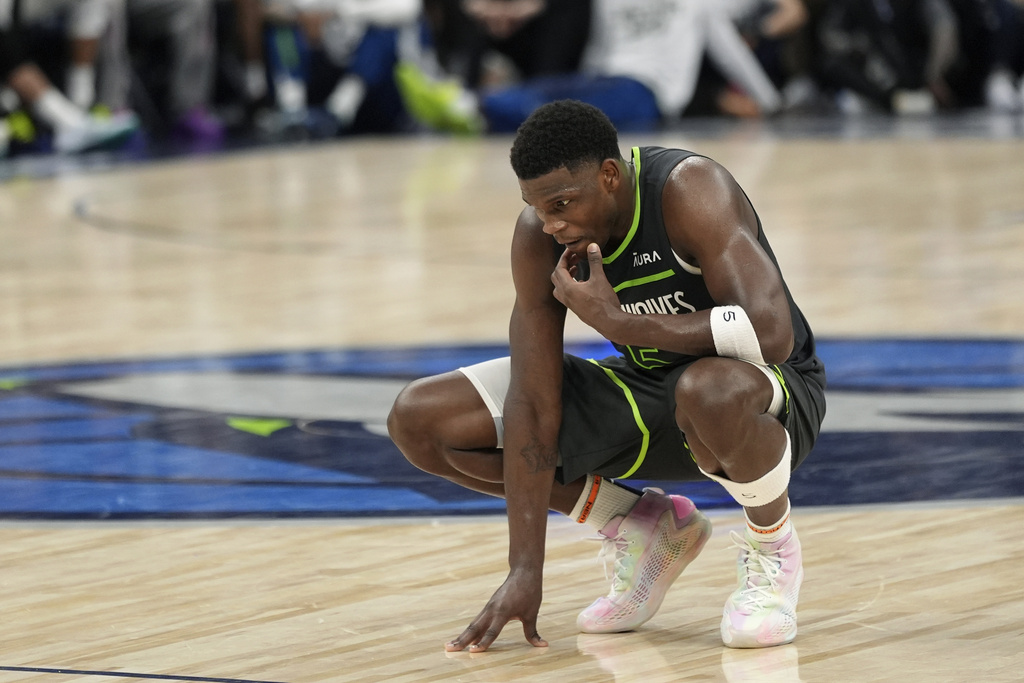
Anthony Edwards needs more postseason stamina for Timberwolves. He knows it. But how can he achieve it?

posted in: News | 0

Austin Rivers couldn’t believe what he was watching.

Dallas reserve guard Jaden Hardy had the ball at the top of the floor in the final 10 seconds of the third quarter of Game 4 of the Western Conference Finals. Hardy was being guarded by Kyle Anderson.

And Dallas ran a ball screen to get Anthony Edwards switched onto Hardy.

“They were looking for Ant on switches,” Rivers said last week on The Ryen Russillo Podcast. “And I had to (sit) back in my seat like, ‘Whoa, whoa, whoa, there’s no way they’re calling Ant up for a pick-and-roll switch. He’s one of the best defenders in the league on the ball.’”

It took Hardy all of a couple dribbles to get past Edwards and to the basket for a layup.

“They knew he was tired and gassed and trying to hide, and they called him up,” said Rivers, who was a teammate of Edwards a year ago and now is an NBA commenter. “There’s no way they should ever be picking on Ant on defense. Should never happen. He’s too good of a defender, and I saw that multiple times (in Game 4). And we’re not even talking about Kyrie (Irving) and Luka (Doncic). We’re talking about like their fourth guard, trying to find Ant on a switch to go by him. That can’t happen.”

A day after Minnesota was eliminated from the West finals by Dallas in five games, Anderson was speaking to his father, who told him it looked like the Wolves simply “hit a wall.” The forward concurred.

“Just felt like we didn’t have the same juice that we had in the Denver and Phoenix series, and sometimes you don’t even realize it,” Anderson said. “You try to stay away from that, think I got energy or I’m ready to go. We just didn’t have that same pop on both sides of the ball as a unit too in the Dallas series, as we did in Denver and as we did all season, as we did in Phoenix. Tough.”

That starts with Edwards, Minnesota’s best player and barometer for success. When he’s playing with a certain vigor, the Timberwolves are awfully tough to stop. But he just didn’t seem to have it throughout the West finals.

After lighting the NBA world on fire through his first six postseason bouts this spring, Edwards’ gas tank started to wane. At points in the Dallas series, he appeared to be teetering toward “E.”

Timberwolves coach Chris Finch noted after the series that the value of fitness was a lesson learned for Minnesota in its playoff run.

“Mentally, physical fatigue becomes a real thing the deeper you go. The number of minutes you’re playing, the load, the intensity. Everything goes up,” Finch said. “I think, over time, it probably took its toll on us a bit more.”

It’s a challenge, for sure. It’s not easy to outlast the defending champions in a seven-game series — with four of the contests played at altitude — and then turn around 72 hours later and play another top-tier team.

“That doesn’t mean that you can’t be in better shape or frame of mind for it,” Finch said. “Yeah, every step you go it gets harder and harder. That’s what makes it so special. Your level of detail, execution and all that stuff has to continue to go up.”

On Thursday, Finch told Paul Allen on KFXN-FM 100.3 that Edwards now knows what deep postseason runs are going to look like.

“I think the physical and the mental fatigue that he needs to overcome as the series go on and on,” Finch told Allen. “The playoffs, in many ways, are kind of a war of attrition — whether it be injuries or stamina.”

Edwards is asked to carry a heavy load for Minnesota. He often has to take on a difficult defensive assignment while also supplying the bulk of the offense. That’s a lot, but it’s his reality. And if the Wolves are to push for a title, he has to be able to deliver night in and night out for two straight months.

Immediately after the Game 5 loss to Dallas, Edwards acknowledged exactly that.

“I’ve never played this deep into a basketball season. So now I know, like, OK, in order for me to be dominant in the third round and if we get past this and finally go to the Finals, I’ve got to train like I’m going to go to the playoffs,” he said. “So I can’t be missing training days, I can’t take days off, you know what I mean? I’ve got to be ready.”

Edwards said he didn’t train the previous offseason as though he was going to make a deep run with Minnesota. He plans to train this summer in the same way he did when he was entering his freshman year at Georgia, which he said was “the best shape of my life.” That period of time included different types of training that made him uncomfortable.

That’s all well and good, but perhaps what’s more valuable than the work done  in July to prepare for 11 months from now is the work done in January and February. There’s no better way to brace your body to go at a high intensity every other day during the playoffs than to do so in the regular season.

That’s something Edwards hasn’t done to date. Certainly, he always makes himself available. The guard — who will turn 23 in August — played 79 games in each of the past two regular seasons. But he does give some contests far more of his attention than others. You can circle games on the calendar when the schedule comes out that Edwards will likely downshift for.

For much of the past two seasons, Edwards simply wouldn’t compete at full throttle against cellar dwellers. He admitted as much late in the regular season.

“Usually these games I come out and don’t have no energy and look like I don’t want to be here, and Finchy been gettin’ on my (butt) about that the last couple games,” Edwards said during the regular season.

To his credit, Edwards turned it around in such contests, including a 51-point outing against Washington in the final week of the regular season. But those types of efforts — not outputs, but efforts — may need to become more of the norm if Edwards is to properly prepare his body for what’s to come when the season is on the line.

For the best teams, the regular season is about building habits that can carry them through the playoffs. Over his first six healthy NBA seasons, Michael Jordan scored below 15 points on just three occasions. Edwards did it 10 times this season alone on nights he was available for the whole game.

Scoring output isn’t always an indicator of anything, but for Edwards it often speaks to his mindset. Jordan may be too high of a bar for anyone else to be held to, but his nightly approach is one to which all — including Edwards — should aspire.

“I say this with respect, because I know (he was) in the conference finals — one (series win) away from the finals, and I know he has a lot on his shoulders — I think there’s a different level of stamina Ant can reach,” Rivers said to Russillo. “We had those comparisons to Mike and Kobe (Bryant)  and some of these guys that we’ve already thrown at Ant, and those are some heavy names. The one thing that we knew about those two guys is they did not get tired consistently. Their stamina was at an all-time high, whether that’s because of mental toughness, whether that’s because they lived in the gym. … There’s a different level of stamina with Ant.”

And, if he can find it within himself to reach it, look out.

“I know what it takes,” Edwards said, “and I’ll be ready.”

Related Articles

Minnesota Timberwolves |


Michael Bloomberg joins Marc Lore-Alex Rodriguez group for in-dispute purchase of Timberwolves

Minnesota Timberwolves |


Timberwolves’ roster next season will be expensive; basketball brass wants ownership to pay the bill

Minnesota Timberwolves |


St. Paul native Sean Sweeney says ‘it was special’ to help lead Dallas past Timberwolves in West Finals. Now, he’s focused on a title

Minnesota Timberwolves |


The Timberwolves’ offensive approach won’t change next season — the execution will have to

Minnesota Timberwolves |


Kyle Anderson wants to be back in Minnesota. But can the Timberwolves afford him?

Your Money: How the financial adviser’s role has evolved

posted in: News | 0

Bruce Helmer and Peg Webb

The business of giving financial advice has changed dramatically over the past 30 to 40 years. When we started, the relationship was mostly transactional: Investors came to you to help them pick stocks and manage portfolios. At most firms, the emphasis was on “beating the market” and finding the next “hot stock.” Financial planning was nowhere to be found.

Most advisers today offer a new, distinctly different model for client engagement — one that consolidates every piece of an investor’s financial life into one place so that it can be managed more holistically.

The evolution

It may help to understand how far the industry has come since the 1970s and 1980s.

Older investors may have worked with stockbrokers in the past to help manage their money. This was a very different world. In the old days, the emphasis at most brokerage firms was on salesmanship and returns. Goals were very much directed to a future point in time — setting retirement at 65, for example, and gearing a portfolio around accumulation. Wall Street relied on armies of analysts who performed technical research into stocks, and often the process was rife with conflicts as the analysts supported the firm’s investment banking business. Overall, the process was transactional and performance-driven.

Since then, most practitioners have moved away from selling stocks or funds to an advisory model that is oriented toward helping investors achieve their goals. It views wealth not as an end point but as a fluid journey, guided by a unified, holistic, comprehensive plan that’s tailored to each client’s individual situation. To address their clients’ more complex wealth management challenges, today’s advisers draw not so much on individual technical training and processes but rather on the collective wisdom and perspective of small adviser teams who focus on addressing clients’ individual needs.

How advisers add value

We’ve found that forming a relationship with each client is a unique experience. No two clients are alike, so it’s important that there’s the right fit between what clients need and the adviser’s range of services.

People usually decide to hire an adviser when they settle into a career, start a family, or experience some other major life event. With busy lives, many find they don’t have the time or inclination to manage their finances themselves.

It’s not all about investment returns. The greatest value that an adviser can add is in seven areas of financial planning:

1. Budgeting

You shouldn’t be investing until you’re confident you can stick to a monthly budget and manage debt. A good adviser will help you construct a manageable budget, let you know when your spending exceeds your means, and advise you when you need to dial it back. Holding you accountable to your vision of the life you want is a major benefit of working with an adviser.

2. Investment Access

Larger advisory firms may be able to offer you investment options at a lower cost than you might get on your own, as well as access to difficult, highly rated, hard-to-access managers that may be closed to new investors. If an adviser is charging you 1% of your assets each year to manage your money, all in, you may recoup as much as half of that amount in terms of lower total costs.

3. Asset allocation strategy

An adviser’s fee should include creating an asset allocation strategy tailored to your individual goals and risk tolerance. You receive value when the adviser monitors your account and manages any future adjustments to keep that allocation strategy on target — either quarterly or annually. This can save you valuable time.

4. Retirement planning

Many investors don’t understand the different ways that various retirement-focused accounts can be used in income planning: 401(k)/403(b), traditional IRA, Roth IRA, income ladders, annuities, or taxable accounts. When an adviser helps you diversify your tax exposure, you may be better positioned to make your money last longer in retirement.

5. Asset protection

Once you have accumulated financial and other types of assets, you need to manage risk. An adviser can help you purchase various types of insurance, including property and casualty, life, liability/umbrella, and special policies or riders to cover valuable art or collectibles.

6. Cohesive tax strategy

Many investors don’t understand the different tax treatments that apply to 401(k), traditional or Roth IRAs, or taxable accounts — or how to diversify their tax exposure. Advisers can help you decide when to take Social Security benefits or required minimum distributions (RMDs) — which can be surprisingly complicated, depending on your situation.

7. Estate and gift planning

A full-service advisory firm should be able to quarterback the creation of your legacy planning and gifting strategy — with input from your attorney and tax professional. This includes the creation of trusts to pass your wealth efficiently to future generations or to distribute gifts of cash or securities to your loved ones or favorite causes in a tax-smart way.

What you should expect

Today’s financial advisers are able to offer much more than simply recommending a basket of stocks or mutual funds and seeing which way the market takes you. The adviser who ultimately earns your trust and business should carefully and thoughtfully review your situation to make sure you are fully supported in expressing your values, gaining investment access, developing a resilient asset allocation strategy, fine-tuning a cohesive tax strategy, and carrying out legacy wishes with estate and gift planning.

Perhaps most importantly, your adviser should work with you to re-establish goals and reinforce the importance of structure and sticking to your plan — especially when markets get choppy, or life throws you curveballs.

Related Articles

Business |


Your Money: Women and wealth: a values-based approach to planning

Business |


Your Money: Don’t treat your 401(k) like an ATM

Business |


Your Money: Train your brain to make better money decisions

Business |


Your Money: Squaring values with your investments

Business |


Your Money: Timely milestones on your retirement journey

The opinions voiced in this material are for general information only and are not intended to provide specific advice or recommendations for any individual. There is no guarantee that asset allocation or diversification will enhance overall returns, outperform a non-diversified portfolio, nor ensure a profit or protect against a loss. Investing involves risk, including possible loss of principal.

Bruce Helmer and Peg Webb are financial advisers at Wealth Enhancement Group and co-hosts of “Your Money” on WCCO 830 AM on Sunday mornings. Email Bruce and Peg at yourmoney@wealthenhancement.com. Securities offered through LPL Financial, member FINRA/SIPC. Advisory services offered through Wealth Enhancement Advisory Services, LLC, a registered investment advisor. Wealth Enhancement Group and Wealth Enhancement Advisory Services are separate entities from LPL Financial.


Ship carrying taconite taking on water after underwater collision near Isle Royale

posted in: News | 0

NEAR ISLE ROYALE — The Michipicoten, a 689-foot laker, has taken on water after a collision with something under water on Lake Superior, 35 miles southwest of Isle Royale.

The U.S. Coast Guard, sharing the information on its USCG Great Lakes account on the social media platform X, said the incident happened at 6:53 a.m. Saturday and that 22 people were on board.

The Coast Guard also said a helicopter from Traverse City, Michigan and boat crews from Bayfield were on their way to the scene.

In updates on X, the Coast Guard said pumps operating on the Michipicoten have reduced the listing of the vessel from the initial report of 15 degrees to 5 degrees and that the ship is carrying taconite.

There are pumps on the ship to displace some water and there are currently no signs of spillage, according to the Coast Guard. The Edwin H. Gott is also on its way to the Michipicoten.

No injuries have been reported.

Related Articles

News |


Grand Marais coffee shop offers a daily dose of the North Shore

News |


Joe Soucheray: Kathy Cargill had me at ‘McLaren’ …

Summer books 2024: It’s summertime and the reading’s easy. Or epic. Choose your own adventure.

posted in: News | 0

One strategy for summer reading — and yes, there are strategies — is to begin a project.

Dabble in short punchy books, but devote the season to an epic. You get three months.

I read “The Lord of the Rings” this way, one installment a summer, for years. Now I’m picking through Robert Caro’s (still unfinished) Lyndon Johnson biography this way. Another strategy: Give yourself a quasi-degree in something very specific. Read the complete short stories of the late Alice Munro. The crime novels of Stephen King. Or underrated Penguin Classics: This summer offers a couple of fresh contenders — Harry Crews’ “The Knockout Artist” (about a boxer with a talent for knocking himself out), and “A Last Supper of Queer Apostles,” unclassifiable writing about being gay under a dictatorship, by Chilean legend Pedro Lemebel.

You’ll clip right along.

Same goes for an excellent new edition of a monster: The Folio Society’s wonderful “Jonathan Strange & Mr. Norrell,” Susanna Clarke’s contemporary classic about magicians in 19th century England. As a single adventure, it was an 800-plus page cinderblock in 2004. Folio divides all of that into a much brisker trilogy, as it should have been, ideal for devouring in adult-size chunks that you can pass along to a precocious child or spouse, while continuing yourself.

As for the rest of you who just want a new mystery or history for the backyard, this summer is overstocked, even more so than the coming fall season. Yes, I read all of these; now get started.

No-guilt beach reads: One of the great American mystery series continues with “Farewell, Amethystine,” Walter Mosley’s 16th novel about Los Angeles detective Easy Rawlins. This one finds him in 1970, tracking an ex-husband, navigating gender upheaval. “The Sicilian Inheritance,” by airport favorite Jo Piazza, nails a clever twist on a contemporary cliche: Newly single American woman moves to Italy, discovers herself. The twist — she’s pulled into ugly family business — plays like a Palermo breeze.

You got the top pulled down and radio on, baby: “Traveling: On the Path of Joni Mitchell” (June 11) is the best kind of summer bio. It’s too critical and wandering to read like hero worship. NPR’s Ann Powers, among the smartest of music critics, captures the restlessness of a Mitchell album, walking through her catalog with eyes and ears open for both unease and transcendence. “Hip-Hop is History” (June 11) nails a similar feeling: It’s less like a timeline than a long hang with the Roots’ Questlove, who digs through the classics, offering reminiscence and discernment.

Family time: ‘Tis the season for other people’s problems. “Same as It Ever Was” (June 18), by Oak Park native Claire Lombardo (“The Most Fun We Ever Had”), and “Long Island Compromise” (July 9) by Taffy Brodesser-Akner (“Fleishman Is in Trouble”), check a lot of boxes — relatable but never dull, reliably bonkers family, funny. But they’re also breezy satires of privilege without sacrificing gravitas. Lombardo hems with modesty to the way minor breaks in routine spiral into epic crisis. Brodesser-Akner, who twists her knife with more relish, begins with actual crisis (a mysterious kidnapping and release), then leaps to the surprising ways it stamps fear into each member of the wealthy family. For austerity: “This Strange Eventful History,” Claire Messud’s somewhat autobiographical saga about several generations of a French family, severed from each other during World War II, and the way time and distance become inevitable.

Tales of future past: “What the Wild Sea Can Be: The Future of the World’s Ocean” (July 16), by Helen Scales, a marine biologist who doesn’t write like one. Here is a clear-eyed survey of what ails ocean life, shaped by Scales’s own experience and a bracing look at what’s being done. For something completely different: “The Book of Elsewhere” (July 23) is not quite science fiction, or fantasy, but as hard to pin down as you might expect a book authored by British surrealist China Miéville and Keanu Reeves. It’s also fun, a novel-length continuation of Reeves’s hot comic book, “BRZRKR,” a kind of Conan the Barbarian tale with black helicopters.

“Nat Turner, Black Prophet: A Visionary History” by Anthony E. Kaye and Gregory P. Downs, “The Work of Art” by Adam Moss, “Circle of Hope” by Eliza Griswold, photographed in Barrington. (Stacey Wescott/Chicago Tribune)

Rebel yells: “Nat Turner, Black Prophet: A Visionary History” (Aug. 13) begins with what you (might) know: In 1831, an enslaved preacher named Nat Turner led an uprising that was inevitably quashed, yet promised more to come. The late historian Anthony E. Kaye, with Gregory P. Downs, retells this in a fascinating new way, centering Turner’s conviction that he was a vessel of God. “Night Flyer: Harriet Tubman and the Faith Dreams of a Free People” (June 18), by National Book Award-winner Tiya Miles, takes a similar approach to a more familiar American hero: It focuses on Tubman as a spiritual leader and self-taught ecologist. It’s the lyrical biography we’ll need before Tubman — already more myth than person — begins gracing the $20 bill, starting in 2030.

Cruel summer: Personally, it’s not summer unless I stretch out with a new Stephen King, and if that sounds familiar: “You Like It Darker,” his latest collection of stories, is among his smartest, yet tipping toward crime tales and the slightly paranormal. The centerpiece, “Danny Coughlin’s Bad Dream,” is a stealth, 140-page mystery novel tucked beside a “Cujo” postscript and the gorgeous “Answer Man,” a late-career classic. For best results: Follow with Harlan Ellison’s “Greatest Hits,” a new compilation of vintage tales that shaped sci-fi and horror, inspiring King and Neil Gaiman (who writes the forward). Sentient AI, dystopias, alien copulation, evil twins …

Two absorbing sports books that aren’t actually about sports: Joseph O’Neill’s “Godwin” — like his celebrated 2008 novel “Netherland” — defies quick description. It reads like a fable, opening with the corporate chill of a Pittsburgh office then travels to suburbs of London and soccer fields of Africa. It follows the story of a soccer agent who talks his estranged brother into finding a soccer phenom. “Charlie Hustle: The Rise and Fall of Pete Rose, and the Last Glory Days of Baseball,” by former Chicago journalist Keith O’Brien, would make a nice double-header: It’s not biography but taxonomy, a pungent epic about hubris and, in the figure of the disgraced Cincinnati Red, moral vacancy.

Summer book recommendations include “Night Flyer” by Tiya Miles, “Hip-Hop is History” by Questlove, “Charlie Hustle” by Keith O’Brien, “You Like It Darker” by Stephen King, “Same as it Ever Was” by Claire Lombardo and “A Last Supper of Queer Apostles” by Pedro Lemebel. Photographed at South Boulevard Beach on June 3, 2024, in Evanston. (Stacey Wescott/Chicago Tribune)

It’s not the heat; it’s the brimstone: “Craft: Stories I Wrote for the Devil” (June 18), by Chicago-based Ananda Lima has an eye-catching premise — you’re reading a collection of stories by the author following a one-night stand with Satan — so clever, it’s a relief to report that’s merely the hook for a substantive first book of major confidence, and belly laughs. Speak of the devil: Randall Sullivan’s “The Devil’s Best Trick: How the Face of Evil Disappeared” and Ed Simon’s “Devil’s Contract: The History of the Faustian Bargain” (July 9) are ideal histories for the warmest weeks, cultural spelunkings into our centuries-old need to portray unencumbered immorality, from Nathaniel Hawthorne to the ‘80s Satanic Panic.

One lit life: “Norman Maclean: A Life of Letters and Rivers” is part author bio, part literary memoir, told by Rebecca McCarthy, a former student of Maclean who kept a lifelong friendship with the Hyde Park legend, a beloved professor at University of Chicago who — famously, very late in life — wrote “A River Runs Through It.”

Just a dream and the wind to carry me: It’s hard to relay how exhilarating, and unsettling, being a speck on the ocean is, with no other specks in sight, horizon to horizon. “Sailing Alone: A Surprising History of Isolation and Survival at Sea,” by maritime historian Richard J. King, gathers dizzying case studies of what drives people to do this, improvising steering systems for sleeping, talking to dolphins out of lonliness. Consider the complicated hero at the heart of Hampton Sides’ excellent best-seller, “The Wide Wide Sea: Imperial Ambition, First Contact and the Fateful Final Voyage of Captain James Cook.” Cook represented the best of global exploration. Until he represented the worst. As forward-thinking as he was with native cultures, he died on a beach in Hawaii, stoned by its people. Sides’s compulsively readable 16th-century history is about the gulf between decency and a boss’s orders.

“The Age of Grievance” by Frank Bruni, “Fire Exit” by Morgan Talty, “Footnotes from the Most Fascinating Museums” by Bob Eckstein, “Horror Movie” by Paul Tremblay and “Parade” by Rachel Cusk, photographed in Barrington. (Stacey Wescott/Chicago Tribune)

Summer ennui: If you have read Rachel Cusk — and if you haven’t, there’s your summer reading list — you’re safe to assume her latest novel about creative life, “Parade” (June 18), starts with a darkly funny come-on (an artist paints a portrait of his wife, makes it ugly and it sells), only to end up very far afield. “Fire Exit,” the lacerating debut novel by Morgan Talty, whose story set “Night of the Living Rez” was a 2022 critical smash, delves again into the families in a Native American community, for a tale of a man haunted by descendants present and just out of reach. Speaking of haunting: “We Burn Daylight” (July 30), by the underrated novelist Bret Anthony Johnston (“Remember Me Like This”) delivers another thriller less visceral than traumatic: The story of a cult in Waco, Texas, about to be taken by law enforcement, and the drama that unfolds inside and out. (Any similarities to Branch Davidians are purely intentional.)

Rethinking summer programming: “Something authentic, buried beneath something fake.” That’s how New Yorker TV writer Emily Nussbaum perfectly explains the allure of both “The Bachelor” and “Candid Camera” in “Cue the Sun! The Invention of Reality TV” (June 25). She works magic, walking on that wavering line between fandom and disgust but never scolding. “The Future Was Now: Madmen, Mavericks, and the Epic Sci-Fi Summer of 1982” (July 30), by “Caddyshack” historian Chris Nashawaty, begins with the maxim “Film critics get it wrong all the time,” then proves it. This is Gen-X catnip, a backstage rewind through a momentous movie summer that delivered us “Blade Runner,” “The Thing,” “E.T.,” “The Road Warrior” and far more.

Summertime sadness: “Challenger: A True Story of Heroism and Disaster on the Edge of Space,” by Adam Higginbotham — whose remarkable “Midnight in Chernobyl” established him as the go-to narrator of tragedies — reads like a backward mystery, starting with the Space Shuttle explosion in 1986, then unwinding through institutional arrogance and the queasy assumption of “acceptable risk” that dooms even the best intentions. Eliza Griswold’s equally immersive “Circle of Hope: A Reckoning with Love, Power and Justice in an American Church” (Aug. 6) documents the conflicts and frayed idealism that pulled a Philadelphia church apart over 30 years, but Griswold — whose “Amity and Prosperity” won the nonfiction Pulitzer in 2019 — grounds much of the story in old-fashioned fly-on-the-wall reporting, tagging along until she’s invisible.

“The Knockout Artist” by Harry Crews, “Farewell, Amethystine” by Walter Mosley and “Sailing Alone” by Richard J. King. (Stacey Wescott/Chicago Tribune)

Summer Art Fare: At some point this summer, you may duck into the cool marble halls of a museum. “Footnotes from the Most Fascinating Museums,” by New Yorker cartoonist Bob Eckstein, is a lovely wish list of American options, dreamily illustrated, full of histories of the classics (the Art Institute of Chicago), but also battleship museums, Kentucky’s Noah’s Ark, the Rothko Chapel in Texas … “The Work of Art: How Something Comes From Nothing,” by former New York magazine editor Adam Moss, should get you through the rest of summer. Here is a brick of insight into that creative purgatory called the process, featuring notebook scribbles, sketches and chats with Sofia Coppola, Gay Talese, Suzan-Lori Parks and many more artists in far-flung fields. “Dinosaurs at the Dinner Party” (Aug. 6) could be an engrossing anecdote from those books, the story of why history museums are now occupied by creatures none of us have seen. It follows the accidental discoveries that led to piecing together the first dinosaur skeletons, and what that meant for naturalists and clergy alike.

Election-year reading that isn’t a chore: What ails us, Frank Bruni writes in “The Age of Grievance,” isn’t grievance — this is a nation, of course, founded on the stuff. But rather, “a manner of individualism often indistinguishable from narcissism,” fostering “a violent rupture of our national psyche.” It’s an illuminating rant about humility, and one that echoes throughout “The Playbook: A Story of Theater, Democracy and the Making of a Culture War,” by James Shapiro. Here, the history is the birth and death of the New Deal’s Federal Theatre Project, and the question of whether a country so fractious can sustain a national theater. Each chapter, often centered on loathsome political hearings, is part rousing, part enraging.

Dipping into the deep end: One of the year’s best books is “I Just Keep Talking: A Life in Essays” by Nell Irvin Painter, a digressive, accessible summer course on visual aesthetics (Black Power art), Southern history, Black figures both well-known (Sojourner Truth) and obscure (Alma Thomas), but primarily, the art of writing a pointed essay. “The Art of Dying: Writings 2019-2022” collects the final 46 stories by late New Yorker critic Peter Schjeldahl, from his 2019 essay about learning he had advanced lung cancer to his final piece on German photographer Wolfgang Tillmans. It’s another art course in a book (with a bonus introduction by Schjeldahl pal Steve Martin). For a decidedly more fun essay: “Any Person Is the Only Self” (June 11), by Elisa Gabbert, which collects her thoughts on Sylvia Plath, Motley Crue, “Point Break,” Proust …

“Rebel Girl” by Kathleen Hanna and “The Wide Wide Sea: Imperial Ambition, First Contact and the the Fateful Final Voyage of Captain James Cook” by Hampton Sides. (Stacey Wescott/Chicago Tribune)

I know what you read this summer: Gabino Iglesias, whose “The Devil Takes You Home” was one of the best books of 2022, summons similar darkness for “House of Bone and Rain” (Aug. 6), returning the author to his native Puerto Rico for more gangs, bad weather and traditions that slowly draw in creepy crawlies. Iglesias is where Paul Tremblay (“Cabin at the End of the World”) was a few years ago. “Horror Movie” (June 11), Tremblay’s latest, is a new jewel, the story of a cursed film, alternating between the screenplay and “the unreality of the entertainment ecosystem” that worships it. (Read before the inevitable horror movie of “Horror Movie.”)

Summer sleepers: “The Swans of Harlem” tells a vibrant, lovingly researched group biography of the 152nd Street Black Ballet Legacy Council, the five Black ballerinas who, at the peak of the civil rights movement, brought new urgency to a segregated art form. “When Women Ran Fifth Avenue” is another unheralded history, a fascinating excavation of the midcentury women — including two Chicagoans, Dorothy Shaver and Geraldine Stutz — whose designs and ideas reinvented American department stores and consumer fashion. In each of these books, a set of women is assembling a world they want. Bringing that history into today: In “Rebel Girl: My Life as a Feminist Punk,” Kathleen Hanna of Le Tigre and Bikini Kil writes about the grassroots Riot Grrrl movement and her fidelity to a low-fi, DIY independent music scene with bluntness, stumbling through the ‘90s, loaded with exclusionary politics and hope.

cborrelli@chicagotribune.com