Gretchen’s table: Coffee-rubbed steaks for just two are worth celebrating

posted in: News | 0

When my five kids were growing up, we only ate steak on grilling holidays and special occasions such as Memorial Day, the Fourth of July or Father’s Day, because filet, rib-eye or strip steak was just too expensive for our family as an everyday meal.

That’s no longer the case now that my husband and I are empty nesters, especially when we want to raise a toast to a happy event.

Actually, we had two reasons to celebrate this past month. First, my youngest son and his wife bought a house just around the corner from the house he grew up in and we still call home.

Second, after living with us for a month while we helped them paint and strip wallpaper and offered advice on countless other necessary repairs, they moved out.

I was quite sad to see them go, of course, especially since they took my 4-month-old grandson, Theo, with them. It was their dog (a very energetic beagle) and cat’s departure (my husband is severely allergic) that had us high-fiving each other as they rounded the corner in their SUV.

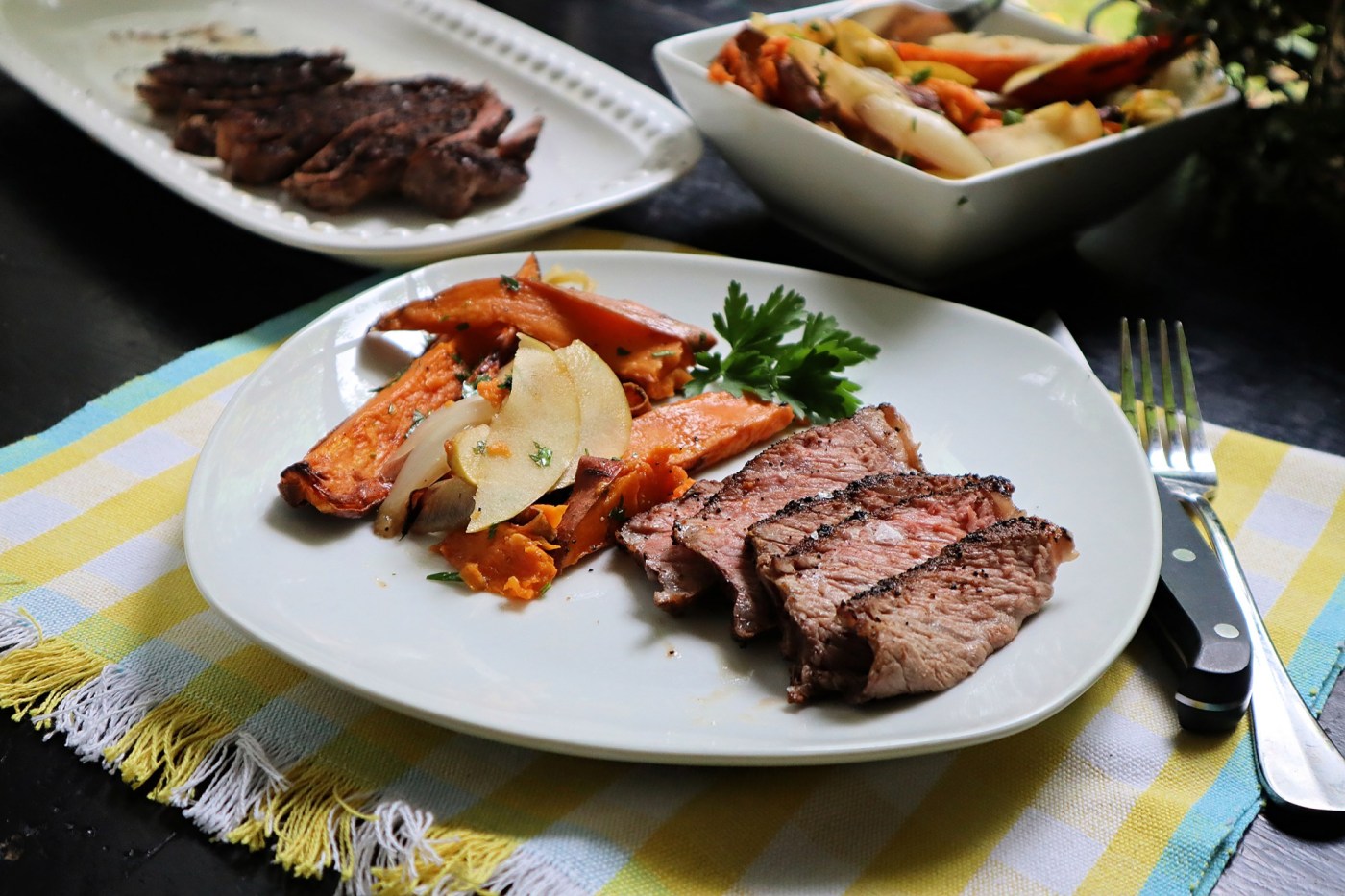
This foolproof steak recipe — perfectly sized for two — was one of the first dinners we enjoyed once things were quietly back to normal. Made in the oven instead of on a grill, it gets its exceptional taste from a bold and flavorful rub made with finely ground coffee, chili powder and brown sugar.

Thick wedges of sweet potatoes, shallot and sliced apple are roasted alongside the steak in the pan, making for an easy and complete meal. Depending on appetites, leftovers can be used to top a salad or stuff into a taco. It’s also pretty tasty cold the next morning with coffee.

Coffee-rubbed steak is roasted in the oven with sweet potatoes, shallots and apples for an easy meal for two. (Gretchen McKay/Pittsburgh Post-Gazette/TNS)

One-Pan Coffee-Rubbed Steak

PG tested

1 pound sweet potatoes, unpeeled, cut lengthwise into 1-inch wedges
4 shallots, peeled and quartered lengthwise
2 tablespoons extra-virgin olive oil, divided
1/2 teaspoon salt, divided
1/2 teaspoon black pepper, divided
1 large apple, cored, halved and sliced thin
2 teaspoons packed dark brown sugar
2 teaspoons finely ground coffee
2 teaspoons ancho chili powder
Pinch of paprika
1 12- to 16-ounce boneless strip steak (about 1 inch thick), trimmed
2 tablespoons minced fresh parsley, plus extra for serving
1 tablespoon red wine vinegar

Adjust oven rack to lower-middle position and heat oven to 450 degrees.

Toss potatoes and shallots with 2 teaspoons oil, 1/8 teaspoon salt and 1/8 teaspoon pepper in a large bowl.

Arrange potatoes skin side down on half of rimmed baking sheet and arrange shallots in single layer next to potatoes. Roast until vegetables are softened and lightly browned, 20-25 minutes.

Toss apple with 1 teaspoon oil and 1/8 teaspoon salt in now-empty bowl. Combine sugar, coffee, chili powder and remaining salt and pepper in small bowl. Pat steak dry with paper towels and rub with spice mixture.

Place steaks on empty portion of baking sheet. Arrange apple slices on top of shallots. Roast until potatoes, shallots and apples are fully tender and meat registers 120-125 degrees (for rare), or 130-135 degrees for medium-rare, 10-15 minutes.

Transfer steak, bottom side up, to cutting board, tent loosely with aluminum foil and let rest for 5 minutes.

Combine parsley, vinegar and remaining 1 tablespoon oil in large bowl. Add potatoes, shallots and apples and toss to combine. Season with salt and pepper to taste.

Slice steak against grain and sprinkle with extra parsley. Serve steak with potato mixture.

Serves 2.

— adapted from “The Complete Cook for Two Cookbook” by America’s Test Kitchen

©2024 PG Publishing Co. Visit at post-gazette.com. Distributed by Tribune Content Agency, LLC.

Related Articles


Recipe: Oakville Grocery’s Smoked Salmon Sandwiches with Skyhill Chèvre


Recipe: Oakville Grocery’s Pesto Pasta Salad


Recipe: Chilled green garlic bisque


Recipe: Watermelon, Heirloom Tomato, Feta and Mint Salad


Recipe: French green bean salad
Music therapy helps stroke survivors regain lost speech by singing

posted in: Society | 0

Ray Hart’s vocabulary consisted of just one word after his August 2022 stroke.

“Yep” was all he could say, said Pamela Jenkins, his caregiver and partner of 24 years.

Like many survivors, Hart, 62, can understand what’s said to him almost as well as he could before the stroke, but it’s still hard for him to form complete sentences.

Now, though, a year after adding music therapy to his rehabilitation schedule, he can sing them.

“I’ve got sunshine on a cloudy day,” he sang during a recent session at Sentara Fort Norfolk Plaza, relief and pride glowing on his face as the pent-up words escaped. “What can make me feel this way? My girl!”

Jenkins urged medical professionals to consider including music therapy in their rehabilitation recommendations as a panelist in Friday’s Stroke Symposium hosted by Sentara in Williamsburg.

“That therapy, we have found, has helped him more than anything else,” she said.

Hart sees Tracy Bowdish, the only music therapist Sentara employs. Bowdish had worked with a task force to help pass music therapy licensure legislation in Virginia in 2020.

Despite its effectiveness for stroke survivors, Parkinson’s and Alzheimer’s patients and others with various types of cognitive deficit, music therapy is generally not covered by insurance, Bowdish said.

To make it accessible, Sentara takes a loss on the program and charges patients a $40 fee for each session. That amount hasn’t increased in Bowdish’s 12 years with the hospital system.

“I’m inherently skeptical by nature, so I know people look at music therapy and think it looks all fluffy,” Bowdish said.

But neurologic music therapy engages various parts of the brain, involving emotion, rhythm, memory and language, she said. When functional magnetic resonance imaging emerged, she added, practitioners thought they’d be able to find where music lives in the brain. It turned out, though, that unlike speech, which is controlled from the brain’s left hemisphere, music shows up all over the place.

“We use more of our brain when we sing than we do when we speak,” she said.

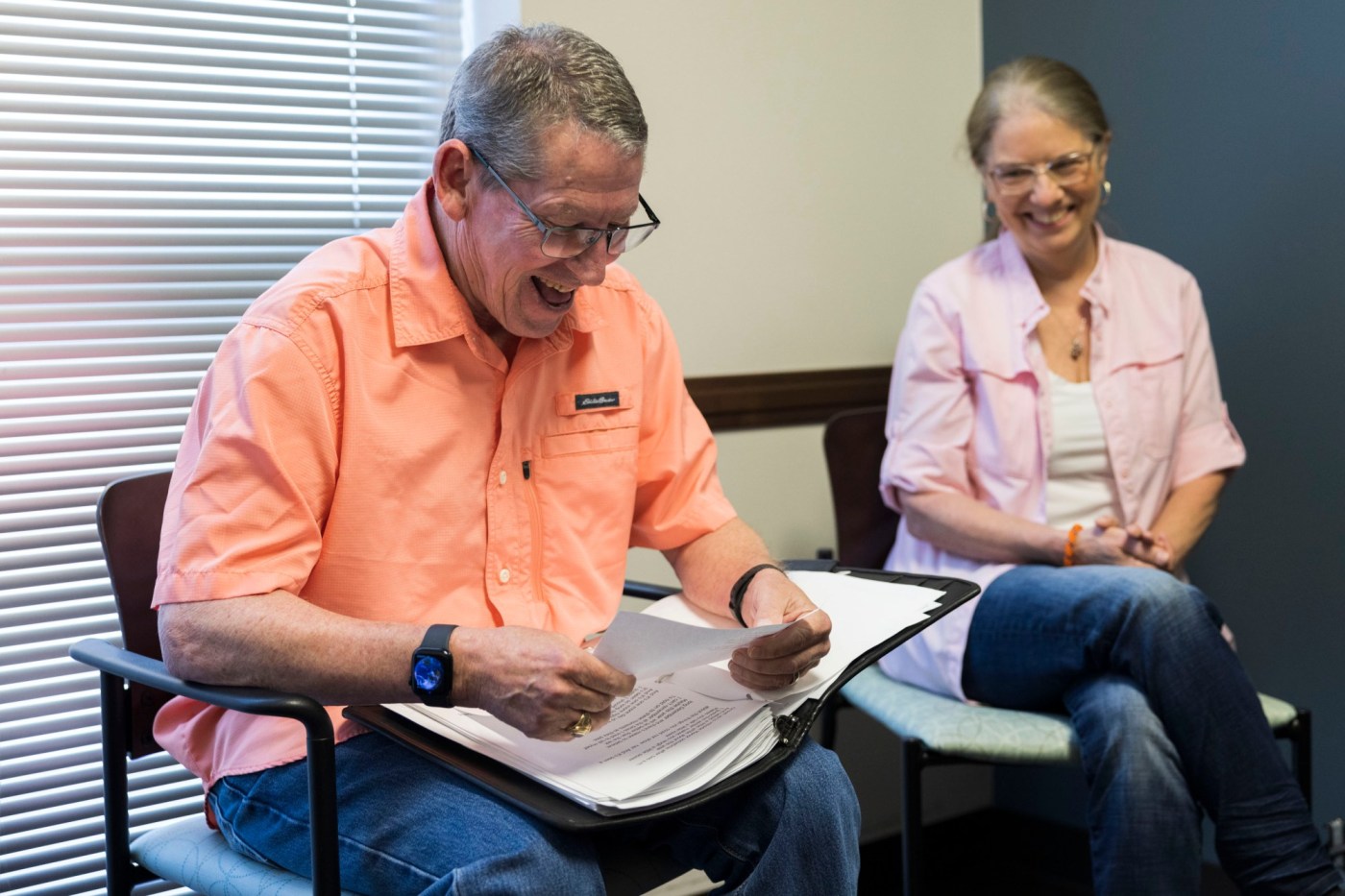
Music therapist Tracy Bowdish works with stroke survivor Ray Hart, 62, and his partner Pamela Jenkins during a session at Sentara Fort Norfolk Plaza in Norfolk on Thursday, May 16, 2024. (Kendall Warner / The Virginian-Pilot)

Dr. Alexander Grunsfeld, Sentara’s medical director for neuroscience and the director of Friday’s conference, said the power of music has always fascinated him.

“Everything else that moves you as a human being, you can correlate that with some value for survival,” Grunsfeld said. From love to fear, there’s a clear relationship, he said, but music doesn’t seem to have the same obvious correlation.

“I’ve always been really curious about that,” he said. “Why is music so powerful?”

Related Articles

Health |


10 questions and answers about drinking and alcohol use in older adults

Health |


Presidential election could decide fate of extra Obamacare subsidies

Health |


Safety-net health clinics cut services and staff amid Medicaid ‘unwinding’

Health |


Wins at the ballot box for abortion rights still mean court battles for access

Health |


Push for defibrillators in schools becomes personal

The neurologic reasons music therapy helps after a stroke are a bit easier to understand, he said. A stroke is caused by an interruption of blood flow to the brain, usually triggered by a blood clot. Those clots, in turn, are often caused by damaged blood vessels, Grunsfeld said, adding that significant increases in stroke rates over the past several decades are associated with metabolic syndrome in a Western diet and sedentary lifestyles.

“It’s very difficult to change lifestyle,” he said. “But for people who really don’t want to have a stroke, the best option for them is to eat healthy and to engage in physical activity.”

Since clots usually occur in a limited area, they also cut off blood flow to the brain in a limited area.

“The brain is unlike any other organ in that it cannot last for more than a few minutes without oxygen,” Grunsfeld said. “If the blood was interrupted long enough, the neuron cells will die, and then that part of the brain will no longer be able to function normally.”

Recovery or improvement after a stroke typically depends on other neurons growing new connections to take over the functions of the brain cells that died, he said, but overall understanding of recovery has changed dramatically over the past decade — especially the assumption that recovery is only possible for the first six months after a stroke.

“What we found out is that is not true, and it was a bit of a self-fulfilling prophecy,” Grunsfeld said. “People should know that if anyone tells them that ‘you’re just never going to get better than this,’ that isn’t accurate.”

“The more you use your brain, even as you get older and even after a stroke, your brain has the ability to adapt and to improve,” he said. “And so I would say that recovery or improvement is possible at any stage. You just have to do the hard work.”

Music therapist Tracy Bowdish works with stroke survivor Ray Hart, 62, and his partner Pamela Jenkins during a session at Sentara Fort Norfolk Plaza in Norfolk on May 16. (Kendall Warner / The Virginian-Pilot)

Music therapy can make that work a little less hard, Grunsfeld and Bowdish both said, simply because it’s fun.

“Obviously, we know what we should do,” Bowdish said. “We know we should exercise more. We know we should put down the cigarettes. We know we should do things, but that doesn’t mean we do them.”

The same is true for therapy, she said, which requires both efficacy, meaning the therapy really works, and compliance, meaning the patient actually completes it. It’s hard for someone to keep a frown on their face and sing along glumly with their favorite songs, she said.

Bowdish, who has been completely blind since birth, said the occasional patronizing attitudes she encounters have affected how she treats her patients.

“I don’t ever want to be condescending or have low expectations for people,” she said. “Just because somebody had a stroke, that doesn’t automatically define who they are now.”

“Yeah!” Hart interjected emphatically, paying close attention to Bowdish’s passionate comments.

“Yeah, say it!” Bowdish responded, laughing. “That’s just one day that one thing happened. It definitely changes the rest of your life, but it’s not necessarily a major part of somebody’s identity unless they choose for it to be.”

Courtesy of the Virginia Department of Health

The signs and symptoms of a stroke, from the Virginia Department of Health.

Have a health care or science story, question or concern? Contact Katrina Dix, 757-222-5155, katrina.dix@virginiamedia.com.

Related Articles

Health |


Prince collaborator Sheila E. says she’s ‘heartbroken’ at being turned away from Paisley Park

Health |


Concert review: Who is this Noah Kahan and how did he sell out two nights at Xcel Energy Center?

Health |


What to stream: Go behind the music with these new documentaries

Health |


What’s up with the canceled tours and slow ticket sales for arena concerts?

Health |


Ringo Starr talks candidly: ‘I’m giving away all the secrets here!’

Alzheimer’s drug that can slow disease gets backing from FDA advisers

posted in: News | 0

WASHINGTON — A closely watched Alzheimer’s drug from Eli Lilly won the backing of federal health advisers on Monday, setting the stage for the treatment’s expected approval for people with mild dementia caused by the brain-robbing disease.

Food and Drug Administration advisers voted unanimously that the drug’s ability to modestly slow the disease outweighs its risks, including side effects like brain swelling and bleeding that will have to be monitored.

“I thought the evidence was very strong in the trial showing the effectiveness of the drug,” said panel member Dean Follmann, a National Institutes of Health statistician.

The FDA will make the final decision on approval later this year. If the agency agrees with the panel’s recommendation, the drug, donanemab, would only be the second Alzheimer’s drug cleared in the U.S. shown to convincingly slow cognitive decline and memory problems due to Alzheimer’s. The FDA approved a similar infused drug, Leqembi, from Japanese drugmaker Eisai last year.

Lilly studied its drug by grouping patients based on their levels of a brain protein, called tau, that predicts severity of cognitive problems. That prompted FDA reviewers to question whether patients might need to be screened via brain scans for tau before getting the drug. But most panelists thought there was enough evidence of the drug’s benefit to prescribe it broadly, without screening for the protein.

“Imposing a requirement for tau imaging is not necessary and would raise serious practical and access concerns to the treatment,” said Dr. Thomas Montine of Stanford University, who chaired the panel and summarized its opinion.

The FDA had been widely expected to approve the drug in March. But instead the agency said it would ask its panel of neurology experts to publicly review the company’s data, an unexpected delay that surprised analysts and investors.

At a high level, Lilly’s results mirrored those of Leqembi, with both medications showing a modest slowing of cognitive problems in patients with early-stage Alzheimer’s. The Indianapolis-based company conducted a 1,700-patient study showing patients who received monthly IV infusions of its drug declined about 35% more slowly than those who got a sham treatment.

But there were differences in the way Lilly tested its drug that raised questions for FDA.

One change was measuring patients’ tau, and excluding patients with very low or no levels of the protein. But panelists said there was enough data from other measures to feel confident that nearly all patients could benefit from the drug, regardless of their levels.

In another key difference, Lilly studied taking patients off its drug when they reached very low levels of amyloid, a sticky brain plaque that’s a contributor to Alzheimer’s.

Lilly scientists suggested stopping treatment is a key advantage for its drug, which could reduce side effects and costs. But FDA staff said Lilly provided little data supporting the optimal time to stop or how quickly patients might need to restart treatment.

Despite those questions, many panelists thought the possibility of stopping doses held promise.

“It’s a huge cost savings for the society, we’re talking about expensive treatment, expensive surveillance,” said Dr. Tanya Simuni of Northwestern University. She and others experts said patients would need to be tracked and tested to see how they fare and if they need to resume treatment.

The main safety issue with donanemab was brain swelling and bleeding, a problem common to all amyloid-targeting drugs.

Three deaths in the donanemab study were linked to the drug, according to the FDA, all involving brain swelling or bleeding. One of the deaths was caused by a stroke, a life-threatening complication that occurs more frequently among Alzheimer’s patients.

FDA’s panel agreed that those the risks could be addressed by warning labels and education for doctors as well as medical scans to identify patients at greater risk of stroke.

___

The Associated Press Health and Science Department receives support from the Howard Hughes Medical Institute’s Science and Educational Media Group. The AP is solely responsible for all content.

Related Articles

Health |


Music therapy helps stroke survivors regain lost speech by singing

Health |


10 questions and answers about drinking and alcohol use in older adults

Health |


Presidential election could decide fate of extra Obamacare subsidies

Health |


Safety-net health clinics cut services and staff amid Medicaid ‘unwinding’

Health |


Wins at the ballot box for abortion rights still mean court battles for access

British TV host Dr. Michael Mosley reached millions by being his own guinea pig

posted in: Society | 0

By BRIAN MELLEY and PETROS GIANNAKOURIS (Associated Press)

RHODES, Greece (AP) — Dr. Michael Mosley was his own guinea pig.

In the name of science, the British television host put his body to the test by ingesting tape worms, injecting snake venom and letting leeches suck his blood.

What didn’t kill him made him more popular and he reached millions through BBC programs like “Trust Me, I’m a Doctor,” other appearances on TV and radio, and through bestselling diet books.

In the end, his death came during a hike in the blazing sun on the Greek island where was vacationing.

Greek police said Monday there was no sign of foul play, though an autopsy was underway to find the cause.

Here are some things to know about Mosley:

He was steps away from reaching a beach

Mosley, 67, was found dead Sunday, four days after he went missing on the island of Symi.

His wife said he took the wrong route on what was supposed to be a short walk to the next town and appeared to have collapsed.

The path would have taken him over or alongside a steep unforgiving slope littered with rocks and no shelter from heat that hit 37 Celsius (98.6 Fahrenheit).

His body was found within a few dozen steps of the water.

“He almost managed to reach his destination,” Lefteris Papakalodoukas, the mayor of Symi told Greek Alpha television. “It was only another 10 meters (33 feet) to the beach. But that must be when his strength left him.”

Dr. Clare Bailey Mosley said her family took comfort knowing her husband almost made it to safety.

“He did an incredible climb, took the wrong route and collapsed where he couldn’t be easily seen by the extensive search team,” she said in a statement.

The banker who became a doctor who didn’t practice medicine

After graduating from Oxford University, Mosley became an investment banker before going back to school to become a doctor. After qualifying for a career in medicine, though, he took another dramatic career change. He trained as an assistant producer at the BBC and that eventually led to a profession in front of the camera.

Mosley was widely admired for his ability to communicate complex science clearly and his willingness to be the subject of experiments that made others shudder.

In a BBC program called “Infested! Living with parasites,” he swallowed tapeworm cysts. He used a “pill camera” to explore his insides and was watching on an iPad in an Indian restaurant when he first saw the tapeworms attached to his intestine.

“I shouted out: ‘Blimey! There’s a tapeworm in me!’ The other diners looked very surprised,” he said. “I was delighted, but at the same time, it was rather horrible.”

When he was diagnosed with stage 2 diabetes in 2012, Mosley turned to health science and developed a diet that beat the diagnosis and became the basis for one of his books.

He later popularized intermittent fasting and low-carb meals through his 2013 book “The Fast Diet,” which he co-authored with journalist Mimi Spencer, that proposed the so-called “5:2 diet” to minimize calories two days a week while eating healthily the other five.

His “Just One Thing” radio series launched in 2021 advocated simple changes that could transform health and wellbeing.

“I remember him as a bright spark who although now sadly extinguished, will live on through his influential ‘Just One Thing,’” said Mark Miodownik, a materials science professor at University College London, who had worked with Mosley. “Science has lost one of its best and most influential communicators. His warmth and connection to the audience was remarkable.”

Tireless search from the air, ground and water

The search for Mosley began when he didn’t return after leaving his wife and friends and going for a walk from Agios Nikolaos beach near where he was staying.

Searchers on foot, divers in the water, helicopters and drones from above and parties combing the shore from boats spent four days looking for Mosley.

CCTV footage that was believed to be the last known sighting him had shown him walking through a village with a black umbrella overhead to protect himself from the sun.

But footage released Monday appeared to show him scrambling down a rock slope next to a fence and falling out of view where his body was later found.

On Sunday, a boat with the mayor and a group of journalists was scanning the rugged slope when a cameraman saw something dark among the rocks.

The mayor took a photo of the camera display and zoomed in.

“It has a good resolution,“ he said. “It was the missing man.”

Ilias Tsavaris, a bar manager at the Agia Marina, said he scrambled up the hillside after getting a call from the boat telling him to confirm the sighting.

“When I walked up I saw something like a body,” he said. “You don’t see a dead body everyday, it is not a warzone, it’s summer, you are supposed to have fun and swimming.”

Clare Bailey Mosley thanked the people of Symi for their tireless search for a man they didn’t know.

“Some of these people on the island, who hadn’t even heard of Michael, worked from dawn till dusk unasked,” she said.

___

Melley reported from London. Associated Press writer Costas Kantouris contributed from Thessaloniki, Greece.