Five faces to watch Tuesday in Georgia, Oklahoma and Virginia

posted in: Politics | 0

Mary Ellen McIntire, Daniela Altimari and Niels Lesniewski | (TNS) CQ-Roll Call

Republican House members are playing defense in expensive primaries in Virginia and Oklahoma, with Freedom Caucus Chair Bob Good of Virginia facing a conservative rival endorsed by former President Donald Trump, while House Appropriations Chair Tom Cole has a challenger in Oklahoma who’s put more than $5 million of his own money into the race.

There are also primaries in Virginia for open seats now held by Democrats that the GOP is trying to flip, and a runoff in Georgia for a Solid Republican open seat.

Here’s a rundown of five races worth watching.

Good opponent McGuire backed by Trump

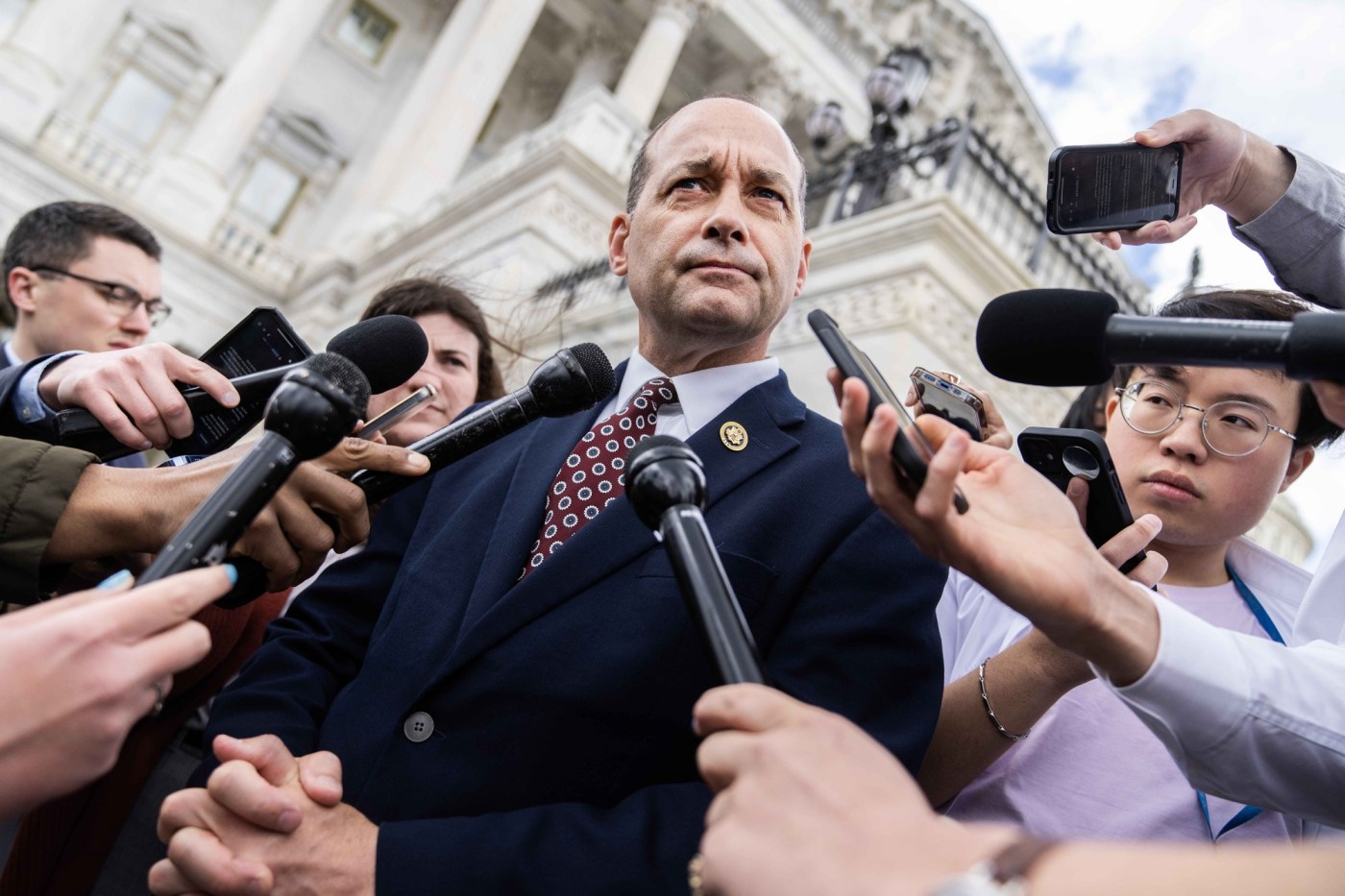
Good could be the first incumbent of the year to lose to a primary challenger when 5th District voters pick their Republican nominee Tuesday.

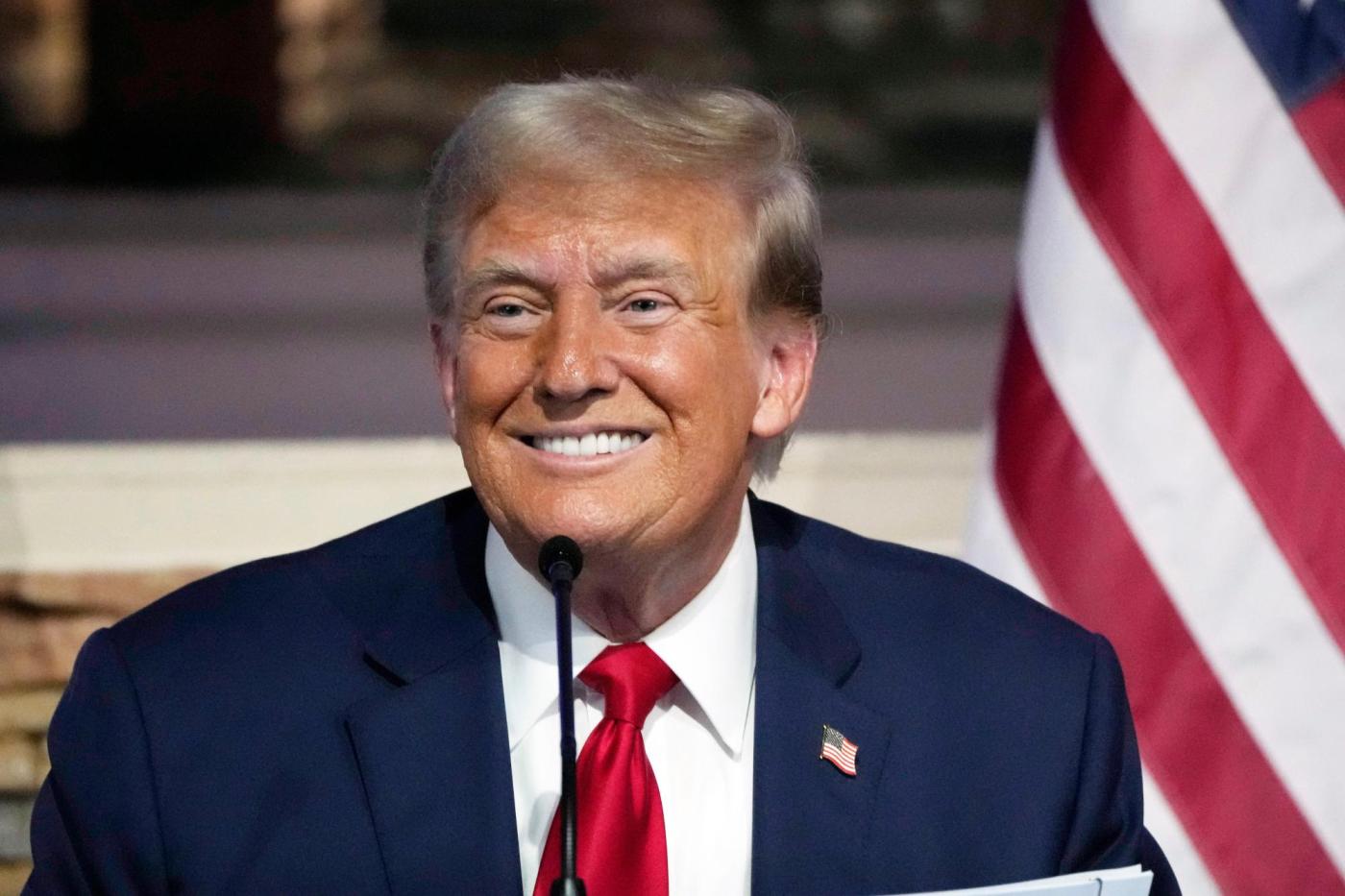
Good, who was one of the eight House Republicans who voted to oust former Speaker Kevin McCarthy, faces a primary challenge from state Sen. John McGuire, who is backed by Trump. Trump has said that Good is “bad for Virginia.”

Good was among the members of Congress who endorsed Fla. Gov. Ron DeSantis for president, but he later endorsed Trump after DeSantis ended his presidential campaign.

McGuire was elected to the state Senate in 2023. He narrowly outraised Good, $1.2 million to $1.1 million as of May 29, but had $520,000 on hand for the final weeks of the campaign compared to Good’s $168,000.

Outside groups have spent a whopping $20 million in the 5th District ahead of Tuesday’s primary. House Freedom Action, the political arm of the Freedom Caucus, spent $241,000 supporting Good and $1.3 million opposing McGuire. Defending Main Street Super PAC, which is aligned with the Republican Main Street Partnership, spent $904,000 supporting McGuire. Several other groups also made independent expenditures.

A handful of House Republicans have also traveled to the central Virginia district, which includes Charlottesville and stretches to the North Carolina border, to campaign for both Good and McGuire.

Cole challenger spending big

In Oklahoma’s ruby red 4th District, Cole is facing an aggressive challenge from a deep-pocketed Republican newcomer.

Businessman Paul Bondar has loaned his campaign more than $5 million, which has funded a flood of negative ads. He says he’s the real “Trump Republican” in the race, even though former President Donald Trump is backing Cole.

Bondar, who owned an Illinois-based trucking insurance company, is facing questions about his residency. He owns a home outside Dallas, holds a Texas driver’s license and voted in the Texas primary on March 5, according to a report on KFOR.

Bondar told the Oklahoma City television station that he’s building a ranch in Durant, Okla., which is outside the boundaries of the 4th District, and registered to vote in Oklahoma on April 3, according to Oklahoma Voice. While the Constitution doesn’t require candidates to live within the district they are seeking to represent, it does stipulate that they must live in the state.

The race has also drawn the attention of outside groups who are backing Cole. Americans 4 Security PAC spent $6.2 million and Defending Main Street SuperPAC Inc. spent $691,000 against Bodnar. On top of that, those two groups and five others, including the National Association of Realtors and the National Rifle Association, spent another $382,000 supporting Cole.

Three other Republicans – Nick Hankins, Rick Harris and Andrew Hayes – are also on the primary ballot, and to win the nomination outright a candidate has to get over 50 percent or there will be a runoff on Aug. 27. Two Democrats – Mary Brannon and Kody Macaulay – are competing in the Democratic primary.

Trump won the 4th District by more than 30 percentage points in 2020.

Crowd vies for Spanberger seat

Democratic Rep. Abigail Spanberger’s decision not to run for reelection and focus on a 2025 run for governor opens up the 7th District, a swing seat that’s attracted seven Democrats and six Republicans.

Eugene Vindman, a former National Security Council official who rose to prominence alongside his twin brother for his role in the first Trump impeachment inquiry, has put a national spotlight on the race. He raised $5 million and had $876,000 on hand as of May 29.

Six other candidates are on the Democratic ballot on Tuesday, including a quartet of female state and local officials: Prince William County Supervisors Andrea Bailey and Margaret Franklin, former state Del. Elizabeth Guzman and state Del. Briana Sewell. But none of those candidates have narrowed the campaign to make it a true two-person race.

On the Republican side, two military veterans, retired Green Beret Derrick Anderson and retired Navy SEAL Cameron Hamilton, are leading a field of six candidates.

Anderson, who lost a 2022 primary for the 7th District, has led the GOP in fundraising and had $422,000 on hand for the final weeks of the campaign. He’s endorsed by Speaker Mike Johnson and other members of the House GOP leadership. Virginia Rep. Jen Kiggans also backed him, along with several other House Republicans.

Hamilton is further to the right to Anderson. He was endorsed by several members of the Freedom Caucus, including Good. Hamilton raised $722,000 and had $178,000 on hand for the campaign’s final stretch.

Groups spent $8.4 million on independent expenditures to support candidates in the 7th District, as of Thursday afternoon. Protect Progress and VoteVets spent a combined $2.6 million to boost Vindman and Casa in Action PAC spent $378,000 to support Guzman. The Protect Freedom Fund Political Action Committee and House Freedom Fund spent $2.5 million to support Hamilton in the Republican primary.

The seat is on both parties’ radar for November. Inside Elections rates the race as Tilt Democratic.

A dozen Democrats seeking NoVa nod

The race to succeed Rep. Jennifer Wexton has drawn a dozen Democrats and four Republicans seeking to represent Northern Virginia’s 10th District.

Of the 12 Democrats in the race, state Del. Dan Helmer, state Sen. Suhas Subramanyam and former defense official Krystle Kaul all raised more than $1 million as of May 29, and former House of Delegates Speaker Eileen Filler-Corn raised $972,000. Kaul’s total includes $556,000 she loaned or donated to her campaign.

The race has stayed competitive and new developments this week led to one candidate calling on another to withdraw. NOTUS reported that four members of the Loudoun County Democratic Committee accused Helmer “of behavior that led to the local party instituting a sexual harassment policy.” The officials, two of whom reportedly endorsed different candidates, didn’t detail specific allegations against him.

Filler-Corn called on Helmer to drop out of the race on Thursday, saying his behavior was “disqualifying.”

Subramanyam was endorsed by Wexton, who is retiring after being diagnosed with progressive supranuclear palsy, which she has referred to as “a kind of ‘Parkinson’s on steroids.’”

Helmer led the Democrats in fundraising. He had $536,000 on hand as of May 29, while Subramanyam had $286,000 and Filler-Corn had $219,000. Kaul had $43,000.

Outside spending in the race reached $11 million as of Thursday. Protect Progress, a PAC with ties to the cryptocurrency industry, VoteVets and With Honor Fund II Inc., spent a combined $9.6 million to support Helmer. A group called The Impact Fund spent $1 million to support Subramanyam. The pro-Israel DMFI PAC spent $300,000 and a group called Virginians United for Progress spent $24,000 to support Filler-Corn, while Virginia Democratic Action PAC and WFP National PAC spent $375,000 opposing her. Repro Rising Virginia PAC spent $25,000 supporting state Sen. Jennifer Boysko.

In the Republican primary, attorney Mike Clancy led three opponents in fundraising. He had $111,000 on hand as of May 29. Veteran Alex Isaac had $23,000 on hand, while Marine veteran Aliscia Andrews had $27,000. Manga Anantatmula had $2,800.

Inside Elections with Nathan L. Gonzales rates the race as Likely Democratic.

Former Trump aide in Georgia runoff

Brian Jack, who served as White House political director under Trump and has his endorsement, finished first in a five-candidate field in the May 21 primary for the open seat in Georgia’s 3rd District.

Jack got nearly 47 percent but needed more than 50 percent to win the nomination outright. So he faces a runoff Tuesday against state Sen. Mike Dugan, who got about 25 percent in the primary.

Jack has the fundraising advantage, raising $1.3 million for the election cycle and holding $360,000 in his campaign account on May 29, compared to $605,000 raised and $173,000 on hand for Dugan. In addition, all but $25,000 of the $835,000 spent by outside groups since the primary went to boost Jack.

The largely rural district in western Georgia is represented by Republican Drew Ferguson, who won his fourth term in 2022 with 69 percent of the vote but said in December he would not run again.

___

©2024 CQ-Roll Call, Inc., All Rights Reserved. Visit cqrollcall.com. Distributed by Tribune Content Agency, LLC.
The politics of memes: How Biden and Trump are fighting each other on the internet

posted in: News | 0

By MEG KINNARD and MICHELLE L. PRICE (Associated Press)

WASHINGTON (AP) — Whether it’s a grinning Joe Biden as “Dark Brandon” or Donald Trump’s face superimposed onto a scene from HBO’s “Game of Thrones,” both presidential campaigns this year have embraced digital memes, the lingua franca of social media.

The campaigns of the Democratic president and Republican former president enthusiastically create and share content trying to shape the narratives around both men. Biden’s campaign even recently posted a job seeking a manager of meme pages.

With tens of millions of people using social media as a primary information source, the battle of memes could affect who wins in November. Many Americans say they’re not excited about a Biden-Trump rematch and growing digital habits make it harder to reach people through traditional spaces for political advertising like print publications or television.

Memes can be an edgier, faster way to get a political point across than a block of text or a lengthy video. But online misfires have hurt candidates and created major controversies.

Here’s a look at how memes are shaping presidential politics.

First: What is a meme?

Memes have been around longer than you think.

The term “meme” was coined in 1976 by British evolutionary biologist Richard Dawkins, who used it to refer to a piece of information that is imitated and shared, be it a slogan, a behavior, an idea.

With the rise of internet culture, digital memes have skyrocketed in popularity. They often take the form of visual content like an image or a video with some kind of message that speaks to people who get it because of some knowledge they have or membership in a particular group. Memes don’t have to be funny or satirical, but that makes them more likely to be shared widely. And while politicians these days work to deliberately create and share memes, some of the most well-known ones were unintentionally sparked.

One of the earliest memes of the modern era was former Vermont Gov. Howard Dean’s enthusiastic scream the night of the Iowa caucuses, with videos and images of the Democrat’s guttural shriek being widely shared, drawing ridicule and damaging his already struggling presidential bid.

When President Barack Obama was moving into the White House in 2009, the photos of outgoing President George W. Bush with the text, “Miss me yet?” were broadly shared by Bush’s supporters.

A 2011 photo of then-Secretary of State Hillary Clinton wearing sunglasses and staring at her phone became a popular meme the following year, “Texts from Hillary,” purporting to show her sending snarky texts to politicians and celebrities.

“If you do it well, you tap into something that the group agrees upon or is feeling suspicious about; you tap into something that connects with the audience,” said Rebecca Ortiz, an associate professor of advertising at Syracuse University who has researched the influence of memes around political identity.

How do the two candidates approach memes?

Biden’s campaign has created its own stockpile of photos and videos for distribution on official Biden-related accounts. According to a Biden campaign official, advisers are also looking to partner with third-party creators in the coming months, with the hopes of reaching the followings of users who already seem aligned with a pro-Biden message.

Related Articles

National Politics |


January 6 investigation lingers as 2024 election nears

National Politics |


New voter registration rules threaten hefty fines, criminal penalties for groups

National Politics |


AI experimentation is high risk, high reward for low-profile political campaigns

National Politics |


Biden’s campaign announces a $50 million advertising blitz highlighting Trump’s conviction

National Politics |


Tobacco-like warning label for social media sought by US surgeon general who asks Congress to act

By developing relationships with outside creators, campaign officials hope that some undecided or as-yet unpersuaded voters will glom onto Biden’s message if they receive it from another account they’re already following.

“We’re trying really hard to run a digital program that is authentic to our candidate, who is probably not spending all his time on Twitter — actually, he definitely is not,” said Clarke Humphrey, senior adviser for digital persuasion for the Biden campaign. “So I think we just have been really creative about how to leverage all the corners of the internet so that he can be where he needs to be without him actually having to go to those places necessarily.”

Trump, a prolific user of social media even before he ran for president, has long embraced memes and shared them, as have his very-online political aides and some of his adult children. His oldest son, Donald Trump Jr., shares them frequently and refers to himself on Instagram as a “Meme Wars General.”

The campaign did not offer any details about its digital team or its use of memes. Spokesperson Steven Cheung issued a statement calling out Biden’s videotaped flubs of speeches and moments of apparent confusion.

“Joe Biden is a walking, talking meme every time he shuffles into public view,” Cheung said.

What are some examples of their content?

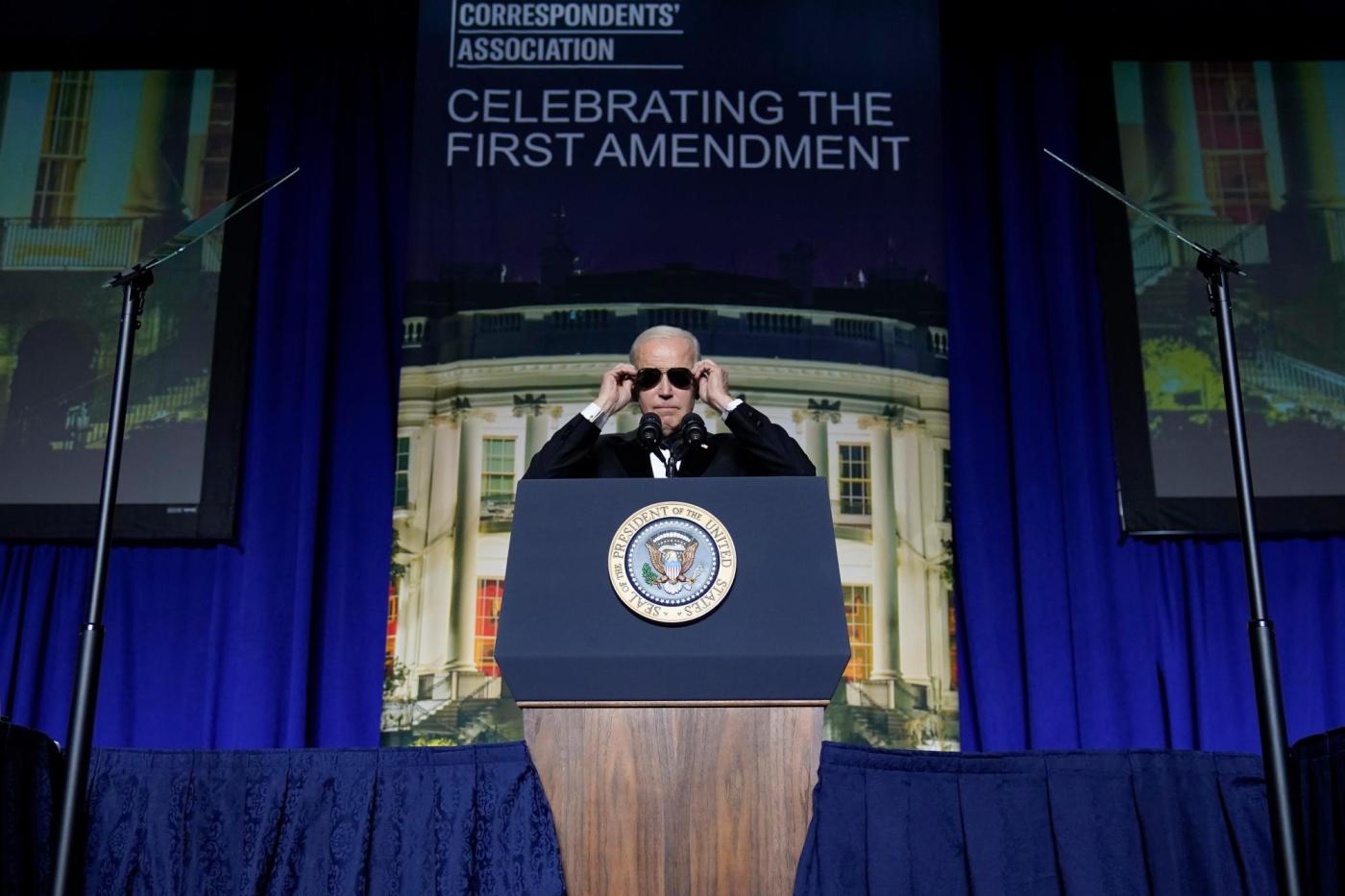
Biden’s team has embraced “Dark Brandon,” reappropriating a right-wing conspiracy meme that depicted the president as a menacing force and used a nickname, “Brandon,” that become an in-joke among conservatives for insulting him.

While “Dark Brandon” originally depicted Biden as a shadowy threat, Democrats adopted it, using the image as a meme to mock conspiracy theories about Biden’s purported influence on events like the Super Bowl and portraying him as a powerful force to tout his accomplishments.

Now, the campaign sells signs, mugs, baby onesies and even coffee bags portraying Biden as “Dark Brandon” with red laser eyes.

Trump and his staff regularly share memes that glorify him in over-the-top ways, such as depicting him to be leading a band of dancing Bollywood soldiers.

In April, right before the total solar eclipse swept across North America, Trump shared a meme video on his Truth Social media account that featured clips of people staring up at the sky wearing eclipse glasses and cheering as the sky darkened, before cutting to an image of the sun with a large silhouette of Trump’s head blocking it out as people cheer.

And both the Biden and Trump campaigns quickly clip potentially embarrassing videos of their opponent and post them online within minutes, injecting those moments into the social media bloodstream and often driving traditional news coverage.

When have the memes gone wrong?

Trump and his campaign often share content created by outside meme-makers — often geared to his base supporters — and sometimes disavow content that stirs outrage later.

In 2016 when he shared a meme about Clinton that appeared to depict the Star of David atop a pile of cash, evoking an antisemitic trope. Trump deleted the image but called it “a basic star, often used by sheriffs.”

Last month, Trump drew backlash for sharing a video meme on Truth Social that included references to a “unified Reich” among hypothetical news headlines if he wins the election in November.

The “unified Reich” meme was created by an outside group of meme makers that The New York Times reported has collaborated with the Trump campaign. The Dilley Meme Team describes itself as “America’s greatest MAGA Members” and “Trump’s Online War Machine” with their creations sometimes shared by Trump himself.

The campaign said the video was shared by a staffer who saw it online and did not see the reference. Trump’s campaign denied it coordinates with the group but said it appreciates the effort of outside creators.

Brenden Dilley, who leads the Dilley Meme Team, did not respond to emailed questions about the group’s work but posted a reply on X saying he would grant an interview in January 2025, after the next presidential inauguration.

Whose memes are going furthest?

It’s hard to say. Both candidates have tens of millions of followers across social media networks, as do their campaign accounts, but it’s difficult to track the number of times any particular meme is shared, or remixed and shared again.

Trump has more social media followers than Biden on Instagram, TikTok, Truth Social (Trump’s social media network) and X, though the former president has only used X once since his account on the site, then known as Twitter, was locked after the Jan. 6 insurrection.

Trump’s lone post since then was to post his mug shot. It, too, has become a meme.

Undersea explorers mark a tragic day. Things to know about the Titan disaster anniversary

posted in: News | 0

By PATRICK WHITTLE and HOLLY RAMER (Associated Press)

PORTLAND, Maine (AP) — A year after an experimental submersible imploded en route to the Titanic, unanswered questions linger — with no immediate answers.

Tuesday marks one year since the Titan vanished on its way to the historic wreckage site. After a five-day search that captured the world’s attention, officials said the craft had been destroyed and all five people on board killed.

The U.S. Coast Guard quickly convened a high-level investigation into what happened. Concerns leading up to the investigation included the Titan’s unconventional design and its creator’s decision to forgo standard independent checks.

A look at the one-year anniversary of the Titan tragedy:

The investigation is taking longer than expected

Coast Guard officials said in a statement last week that they would not be ready to release the results of their investigation by the anniversary. A public hearing to discuss the findings won’t happen for at least two more months, they said.

Investigators “are working closely with our domestic and international partners to ensure a comprehensive understanding of the incident,” Marine Board of Investigation Chair Jason Neubauer said, describing the inquiry as a “complex and ongoing effort.”

The Titan was owned by a company called OceanGate, which suspended its operations last July, not long after the tragedy. OceanGate said in a Tuesday statement that it “has ceased all operations and is continuing to cooperate with authorities, including the U.S. Coast Guard, in their investigations.” The company also said in its statement that it expresses “our deepest condolences to their families and loved ones, as well as everyone impacted by this tragedy.”

The Titan made its last dive on June 18, 2023, a Sunday morning, and lost contact with its support vessel about two hours later. When it was reported overdue that afternoon, rescuers rushed ships, planes and other equipment to the area, about 435 miles (700 kilometers) south of St. John’s, Newfoundland. The Transportation Safety Board of Canada said Monday that there are other submersibles operating within Canadian waters, some of which are not registered with any country.

In addition to OceanGate co-founder Stockton Rush, the implosion killed two members of a prominent Pakistani family, Shahzada Dawood and his son Suleman Dawood; British adventurer Hamish Harding; and Titanic expert Paul-Henri Nargeolet.

Remembering those who died

David Concannon, a former adviser to OceanGate, said he will mark the anniversary privately with a group of people who were involved with the company or the submersible’s expeditions over the years, including scientists, volunteers and mission specialists.

Harding and Nargeolet were members of The Explorers Club, a professional society dedicated to research, exploration and resource conservation.

“Then, as now, it hit us on a personal level very deeply,” the group’s president, Richard Garriott, said in an interview last week.

Garriott said there will be a remembrance celebration for the Titan victims this week in Portugal at the annual Global Exploration Summit.

The tragedy won’t stop deep-sea exploration

The Georgia-based company that owns the salvage rights to the Titanic plans to visit the sunken ocean liner in July using remotely operated vehicles, and a real estate billionaire from Ohio has said he plans a voyage to the shipwreck in a two-person submersible in 2026.

Several deep-sea explorers told The Associated Press that the Titan disaster shook the worldwide community of explorers, but it remains committed to continuing its missions to expand scientific understanding of the ocean.

Garriott believes the world is in a new golden age of undersea exploration, thanks to technological advances that have opened frontiers and provided new tools to more thoroughly study already visited places. The Titan tragedy hasn’t tarnished that, he said.

“Progress continues,” he said. “I actually feel very comfortable and confident that we will now be able to proceed.”

Veteran deep-sea explorer Katy Croff Bell said the Titan implosion reinforced the importance of following industry standards and performing rigorous testing. But in the industry as a whole, “the safety track record for this has been very good for several decades,” said Bell, president of Ocean Discovery League, a nonprofit organization.

Ramer reporter from Concord, New Hampshire.

New York’s top court declines to hear Trump’s appeal of gag order in hush money case

posted in: Politics | 0

By JAKE OFFENHARTZ (Associated Press)

NEW YORK (AP) — New York’s top court declined Tuesday to hear Donald Trump’s gag order appeal, leaving the restrictions in place following his felony conviction last month. The Court of Appeals found that the order does not raise “substantial” constitutional issues that would warrant an immediate intervention.

The decision is the latest legal setback for the former president, who has repeatedly railed against the gag order, which prevents him from commenting on witnesses, jurors and others who were involved in the hush money case. But it could be short lived. The trial judge, Juan M. Merchan, is expected to rule soon on a defense request to lift the gag order.

Trump’s attorneys filed a notice of appeal with the state’s high court on May 15, during the former president’s landmark criminal trial. They argued that the gag order restricted Trump’s “core political speech on matters of central importance at the height of his Presidential campaign.”

But the Court of Appeals disagreed. In a decision list posted on Tuesday, the court said it would not automatically hear the case, writing that “no substantial constitutional question is directly involved.”

Trump’s lawyers were essentially seeking a shortcut to expedite their appeal, which was rejected by the state’s mid-level appeals court last month. They now have 30 days to file a motion for leave to appeal, according to court spokesperson Gary Spencer.

Merchan imposed the gag order on March 26, a few weeks before the start of the trial, after prosecutors raised concerns about the presumptive Republican presidential nominee’s tendency to attack people involved in his cases.

During the trial, Merchan held Trump in contempt of court and fined him $10,000 for violating the gag order. The judge threatened to put Trump in jail if he did it again.

The order remains in effect weeks after the conclusion of the trial, which ended with Trump’s conviction on 34 counts of falsifying business records arising from what prosecutors said was an attempt to cover up a hush money payment to porn actor Stormy Daniels just before the 2016 election. Daniels claims she had a sexual encounter with Trump a decade earlier, which he denies. He is scheduled to be sentenced July 11.

The Manhattan district attorney’s office had urged the Court of Appeals to reject the appeal. In their own letter, prosecutors noted the question about whether the order should be lifted could be dealt with through post-trial court filings.

Trump’s lawyers have argued that he should be entitled to fully address the case, given the continued public criticism of him by his ex-lawyer Michael Cohen and Daniels, both key prosecution witnesses.

Days after the verdict, they sent a letter to Merchan asking him to lift the gag order. They followed up last week with a formal motion requesting that the restrictions be rescinded. Prosecutors have until Thursday to respond. Merchan is expected to rule soon after that, possibly before Trump’s June 27 debate with President Joe Biden.

“It’s a little bit of the theater of the absurd at this point, right? Michael Cohen is no longer a witness in this trial,” an attorney for Trump, Todd Blanche, told the AP earlier this month. “The trial is over.”

Messages seeking comment were left Tuesday for Blanche and the Manhattan DA’s office.