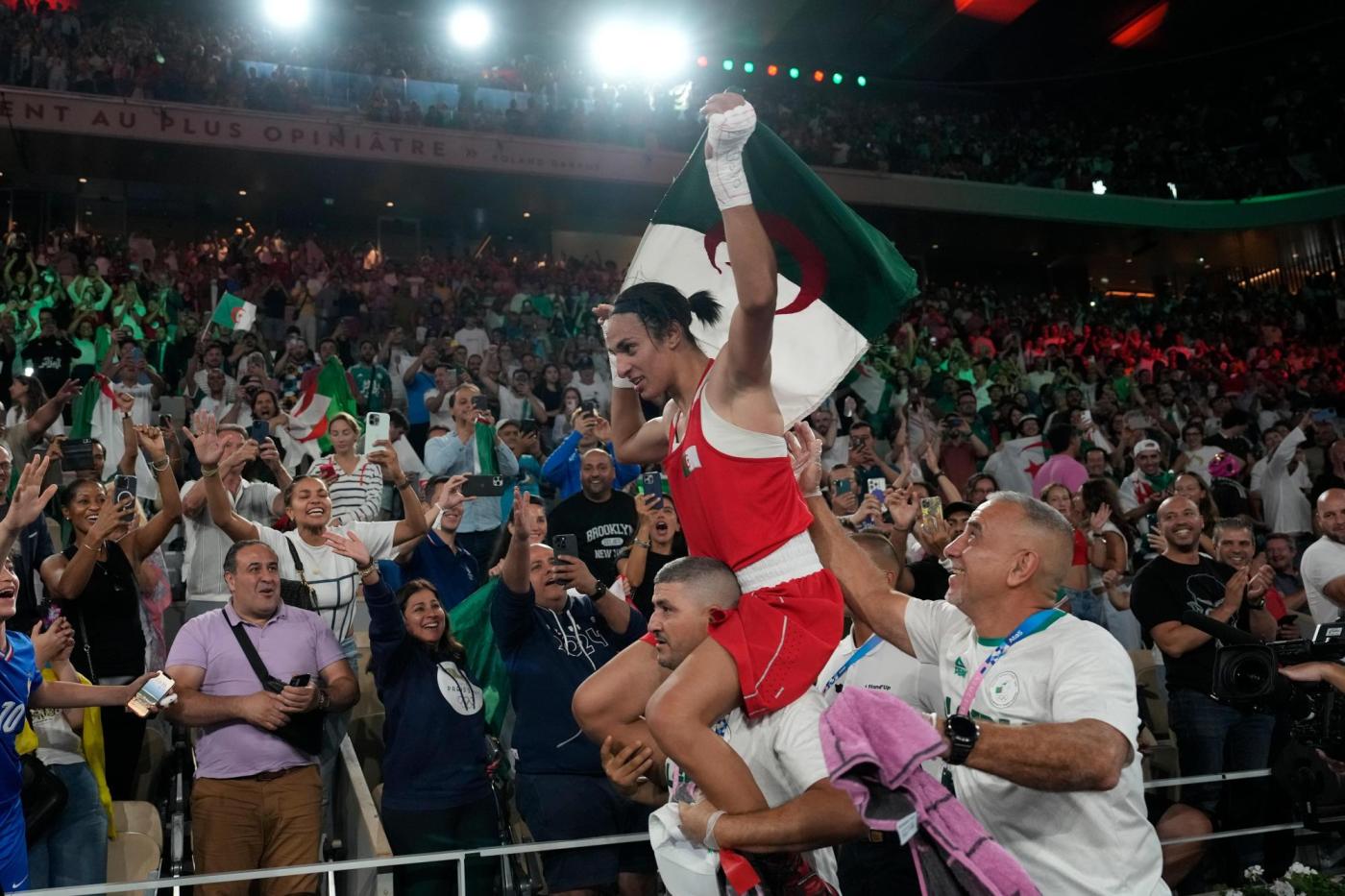
PARIS (AP) — Not long after the Algerian boxer at the center of a gender misconceptions controversy won a gold medal at the Paris Olympics, Donald Trump pounced on the achievement at a rally more than 7,000 miles away in Bozeman, Montana.
The former president has used the saga surrounding Imane Khelif as part of the culture wars raging through America ahead of November’s election. Khelif faced an extraordinary amount of scrutiny from world leaders, celebrities and social media warriors who questioned her eligibility or falsely claimed she was a man.
She won gold Friday night, not long before Trump’s speech in Montana.
“I’d like to congratulate the young woman who transitioned from a man into a boxer. If you saw, he won, she won, the gold medal,” said Trump, who imitated the Italian boxer who quit her match against Khelif because she was overwhelmed.
Trump repeatedly incorrectly referred to Khelif as “he.”
There’s no such thing as an apolitical Olympics, and that was very clear from the dazzling opening ceremony in Paris that offended religious groups and also drew Trump criticism. And just like that, the two-week sporting spectacle was pulled into the political discourse pulsating throughout the United States.
It isn’t a new phenomenon as the connection between politics and the Olympics have gone hand-in-hand dating back to when they resumed in the late 19th century – optimistically billed as a way for nations to compete without going to war.
“The Olympics are always pulled into political discourse because of the nature of the competition, in which nations compete against each other for dominance. This foundation in nationalism means that at its core, the Olympics is about nationalism first and athletics second,” said Zein Murib, associate professor of political science at Fordham University.
“Additionally, the Olympics have been used to condone or punish nations, as is the case with Germany in 1936, when the Olympics were held in Nazi Germany despite global protest that doing so would condone the regime, or 2024 when Russian athletes were excluded due to the invasion of Ukraine.”
For the Paris Games, the International Olympic Committee banned Russian athletes who are in the military or publicly supported the invasion of Ukraine. The IOC also blocked Russians from team sports, while track and field enforced its own blanket ban.
In gymnastics and weightlifting, Russia’s teams skipped qualifying events in protest of being forced to compete as neutrals or to undergo vetting, including checks of their social media.
There are 32 “neutral” athletes at these Games, 17 of whom previously represented Belarus and 15 representing Russia. They are competing under the status of “Individual Neutral Athletes” and were not permitted to participate in the opening ceremony. The Summer Games in Tokyo three years ago had more than 300 Russian athletes.
One political swipe against these Games came in the form of a video that portrayed Paris as a crime-ridden cesspool and mocked the Olympics. The video spread quickly on social media as 30,000 social media bots linked to a notorious Russian disinformation group. Within days, the video was available in 13 languages, thanks to quick translation by AI.
It was a way for Moscow to make its presence felt in Paris as groups linked to Russia’s government using online disinformation and state propaganda to attack France. It was evidence that global events like the Olympics are now high-profile targets for online disinformation and propaganda.
Murib said the political tension tied to this year’s Olympics is heightened because a coordinated group of “bad actors” has grown significantly and gained massive global reach over the past decade.
The tension was high going into the opening of the Games, as high-speed rail in France was disrupted by coordinated arson attacks. Even before the Olympics, French officials said they disrupted several sabotage plots, including arresting a Russian man who planned to destabilize the Games
“I think people on all sides of the political spectrum look to athletic competition as a barometer of the legitimacy of governing logics, and many will take wins — and losses — as lessons for the viability of democracy or authoritarianism,” Murib said. “We can see this at play in the ways that Trump immediately weighed in on Imane Khelif’s Olympic eligibility with the far right trope of keeping men out of women’s sports.”
Despite the dramas, these Games will be remembered as an overwhelming success. Paris was on full display with breathtaking — and accessible by public transportation — venues, star performances by the athletes and spectators back for the first time since before the 2020 global pandemic.
NBC across all platforms set viewership records as millions tuned in daily despite declarations on social media that individuals were “ boycotting ” the Olympics either because of the “ woke ” opening ceremony or Khelif.
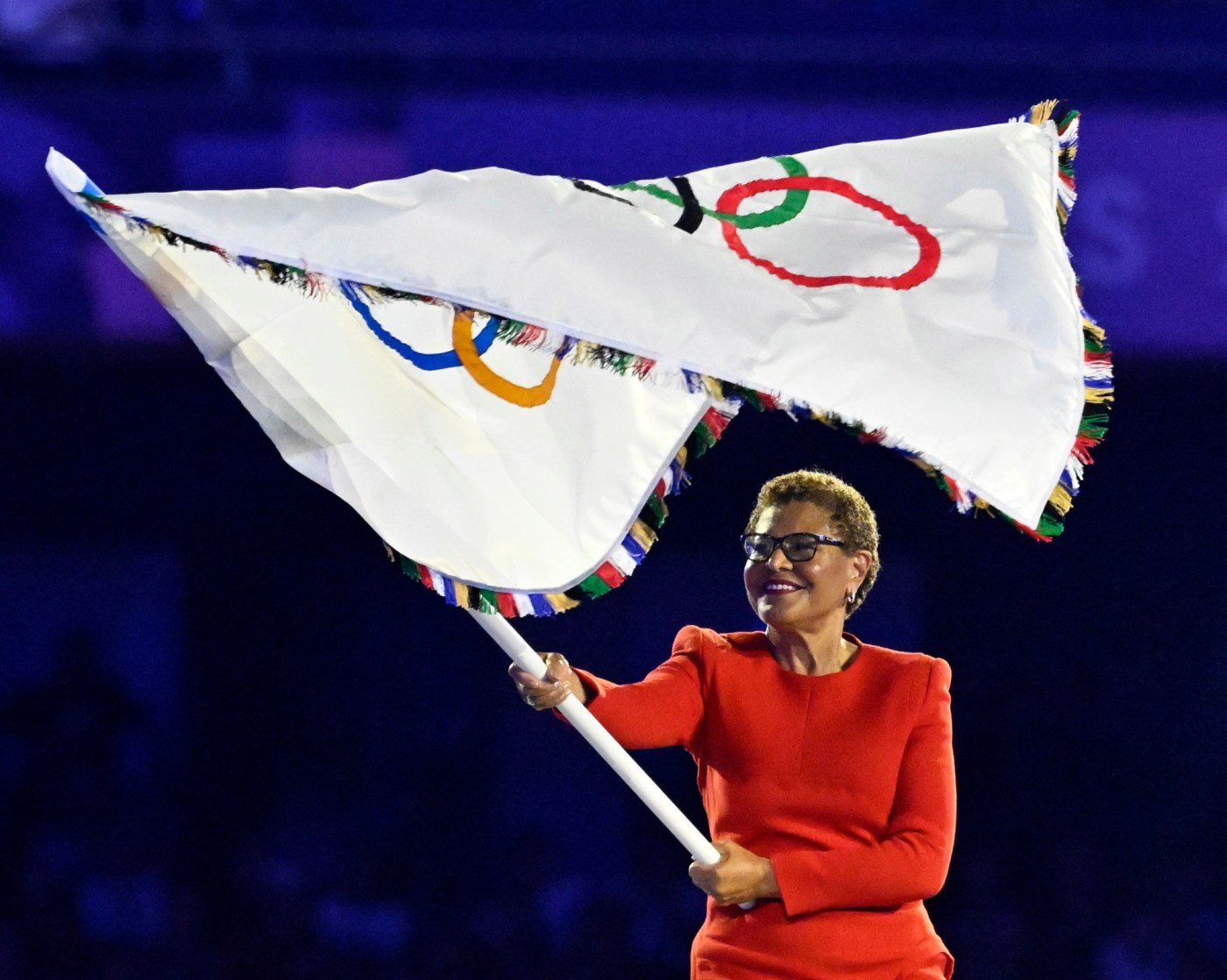
Paris on Sunday night handed the Olympic flag off to Los Angeles Mayor Karen Bass, who on Monday flew it back to California for preparations ahead of the 2028 Games. Bass and LA 2028 chairman Casey Wasserman have acknowledged that the outcome of the November presidential election will have some effect on their Games, but aren’t concerned the winner will create issues for them.
The LA 2028 organizers watched the Paris Games carefully and know they will be closely watched by the public — both to criticize and praise.
“More than anything, what I have learned here, and I give the French team a lot of credit for, is they were willing to do things differently and take chances,” Wasserman said. “It didn’t mean they were all going to be perfect or work, and most of them did, and they’ve been spectacular. But they really thought outside the box, obviously starting with the opening ceremony.”
Wasserman said the approach of Paris organizers has made him step back and ask “how can we do things differently and do things right for our city and our communities?”
“An Olympics are a daunting project, and you need to be willing to take chances and swings, big swings,” Wasserman added. “It’s a good lesson for us to really take a very intentional, thoughtful way, to take some chances on things that we may not have.”
WASHINGTON (AP) — Vice President Kamala Harris has repeatedly taunted her opponent’s seeming reluctance to debate, telling a series of raucous audiences about Donald Trump’s criticisms of her: “As the saying goes, if you’ve got something to say, say it to my face.”
After first backing out of an agreement, Trump reversed himself and said he’d meet Harris on Sept. 10 for an event hosted by ABC. That sets up a long-anticipated faceoff between the Democratic and Republican nominees — and, indeed, the chance for both of them to deliver their attack lines directly at one another.
A former San Francisco district attorney and California attorney general, Harris has long presented her debating prowess as a strength, and her sharp questioning of opponents has produced many a career highlight. But she has also had testy exchanges that didn’t play as well.
“She’s certainly had a good rollout in the past few weeks and that will naturally translate to expectations on the debate stage,” said Aaron Kall, director of the University of Michigan’s debate program. “Part of the problem is, President Biden did so poorly in the first one, there’s no way she could do worse, and so that comparison is not going to help. But her debate history is a mixed bag.”
Trump faces high expectations too. And Biden’s disastrous performance helped obscure that the former president delivered many falsehoods — from lies about the Jan. 6 riot to misleading claims about abortion and immigration — that went unchecked during the debate.
Two Democratic primary moments offer insight into how Harris debates
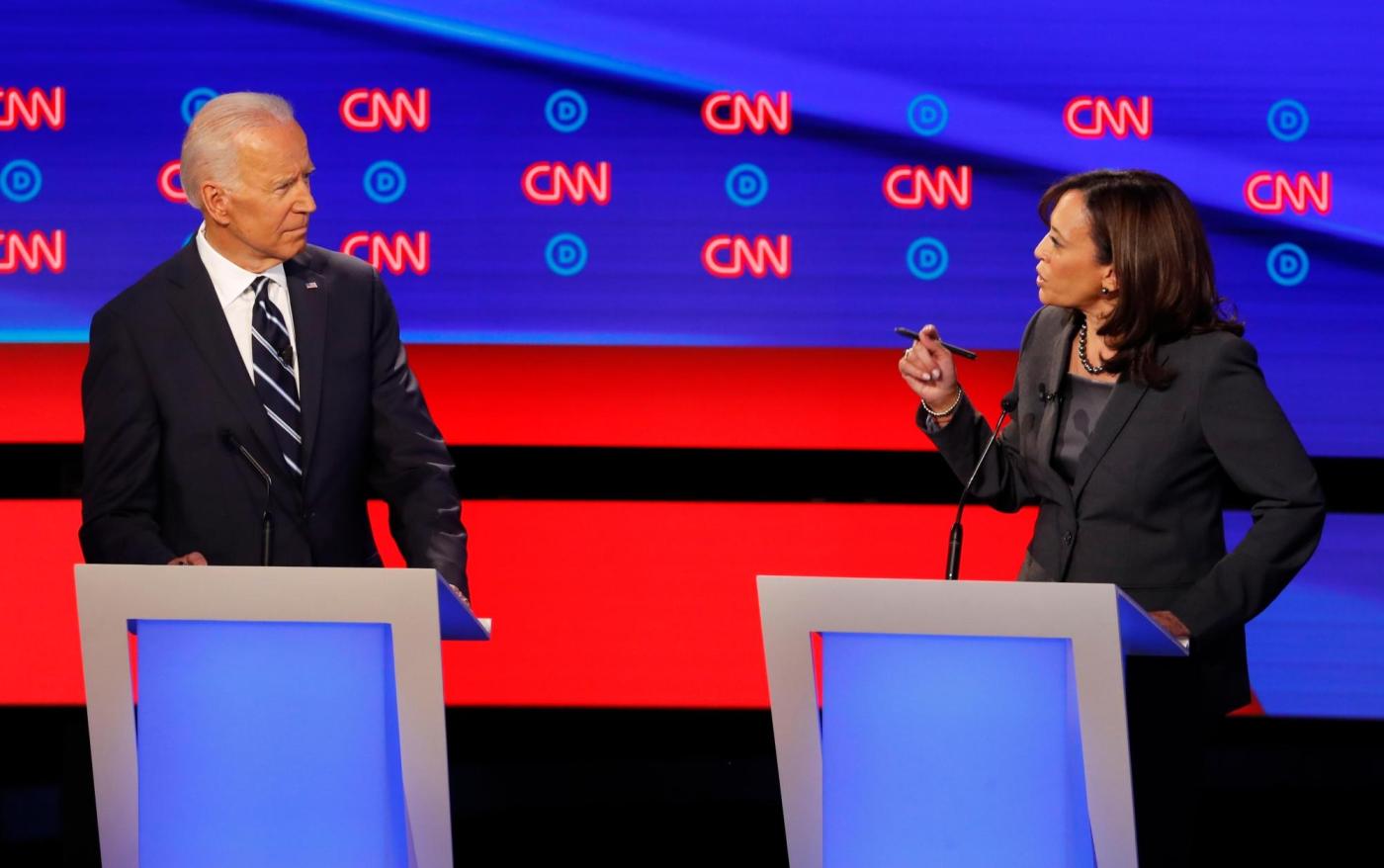
Perhaps the pinnacle of Harris’ short-lived 2020 presidential campaign was a broadside against then-candidate Biden, who later made her his running mate anyway. She seized on Biden opposing busing to integrate public schools in the 1970s by describing a young girl who boarded such buses before offering, “That little girl was me.”
It was memorable but also planned. Harris’ campaign then posted the same phrase on social media over a picture of its candidate as a school-aged girl in pigtails.
But a low moment of Harris’ same campaign came at a subsequent debate. Another rival, former Rep. Tulsi Gabbard of Hawaii, launched a lengthy attack on Harris’ prosecutorial record.
Gabbard said Harris “put over 1,500 people in jail for marijuana violations and then laughed about it when she was asked if she ever smoked marijuana.” With the audience roaring, Gabbard further accused Harris of having “blocked evidence that would have freed an innocent man from death row until the courts forced her to do so.”
Gabbard now says she was surprised that Harris’ record hadn’t been more carefully scrutinized during the primary. She said she uncovered the issues she raised not with opposition research, but by using Google.
“I was surprised at how unprepared she was to respond to them. Just from, you know, I would imagine that you’d prepare before going into a debate,” Gabbard said in an interview. “And also that she made no attempt to deny them or frankly justify them, if she was proud of those decisions.”
“Ultimately this is disrespectful to voters, if she’s not responding to, or addressing, questions about a record that she claims to be proud of,” she added.
In her response on the debate stage, Harris attempted to dismiss Gabbard, saying, “I am proud of making a decision to not just give fancy speeches, or be in a legislative body and give speeches on the floor, but actually doing the work.”
She got even more personal after the debate, calling herself a “top-tier candidate” while suggesting that Gabbard was polling at “0 or 1% or whatever she might be at.” At a subsequent debate, Harris hit back, saying Gabbard had spent years “full time on Fox News criticizing President Obama.”
Ironically, Gabbard, who has served as a Fox News contributor, remained in the presidential race long after Harris had dropped out.
Harris can show defiance in confrontational moments
Sometimes flashing a touch of defiance can work.
Harris first established a national reputation as being especially verbally nimble while questioning Trump’s nominee for attorney general, William Barr, and his pick for the Supreme Court, Brett Kavanaugh.
After Kavanaugh repeatedly sidestepped abortion questions, Harris demanded to know if he could think of “any laws that give the government the power to make decisions about the male body?” forcing Kavanaugh to concede, “I am not thinking of any right now.”
Kall, of the University of Michigan, said Harris’ 2020 debate performance against Republican Vice President Mike Pence was also well-received. Her most memorable line then was probably rebuking Pence’s interruptions by retorting, “Mr. Vice President, I am speaking.”
Meet the press? Hold that thought. The candidate sit-down interview ain’t what it used to be
But she then continued, “I am speaking now,” drawing sustained applause from rallygoers before adding, “If you want Donald Trump to win, then say that. Otherwise, I’m speaking.”
“Abandon Biden,” a progressive group that has opposed the president’s now-defunct reelection bid over his Israel policy, bristled at Harris’ “disdain for citizens of this country who are pleading for an end to a genocide.”
Cullen Tiernan, who was a spokesperson for Gabbard’s 2020 campaign, spent hours in debate prep with the then-congresswoman before the on-stage exchange with Harris. He played one of her other primary rivals, Tim Ryan, and laughed about “coastal elites starting being a big problem for me,” latching onto one of Ryan’s catchphrases.
Now a political activist based in New Hampshire, Tiernan said he saw parallels between Harris’ debate stage reaction to Gabbard’s criticisms and the interruption in Michigan — but not in a good way.
“As a progressive person, I’m looking for change and empathy, and understanding about what’s happening,” he said. “Not gaslighting, and feeling like the reality that is being discussed never existed.”
Gabbard said she hoped a Trump-Harris debate would showcase for voters the huge differences between the candidates.
“Given the history of many presidential elections, unfortunately, political theater is the norm,” she said. “But that substantive debate is really what we need and what we deserve right now.”
Tom Cruise jumps into the stadium during closing ceremonies of the Paris 2024 Olympic Games in Saint-Denis on Sunday, Aug. 11, 2024. (Photo by Keith Birmingham, Orange County Register/ SCNG)
Los Angeles Mayor Karen Bass and Simone Biles gives the Olympic Flag to Tom Cruise during closing ceremonies of the Paris 2024 Olympic Games in Saint-Denis on Sunday, Aug. 11, 2024. (Photo by Keith Birmingham, Orange County Register/ SCNG)
Los Angeles Mayor Karen Bass and Simone Biles gives the Olympic Flag to Tom Cruise during closing ceremonies of the Paris 2024 Olympic Games in Saint-Denis on Sunday, Aug. 11, 2024. (Photo by Keith Birmingham, Orange County Register/ SCNG)
during closing ceremonies of the Paris 2024 Olympic Games in Saint-Denis on Sunday, Aug. 11, 2024. (Photo by Keith Birmingham, Orange County Register/ SCNG)
Athletes jump onto the stage during closing ceremonies of the Paris 2024 Olympic Games in Saint-Denis on Sunday, Aug. 11, 2024. (Photo by Keith Birmingham, Orange County Register/ SCNG)
Athletes jump onto the stage during closing ceremonies of the Paris 2024 Olympic Games in Saint-Denis on Sunday, Aug. 11, 2024. (Photo by Keith Birmingham, Orange County Register/ SCNG)
Athletes jump onto the stage during closing ceremonies of the Paris 2024 Olympic Games in Saint-Denis on Sunday, Aug. 11, 2024. (Photo by Keith Birmingham, Orange County Register/ SCNG)
1 of 7
Tom Cruise jumps into the stadium during closing ceremonies of the Paris 2024 Olympic Games in Saint-Denis on Sunday, Aug. 11, 2024. (Photo by Keith Birmingham, Orange County Register/ SCNG)
SAINT-DENIS, France – In the parlance of the next Summer Olympics host city, Los Angeles’ portion of the Paris Games’ closing ceremony Sunday night was a coming attraction, a global trailer for what International Olympic Committee and local officials hope is the blockbuster hit of the summer of 2028.
“Our chance to give a glimpse to the world of what to expect in 2028,” said sports and entertainment mogul Casey Wasserman, the chairman of LA 28.
So actor Tom Cruise repelled into Stade de France to the theme of “Mission Impossible,” grabbed the Olympic flag, hopped on a motorcycle and rode off through the streets of Paris to an awaiting plane.
“I’m on my way,” Cruise said, talking on a cell phone before boarding the plane in a pre-filmed segment in which he attaches the Olympic rings to the Hollywood sign.
While Cruise’s arrival showed that Los Angeles still knows how to make an entrance it upstaged a moment that was significant in multiple ways.
When Paris mayor Anne Hidalgo presented Karen Bass, the mayor of Los Angeles, accompanied gymnast Simone Biles, the Olympic flag, the first ever such handoff between two female mayors, Los Angeles, seven years after being awarded the city’s third Olympic Games, was officially on the clock.
“It’s both symbolic and historic,” Wasserman said. “But for me and the LA 28 organization, it’s the signification that it is our turn. We are no longer on deck. We are in the batter’s box and ready to go.”
And with all the swagger of Hollywood and emboldened and inspired by the Paris Games, Wasserman and Los Angeles intend to swing for the fences.
“The opportunity to have one of the great sporting cities in the world showcase the greatest sporting event in the world and the place where the world comes to tell their stories,” Wasserman said, “we think is a really powerful opportunity.”
The Paris Olympics have both presented Los Angeles with a tough act to follow and have taken Wasserman and LA 28 off the hook.
“He doesn’t have to save the Olympic movement,” Rick Burton, a Syracuse sports marketing professor and the former chief marketing officer for the U.S. Olympic and Paralympic Committee, said of Wasserman.
Paris took care of that.
The first Games not held in COVID-forced isolation since 2018, Paris rebooted – many would indeed say saved – an Olympic movement undercut by decades of corruption, sexual abuse and doping scandals, widespread criticism that the IOC in doing business with authoritarian regimes in Russia and China has prioritized its bottom line over human rights abuses, and the billions in cost overruns by host cities with a trail of white elephant venues stretching from Sydney to Athens to Sochi that became obsolete almost from the moment the Olympic flame was extinguished.
Parisian venues were sold out from track and field to gymnastics to table tennis. Paris sold an Olympic record 8.6 million tickets, generating $2.83 billion. The opening ceremony drew 28.6 million viewers across the NBC and Peacock platforms, up significantly from the 17.9 million who tuned into Tokyo’s opening night three years earlier. If the 17-day Olympics were an original series they would have been the summer’s second most-watched series, averaging 33 million viewers per day.
“The appeal of these games has been absolutely undeniable in every metric, viewership engagement, tickets,” Wasserman said, “and that provides a great deal of momentum for us as we head to Los Angeles in just four years.”
Those numbers were driven by a galaxy of generational stars. Cruise was far from the biggest superhero to land in Paris. It only seemed like Biles could leap tall buildings in a single bound on her way to winning gold medals in the all-around, vault and team competition and further cementing her as history’s greatest gymnast.
Hometown hero Leon Marchand gave the French plenty to cheer about, capturing five swimming medals, four of them gold. Marchand won the 200 butterfly and 200 breaststroke in less than two hours, becoming the first Olympic swimmer to win two individual events on the same day since 1976.
“A full stadium every day, both morning and evening sessions, countries winning their first-ever Olympic gold medals, incredible performances, shock upsets, world and Olympic records, three marriage proposals, a couple of GOATs and a Snoop Dogg,” said Jamie Fox, director of communications for World Athletics, track and field’s global governing body, referring to the rapper ever-present on NBC.
But the real hero of these Games was Paris itself and the most iconic and historic settings and venues in Olympic history, all them anchored by the Eiffel Tower from which the five Olympic rings lit up the city each night.
“The truth north of these Olympic Games, being Games wide open,” Wasserman said, “I think really opened the eyes of the world to how spectacular the Olympics are and how successful they have been, not just in the city of Paris but for the whole world to experience. The appeal of these Games has been absolutely undeniable.”
The lesson of the Paris Olympics, he said, is to not be afraid to take chances.
Dozens of LA 28, Los Angeles city, county and state officials spent the Games shadowing Paris 2024, local and national government and law enforcement officials in preparation for the 2028 Games which open July 14.
“Bastille Day,” Wasserman said laughing.
“What I learned here and I give the French team a great deal of credit for is they were willing to do things differently and take chances and it didn’t mean they were all going to be perfect or work, although most of them did,” Wasserman said. “But they really thought outside the box, obviously starting with the opening ceremonies, which was spectacular, but in every facet of their delivery they took a step back and said how can we do things differently and do things that’s right for our city and our communities and it’s not the way that other Games have done them. They were doing it for them and I give them a lot of credit because the easy thing to do has been to do what has been done before.
“But they have taken chances and those chances have been rewarded. And they have been spectacular and I still think it’s incumbent upon us in an appropriate way for Los Angeles to think about what we can do to do things differently for our communities in our city.”
For Los Angeles that means working within a $6.8 billion budget with a $615.8 million contingency fund in case the Games are postponed or canceled, adding sports like cricket, lacrosse and flag football to Olympics that will be held almost exclusively at existing or previously planned venues and holding to what Bass vowed would be “No Cars Games,” despite the region’s lack of a mass public transportation system comparable to recent Summer Olympic hosts like Paris, Tokyo and London.
“As we’ve seen here in Paris, the Olympics are an opportunity to make transformative change,” Bass said. “It’s our top priority to ensure that the Olympic preparations benefit Angelenos for decades.”
While LA 28 will submit an updated budget to the city later this year, the organizing committee has a projected goal of generating $2.5 billion in domestic sponsorship revenue, and Wasserman has said that the 2028 Games have already attracted more contracted revenue from sponsors such as Coca Cola, Delta and Visa than the Paris Games will have in total revenue.“American sponsors are coming back in and wanting to be part of the movement,” Burton said.
In naming Los Angeles host of the 2028 Games in September 2017 as part of an unprecedented double award in which Paris received the 2024 event, the IOC agreed to pay LA 2028 at least $2 billion, up from $1.7 billion had the city hosted the 2024 Games and the largest payout ever to an Olympic host city.
As part of that agreement, the IOC paid LA 28 $180 million up front in 20 quarterly $9 million payments starting on January 1, 2018.”We feel very good about where we are today,” Wasserman said. “And it’s our job to stay really diligent.”
Longtime Olympic observers and sports economists are optimistic that LA 28 will stay within its budget.
“There’s a potential problem of mission creep, that’s the military version of it, or the upgrades creep,” said Victor Matheson, a Holy Cross economics professor who has written extensively on Olympic finances.
“That’s the concern and we’re hoping that LA stays with its good reputation of having actual competent and rational people running the Games like Ueberroth did back in the old days,” Matheson continued, referring to Peter Ueberroth, chairman of the 1984 Los Angeles Olympic organizing committee. “The initial numbers look pretty good but again, just like in Paris, what remains to be seen is do those good numbers finally hold up when the final books are closed?
“At least they’ve got a shot. You don’t have anybody over there saying, ‘Oh, you know what would be really cool is a permanent 80,000 stadium just for track? Don’t think that would be cool?’ We’re not even getting a hint of that.”
LA 28 has used that money to help fund a $160 million youth sports program in Los Angeles, what Wasserman calls “the single biggest investment in youth sports in the history of America in one city.”
“Your zip code is no longer a barrier to entry to participate in sports,” he said.
The federal government will pick up the cost of security, which is expected to exceed $2 billion. The Games received national special security event designation last January.
LA 28 will borrow a page from the London Games in 2012 and use local sporting events as dry runs to train both law enforcement and the military and educate the public on what to expect security-wise at the Olympics. In London’s case, they used a day at Wimbledon a year earlier for a dry run for security and the public.
“So just to be ready we could take a Dodgers game and enact on a Thursday night in 2027 and tell people what it’s going to be like so that we can practice,” Wasserman said, “They can practice and we can learn.”
The 2028 Games will only be accessible by public transportation. While the region continues to expand its public transportation lines and hubs, Bass acknowledged “that’s not going to be enough. We’re going to need over 3,000 buses.”
A significant portion of those buses – and their drivers – will come from other U.S. cities. Atlanta implemented a similar program for the 1996 Games with mixed results.
Paris, following an approach taken by previous Olympic host cities, removed the homeless from the city during the Games. Bass didn’t directly answer when asked in Paris if Los Angeles would implement a similar program in 2028.
Los Angeles County reported 75,518 homeless persons in 2023, a nine percent year-over-year increase with the City of Los Angeles reporting 46,210 homeless, a 10 percent increase, according to the Los Angeles Homeless Security Authority.
“We are going to get Angelenos housed,” Bass said. “That is what we have been doing and we’re going to continue to do that. We will get people housing, we will get them off the street. We will get them into temporary housing, address the reasons why they are unhoused and get them into permanent housing.”
After Paris Olympics shined, Los Angeles in 2028 brings new and returning sports, plus a fresh look
Bass will board a Delta flight Monday for LAX, the Olympic flag now in her care, with the lessons of 17 glorious days in Paris and the knowledge that any issue facing Los Angeles will be played out on a global stage and that the clock is ticking.
“The day after the Olympics and everybody is back in town and they roll up their sleeves it’s going to be about is A) Is there anything to be gleaned from Paris and then B), Let’s go,” said David M. Carter, a sports marketing professor at USC’s Marshall School of business and founder of the Sports Business Group, a sports and entertainment consulting firm. “We need to start hiring. We need to start getting these Games in the right position and I think they’ve got a lot of this at the gate.
“The day afterwards is where they’ve been at for years, it’s just that it’s going to go from a jog to a sprint.”
Wasserman said he is ready.
“So we’ve learned a lot here,” he said Saturday. “We are focused on the road ahead. It’s about 14,135 days to the opening ceremonies. But who’s counting?”
The Paris Olympics have brought some joie de vivre to NBCUniversal.
For the first 13 days of the Games, the Comcast Corp.-owned media company averaged 32.2 million viewers across its TV and streaming platforms, according to data from Nielsen and Adobe Analytics. The figure combines the live coverage shown during the day and the taped highlights telecast and streamed in the evening.
The Paris number is 76% higher than the audience for the Games in Tokyo, which were delayed a year and held in 2021 because of the COVID-19 pandemic. Olympics content streamed on NBC’s Peacock platform surpassed 19.1 billion minutes viewed, more than the 16.8 billion minutes watched on the service for all previous Olympics, winter and summer, combined.
After Paris Olympics shined, Los Angeles in 2028 brings new and returning sports, plus a fresh look
At that time, the pandemic still loomed large and the biggest U.S. star, gymnast Simone Biles, departed early from much of the competition due to mental health issues. Those who competed did so in front of empty spectator stands, depriving viewers of the emotion and passion that family members and fans provide during the Games.
In 2021, NBC had to give commercial time away to advertisers when the ratings came in lower than expected. The network typically holds back commercial time in the event that audience levels fall short of what brands are promised.
But this year, the ratings performance exceeded NBC’s expectations, and the network is reaping the benefits.
NBC was able to sell its reserve of commercials at an even higher price than the inventory purchased before the Games began. Among the major takers was the presidential campaign of Vice President Kamala Harris, who abruptly became the presumptive Democratic nominee last month and needs to quickly introduce herself to the public.
“It’s a nice piece of business for us,” Lazarus said in a telephone interview.
Eliud Kipchoge of Team Kenya, Gabriel Gerald Geay of Team Tanzania, Jie He and Shahoui Yang of Team People’s Republic of China run past Eiffel Tower during the Men’s Marathon during day fifteen of the Olympic Games Paris 2024 at Esplanade Des Invalides on August 10, 2024 in Paris, France. (Photo by David Ramos/Getty Images)
The additional sales helped push NBC’s ad revenue well past the previous record of $1.25 billion it took in during 2021. The final number for Paris will be the largest ad revenue take for any TV event in history, an NBC representative said. (Super Bowl Sundays typically generate about $1 billion for the network carrying the game.)
NBC may have been fortunate that the Paris Olympics came along at a time when a deeply politically divided country could use a break.
Two weeks before the Games began, former President Donald Trump barely escaped an assassination attempt at a Pennsylvania rally. Not long after, President Joe Biden made the stunning decision to pull out of his reelection campaign. Tensions are running high over Israel’s war with Hamas, creating fear over a larger military conflict in the Middle East.
Brent Magid, chief executive of the media research firm Magid, said a celebratory collective viewing experience may have been just what the public needed.
“The Olympics are an in-the-moment activity that happens to be very positive in a world that is thinking very negatively,” Magid said. “Consumers are looking for escape in their lives and this brings it in spades.”
A general view as inside the stadium as athletes participate in the parade during the Closing Ceremony of the Olympic Games Paris 2024 at Stade de France on August 11, 2024 in Paris, France. (Photo by Luke Hales/Getty Images)
Having the City of Lights as a backdrop also helped. Athletes have been shown having fun on their off days, cheering on their competing comrades and hanging out with the network’s breakout Olympics coverage star, Snoop Dogg. Celebrities from Tom Brady to Lady Gaga have turned up in the crowd.
Peacock, which trails other major streaming platforms with around 34 million subscribers, is a major beneficiary from the success. NBC Sports President Rick Cordella said new subscribers sign-ups have surpassed expectations, although the company has not revealed that number yet.
Peacock streamed every sport live, including all 329 medal events. NBCUniversal enhanced the Peacock streaming experience by offering exclusive elements such as the addictive “Gold Zone” feature, which guided users to decisive moments in a variety of events as they happened, sometimes using multiple boxes on the screen.
Shamier Little, Sydney McLaughlin-Levrone, Gabrielle Thomas and Alexis Holmes of Team United States celebrate winning the Gold medal in the Women’s 4 x 400m Relay Final on day fifteen of the Olympic Games Paris 2024 at Stade de France on August 10, 2024 in Paris, France. (Photo by Patrick Smith/Getty Images)
Making a multitude of events available on demand satisfied the streaming audience that wanted the choice and convenience of on-demand viewing. But the Games’ performance also proved that people will show up for traditional TV if there is compelling drama they have to see in real time.
The gold-medal-winning performance of Biles and the U.S. women’s gymnastic team was watched by 12.7 million people across NBC’s platforms on July 30, even though it ran smack in the middle of the workday. The figure was an all-time high for a daytime Olympics event and topped the average audience for this year’s NBA Finals, which aired in prime time on ABC.
The number may have been helped by a behavioral shift left over from the COVID-19 lockdowns. More people are working at home — and what’s the harm of having some gymnastics playing in the background?
“It’s the content that’s precious, not the time of day,” said Lazarus. “If you exhibit in a way that’s interesting, people will show up.”
A general view of the Paris 2024 Olympic Games Cauldron, air balloon prior to the Closing Ceremony of the Olympic Games Paris 2024 at Stade de France on August 11, 2024 in Paris, France. (Photo by Maja Hitij/Getty Images)
John Rood, chief marketing officer for Magid, said consumers’ willingness to turn on the TV at all hours will continue to benefit the Olympics as time goes on. “One’s ability to watch on their laptop or phone is only going to get more common in every passing four-year span,” he said.
NBCUniversal has the rights to the Games through 2032. The next Summer Games will be held in Los Angeles in 2028. The next Winter Games are in Milan in 2026.
Gymnastics has long been a strong draw for female viewers. But the Paris Olympics may also be benefiting from an overall increase in interest in women’s sports.
The wild popularity of Caitlin Clark, now with the WNBA, helped drive a record audience of 17 million viewers for NCAA women’s basketball championship game in March. (Clark’s exclusion from the women’s U.S. Olympic basketball team became a national topic of discussion.)
A Magid study conducted that same month showed that 60% of consumers said they are paying more attention to women’s professional sports. The figure was 57% for women’s college sports.
Karen Bass, Mayor of Los Angeles, waves the Olympic flag as Thomas Bach, President of International Olympic Committee, applauds during the Closing Ceremony of the Olympic Games Paris 2024 at Stade de France on August 11, 2024 in Paris, France. (Photo by Carl Recine/Getty Images)
NBC was also able to integrate entertainment figures into its Olympics coverage without generating a lot of pearl-clutching from sports purists. It helped the network deliver audiences of 13 million or higher in prime time, even though all of the competition shown was on tape.
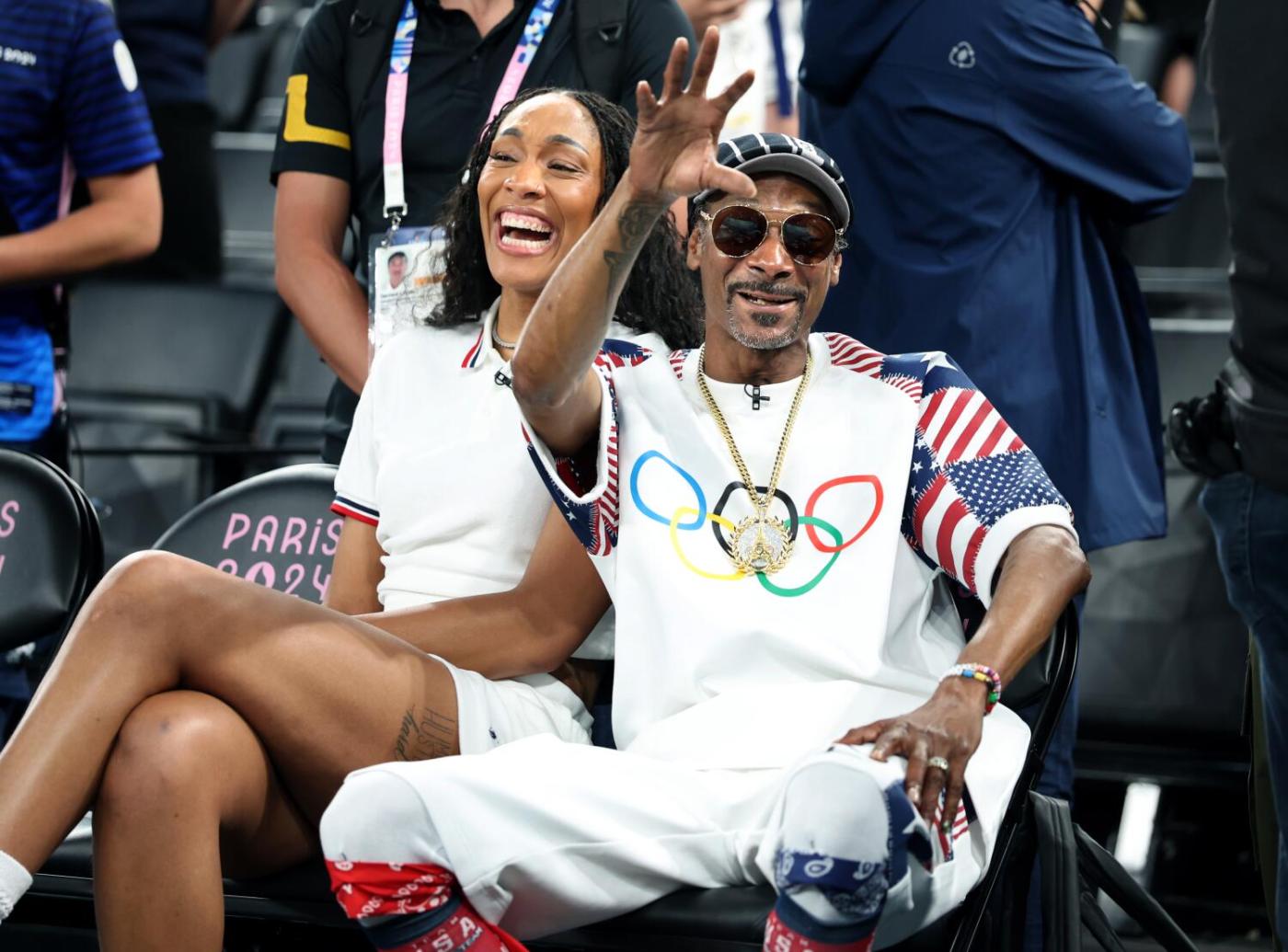
Viewers embraced Snoop Dogg’s feel good vibe as he wandered through the events as the No. 1 U.S. Olympics team cheerleader. His role is long in the making.
The legendary rapper was part of the network’s Tokyo coverage in 2021. He has also developed a relationship with NBC by co-hosting a competition series, “The Great American Song Contest,” and serving as a coach on the upcoming season of “The Voice.”
Executive producer Molly Solomon and her team saw the potential to expand his role this year. “He obviously came these Olympics with an enthusiastic optimistic point of view,” said Lazarus. “Molly Solomon calls him the ambassador of happiness.”