Masked agents, face scans and a question: Are you a citizen? Inside Trump’s Minnesota crackdown

posted in: All news | 0

By GARANCE BURKE and BYRON TAU, Associated Press

Luis Martinez was on his way to work on a frigid Minneapolis morning when federal agents suddenly boxed him in, forcing the SUV he was driving to a dead stop in the middle of the street.

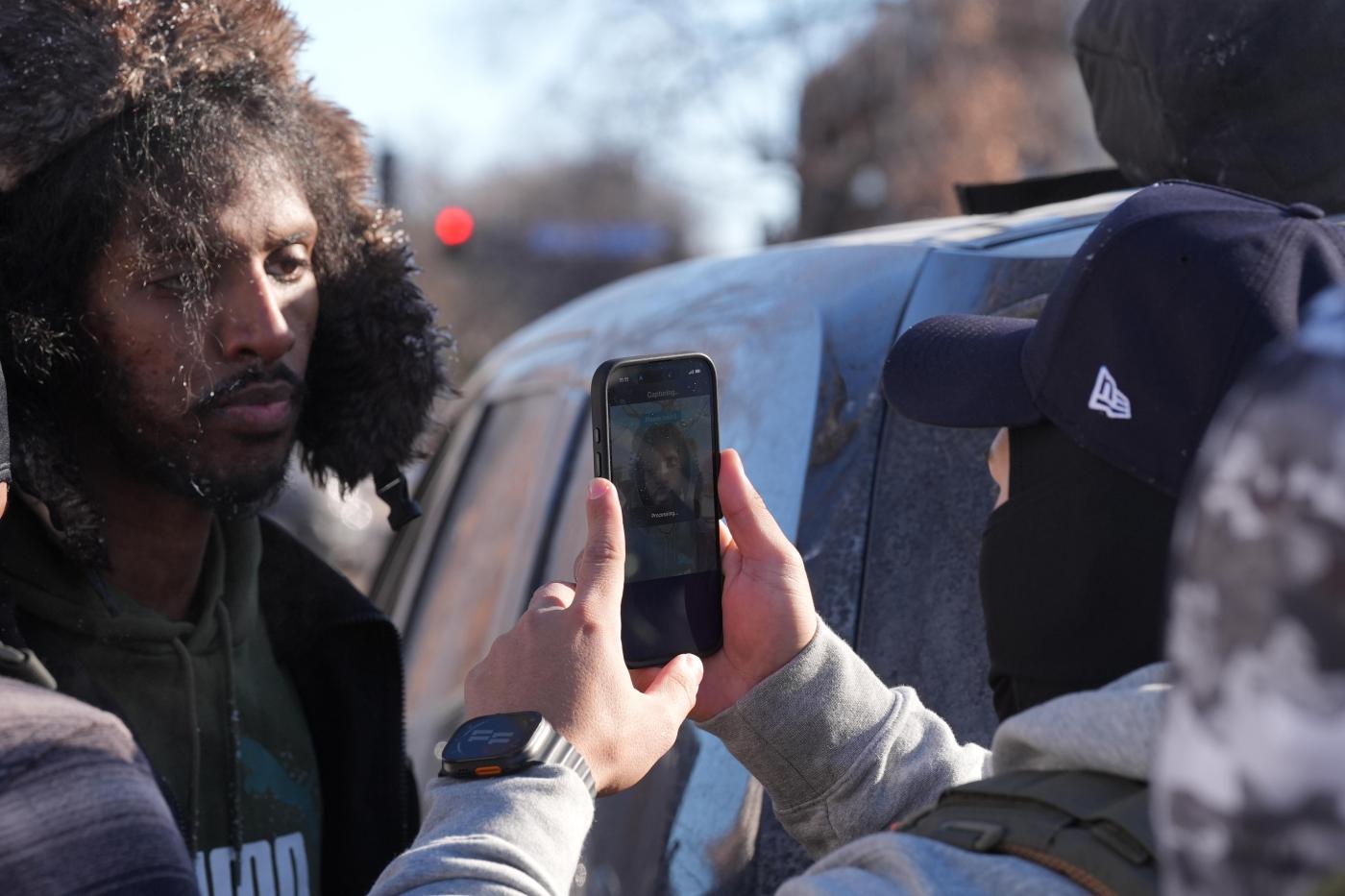
Masked agents rapped on the window, demanding Martinez produce his ID. Then one held his cellphone inches from Martinez’s face and scanned his features, capturing the shape of his eyes, the curves of his lips, the exact quadrants of his cheeks.

All the while, the agent kept asking: Are you a U.S. citizen?

A federal agent uses a facial recognition app during a traffic stop on a person on Tuesday, Jan. 27, 2026, in Minneapolis. (AP Photo/Adam Gray)

The encounter in a Minneapolis suburb this week captures the tactics on display in the Trump administration’s immigration crackdown in Minnesota, which it describes as the largest of its kind and one that has drawn national scrutiny after federal agents shot and killed two U.S. citizens this month.

Across Minnesota and other states where the Department of Homeland Security has surged personnel, officials say enforcement efforts are targeted and focused on serious offenders. But photographs, videos and internal documents paint a different picture, showing agents leaning heavily on biometric surveillance and vast, interconnected databases — highlighting how a sprawling digital surveillance apparatus has become central to the Trump administration’s immigration crackdown.

Civil liberties experts warn the expanding use of those systems risks sweeping up citizens and noncitizens alike, often with little transparency or meaningful oversight.

Over the past year, Homeland Security and other federal agencies have dramatically expanded their ability to collect, share and analyze people’s personal data, thanks to a web of agreements with local, state, federal and international agencies, plus contracts with technology companies and data brokers. The databases include immigration and travel records, facial images and information drawn from vehicle databases.

In Martinez’s case, the face scan didn’t find a match and it wasn’t until he produced his U.S. passport, which he said he carried for fear of such an encounter, that federal agents let him go.

“I had been telling people that here in Minnesota it’s like a paradise for everybody, all the cultures are free here,” he said. “But now people are running out of the state because of everything that is happening. It’s terrifying. It’s not safe anymore.”

Together with other government surveillance data and systems, federal authorities can now monitor American cities at a scale that would have been difficult to imagine just a few years ago, advocates say. Agents can identify people on the street through facial recognition, trace their movements through license-plate readers and, in some cases, use commercially available phone-location data to reconstruct daily routines and associations.

When asked by The Associated Press about its expanding use of surveillance tools, the Department of Homeland Security said it would not disclose law enforcement sensitive methods.

“Employing various forms of technology in support of investigations and law enforcement activities aids in the arrest of criminal gang members, child sex offenders, murderers, drug dealers, identity thieves and more, all while respecting civil liberties and privacy interests,” it said.

Dan Herman, a former Customs and Border Protection senior adviser in the Biden administration who now works at the Center for American Progress, said the government’s access to facial recognition, other personal data and surveillance systems poses a threat to people’s privacy rights and civil liberties without adequate checks.

“They have access to a tremendous amount of trade, travel, immigration and screening data. That’s a significant and valuable national security asset, but there’s a concern about the potential for abuse,” Herman said. “Everyone should be very concerned about the potential that this data could be weaponized for improper purposes.”

Facial recognition

On Wednesday, DHS disclosed online that it has been using a facial recognition app, Mobile Fortify, that it said uses “trusted source photos” to compare scans of people’s faces that agents take to verify their identity. The app, which Customs and Border Protection said is made by the vendor NEC, uses facial comparison or fingerprint-matching systems.

Related Articles


Today in History: January 30, Catholic civil rights marchers killed on ‘Bloody Sunday’


Former First Brands CEO Patrick James and his brother are indicted for bilking billions from banks


Owner of Johnny Rockets, Fatburger files for bankruptcy


Scientists marvel at a Galapagos seabird that wandered 3,000 miles to California


Newborn calf struggling in deep freeze brought indoors to curl up on couch

The app was in operation for CBP and ICE before the immigration crackdown in the Los Angeles area in June, when website 404Media first reported its existence.

In interactions observed by reporters and videos posted online, federal agents are rarely seen asking for consent before holding their cellphones to people’s faces, and in some clips they continue scanning even after someone objects.

In two instances seen by an AP journalist near Columbia Heights, Minnesota, where immigration officials recently detained a 5-year-old boy and his father, masked agents held their phones a foot away from people’s faces to capture their biometric details.

The technology resembles facial recognition systems used at airports, but unlike airport screenings, where travelers are typically notified and can sometimes opt out, Martinez said he was given no choice.

According to a lawsuit filed against DHS by the state of Illinois and the city of Chicago this month, DHS has used Mobile Fortify in the field more than 100,000 times. The Department of Homeland Security told AP that Mobile Fortify supports “accurate identity and immigration-status verification during enforcement operations. It operates with a deliberately high-matching threshold,” and uses only some immigration data.

Without federal guidelines for the use of facial recognition tools, the U.S. Commission on Civil Rights warned in a September 2024 report their deployment raises concerns about accuracy, oversight, transparency, discrimination and access to justice.

Body-camera footage

Last year, the Trump administration scaled back a program to give Immigration and Customs Enforcement officials body cameras, but administration officials said some agents tied to the fatal shooting of Minneapolis ICU nurse Alex Pretti were wearing them and that footage is now being reviewed.

Gregory Bovino, who was the administration’s top Border Patrol official charged with the immigration crackdown in Minneapolis until Monday, began wearing a bodycam in response to a judge’s order late last year.

Body-camera video could help clarify events surrounding federal agents’ killing of Pretti, who was filming immigration agents with his cellphone when they shot him in the back.

Administration officials shifted their tone after i ndependent video footage emerged raising serious questions about some Trump officials’ accusations that Pretti intended to harm agents.

Emerging technologies

Homeland Security and affiliated agencies are piloting and deploying more than 100 artificial intelligence systems, including some used in law enforcement activities, according to the department’s disclosure Wednesday.

Congress last year authorized U.S. Customs and Border Protection to get more than $2.7 billion to build out border surveillance systems and add in AI and other emerging technologies.

In recent weeks, DHS requested more information from private industry on how technology companies and data providers can support their investigations and help identify people.

Meanwhile, longtime government contractor Palantir was paid $30 million to extend a contract to build a system designed to locate people flagged for deportation. On Wednesday, the Trump administration disclosed it’s using Palantir’s AI models to sift through immigration enforcement tips submitted to its tip line.

DHS has also been exploring partnerships with license-plate reader companies like Flock Safety to expand their tracking capabilities.

Rachel Levinson-Waldman, who directs the Brennan Center for Justice’s Liberty and National Security Program, said more funding for government surveillance tools changes the landscape.

“We are developing these technologies for immigrant enforcement,” she said. “Are we also going to expand it or wield it against U.S. citizens who are engaging in entirely lawful or protest activity?”

AP freelance photojournalist Adam Gray contributed to this report from Minneapolis.
Senate leaders scramble to save bipartisan deal and avert partial government shutdown at midnight

posted in: All news | 0

By MARY CLARE JALONICK, Associated Press

WASHINGTON (AP) — Senate leaders were scrambling to save a bipartisan spending deal and avert a partial government shutdown at midnight Friday as Democrats have demanded new restrictions on federal immigration raids across the country.

Democrats struck a rare deal with President Donald Trump Thursday to separate funding for the Homeland Security Department from a broad government spending bill and fund it for two weeks while Congress debates curbs on the U.S. Immigration and Customs Enforcement agency. The deal came as irate Democrats had vowed to vote against the entire spending bill and trigger a shutdown in the wake of the deaths of two protesters at the hands of federal agents in Minneapolis.

“Republicans and Democrats have come together to get the vast majority of the government funded until September” while extending current funding for Homeland Security, Trump said in a social media post Thursday evening. He encouraged members of both parties to cast a “much needed Bipartisan ‘YES’ vote.”

President Donald Trump gestures before the premiere of first lady Melania Trump’s movie “Melania” at The John F. Kennedy Memorial Center For The Performing Arts, Thursday, Jan. 29, 2026, in Washington. (AP Photo/Allison Robbert)

Trump had said earlier in the day that “we don’t want a shutdown.”

Still, passage of the agreement was delayed late Thursday as Senate leaders were still working to win enough support for the package.

Leaving the Capitol just before midnight Thursday after hours of negotiations, Senate Majority Leader John Thune said there were “snags on both sides” as he and Democratic leader Chuck Schumer tried to work through any objections that could delay passage past the Friday deadline.

FILE— Senate Minority Leader Chuck Schumer, D-N.Y., waits to speak to reporters following a closed-door meeting with fellow Democrats on spending legislation that funds the Department of Homeland Security and a swath of other government agencies as the country reels from the deaths of two people at the hands of federal agents in Minneapolis, at the Capitol in Washington, Wednesday, Jan. 28, 2026. (AP Photo/J. Scott Applewhite, File)

“Hopefully people will be of the spirit to try and get this done tomorrow,” Thune said as the Senate was scheduled to reconvene on Friday.

Sen. Lindsey Graham, R-S.C., said late Thursday that he was one of the senators objecting. He said ICE agents were being treated unfairly and he opposed House language repealing a new law that gives senators the ability to sue the government for millions of dollars if their personal or office data is accessed without their knowledge.

Rare bipartisan talks

The unusual bipartisan talks between Trump and Schumer, his frequent adversary, came after the fatal shooting of 37-year-old Alex Pretti in Minnesota over the weekend and calls by senators in both parties for a full investigation. Schumer called it “a moment of truth.”

“What ICE is doing, outside the law, is state-sanctioned thuggery and it must stop,” Schumer said Thursday. “Congress has the authority — and the moral obligation — to act.”

The standoff has threatened to plunge the country into another shutdown, just two months after Democrats blocked a spending bill over expiring federal health care subsidies. That dispute closed the government for 43 days as Republicans refused to negotiate.

That shutdown ended when a small group of moderate Democrats broke away to strike a deal with Republicans, but Democrats are more unified this time after the fatal shootings of Pretti and Renee Good by federal agents.

Republicans were more willing to make a deal, as well, as several of them said they were open to new restrictions after the two fatal shootings.

Democrats lay out demands

Democrats have laid out several demands, asking the White House to “end roving patrols” in cities and coordinate with local law enforcement on immigration arrests, including requiring tighter rules for warrants.

They also want an enforceable code of conduct so agents are held accountable when they violate rules. Schumer said agents should be required to have “masks off, body cameras on” and carry proper identification, as is common practice in most law enforcement agencies.

Earlier on Thursday, Tom Homan, the president’s border czar, stated during a press conference in Minneapolis that federal immigration officials are developing a plan to reduce the number of agents in Minnesota, but this would depend on cooperation from state authorities.

Still far apart on policy

If the deal moves forward, negotiations down the road on a final agreement on the Homeland Security bill are likely to be difficult.

Democrats want Trump’s aggressive immigration crackdown to end. “If the Trump administration resists reforms, we shut down the agency,” said Connecticut Sen. Richard Blumenthal.

But Republicans are unlikely to agree to all of the Democrats’ demands.

North Carolina Sen. Thom Tillis said he is opposed to requiring immigration enforcement officers to show their faces, even as he blamed Homeland Security Secretary Kristi Noem for decisions that he said are “tarnishing” the agency’s reputation.

“You know, there’s a lot of vicious people out there, and they’ll take a picture of your face, and the next thing you know, your children or your wife or your husband are being threatened at home,” Tillis said.

Graham said some of the Democratic proposals “make sense,” such as better training and body cameras. Still, he said he was putting his Senate colleagues “on notice” that if Democrats try to make changes to the funding bill, he would insist on new language preventing local governments from resisting the Trump administration’s immigration policies.

“I think the best legislative solution for our country would be to adopt some of these reforms to ICE and Border Patrol,” Graham posted on X. But he said that the bill should also end so-called “sanctuary city” policies.

Uncertainty in the House

Across the Capitol, Speaker Mike Johnson, R-La., told The Associated Press on Thursday that he had been “vehemently opposed” to breaking up the funding package, but “if it is broken up, we will have to move it as quickly as possible. We can’t have the government shut down.”

Related Articles


FACT FOCUS: A look at false and misleading claims made during Trump’s first Cabinet meeting of 2026


Jury finds Wisconsin man guilty of forging threat against Trump to get witness deported


Trump threatens tariffs on any country selling oil to Cuba, a move that puts pressure on Mexico


Trump threatens Canada with 50% tariff on aircraft sold in US, expanding trade war


Trump’s pick to lead the NSA vows to follow the law if confirmed

On Thursday evening, at a premiere of a movie about first lady Melania Trump at the Kennedy Center, Johnson said he might have some “tough decisions” to make about when to bring the House back to Washington to approve the bills separated by the Senate, if they pass.

“We’ll see what they do,” Johnson said.

House Republicans have said they do not want any changes to the bill they passed last week. In a letter to Trump on Tuesday, the conservative House Freedom Caucus wrote that its members stand with the Republican president and ICE.

“The package will not come back through the House without funding for the Department of Homeland Security,” they wrote.

Associated Press writers Lisa Mascaro, Kevin Freking, Stephen Groves, Joey Cappelletti, Seung Min Kim, Michelle L. Price and Darlene Superville contributed to this report.

Timberwolves wear ‘Stand with Minnesota’ warm-up shirts to support community they love

posted in: All news | 0

As the Timberwolves ran out onto the Target Center floor for pre-game warmups ahead of Thursday’s win over the Thunder, they all did so sporting black warm-up shirts that read “Stand with Minnesota” in response to this month’s tragic losses of Renée Good and Alex Pretti, who were both shot to death by federal immigration officers.

“We’re just having our city’s back,” Wolves wing Jaden McDaniels said. “The stuff we’re going through right now, it’s hard for everyone, not just the people outside. Making sure we can show our support in any way.”

The team put out a statement on behalf of the players that read:

“We, the Minnesota Timberwolves players, extend our sincere sympathies and love to everyone across the Twin Cities and throughout Minnesota who has been affected by the recent tragic events impacting our communities. Minnesota is strongest when we uplift and support one another, and there is no room for hatred or division across our great state or among all who live here.

“We mourn the lives lost and send strength, peace and compassion to all who are hurting. We believe in the resilience, unity and care that defines Minnesotans and brings our communities together in times of hardship and need.”

The shirts and statement both echoed similar sentiments to what players had shared over the past week — nothing divisive or political, but rather their support for the community they both live in and love.

“Since I’ve been a rookie, the people have embraced me, always wanted to see me succeed,” McDaniels said. “Just giving back (to the community), showing my face is always pretty cool. It’s pretty fun for me as well just meeting high school kids, younger kids. Every year, there’s always a kid I’ve seen or met before, so it’s not like it’s brand new to me. It’s kind of like having a family outside of my family.”

“I like to call it one love, because everybody is so supportive of each other,” Naz Reid said. “They were supportive of me when I came in. Nobody knew who I was, and everybody was so supportive of how hard that I worked. I can only imagine what it looks like from the outside looking in. The support system is huge here, and it’s always, always been love. … Just going into the outside world, people always dedicate themselves to one another, they care for each other so much. Being here for seven years, I feel like this is home away from home. I’ve always felt love here. I want to try to give as much love as I can back to the city.”

“Man, I just love Minnesota, all the love and support that they show me,” Anthony Edwards said. “So I’m behind with whatever they with.”

Related Articles


Timberwolves blitz Thunder: Takeaways from Minnesota’s third straight win


Frederick: If Timberwolves can add Giannis Antetokounmpo, they should


Mavericks pose little threat for Timberwolves


Report: Bucks listening to trade offers for superstar Giannis Antetokounmpo


When the Timberwolves defend, they win. The numbers to prove it

Today in History: January 30, Catholic civil rights marchers killed on ‘Bloody Sunday’

posted in: All news | 0

Today is Friday, Jan. 30, the 30th day of 2026. There are 335 days left in the year.

Today in history:

On Jan. 30, 1972, 13 Catholic civil rights marchers were shot and killed by British soldiers in Northern Ireland on what became known as “Bloody Sunday.”

Also on this date:

In 1649, England’s King Charles I was executed for high treason.

Related Articles


Former First Brands CEO Patrick James and his brother are indicted for bilking billions from banks


Owner of Johnny Rockets, Fatburger files for bankruptcy


Scientists marvel at a Galapagos seabird that wandered 3,000 miles to California


Newborn calf struggling in deep freeze brought indoors to curl up on couch


Detainees pepper-sprayed on 2 occasions at Florida ‘Deportation Depot’ immigration detention center

In 1835, in the first-known attempt to assassinate a U.S. president, an unemployed house painter tried to kill President Andrew Jackson, but both of the attacker’s pistols misfired and he was tackled as Jackson was safely hustled away.

In 1933, Adolf Hitler was named chancellor of Germany.

In 1945, during World War II, a Soviet submarine torpedoed the German ship MV Wilhelm Gustloff in the Baltic Sea, killing over 9,000 people, most of them war refugees; roughly 1,000 people survived.

In 1948, Indian political and spiritual leader Mohandas K. Gandhi, 78, was shot and killed in New Delhi by Nathuram Godse (neh-too-RAHM’ gahd-SAY’), a Hindu extremist.

In 1968, the Tet Offensive began during the Vietnam War as Communist forces launched surprise attacks against South Vietnamese towns and cities.

In 1969, The Beatles staged an unannounced concert atop Apple headquarters in London that would be their last public performance.

In 2017, President Donald Trump fired Acting U.S. Attorney General Sally Yates after she publicly questioned the constitutionality of his refugee and immigration ban and refused to defend it in court.

In 2020, health officials reported the first known case in which the new coronavirus was spread from one person to another in the United States.

Today’s birthdays:

Actor Vanessa Redgrave is 89.
Musician Phil Collins is 75.
Actor Charles S. Dutton (“Roc”) is 75.
Golf Hall of Famer Curtis Strange is 71.
Actor Ann Dowd (“The Handmaid’s Tale”) is 70.
Comedian Brett Butler (″Grace Under Fire”) is 68.
Singer Jody Watley is 67.
U.S. House Speaker Mike Johnson is 54.
Actor Christian Bale is 52.
Actor Olivia Colman is 52.
Actor Wilmer Valderrama (“That ’70s Show”) is 46.
Rapper-musician Kid Cudi is 42.
Pop singer Tyla is 24.