Injured man found in burning house in Frogtown, St. Paul Fire Department says

posted in: Society | 0

A house caught fire at 5:01 a.m. Saturday at 265 Edmund Ave. in St. Paul’s Frogtown neighborhood, the St. Paul Fire Department said.

According to a news release, fire crews arrived to find active fire and smoke conditions. A man in his 30s was found with a laceration to his throat and was transported to Regions Hospital with the life-threatening injury, according to St. Paul police spokesman Mike Ernster.

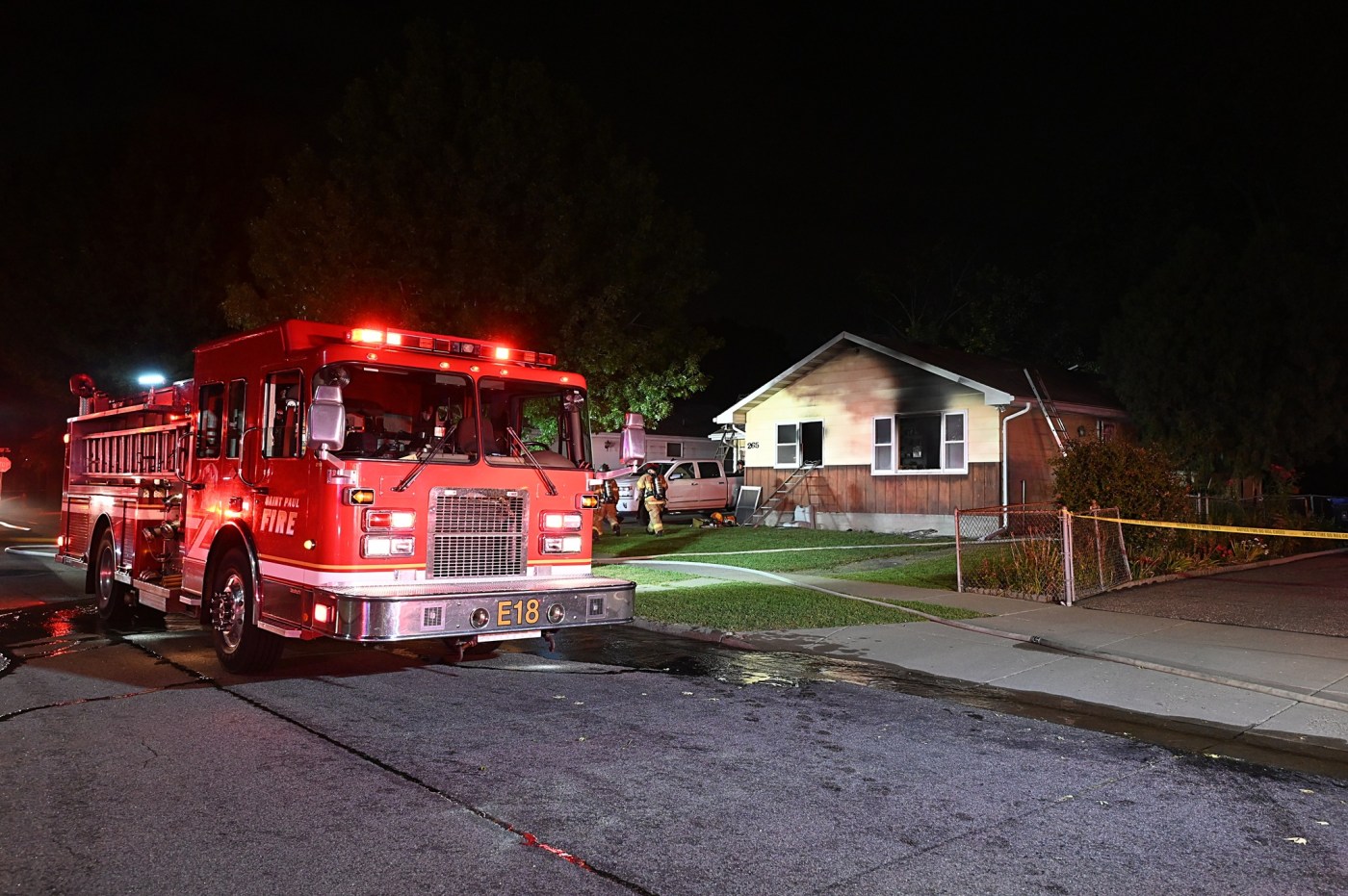
A house caught fire Sept. 14, 2024, at 5:01 a.m. at 265 Edmund Ave. in the Frogtown neighborhood of St. Paul. According to a news release, St. Paul Fire Department crews arrived to find an injured victim. The victim was transported to a hospital with serious injuries but was in stable condition at the time. The cause of the fire is unknown and under investigation, fire officials said. (Courtesy of St. Paul Fire Department)

There were reports of another victim inside, according to the fire department. However, crews searched all levels of the home and found no one else. No other injuries were reported.

St. Paul police investigators are actively working with fire investigators to determine the cause of fire, as well as how the male victim suffered the neck injury, Ernster said.

Anyone with additional information about the fire is asked to call police at 651-291-1111.

Related Articles

Crime & Public Safety |


Expect extra enforcement during Minnesota Click It or Ticket campaign

Crime & Public Safety |


Charges: Man armed with AK-47 left bullet holes in Minneapolis apartment building, neighboring home

Crime & Public Safety |


Naked burglar entered St. Paul home and teen’s closet before she awoke and ‘spooked’ him away, charges say

Crime & Public Safety |


For killing wife during St. Paul Bible study, man gets 33-year prison sentence

Crime & Public Safety |


St. Paul teen charged in daytime fatal shooting outside East Side tobacco shop

Twins star Carlos Correa returns after more than two months

posted in: News | 0

When Carlos Correa was first diagnosed with plantar fasciitis back in July, the star shortstop was initially hopeful he could come back right after the All-Star break after spending a few days off his feet.

It quickly became clear that that wasn’t going to happen. Correa missed the next 51 games because of the right heel pain. Saturday, he finally returned to the Twins’ lineup, a big boost for a team that got Byron Buxton back a day earlier.

“It feels right,” Correa said of his foot. “It feels right to get back in there, in the swing of things. Realistically, I’m not going to go play every game from now on, right? I’m going to miss some games here and there. We have a great team with (manager) Rocco (Baldelli) and the athletic trainers. We’re going to know how to manage this going forward, but we want to be out there as much as possible and get ready for this late run.”

Earlier in the week, Correa had mentioned a new treatment in the training room that had helped get his foot back to the point where he felt like he could finally play once more. While he won’t be out there playing pain-free, he’s made enough improvement to convince Baldelli and the training staff that he’s ready to return.

Correa did not go on a a rehab assignment — Baldelli said they simply ran out of time for that — and instead got live at-bats at Target Field over the past week against Twins minor league pitchers.

“I think he basically got to a point where he just said, “I’m going to give this everything that I have. I’m going to go out there and I’m going to play,’” Baldelli said. “Is the heel issue resolved? No, it’s not. It’s still there. But it’s better than what he was dealing with last week, last month.”

Correa was in the midst of an All-Star season when he got injured, hitting .308 with a .896 OPS and a 148 OPS+, a mark that is 48 percent better than the league average hitter.

He felt like he was playing his best right before the injury and that’s one of the things that hurt the most, he said.

“Hopefully, we can hit the ground right away running and go out and perform,” Correa said. “It sucked to go down at the level I was playing, but it’s what happened. We have to deal with it and now we have to focus on the now, go out there and help the team win games.”

Game 18

Saturday marked the Twins’ 148th game of the season. It was just the 18th that Correa, Buxton and Royce Lewis were all in the same lineup.

The talented trio has been on and off the field this season because of various injuries.

Lewis got hurt in the very first game season, straining his quad, which forced him to miss two months. He later had an adductor strain that kept him off the field.

Correa had an oblique strain before dealing with plantar fasciitis for the past two months and Buxton recently missed a month because of hip inflammation. Knee inflammation also kept him off the field earlier this year.

“This is good for us,” Baldelli said. “I mean this is what we were hoping for. Obviously every game we’re hoping for this, but we finally have these guys back. Now we have to work them back into shape as quickly as possible so they can go out there and play like they can play but seeing them all in the lineup, allowing them to go out there and play with each other, hopefully build off the energy each one of them brings and all the positive things they’re going to do, you start bringing that together and I think nothing but good can come from it.”

Briefly

Rookie outfielder DaShawn Keirsey Jr. was optioned to Triple-A to make room on the roster for Correa. … David Festa will take the ball for the series finale against the Cincinnati Reds. Festa gave up four runs in four innings the last time he pitched. He has lost each of the last four of his decisions stretching back to Aug. 23. … The Twins have listed Pablo López, Zebby Matthews, Bailey Ober and Simeon Woods Richardson as their probable starters for their upcoming series in Cleveland.

Related Articles

Minnesota Twins |


Elly De La Cruz provides the power as Reds beat Twins

Minnesota Twins |


Byron Buxton returns; Carlos Correa coming back Saturday

Minnesota Twins |


Saints give up three in 8th in loss at Columbus

Minnesota Twins |


For Twins minor leaguer brought in to face rehabbing stars, experience ‘doesn’t really feel real’

Minnesota Twins |


Saints blow 5-0 lead to lose again in Columbus

Gophers’ returner Quentin Redding out for year, creating opportunity for Koi Perich, others

posted in: News | 0

The Gophers football program on Saturday ruled out Quentin Redding for the rest of the season, opening up opportunities on punt and kick return for the final 10 games.

Redding, who was injured on the opening punt return in the 48-0 win over Rhode Island last week, has been a regular on both units for years. His specific injury is unknown, but his status was confirmed in the U’s unavailability report shared two hours before the 2:30 p.m. kickoff against Nevada at Huntington Bank Stadium.

When Redding went out with a leg injury last Saturday, Daniel Jackson initially stepped in on punts and had one return for three yards.

Then in the fourth quarter of the blowout, Koi Perich produced an entertaining 28-yard return. It was the Gophers longest return since Demetrius Douglas had a 69-yard return for a touchdown at Wisconsin in 2018.

Cristian Driver and Kristen Hoskins are two other options on punt return.

The main question is how much does head coach P.J. Fleck trust Perich, a highly touted prospect from Esko, Minn., but still just a true freshman. On for Jackson, the U’s No. 1receiver, Fleck has shown a willingness to use his best players — including Antoine Winfield Jr. and Rodney Smith — in return situations.

On kickoffs, Le’Meke Brockington and Jordan Nubin have mixed in. Brockington had a 27-yard return against Rhode Island.

Minnesota was 132nd out of 133 in kickoff return average (14.4) last season. The U was 116th in total punt returns (eight) a year ago, but were 21st in the nation in punt return average (11.7).

Briefly

Gophers nickleback Jai’Onte McMillan was not included in the unavailable list Saturday, setting up a return against Nevada. The TCU transfer exited early with a lower leg injury in the 19-17 loss to North Carolina and missed the Rhode Island game.

Related Articles

College Sports |


Gophers football vs. Nevada: Keys to game, how to watch, who has the edge

College Sports |


How Gophers revamped offense for better run-pass balance this season

College Sports |


Gophers football: P.J. Fleck on freshman QB Drake Lindsey’s debut: ‘Cool, calm, precise’

College Sports |


Gophers football: ‘Our deepest (NFL) draft class’ could be on 2024 roster

College Sports |


Gophers football: North Carolina loss provides ‘fertilizer’ for Rhode Island win

Your Money: Financial planning for special needs families

posted in: News | 0

Bruce Helmer and Peg Webb

Overall, there are about 42.5 million Americans who live with disabilities, making up 13% of the population, according to 2021 Census data. This group includes people who have hearing, vision, cognitive, walking, self-care, or difficulties living independently.

Not surprisingly, older Americans are significantly more likely than younger adults to have a disability (45% of Americans 75 and older vs. 12% of adults ages 35 to 64); their most common disabilities include difficulties with walking, independent living, or cognition.

Families with special needs can be hard-pressed to set long-term goals, create a plan, and implement it. For family members with more severe conditions such as autism, many parents find themselves in a race against time to create a plan to cover health care, living expenses, and therapies that can last the special-needs family member’s lifetime — from childhood to after the parents have gone.

This article is intended to provide an overview of how to plan for special needs situations using a broad array of available public and private resources.

Elements of a special needs financial plan

The biggest challenge for most families is transitioning a special-needs child from high school, where benefits are readily available, to early adulthood and beyond. When such support abruptly ends, many parents don’t know what planning questions to ask or know where to turn.

We believe the main goal for parents of special-needs kids is to create a long-term vision for the future — a life plan. The plan should include financial planning and considerations, and directions regarding all of the benefits that may be available to your loved ones. It should break down all family members’ goals into discrete, manageable buckets.

In our experience, the special-needs buckets will often look very different given the uncertainty of the time horizon. In terms of financial support, we believe families should turn to readily available public resources as their first resort. Here are some common approaches (among others):

Government assistance: The most readily accessible support for special needs families may come from Supplemental Security Income (SSI), which provides a monthly income stream to any qualifying person. To qualify for SSI, an individual must be elderly, blind, or disabled, and recipients must follow strict guidelines around other types of income earned and assets owned or risk losing benefits. SSI can provide crucial support to people with special needs, as they often lack the work or other experience required to be eligible for Social Security Disability Insurance (SSDI). The maximum SSI monthly benefit in 2024 is modest: $943 for individuals and $1,415 for a couple; it’s reduced by factors such as other income, living situation, and so on. Many state programs provide additional benefits that can increase the monthly payment to more than the federal maximum (subject to income and asset testing).

Health care benefits: Raising a child to age 18 in the U.S. costs $240,000, on average, but people with disabilities or special needs have greater health care costs and usage than an average person. For example, according to Autism Speaks, the average lifetime costs of care for an autistic individual range from $1.4 million to $2.4 million. Furthermore, 38% of individuals with disabilities have 10 or more annual doctor visits, compared to only 6% of individuals without disabilities, according to the National Disability Navigator Resource Collaborative.

People with disabilities generally have three available healthc are options: (1) Medicaid covers individuals who cannot pay for health care independently, including children, older adults, the blind, and anyone eligible to receive federally assisted income maintenance payments. (2) Medicare primarily covers Americans over age 65, but also individuals who are under 65 and receiving SSDI benefits (there are qualifying tests for eligibility, and the cost of Medicare Part B will be deducted from the SSDI monthly benefit).

There’s also coverage for adult children incapable of self-support. (3) The Affordable Care Act (ACA) allows young adults to stay on their parents’ health insurance until age 26 — including married and unmarried children. For an adult child incapable of self-support due to a physical/mental disability that existed before turning age 26, they can continue to receive coverage under their parent’s health care plan after age 26.

Life Insurance: For families facing a long-term funding gap, life insurance may be an option. Parents can buy a policy that will pay a death benefit upon the death of the policy owner or at the second spouse’s death. This strategy can be helpful for young families, who can buy more coverage when it’s less expensive.

Special needs trust: In certain cases, families may want to restrict the beneficiary’s access to trust assets. By setting up and funding a special needs trust, the trust assets will not be considered legally available to the beneficiary, and won’t jeopardize Medicaid, SSDI, or SSI benefits. In addition, there’s no asset limit to what can be held in the trust. In these more often complex situations, families retain a financial adviser to advise on trust assets and see that the donor’s wishes are carried out.

Having the right team in place is critical

Families navigating this world barely have time for their own personal, emotional, and financial well-being. Parents may name a close friend or trusted aunt or uncle as trustee for their special needs child. But are they up to the task and the responsibility? We think families need to consider selecting a fiduciary to help handle their child’s care over their lifetime; many of the advisers at Wealth Enhancement Group have helped ease this burden for numerous families around the country. The advantage of working with an adviser is that parents may gain comfort knowing that their child’s day-to-day living needs will be provided for long after they’re gone.

Related Articles

Business |


Your Money: How to protect yourself from cyberattacks

Business |


Your Money: Plan now for tax-law changes in 2026

Business |


Your Money: All this paperwork! What to keep, organize, trash and shred

Business |


Your Money: How to become financially independent

Business |


Your Money: Practicing Financial Wellness, a holistic approach

The opinions voiced in this material are for general information only and are not intended to provide specific advice or recommendations for any individual.

Bruce Helmer and Peg Webb are financial advisers at Wealth Enhancement Group and co-hosts of “Your Money” on WCCO 830 AM on Sunday mornings. Email Bruce and Peg at yourmoney@wealthenhancement.com. Securities offered through LPL Financial, member FINRA/SIPC. Advisory services offered through Wealth Enhancement Advisory Services, LLC, a registered investment advisor. Wealth Enhancement Group and Wealth Enhancement Advisory Services are separate entities from LPL Financial.