

Will the Emmys be the ‘Shogun’ show? What to expect on Sunday

posted in: News | 0

By ANDREW DALTON

The Emmys have become the “Shogun” show well before Sunday’s ceremony even begins.

This image released by FX shows Anna Sawai as Toda Mariko in a scene from “Shogun.” (Katie Yu/FX via AP)

The FX series about political machinations among local lords, Portuguese traders and a wandering British sailor is already the winningest series for a single season in Emmy history after taking 14 trophies at the precursor Creative Arts ceremony on Sunday.

The main Emmys show could not only extend its lead — it could bring historic wins for its lead actors.

Related Articles

Things to Do |


Fall is coming, and so is booya. Here’s where to find it.

Things to Do |


Weeknight recipes that will make you a household hero

Things to Do |


Gluten-free gnocchi with lemon, peas and spinach goes down easy

Things to Do |


‘Field of Bands’ fundraiser to aid veterans and troops

Things to Do |


Hudson Bloody Mary Walk to support hot air balloon festival

Here’s a look at the 76th Primetime Emmy Awards, which will be held Sunday night at the Peacock Theater in Los Angeles, hosted by Dan and Eugene Levy and airing on ABC.

‘Shogun’ steamrolls into Sunday

“Shogun” could win six more trophies, including best drama series, best actor in a drama for Hiroyuki Sanada and best actress in a drama for Anna Sawai.

Though if it fails to win in the biggest categories, “Shogun” may end up feeling like a sports team that has a record-setting regular season then tanks in the playoffs.

From left, Brian J. Armstrong, Benjamin Cook, James Gallivan, John Creed, Mark Hailstone, Ken Cain, Melissa Muil, Matt Salib and Sanaa Kelley pose with the award for Outstanding Sound Editing for a Comedy or Drama Series (One-Hour) for Shogun during night two of the Creative Arts Emmy Awards on Sunday, Sept. 8, 2024, in Los Angeles. (Photo by Richard Shotwell/Invision/AP)

Sanada, 63, is a revered veteran Japanese actor whose face may be familiar to most American viewers for films including “The Last Samurai” and “John Wick: Chapter 4” even if his name is not. He’s favored by most experts to win best actor over more widely known performers including Gary Oldman, Donald Glover and Idris Elba.

Sawai, 32, even less known in the U.S., is in the same situation, favored over famous names like Jennifer Aniston — who had been considered a frontrunner for “The Morning Show” before the “Shogun” wave took shape — and her castmate Reese Witherspoon.

Either Sanada or Sawai would be the first Japanese actor to win an Emmy.

This image released by FX shows Cosmo Jarvis, left, and Nestor Carbonell in a scene from “Shogun.” (Katie Yu/FX via AP)

When “Shogun” led all Emmy nominees with 25 at the announcements in July, many — including The Associated Press — suggested it was at least in part because of the absence of last year’s HBO big three: “Succession,” “The White Lotus” and “The Last of Us.”

But its dominance at the Creative Arts ceremony put it in its own class. It wasn’t just the number, it was the percentage. It won 14 of the 16 awards it was up for, getting snubbed only in two music categories. It won for its costumes, its hairdressing, its cinematography, its costumes, its casting and many more categories on its way to breaking the record of 13 Emmys set by the 2008 limited series “John Adams.”

When Néstor Carbonell won best guest actor in a drama and thanked the crew, he gleefully declared, “You’re all here!” because the crowd was so full of people who worked on the show.

Nestor Carbonell with the award for Outstanding Guest Actor in a Drama Series for Shogun attends night two of the Creative Arts Emmy Awards on Sunday, Sept. 8, 2024, in Los Angeles. (Photo by Richard Shotwell/Invision/AP)

Possibly getting a whiff of the golden possibilities, the makers of “Shogun” shifted from the limited series to the more prestigious drama category in May at the expense of competitors like “The Crown,” which might have been getting a coronation for its final season. The Netflix series is considered the only significant competitor for “Shogun.” Elizabeth Debicki is very likely to win for playing Princess Diana, and Imelda Staunton could take the best actress trophy from Sawai for playing Queen Elizabeth.

But it would truly be a stunner if “The Crown” won its second best drama series Emmy this year.

This image released by Netflix shows Elizabeth Debicki as Diana, Princess of Wales, in a scene from “The Crown.” (Keith Bernstein/Netflix via AP)

‘The Bear’ plays second banana

“The Bear,” which led all comedies with 23 nominations, could well have been the darling of these Emmys after tying “Succession” with six wins at the previous ceremony, held in January because of Hollywood’s strikes.

Its placement in the comedy category — mocked by some for a show with more drama than many dramas — will be a major perk this time amid the “Shogun” dominance.

This image released by Netflix shows Imelda Staunton as Queen Elizabeth in “The Crown.” (Alex Bailey/Netflix via AP)

The FX show’s second season — which this year’s nominations are for — was even more acclaimed than its first, and even though its recently released third season was received more coolly, it could easily see repeat acting wins for Jeremy Allen White, Ebon Moss-Bachrach and Ayo Edebiri, who will face somewhat stiffer competition after a shift from supporting actress to lead.

Stars in the periphery

While “Shogun” and “The Bear” may lack household names, there are truly major stars who are potential winners at these Emmys, several of them Oscar winners.

Two-time Academy Award winner Jodie Foster is a good bet to win her first Emmy as best actress in a limited or anthology series or TV movie for playing a hot-tempered cold-weather cop in “True Detective: Night Country.”

This image released by HBO shows Kali Reis, right, and Jodie Foster in a scene from “True Detective: Night Country.” (HBO via AP)

Meryl Streep could end up with more Emmys than Oscars if she wins her fourth for best supporting actress in a comedy for “Only Murders in the Building.”

Reigning best supporting actor Oscar winner Robert Downey Jr. could also become a first-time Emmy winner. He’s up for best supporting actor in the limited series category for playing five different roles in “The Sympathizer.”

Academy Award winners Gary Oldman and Brie Larson are also among the nominees, and one Oscar winner, Jamie Lee Curtis, already won an Emmy for her guest role on “The Bear.”

This image released by Apple TV+ shows Gary Oldman in a scene from “Slow Horses.” (Jack English/Apple TV+ via AP)

Old Emmy constants will also be featured. Aniston is a 10-time Emmy nominee who only won once during her time on “Friends.”

Jon Hamm is up for acting Emmys for both “The Morning Show” and “Fargo.” He’s an 18-time nominee who also only won once, for “Mad Men.”

Father and son hosts

An ABC awards show not hosted by Jimmy Kimmel? It’s about to happen. And the father-son duo of Eugene and Dan Levy make plenty of sense as replacements.

FILE – Eugene Levy, left, and Dan Levy appear at the 71st Primetime Emmy Awards in Los Angeles on Sept. 22, 2019. (Photo by Jordan Strauss/Invision/AP, File)

The four-time Oscar host Kimmel emceed the last time ABC aired the show in 2020, and those “Pandemmies” were among the only successful awards shows of the pandemic era. The novelty of an empty theater, show’s casts gathered together in remote locations, and a hazmat-suited representative comically handing out the trophies somehow worked.

The stars of that show were the cast members of the Levys’ show “Schitt’s Creek,” which swept the comedy categories including wins for best actor for Eugene Levy and best supporting actor for Dan.

The telecast still rotates between the four broadcast networks, even as they consistently fail to get nominations, much less wins, in the biggest categories. ABC’s “Abbott Elementary” and NBC’s “Saturday Night Live” have been the lone broadcast bright spots in recent years.
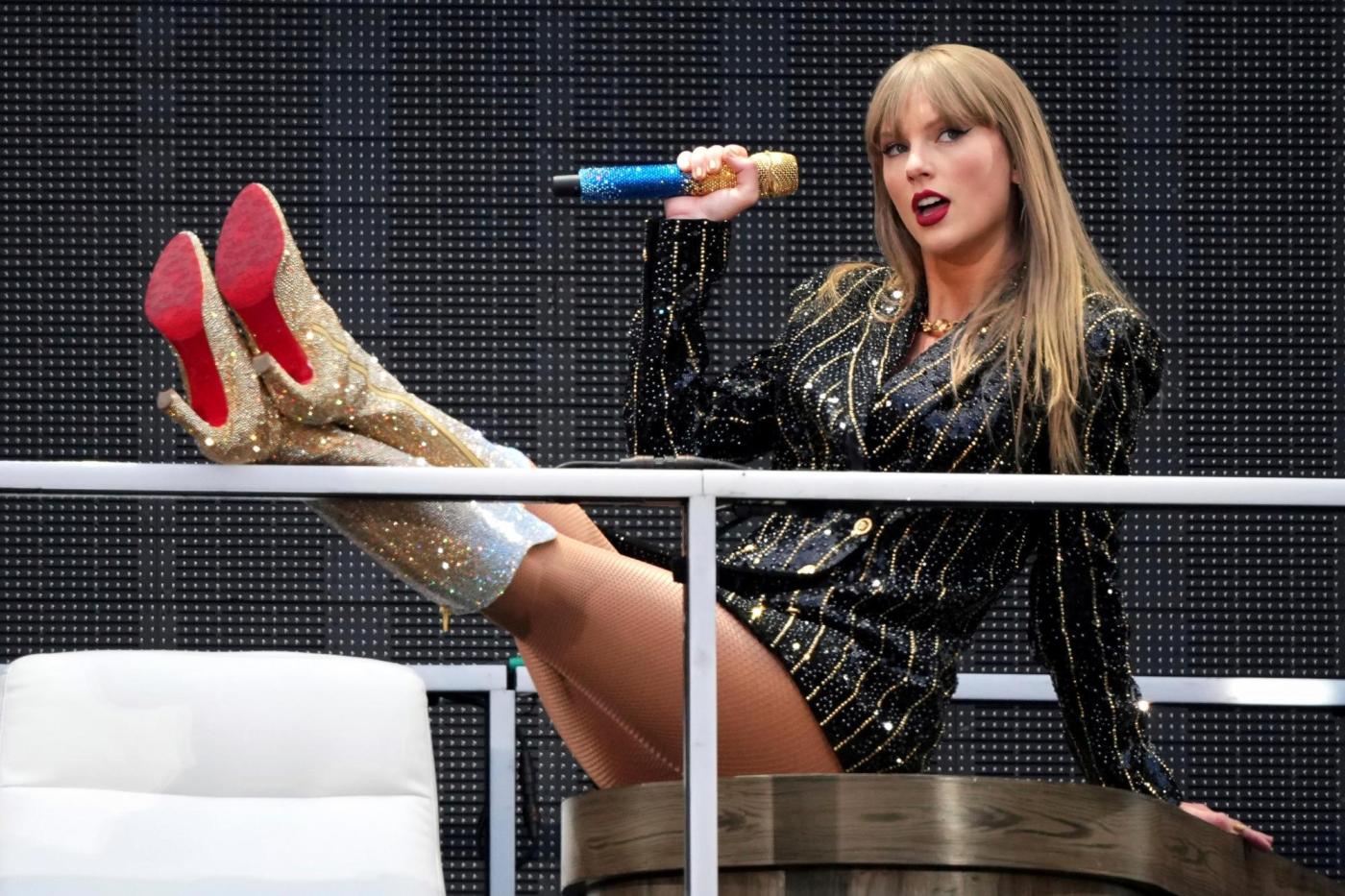

The MTV Video Music Awards are back. Will Taylor Swift make history?

posted in: News | 0

By MARIA SHERMAN

NEW YORK (AP) — The MTV Video Music Awards return Wednesday night with a whole lot of Taylor Swift. Will she become the most-awarded musician in VMAs history?

The pop star leads the nominations with 12 — eight for her “Fortnight” music video, two social categories and nods in the best pop and artist of the year categories. She’s followed by her “Fortnight” collaborator Post Malone, who has 11. He is nominated along with Swift 10 times and earned his 11th nom for his country hit “I Had Some Help,” featuring Morgan Wallen.

It’s unclear whether Swift will attend the show, but if she does, winning would give her a prominent stage to voice support for Kamala Harris’ presidential bid. Swift endorsed the vice president Tuesday night, moments after Harris’ debate with former president Donald Trump ended.

FILE – A statue of the MTV Moon Man appears on the red carpet at the MTV Video Music Awards in New York on Aug. 21, 2018. (Photo by Charles Sykes/Invision/AP, File)

If prior years are any indication, Swift may make multiple speeches.

She took home nine VMAs last year, bringing her total to an impressive 23. That places her just behind Beyoncé, who has 30 and just ahead of Madonna, who has 20 awards. Lady Gaga, has 19.

Seven Swift wins would tie Beyoncé’s record, and if she wins eight, she could become the most awarded musician in VMA history.

Related Articles


Trump posted a fake Taylor Swift image. AI and deepfakes are only going to get worse this election cycle


Taylor Swift calls cancellation of Vienna shows ‘devastating’ and explains her silence


Hollywood’s A-listers are lining up behind Joe Biden. Will their support matter in November?

That is, if Beyoncé doesn’t take home any of her own trophies. She’s up for song of the year (“Texas Hold ‘Em”) and two social categories.

The VMAs, which begin at 8 p.m. Eastern and are being held at the UBS Arena on New York’s Long Island — will be hosted by Megan Thee Stallion. It marks her first time hosting an award show. She’ll perform as well. The last two years have been hosted by Nicki Minaj: She emceed solo in 2023, in 2022, she was joined by Lil Wayne and Jack Harlow.

Katy Perry will receive the Video Vanguard Award and also perform. Previous recipients include Shakira, Beyoncé, Minaj, Madonna, Janet Jackson, Jennifer Lopez, Rihanna and Missy Elliott.

Other scheduled performers include Eminem, who will open the show, as well as Benson Boone, Sabrina Carpenter, Megan Thee Stallion, Chappell Roan, GloRilla, Halsey, Lenny Kravitz, LISA, Rauw Alejandro, Karol G, LL COOL J, Shawn Mendes, Camila Cabello and Anitta, who will be joined by Fat Joe, DJ Khaled and Tiago PZK.

The VMAs will air on MTV and simulcast on BET, BET Her, CMT, Comedy Central, Logo, MTV, MTV2, Nick at Nite, Paramount Network, Pop, TV Land, VH1, and in Spanish on Univision.

Speaker Johnson pulls a vote on a bill to avoid a partial government shutdown

posted in: News | 0

By KEVIN FREKING

WASHINGTON (AP) — Speaker Mike Johnson pulled a vote Wednesday on a temporary spending bill that would keep federal agencies and programs funded for six months as it became increasingly clear the measure lacked the support to pass as a potential partial government shutdown looms.

The legislation to continue government funding when the new budget year begins on Oct. 1 includes a requirement that people registering to vote must provide proof of citizenship. Johnson, R-La., signaled that he was not backing off linking the two main pillars of the bill.

“No vote today because we’re in the consensus building business here in Congress. With small majorities, that’s what you do,” Johnson told reporters outside the House chamber. “We’re having thoughtful conversations, family conversations within the Republican conference and I believe we’ll get there.”

Congress needs to pass a stopgap spending bill before Oct. 1 to avoid a federal shutdown just weeks before the election. The measure had been teed up for a vote on Wednesday afternoon, but Democrats are overwhelmingly opposed and enough Republicans had voiced opposition to raise serious doubts about whether the measure would pass.

The stopgap bill would generally continue existing funding through March 28. The GOP opponents of the bill argue that it continues spending at levels they consider excessive. And some Republicans simply won’t vote for any continuing resolution, arguing that Congress must return to passing its 12 annual spending bills separately rather than the one or two catchall bills that have become the norm in recent decades.

Despite the dim prospects for the bill, Johnson had said on Tuesday that he would push ahead with the vote. He has embraced concerns that some of the migrants who have entered the country at the U.S.-Mexico border in recent years could swing the elections, though it’s illegal for noncitizens to vote and research has shown that such voting is extremely rare.

“Congress has a lot of responsibilities, but two primary obligations — responsibly fund the government and make sure that our elections are free and fair and secure,” Johnson said. “And that’s what we’re working on.”

The House approved a bill with the proof of citizenship mandate back in July. Republicans believe there is value in revisiting the issue and making Democrats in competitive swing districts vote again.

Democrats are calling on Johnson to “stop wasting time” on a bill that will not become law and to work with them on a short-term spending measure that has support from both parties. At the end of the day, they say no spending bill can pass without bipartisan support and buy-in from a Democratic-led Senate and White House.

“Republicans should work with Democrats on a bipartisan package, one that has input from both sides, one that avoids harmful cuts, one that is free of poison pills. We’re ready to sit down and work with them immediately,” Senate Majority Leader Chuck Schumer, D-N.Y., said before Johnson had postponed the vote.

Republican presidential nominee Donald Trump on Tuesday seemingly encouraged a government shutdown if Republicans in the House and Senate “don’t get assurances on Election Security.” He said on the social media platform Truth Social that they should not go forward with a stopgap bill without such assurances.

Senate Republican leader Mitch McConnell, R-Ky., disagreed when asked about Trump’s post.

“Shutting down the government is always a bad idea, no matter what time of the year it is,” McConnell said.

‘Good Cause’ Eviction’s Legal Litmus Test Begins

posted in: Society | 0

“The enforcement mechanism has truly always been the courts,” said Good Cause sponsor State Sen. Julia Salazar, as anticipation mounts for litigation that will hash out the reach of the new tenant protection law.

Chris Janaro

State Sen. Julia Salazar at a rally calling for passage of good cause eviction legislation on Feb. 22, 2024.

New York’s Good Cause Eviction law was enacted more than four months ago. The recent introduction of a tenant notification requirement has heightened expectations of coming legal battles that may help define its reach—as tenants aim to utilize the law and landlords navigate compliance.

Inspired by similar protections in places like California and Washington D.C., including good cause protections was a crucial bargaining tool during state budget negotiations, sought by tenant advocates and progressive lawmakers to go alongside a replacement of 421-a, a housing developer tax incentive that expired in 2022.

But to the disappointment of many good cause supporters, the version of the law passed in the 2025 fiscal year budget saw the reach of its tenant protections scaled back, and left some of the wording vague.

Since Aug. 18, New York City landlords are required to notify tenants of whether the law applies to them when issuing new or renewed leases, rental increases, and notices of eviction or litigation.

Now, legal experts and advocates for both tenants and property owners have begun to weigh in on what’s to come, and what may get ironed out for the new law in an already beleaguered city housing court system.

“A lot of people are about to learn if they’re covered by good cause,” said Andrea Shapiro, director of programs and advocacy at the Met Council on Housing. This includes tenants with existing protections who aren’t impacted by the law, she added. “So you can be rent-stabilized, and you’ll get a note saying whether you’re covered by good cause, which obviously you aren’t —but just to make sure.”

Who’s covered, who’s not

In principle, good cause is a housing court defense that protects tenants from eviction without a legally sufficient reason, such as failing to pay rent, violating lease terms, or being a nuisance. It can also provide defense against rent increases over a certain threshold.

Try It Out: City Limits’ NYC ‘Good Cause’ Rent Calculator

But it can be complicated for tenants to determine whether or not their residence qualifies under good cause. Tenants living in rent-stabilized apartments or other rent-regulated frameworks, such as NYCHA, are not covered under good cause since they are already afforded many of the same protections.

In New York City, homes owned by smaller landlords—defined as those who own 10 or fewer units—are exempt from the law, as are buildings with 10 or fewer units if the owner resides there, even if that owner has additional properties elsewhere.

Homes provided as part of a job, condos, co-ops, seasonal homes, certain senior and healthcare facilities, manufactured homes, hotel rooms, dormitories, and religious facilities aren’t covered. Neither are properties built after Jan. 1, 2009, where good cause protections won’t kick in until 30 years after construction. 

The law also excludes homes renting for more than 245 percent of Fair Market Rent (FMR) set by the Department of Housing and Urban Development (HUD). In 2024, this means rents exceeding $5,486 for a studio in New York City, $6,005 for a one-bedroom, $6,742 for a two-bedroom, $8,413 for a three-bedroom, and $9,065 for a four-bedroom.

“The law is a great step forward, but it’s not the most perfectly worded,” said Jeremiah Schlotman, director of litigation for housing at Legal Services NYC. “There are certain loopholes or areas that [our] tenant advocates are preparing ourselves to litigate because we think they will be exploited by landlords.”

These anticipated loopholes include landlords hiding the total number of units they own by using an LLC, or Limited Liability Company, to obscure whether they are subject to the law. 

Another could involve landlords claiming demolition plans as an exception to good cause, but not following through with it.

“What if the landlord says, ‘I want to demolish, you need to move out,’ and then the landlord never does. But then the landlord says: ‘No, it was in good faith, I just changed my mind,” said Schlotman. “This can get dicey because how do you know what’s a good faith intention or not? So we’re saying that must mean something. You must be able to prove something significant or have substantial proof.”

Some well-informed tenants have successfully used good cause to resolve lease issues with their landlords, avoiding rent hikes and eviction, without having to take legal action. But if that fails, the only way for tenants to legally address their concerns is to take the matter to court.

​​”One of the drawbacks is that you are going to be in housing court, because you have to sit back and get sued for eviction before you can avail yourself with a good cause eviction protection,” Schlotman said.

Adi Talwar

Bronx County Housing Court in January 2022.

Headed to court

This is the scenario AnnLynn Hayashi, a 27-year resident who is raising two daughters at the Flora apartments at 310 East 12 St. in Manhattan, has found herself in. After the building changed hands in 2022, the new owner, listed on city property records as EVMF Owner LLC, stopped renewing leases for market-rate units in her building. 

Hayashi and a neighbor both had leases ending at the end of May, and they were both overjoyed when they heard that good cause had passed into law, and could offer them recourse from eviction.

“Talk about luck. We’re like, oh my god, this is fantastic. We’ll be covered,” said Hayashi. 

However, their exuberance was short-lived. “We write for our new leases, and our landlord writes back, ‘Oh, I’m sorry. We’re going to use a demolition clause. We’re going to demolish and renovate your apartment.”

Hayashi believes the demolition plan is a falsehood, and the owner is simply converting the market-rate units individually into dormitory-style apartments and increasing the rent.

“It’s not true. They’re just renovating. There’s no demolishing happening in our building, so they’re trying to get away with this little loophole,” she said.

Filings on the Department of Buildings’ website list a number of work applications filed since the start of the year, including for gut rehabilitation jobs dated earlier this month for six apartments.

A representative of the building’s owner, EVMF Owner LLC, declined to comment for this story. 

After her lease ended in May, Hayashi continued making her rent payments to the landlord, which were accepted until last month’s payment was returned to her shortly before she received an eviction litigation notice on her door, with a court date.

Hayashi plans to fight it in housing court and recently acquired legal representation, which adjourned her court date until the end of October so she and her attorney can prepare a response to the litigation and request discovery.

Lawyers representing both landlords and tenants foresee a rise in tenants requesting discovery in these cases. Discovery, the process where both parties exchange information before trial, can be utilized to determine if a residence qualifies under the good cause law. 

“It seems like there’s some attorneys chomping at the bit already,” said Ann Korchak, board president of Small Property Owners of New York (SPONY).

In housing court, discovery is not an automatic phase of the trial; it must be requested explicitly by one of the parties. Property owners and their lawyers worry that this could delay proceedings by months or longer.

“Landlords are not getting rent during this time, and tenants are falling behind in rent during this time,” says landlord attorney Lisa Faham-Selzer, a partner at Kucker Marino Winiarsky & Bittens LLP.  “So it’s going to be really hard once the motion is decided for the tenant to reconcile the balance owed and for the landlord to sustain not getting paid rent.”

But tenant lawyers counter that discovery is the most effective method of determining whether the law applies to their good cause clients, and regardless of any additional court time—it’s a tenant’s right to request it.

“So with respect to this idea that it’s going to bog down cases and slow down the eviction proceedings—it’s called due process,” said Dannelly Rodriguez, a staff attorney with Legal Services NYC.

He currently represents a group of tenants in a building in Corona, Queens, which he believes qualifies for the good cause defense after their rent was raised substantially higher than this year’s allowable threshold of 8.82 percent.

“It’s a fundamental right for anyone in America facing legal proceedings,” Rodriguez added. “You have a right to move for discovery, to determine whether good cause applies or not, and if that’s what needs to be done, that’s what needs to be done.”

Adi Talwar

Apartments on Atlantic Avenue and Pacific Street in Brooklyn.

Notification requirements add some confusion

Another frustration is the perceived lack of guidance on complying with the new law, with some wishing the state’s Division of Housing and Community Renewal (DHCR) provided clearer direction and a tenant notification form for landlords to use.

“The expectation was that DHCR would promulgate a notice so that we were all using the same language,” said Korchak of SPONY. “DHCR is not a tenant-only body; they’re responsible for advising owners as well. So that’s disappointing.”

The law does not charge DHCR with publishing a tenant notice. It’s only responsible for publishing annual notices that outline the localities participating in good cause—outside the five boroughs, towns and cities were given the choice to “opt” into the program—as well as other details, like the applicable percentage of FMR that qualifies for exemptions, and definitions of small landlords.

While DHCR doesn’t directly provide landlords with the notification form, it is published in its entirety under section 231-c of the Real Property Law for landlords to use and for tenants to help identify the validity of their own cases. 

Regardless of whether or not a residential unit falls under the law’s protections, all new leases, renewals, and eviction litigations are now required to include a good cause notification spelling out whether the law applies to the tenant and, if not, the reason why.

But both tenant and landlord lawyers worry that notifying non-applicable tenants, like those living in rent-stabilized units who aren’t covered by good cause, is unnecessary, since they already receive similar protections under New York’s rent regulation laws. 

“Think about the waste there. Housing court has so many cases that need to go through the process,” says Korchak, who believes that the requirement will create pointless tie-ups in court from rent-stabilized tenants. “What a waste of time. It’s just where they could have just added that one sentence to the bill.”

Conversely, tenant advocates worry that the notification will confuse ineligible tenants who already benefit from stronger rent protections.  

“So rent-stabilized tenants are getting riders that say, ‘Hey, you’re not covered by good cause,’ even though rent stabilization is much stronger than good cause and contains all the same provisions and more,” said Cea Weaver, coalition director at Housing Justice for All. “So it’s true that they’re not covered by this specific law, but it’s misleading and scary for renters, and that’s just sloppy.”

State Sen. Julia Salazar, who has sponsored a good cause bill since 2019, is pleased with the positive impact the law could have on tenants, even if her version underwent carve outs to get passed during budget negotiations. 

NYS Senate Media Services

Lawmakers and housing activists at a rally to support the good cause bill last year.

“I think that, as of now, the law is really strong,” said Salazar. “The enforcement mechanism has truly always been the courts, and it’s always been extremely important that we educate tenants about their rights so that landlords can’t simply misrepresent the law or fail to comply.”

To tenant advocates, “good cause” represents a step in the right direction, even if it’s imperfect. 

Ultimately, however, they still want to see stronger rent stabilization protections, as was seen with the 2019 Housing Stability and Tenant Protection Act (HSTPA)—a major win for tenants that significantly curtailed rent-raising between rent-stabilized tenancies. Beyond New York City, several cities and towns are in the process of adopting rent regulation, or exploring it.

“We need more rent stabilization,” says Shapiro, who believes that good cause has always been “like a crutch” on the way toward stronger tenant protections. “There are definitely some loopholes and things that we’re trying to get small fixes on. But in reality, we want stronger laws, and good cause is a stepping stone on that way.”

For good cause sponsor Sen. Salazar, the fight for tenants involves improving both measures.

“Frankly, for my part, I think we still have a lot of work to do to ensure that every renter, every person in New York state, has housing stability and housing security. And so, I join them in demanding an expansion of rent stabilization,” says Sen. Salazar, adding, “I’m also eager to see the Good Cause Eviction lobby as strong as it possibly can be.”

To reach the reporter behind this story, contact Chris@citylimits.org. To reach the editor, contact Jeanmarie@citylimits.org

Want to republish this story? Find City Limits’ reprint policy here.