Federal ‘Polluters Pay’ Bill Debuts, As NY’s Version Awaits Hochul’s Signature

posted in: News | 0

More states are considering legislation to make the largest fossil fuel companies pay for the impacts of climate change, and activists hope a national effort will pressure Gov. Hochul to sign New York’s own superfund bill, which passed both houses earlier this year.

Kevin P. Coughlin / Office of Governor Kathy Hochul

Gov. Kathy Hochul touring storm damaged in upper Manhattan after Hurricane Ida in 2021. The Climate Change Superfund Act would make the largest corporate polluters help pay for the impacts of climate change, including damage wrought by extreme weather.

As New York City’s climate week kicks off, environmental activists will convene Tuesday in front of Gov. Kathy Hochul’s Manhattan office to deliver over 85,000 petitions urging her to sign legislation to make fossil fuel polluters pay for climate damages.

While the bill passed both the State Senate and Assembly during this year’s legislative session, the governor has not yet signed it into law. Hochul, who has until the end of the calendar year to do so, did not immediately respond to City Limits request for comment.

As pressure mounts for her signature, climate activists hope similar legislation introduced on the national level last month will nudge New York’s own bill across the finish line. The federal bill is backed by influential democrats in congress like Alexandria Ocasio-Cortez.

“This introduction serves to build momentum and awareness for the concept,” said Cassidy DiPaola, communications director at Fossil Free Media and spokesperson for the nation-wide Make Polluters Pay Campaign.

“This is about making the cost of the climate crisis into a kitchen table topic that’s part of everyday conversation more than anything else,” she added.

And the topic has started to catch on. Vermont became the first state in the nation to pass a climate Superfund law in May and legislators in Maryland and Massachusetts have considered similar bills.

On the federal level, the Polluters Pay Climate Fund Act would require the world’s largest fossil fuel companies doing business in the United States to pour $1 trillion over 10 years into a fund that will be used to address the impacts of climate change. 

The money could be used, for instance, to clean up pollution, rebuild and upgrade infrastructure torn down by severe weather events and provide climate-related disaster assistance to the communities that need it most.

Covered companies include those responsible for emitting at least 1 billion tons of carbon dioxide into the atmosphere between 2000 and 2022. That means major oil companies like ExxonMobil, Chevron, Shell, and British Petroleum, as their greenhouse gas emissions are all well above the law’s benchmark, data shared with City Limits last year showed.

The amount each company is required to pay into the fund will be proportional to the amount of emissions they spewed above the 1 billion metric ton threshold. 

The idea is to hold them accountable for past damages done to the atmosphere, the same way a company is asked to pay into a superfund when it has spilled oil or contaminated a river with hazardous waste. 

Company reports that track fossil fuel production will help determine how many metric tons of greenhouse gasses the largest polluters launched into the atmosphere. A formula crafted by climate scientists and derived by the U.S. Environmental Protection Agency (EPA) will then be used to estimate how many metric tons were released annually.

“It’s critically important that scientists calculate these emissions and begin to quantify how much particular corporations have contributed to the impacts of climate change,” said Kathy Mulvey, the clean energy and climate accountability director at the Union of Concerned Scientists.

While Mulvey warns that the total economic costs of climate change are difficult to quantify, experts have been able to put a price tag on some of the damage. 

The U.S government’s most recent report on climate change, known as the Fifth National Climate Assessment, puts the nationwide costs of climate-related extreme weather events at over $150 billion per year.

Ayman Siam/Office of NYC Comptroller

Climate activists with NYPIRG and Food & Watch Watch rallying for New York’s Climate Change Superfund Act in December 2023.

This figure was used as a starting point for coming up with how much fossil fuel companies should pay into the climate superfund. Lawmakers calculated that if the U.S was hit with at least $100 billion a year in climate disasters, the tab would add up to at least $1 trillion in a decade’s time.

Lawmakers and environmentalists have been pushing for polluters to help foot the bill for these escalating damages since 2021, when they drafted a similar version of this legislation, though this is the first time it’s been introduced as a standalone bill. Maryland’s U.S. Senator Chris Van Hollen is sponsoring the legislation alongside New York Rep. Jerry Naddler.

For Nadler, the time to raise money for tackling the escalating issue of climate change is long overdue.

“We’ve noticed a mounting crisis. You see it in New York where we were breathing the ash from the wildfires in Canada [last year]. People see it and it’s certainly mounting almost exponentially in the last few years. It’s almost like we’ve reached a tipping point,” Nadler told City Limits.

Nadler says he doesn’t believe the legislation will become law in the near future “given the fact the Republicans are so negative on it” and currently have control of the house.

“But I do believe that, given the increasingly obvious severity of the crisis, we will pass this at some point, hopefully sooner rather than later. Obviously not in this Congress, but hopefully in the next one,” he added.

To reach the reporter behind this story, contact Mariana@citylimits.org. To reach the editor, contact Jeanmarie@citylimits.org

Want to republish this story? Find City Limits’ reprint policy here.

Donald Trump and Kamala Harris both say food costs too much. What can they do about it?

posted in: News | 0

David Lightman | (TNS) McClatchy Washington Bureau

WASHINGTON — Donald Trump and Kamala Harris agree on this much: Groceries cost too much.

But despite promises from each presidential candidate that they’ll take bold steps to stop the price madness, experts say there’s probably little they can do.

“The rate of price growth has reverted back to normal, but prices will not go back down,” said Aaron Smith, professor of agricultural and resource economics at University of California, Berkeley.

Harris vows to curb what she called grocery price gouging. Trump says that he’ll lower energy costs and prices overall, which in turn will mean less expensive food

Analysts agree a president is largely handcuffed dealing with food prices. Any presidential initiative probably needs congressional approval. Republicans have been unenthusiastic about anti-gouging measures and Democrats are not eager to embrace Trump’s energy production ideas.

And there are questions about whether either candidate’s initiatives are targeted in the right place.

“There is little evidence of price gouging. Reported net profits by food companies over the past couple of years show no evidence that profits are higher than average over the last decade,” said Joseph Glauber, senior research fellow at the nonpartisan International Food Research Institute.

“Likewise,” he said, “It is unlikely that reducing the cost of energy by itself would have a significant impact on the cost of food.”

Why are food prices so high?

Food prices are affected by a wide variety of factors, including weather, import and export policy, energy prices, labor, supply chains, and marketing costs.

Though food prices have stabilized recently, consumers are still feeling the effects of price hikes in previous years. Grocery prices in 2022 alone jumped 11.4%., according to the U.S. Department of Agriculture’s Economic Research Service. Major reasons were that egg and poultry prices were up because of an Avian flu outbreaks, and Russia’s invasion of Ukraine helped boost energy and grain costs.

The rate of increase slowed somewhat last year, but grocery prices still grew 5%, as supply chain issues continued.

Prices have studied this year, as calmed this year, as energy costs stabilized and supplies were more in balance.

Food bought for use at home, which reflects grocery store prices, was up an average of 0.9% in the 12 months that ended in August, according to the federal Bureau of Labor Statistics.

Grocery prices are expected to continue going up at that pace the rest of this year and in 2025, according to the Economic Research Service.

Still, said Berkeley’s Smith, “people understandably feel poorer because they notice the higher prices.”

Harris wants to stop gouging

Vice President Harris, the Democratic presidential nominee, has vowed to fight food price inflation partly by tackling what she calls grocery price gouging.

“As president, I will take on the high costs that matter most to most Americans, like the cost of food,” she told a rally in North Carolina recently.

In her economic proposal, unveiled last month, she said she would “advance the first-ever federal ban on price gouging on food and groceries.”

Harris said she direct her administration “to crack down on unfair mergers and acquisitions that give big food corporations the power to jack up food and grocery prices and undermine the competition that allows all businesses to thrive while keeping prices low for consumers.”

She also pledged to “support smaller businesses, like grocery stores, meat processors, farmers, and ranchers, so those industries can become more competitive.”

Trump and GOP lawmakers have said Harris’ idea was essentially a way to control prices.

At a Capitol news conference Tuesday, Sen. Joni Ernst, R-Iowa, said Harris wants “communist price controls. Sen. Shelly Moore Capito, R-W.Va., listed increases in the price of bread, ground beef, gasoline and other items in recent years, and declared “this to me is the issue of the presidential campaign.”

Gouging usually refers to price increases that occur when demand is strong, usually after emergencies. California has an anti-gouging law that limits how much can be charged after an emergency has been declared.

Nate Rose, senior director of communications for the California Grocers Association, called Harris’ claims “ a political narrative that isn’t borne out by the data.”

Grocery profit margins have historically been very thin. “The reality is with razor thin profit margins there’s really no place for inflationary impacts to go other than back to consumers in the former of higher prices,” Rose said.

Trump’s plan to reduce costs

Tuesday night at a town hall in Michigan, a participant asked Trump how he would stabilize food prices.

“We have to start always with energy,” he told the group. “There’s no bigger subject. It covers everything.”

He said his goal is to get energy bills down 50% in a year.

Trump also said he would work with farmers to provide more markets for their products, perhaps by restricting imports. Farmers are being “absolutely decimated,” he said, and a reason is that “We allow a lot of farm product into our country.” If he’s elected, Trump said, “We’re not gonna allow so much (to) come.”

The key point Republicans are trying to make is that “the numbers don’t lie—Kamala Harris’ dangerously liberal economic agenda have sent food costs soaring with overall grocery prices up 21% since she took office,” said Taylor Rogers, a Republican Party spokesman.

“President Trump will once again cut taxes and unleash American energy to lower prices on groceries and other goods when we send him back to the White House,” Rogers said.

Energy costs account for roughly 4% of food prices, the USDA says. Prices are affected by a variety of factors that can be difficult for anyone to control.

The cost of commodities such as wheat, corn and so on accounts for only about one-fourth of the retail cost of food.

“The is accounted for by the cost of processing, transporting, marketing, etc. These costs are driven by other factors such as energy and labor costs,” Glauber explained.

_____

©2024 McClatchy Washington Bureau. Visit mcclatchydc.com. Distributed by Tribune Content Agency, LLC.

OceanGate co-founder says he hopes submersible tragedy yields renewed interest in exploration

posted in: News | 0

By PATRICK WHITTLE, Associated Press

The co-founder of the company that owned the experimental submersible that imploded en route to the wreckage of the Titanic told a Coast Guard panel Monday that he hoped that the silver lining of the disaster will inspire a renewed interest in exploration, including the deepest waters of the world’s oceans.

“This can’t be the end of deep ocean exploration. This can’t be the end of deep-diving submersibles and I don’t believe that it will be,” said businessman Guillermo Sohnlein, who helped found OceanGate with Stockton Rush.

Sohnlein ultimately left the company before the Titan disaster in June 2023. Rush was among the five people who died when the submersible imploded. Though Sohnlein left the Washington company years ago, he spoke in defense of its efforts in the aftermath of the submersible’s implosion.

On Monday, he testified that the company wanted to create a fleet of four or five deep-diving submersibles capable of carrying five people to 6,000 meters (6,500 yards) deep. The plan for the company was to have no dedicated mothership — which would’ve lowered costs substantially, he said.

“We wanted to give humanity greater access to the ocean, specifically the deep ocean,” Sohnlein said.

Sohnlein testified that the company zeroed in on the use of carbon fiber for the doomed vessel because the company wanted a lightweight, less costly submersible that did not need to be tethered to a specific mother ship. He testified that the use of carbon fiber as “not a novel idea” and said “people have looked at that before.”

No existing submersible builders could meet the company’s requirements, necessitating the pivot to building its own subs, Sohnlein said. And he said the company worked closely with the Coast Guard during development.

Sohnlein said he had the opportunity to dive in Titan “many times” and he declined. He said his reasons included not wanting to take space away from potential customers. He said when Rush reached a point when it was “time to put a human in there,” he wanted to do it himself. Rush felt it was his design and said “if anything happens, I want it to impact me,” Sohnlein said.

The Coast Guard opened a public hearing earlier this month that is part of a high level investigation into the cause of the implosion. Some of the testimony has focused on the troubled nature of the company.

Earlier in the hearing, former OceanGate operations director David Lochridge said he frequently clashed with Rush and felt the company was committed only to making money. “The whole idea behind the company was to make money,” Lochridge testified. “There was very little in the way of science.”

But Sohnlein said Monday that neither he nor Rush was ever “driven by tourism” and the idea of visiting the Titanic, which had already been explored by others, was not exciting to either of them.

Sohlein also testified Monday that he left the company in 2013 as the company transitioned to engineering, which he described as a bigger strength of Rush’s than his. He said it was a “fairly easy decision” for Rush to take over the company, but it was more difficult to decide whether to stay on at all.

Ultimately, Sohnlein said, he didn’t feel it made sense for the company to continue paying him a salary of $120,000 for a reduced role. He said he maintained a minority stake in the company that still exists.

“It just didn’t make sense financially to keep paying me that kind of salary when I wasn’t going to be doing much other than overseeing business operations,” Sohnlein said, adding that it was “one of the hardest decisions I had to make” and he once thought it was going to be “the last job he ever had.”

The hearing is expected to run through Friday and include more witnesses. Roy Thomas of the American Bureau of Shipping also testified Monday and detailed the challenges associated with carbon fiber as a material for submersibles. He said carbon fiber is “susceptible to fatigue failure under repeated external pressurization.”

Former OceanGate engineering director Phil Brooks was also scheduled to testify Monday.

Lochridge and other previous witnesses painted a picture of a troubled company that was impatient to get its unconventionally designed craft into the water. The accident set off a worldwide debate about the future of private undersea exploration.

Coast Guard officials noted at the start of the hearing that the submersible had not been independently reviewed, as is standard practice. That and Titan’s unusual design subjected it to scrutiny in the undersea exploration community.

OceanGate, based in Washington state, suspended its operations after the implosion. The company has no full-time employees currently, but has been represented by an attorney during the hearing.

During the submersible’s final dive on June 18, 2023, the crew lost contact after an exchange of texts about Titan’s depth and weight as it descended. The support ship Polar Prince then sent repeated messages asking if Titan could still see the ship on its onboard display.

One of the last messages from Titan’s crew to Polar Prince before the submersible imploded stated, “all good here,” according to a visual re-creation presented earlier in the hearing.

When the submersible was reported overdue, rescuers rushed ships, planes and other equipment to an area about 435 miles (700 kilometers) south of St. John’s, Newfoundland. Wreckage of the Titan was subsequently found on the ocean floor about 330 yards (300 meters) off the bow of the Titanic, Coast Guard officials said. No one on board survived.

OceanGate said it has been fully cooperating with the Coast Guard and NTSB investigations since they began. Titan had been making voyages to the Titanic wreckage site going back to 2021.

Banned Books Week starts with mixed messages as reports show challenges both up and down

posted in: News | 0

By HILLEL ITALIE

NEW YORK (AP) — Two reports released Monday provide a mixed but compelling outlook on the wave of book removals and challenges as the annual Banned Books Week begins for schools, stores and libraries nationwide.

The American Library Association found a substantial drop in 2024 so far in complaints about books stocked in public, school and academic libraries, and in the number of books receiving objections. Meanwhile, PEN America is documenting an explosion in books being removed from school shelves in 2023-24, tripling to more than 10,000 over the previous year. More than 8,000 were pulled just in Florida and Iowa, where laws restricting the content of books have been passed.

The two surveys don’t necessarily contradict each other.

The library association’s Office for Intellectual Freedom has recorded 414 challenges over the first eight months of 2024, with 1,128 different titles criticized. Over the same time period last year, the office tallied 695 cases, involving 1,915 books. The ALA relies on media accounts and reports from librarians and has long acknowledged that many challenges may not be included, whether because librarians preemptively withhold a book that may be controversial or decline to even acquire it.

Challenges have surged to record highs over the past few years, and the 2024 totals so far still exceed the ALA’s numbers before 2020. Deborah Caldwell-Stone, who directs the association’s Office for Intellectual Freedom, also cautioned that the numbers predate the start of the fall school year, when laws that had been on hold in Iowa will again be in effect.

“Reports from Iowa are still coming in,” she said. “And we expect that to continue through the end of the year.”

The library association defines a “challenge” as a “formal, written complaint filed with a library or school requesting that materials be removed because of content or appropriateness.” The ALA doesn’t keep a precise figure of how many books have actually been withdrawn.

According to PEN, bans are tallied through local media reports, “school district websites, and school board minutes, as well as organizational partners” such as the Florida Freedom to Read Project and Let Utah Read. The library association relies primarily on local media and accounts from public librarians. And the two organizations have differing definitions of “ban,” a key reason their numbers vary so greatly. For the ALA, a ban is the permanent removal of a book from a library’s collection. Should hundreds of books be pulled from a library for review, then returned, they are not counted as banned, but listed as a single “challenge.”

For PEN, withdrawals of any length qualify as bans.

“If access to a book is restricted, even for a short period of time, that is a restriction of free speech and free expression,” says Kasey Meehan, who directs PEN’s Freedom to Read program.

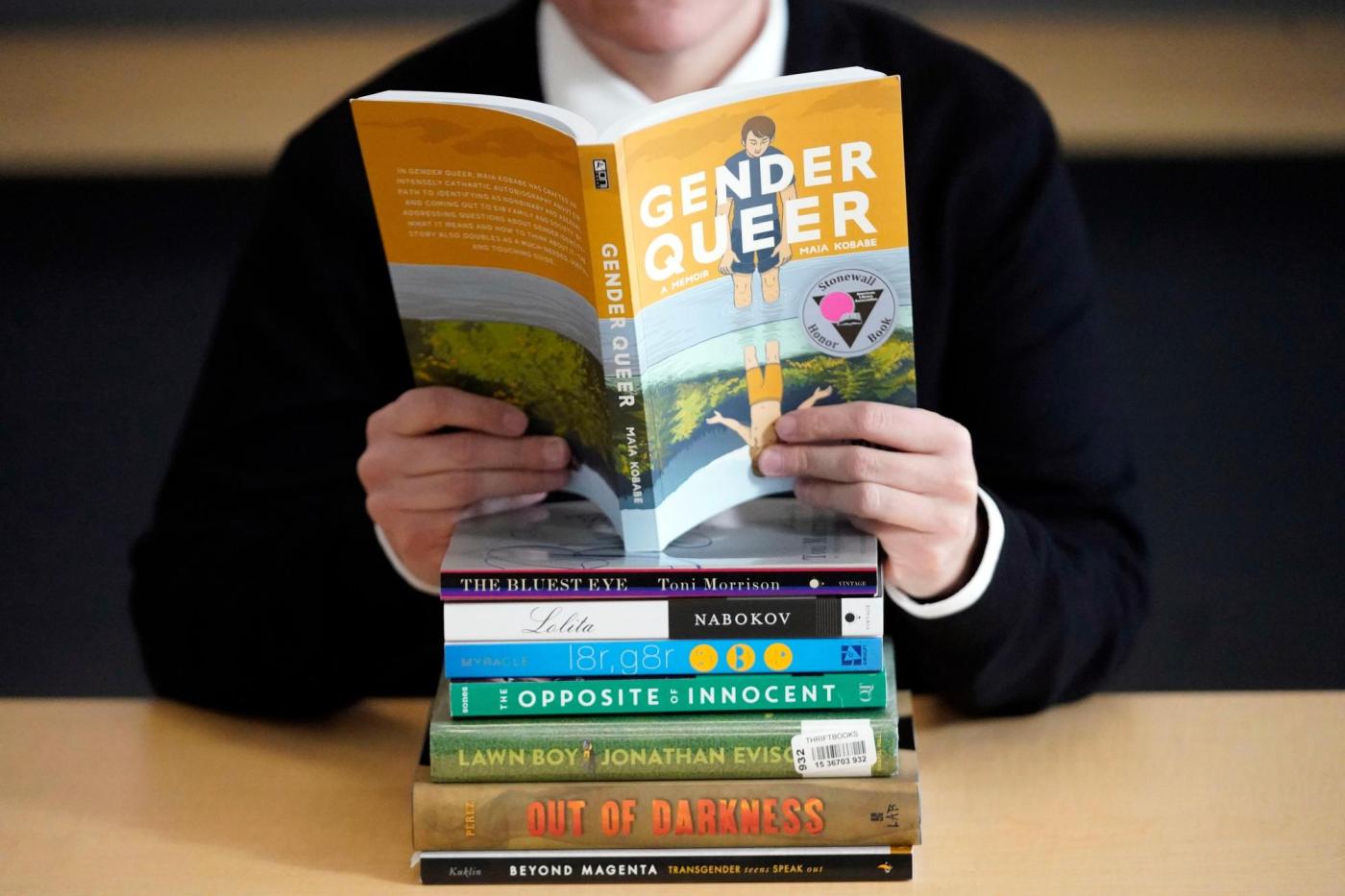
The ALA and PEN both say that most of the books targeted have racial or LGBTQIA+ themes, whether it’s Maia Kobabe’s “Gender Queen,” Toni Morrison’s “Beloved” and “The Bluest Eye” or Jonathan Evison’s “Lawn Boy.” While some complaints have come from liberals objecting to the racist language of “The Adventures of Huckleberry Finn” and other older works, the vast majority originate with conservatives and such organizations as Moms for Liberty.

The Iowa law, passed last year in the Republican-controlled statehouse, bans school libraries from carrying books that depict sex acts. The law also requires schools to publicize its library collection online and provide instructions for parents on how to request the removal of books or other materials. Many districts already had those systems in place.

After LGBTQIA+ youth, teachers and major publishers filed legal challenges, a federal judge in December put a temporary hold on key parts of the law, but it was lifted by a federal appeals court last month in an order that left room for challengers to seek a block again.

Records requests filed by the Des Moines Register with Iowa’s 325 districts showed nearly 3,400 books had been removed from school libraries to comply with the law before it was paused. In Davenport, which is among Iowa’s 10 largest districts and serves more than 12,000 students, Margaret Atwood’s “The Handmaid’s Tale,” Kabobe’s “Gender Queer” and Morrison’s “Bluest Eye” were among the nine books taken out of circulation.

After the law passed, staff were instructed to review books in their care available to students, district communications director Sarah Ott wrote in an email.

“If any books were preliminarily identified as potentially violating the new law, building staff referred the books to district administration for official review,” according to Ott. The district administration uses a process that was already in place to review materials and ensure compliance with the law, she said.

Banned Books Week, which runs through Sunday, was established in 1982 and features readings and displays of banned works. It is supported by the ALA, PEN, the Authors Guild, the National Book Foundation and more than a dozen other organizations. Filmmaker Ava Duvernay has been named honorary chair, and student activist Julia Garnett, who has opposed bans in her native Tennessee, is the youth honorary chair. Garnett was among 15 “Girls Leading Change” praised last fall by first lady Jill Biden during a White House ceremony.

“We observe Banned Books Week, but we don’t celebrate,” Caldwell-Stone said. “Banned books are the opposite of the freedoms promised by the First Amendment.”

___

Associated Press writer Hannah Fingerhut in Des Moines, Iowa, contributed to this report.

___

This story corrects the name of author Maia Kobabe.