“Both Moses, the ‘master builder’ of the urban renewal era, and Jacobs, the grassroots champion of small-scale urbanism, have left deep and lasting imprints on our city. But today, the debate over their visions is a diversion from broader truths about New York City’s history and present-day challenges.”
Jeanmarie Evelly
Robert Caro’s “The Power Broker,” which chronicles Robert Moses’ reshaping of New York City.
CityViews are readers’ opinions, not those of City Limits. Add your voice today!
We just marked the 50th anniversary of the publication of The Power Broker, the epic urbanist history that has helped generations of New Yorkers understand the warring visions of Robert Moses and Jane Jacobs.
And now it’s time to shut up about Moses vs. Jacobs.
Let me explain.
Both Moses, the “master builder” of the urban renewal era, and Jacobs, the grassroots champion of small-scale urbanism, have left deep and lasting imprints on our city. But today, the debate over their visions is a diversion from broader truths about New York City’s history and present-day challenges.
Why? The Moses-Jacobs clash occurred during the only period in history—going back centuries!—when New York City’s population was not growing. From 1940 through 1970, while these titans clashed over Washington Square Park and the Lower Manhattan Expressway, the number of people living in New York City remained essentially unchanged. In the 1970s, the city’s population plummeted. But since 1980 the number of New Yorkers has been steadily climbing, setting records in every Census since 2000.
Many consequential decisions about New York City were made through the lens of this uniquely stagnant mid-century period. Moses and Jacobs sparred over how to provide for a city that they figured was pretty much done growing. The authors of the city’s Zoning Resolution, adopted in 1961, agreed—it was the shape of the city, not its size, that they wanted to change. The suburbs were the center of growth and business investment. Thinkers saw the city as something that needed to be either reinvented or salvaged.
So they advocated approaches that modernized or preserved, but didn’t actually make room for more people. Moses could embrace demolishing as much housing as was built to remake neighborhoods; Jacobs could advocate for small-scale changes and rehabilitating existing buildings without mobilizing the massive resources needed to build much more.
New Yorkers have drawn many lessons from the Moses-Jacobs debate. We have discarded the savage urban renewal of the Moses era and the notion of replacing our historic fabric with new “towers in the park.” We have stitched together the holes gouged into neighborhoods through the disinvestment of the 1970s.
But economic success and the addition of nearly a million more New Yorkers has changed our reality and burst the seams of that fabric. Our city, always a magnet for opportunity-seekers from around the globe, has never been more unaffordable for people seeking to move or to remain here.
When the city’s population was flat, sprucing up buildings as they existed without adding more could be construed as bolstering communities and the city’s overall well-being. But in a growing city, it is a recipe for gentrification and displacement.
Jane Jacobs bought her house in 1947 for $7,000. It sold 15 years ago for $3.3 million, and it’s assessed today at twice that value. Every brick on this block of Hudson Street is precisely where it was when Jacobs lived there. But while she could celebrate the working-class “ballet of the street,” today the only people who can afford Hudson Street are those with season tickets to the ballet.
The razing of San Juan Hill in the 1950s to build the Lincoln Center neighborhood displaced tens of thousands of largely Puerto Rican residents—a terrible price for “renewal.” But today, every night, there are roughly five times this many New Yorkers sleeping in shelters. We also pay a terrible price for failing to address growing housing needs.
Recently, we heard home-owning neighbors question loudly why a new building on a large, vacant plot in Windsor Terrace, Brooklyn—one of the only lots in the neighborhood where new housing can be built without demolishing existing housing— needs to be significantly taller than the three-story houses that flank it.
They are asking questions that may have made sense a half-century ago. Why replace the city’s fabric when we can simply stitch it back together? But today, the question is not how to restore a tattered neighborhood. It is how to find places in a crowded and costly city to fit the additional housing we need. How much can suitably be located here, and how much must be placed elsewhere? How can we, as the current administration’s City of Yes for Housing Opportunity proposal puts it, add a little more housing in every neighborhood?
My organization’s research has documented how a series of downzonings, adopted over decades with the goal of slowing change, has made it virtually impossible to increase housing options available in New York City’s low-density neighborhoods. They have become the epicenter of our housing shortage, adding less new housing per capita than Detroit or Long Island. And as with Jacobs’s Hudson Street house, keeping the buildings the way they are has fueled escalating unaffordability, leaving residents skeptical that they or their families can afford to remain in their neighborhoods.
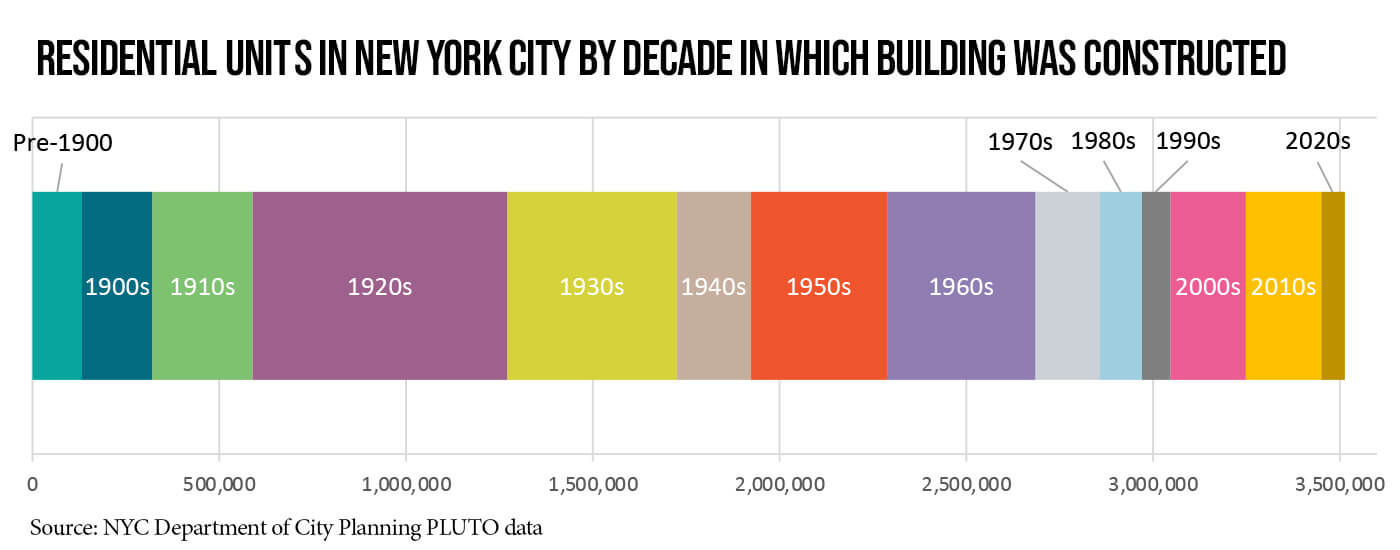
We can learn from looking further back in our history, to a time when the city embraced the challenges of growth. In the 1920s, New York City faced a severe housing shortage amidst a booming economy and surging population. A combination of flexible zoning and tax incentives kicked off the biggest building boom in the city’s history. To this day, more New Yorkers live in housing built during the 1920s than in any other decade.
So by all means, read about Moses and Jacobs (and watch West Side Story!). But when it comes to finding solutions to New York City’s present-day challenges, it’s well past time for us to turn the page.
Howard Slatkin is executive director of Citizens Housing and Planning Council, a nonprofit policy research organization, and former deputy executive director for strategic planning at the New York City Department of City Planning.