By LOLITA C. BALDOR
FORT JACKSON, South Carolina (AP) — After several very difficult years and a swath of new programs and enticements, the Army, Air Force, Marine Corps and Space Force will all meet their recruiting goals by the end of this month and the Navy will come very close, the military services say.
The results represent a slight uptick in young people joining the military, reversing a dismal trend as the services struggled to overcome severe restrictions on in-person recruiting mandated by the COVID-19 pandemic, the low unemployment rate and stiff competition from private companies able to pay more and provide similar or better benefits.
But Army leaders looking to the future worry that an expected drop in the youth population may signal more difficult times ahead. And other military officials say that while they are seeing improvements, they will still face tough challenges and must keep transforming their recruiting going forward.
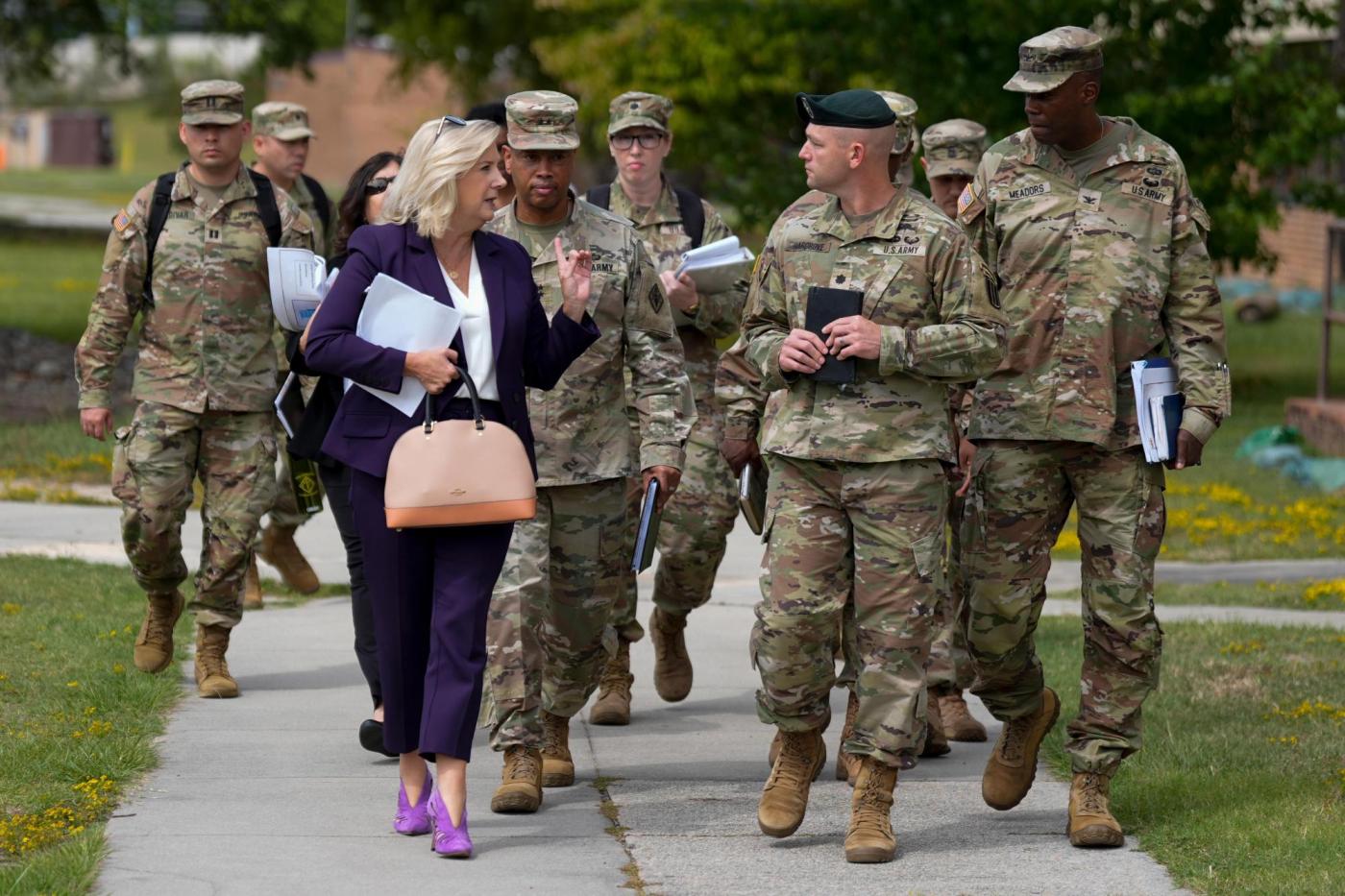
Army Secretary Christine Wormuth talks with soldiers at Fort Jackson, a U.S. Army Training Center, Wednesday, Sept. 25, 2024, in Columbia, S.C. (AP Photo/Chris Carlson)
Military leaders note that only about 23% of young adults are physically, mentally and morally qualified to serve without receiving some type of waiver. Moral behavior issues include drug use, gang ties or a criminal record. And of those qualified to serve, many are wary of taking on a job that puts their life or health at risk.
The Army has made the biggest comeback, after falling far short of recruiting goals for the past two years. Two years ago, the Army brought in 45,000 recruits, far less than the 60,000 it needed, and last year it again fell 15,000 short of what leaders publicly set as a “stretch goal” of 65,000 recruits.
This year, with a lower goal of 55,000, the service will meet its target, Army Secretary Christine Wormuth said Wednesday, and she plans to now set a higher goal for 2025.
“We not only met our goal, we exceeded it,” she said in an interview with The Associated Press. “Our goal was 55,000 new contracts and 5,000 young people in our delayed entry program. We exceeded that goal of 55,000 by a few hundred, and we put 11,000 young people into the delayed entry program, which is going to give our recruiters a really strong jumping-off point to start towards our recruiting target for next year.”
Army Secretary Christine Wormuth talks with soldiers at Fort Jackson, a U.S. Army Training Center, Wednesday, Sept. 25, 2024, in Columbia, S.C. (AP Photo/Chris Carlson)
Still, she noted, “the headwinds that we’ve been facing are not going to stop blowing.” Wormuth said that an expected drop of about 10% in the number of college-age young people in 2026 is a significant concern. The dip comes 18 years after the financial recession in 2008, which triggered a decrease in the number of children born.
It’s a big issue, she said, because the Army and the other services recruit from that population. And other challenges will also continue.
“I think we’re going to probably continue to see pretty low unemployment. We’re still going to see 60% go to college. It’s a more competitive labor market,” Wormuth said. “So we’re going to have to kind of keep fighting hard for our new recruits.”
A key to the recruiting success, she said, has been the Army’s future soldier prep course that gives lower-performing recruits up to 90 days of academic or fitness instruction to help them meet military standards. This year more than 13,000 recruits — or 24% of the 55,000 — came in through the program, which was started as a test two years ago.
A new recruit participates in the Army’s future soldier prep course that gives lower-performing recruits up to 90 days of academic or fitness instruction to help them meet military standards at Fort Jackson, a U.S. Army Training Center, Wednesday, Sept. 25, 2024, in Columbia, S.C. (AP Photo/Chris Carlson) call
The Navy is the only service that won’t hit its goal this year. While the service was able to sign up 40,600 recruits as hoped, the crush of last-minute enlistments means it won’t be able to get them all through boot camp by next month. As a result, the Navy will fall about 5,000 short of its target to get all of the recruits into the 10-week training course at Great Lakes, Illinois, by the end of the fiscal year.
“I’m excited that even though we can’t get everybody that we’ve signed up right now through boot camp by the end of this month, we now have a delayed entry pool for the beginning of next year, which will really prime the pump,” said Navy Adm. Lisa Franchetti, in an interview with The Associated Press.
The Navy fell short of its recruiting goal by about 7,000 last year, prompting leaders to take more dramatic steps than the other services. It has worked to greatly expand its pool of applicants by bringing in recruits who don’t have high school diplomas or a GED and by taking young adults who score very low on the armed services test. Both are rare steps that the other services greatly limit or avoid.
Army Secretary Christine Wormuth talks with soldiers at Fort Jackson, a U.S. Army Training Center, Wednesday, Sept. 25, 2024, in Columbia, S.C. (AP Photo/Chris Carlson)
Navy leaders also followed the Army and created a future sailor prep course that gives underperforming recruits academic or physical fitness training to help them qualify for enlistment. That course, said Franchetti, “is having really good results for our teammates that want to be in the Navy.”
The Air Force, which fell short of its recruiting target last year by about 10%, will hit its goal to recruit at least 27,100 this year while also managing to bolster its pool of delayed entry applicants and will start the next fiscal year with more than 13,000.
All of the services try to have a pool of applicants ready to go when they start the year, but they all had to dip heavily into that bank of recruits to make their numbers in recent years.
New recruits participate in the Army’s future soldier prep course that gives lower-performing recruits up to 90 days of academic or fitness instruction to help them meet military standards at Fort Jackson, a U.S. Army Training Center, Wednesday, Sept. 25, 2024, in Columbia, S.C. (AP Photo/Chris Carlson) call
Brig. Gen. Christopher Amrhein, who heads Air Force recruiting, told the AP that there wasn’t one “silver bullet” change and the service was able to make some adjustments “without actually changing the quality of the members that are coming in.”
The service expanded its ability to bring in legal permanent residents, beefed up its social media presence and has looked for improved partnerships with sports events, including NASCAR.
Related Articles
When the US left Kabul, these Americans tried to help Afghans left behind. It still haunts them
Takeaways from the AP’s review of Tim Walz’s descriptions of his military record
Walz’s military record under scrutiny as Vance, GOP question his service
Lawmakers push for more consideration into MDMA-assisted therapy for veterans
A Marine survived the attack on Pearl Harbor in WW2 — only to die in Saipan
“It was several initiatives, thoughts, discipline training, all working in harmony, plus some really hard work by our recruiters to have a very strong year,” he said, but added, “We’ve got to keep our foot on the gas on this. We’re not out of the woods.”
The Marine Corps and the tiny Space Force — the two smallest services — have consistently met their goals. The Space Force brought in 716 recruits — a bit more than its goal of 659.
And the Marine Corps hit its target of roughly 28,000 recruits, and for the first time since the COVID-19 pandemic will go into the next year with a larger delayed-entry pool than the previous year.
“Our recruiters, who are assigned to every ZIP code across the nation, knew this year would be challenging, but they never stopped fighting to accomplish the mission,” said Maj. Gen. William Bowers, head of Marine Corps Recruiting Command, adding that they “are going into the next fiscal year more confident, focused and determined to meet or exceed the 2025 mission.”