A Texas Pipeline Giant Is Backing a Regulatory Disaster

posted in: News | 0

A massive pipeline fire broke out last week outside of Houston, generating billowing black clouds of smoke that hovered over the industrialized suburb of Deer Park for multiple days. That fire began after an SUV hit a 20-inch-wide natural gas pipeline owned by Energy Transfer. The resulting explosion and fire killed the SUV driver, forced evacuations, and left hundreds of homes without power for nearly two days during a week of near-constant 90-degree heat. 

Energy Transfer, a corporate energy infrastructure giant, delayed issuing a response, including waiting more than three hours before confirming that it owned the exploded valve, misstating the amount of people injured by the fire, and seemingly refusing to answer questions from the public and the press. Unfortunately, this is par for the course for the company, also behind the Dakota Access Pipeline, and its infamous Executive Chairman (and ex-CEO) Kelcy Warren. 

Energy Transfer is one of the Fortune 500 companies headquartered in Texas, and Warren is its extremely politically connected co-founder. Warren is also one of the most generous donors in the Texas (and national) conservative political scene, and has funneled huge donations to politicians like Governor Greg Abbott, Lieutenant Governor Dan Patrick, and Attorney General Ken Paxton. Warren’s investments, unfortunately, seem to have paid off. In 2021, Energy Transfer and its execs profiteered $2.4 billion off of the February collapse of Texas’ electric grid, which resulted in the deaths of at least 246 Texans. Governor Abbott subsequently, and successfully, steered scrutiny away from Energy Transfer and other energy companies who were either responsible for or profited from the crash. Mere months later, Warren sent Abbott’s campaign a million-dollar check.

Warren and other Energy Transfer leaders and lawyers now seem poised to manipulate the system in favor of the pipeline company once again, this time in the federal courts. 

Prior to the recent raging pipeline fire in Texas, Energy Transfer was behind a very different disaster unfolding at the National Labor Relations Board (NLRB), the federal agency that often acts as a watchdog for labor unions and regularly fields and reviews complaints from union members nationwide. In 2022, an unidentified employee of Energy Transfer’s subsidiary La Grange Acquisition filed an unfair labor practice charge against the company, alleging that it had retaliated against him for complaining about unsafe working conditions, including “radioactive material and hazardous dust in work areas.” The NLRB opened an administrative case, investigating those claims and the subsequent allegation that he was fired in part for filing the complaint.

In 2024, Energy Transfer sued the NLRB, seeking to halt the administrative proceedings and joining SpaceX, Amazon, and other corporations in basically arguing that the board’s foundational structure is unconstitutional. That argument threatens the basic function of the NLRB (and other agencies like it) and could have sweeping consequences for its ability to conduct investigations or engage in basic enforcement actions for violations of labor rules and regulations. 

That suit ultimately landed in front of Judge Jeffrey Vincent Brown of the Southern District of Texas—a Trump appointee—who issued a preliminary injunction against the NLRB’s investigation into Energy Transfer in order to allow the company’s suit against the NLRB to proceed. 

Though the NLRB has nearly 90 years of case law supporting its structure and administrative court reviews, Brown’s ruling cited instead a recent Fifth Circuit ruling, Jarkesy v. U.S. Securities and Exchange Commission (SEC), which held that the SEC’s structure and enforcement procedures were unconstitutional. In July of this year, the Supreme Court partially affirmed Jarkesy, but remained silent on the Fifth Circuit’s ruling on the (un)constitutionality of the SEC’s administrative law judges, a structure that the commission shares with the NLRB—and many other federal agencies. 

When the Supreme Court does not affirm nor reject an aspect of a ruling issued by a lower court, the lower court’s ruling is functionally left in place, which now poses a serious threat to the basic functionality of the SEC and other federal regulatory agencies that are mandated to act as watchdogs over unscrupulous corporations and in defense of the public interest. Contradictory rulings on the issue from other federal judges have highlighted the conflicting precedents that have allowed the Fifth Circuit to activate an issue that had been deemed settled for decades. 

The crux of SCOTUS’s Jarkesy ruling doesn’t clearly apply to the NLRB’s powers or proceedings—the case addresses an entirely different agency with different powers and authorities. Even so, Brown was the second Texas-based federal judge to cite the Fifth Circuit’s Jarkesy decision in a ruling against the NLRB, thereby playing his part in right-wing attempts to render the agency—along with the rest of the federal regulatory administration—nonexistent. Brown’s judicial overreach is unsurprising for a lifetime appointee who has been described by civil rights leaders as a right-wing “ideological extremist.” 

Of course, Brown’s apparently eager weaponization of his court to aid Energy Transfer’s corporate interests may also be contextualized, or perhaps motivated, by the prior relationships Brown has to Energy Transfer, its proxies, and its execs. 

Before becoming a federal judge in 2019, Brown served as an elected member of the Supreme Court of Texas.

During Brown’s 2018 reelection bid, Kelcy Warren gave Brown’s campaign $6,250, making Warren Brown’s third largest individual contributor overall, according to information compiled by TransparencyUSA.org. In 2014, during his first successful campaign for the seat, Brown’s campaign received $25,000 from the Texas Oil & Gas Association (TXOGA). The company’s Vice President of Government Affairs currently serves on TXOGA’s Board of Directors

Energy Transfer was represented before Brown’s court by Amber Michelle Rogers, a partner at Hunton Andrews Kurth, LLP. Hunton Andrews Kurth’s PAC donated a whopping $43,000 to Brown’s various judicial campaigns, making the firm’s PAC one of Brown’s top five biggest donors, per FollowTheMoney.org. 

When the company filed an amicus brief at the Supreme Court supporting the court’s affirmation of the Fifth Circuit’s ruling in Jarkesy, it was represented by attorneys for Vinson & Elkins LLP. Vinson & Elkins’s PAC appears to be the third all-time biggest donor to Brown’s campaigns, contributing $63,500 over the course of his state judicial campaigns, according to data posted on FollowTheMoney.org.

Warren is also a member of the Horatio Alger Association, which has lavished gifts on Associate Supreme Court Justice Clarence Thomas, according to the New York Times.

The significant financial interconnections between Energy Transfer, the lawyers representing the pipeline company, and Brown’s past campaigns are incredibly concerning. 28 U.S. Code § 455(a) establishes that a judge “shall disqualify himself in any proceeding in which his impartiality might reasonably be questioned.” That same statute later dictates that, “He shall also disqualify himself” if he knows that he “has a financial interest in the subject matter in controversy or in a party to the proceeding, or any other interest that could be substantially affected by the outcome of the proceeding.” 

At minimum, the prior connections between Energy Transfer, its lawyers, and Judge Brown raise questions about Brown’s impartiality in this case. 

Yet, judicial ethics are largely predicated on self-reporting and enforcement standards, and Brown does not seem particularly concerned with the strictures of such a practice. An NPR investigation just this year found that he, along with two other Southern District of Texas judges, had failed to file a required form disclosing his attendance of a privately funded seminar. 

The case is far from settled, and it will now be heard by the Fifth Circuit with the NLRB’s appeal of Brown’s earlier ruling. What happens next is yet to be seen, but with the foundation of the government agency that historically has protected labor union members’ rights in the hands of a notoriously partisan court that previously attacked it, the outlook is not promising. 

District Energy St. Paul names new president, CEO as part of succession plan

posted in: News | 0

The CEO and president of engineering consulting firm Ever-Green Energy, Luke Gaalswyk, will become the next president and CEO of District Energy St. Paul.

District Energy St. Paul announced Sept. 24, 2024, that Luke Gaalswyk will become its next president and CEO, effective Oct. 1, 2024. (Courtesy of Ever-Green Energy)

Announced Tuesday, Gaalswyk’s appointment completes the succession plan for Ken Smith, who served as president and CEO of the two companies since 2010, according to a company news release.

District Energy St. Paul, the parent company of Ever-Green Energy, is a nonprofit utility that supplies energy to downtown St. Paul and the city’s West Side neighborhood, including heating more than 200 buildings and 300 single-family homes.

“I am grateful for the opportunity to lead these innovative and resilient organizations that are making a difference for our clients and for our communities with the important work that we do. It is an honor,” said Gaalswyk, who was brought on as president of Ever-Green Energy in September 2022, in the release.

Previously, Gaalswyk served in leadership roles in power generation and district energy industries with Xcel Energy and NRG Thermal, now known as Cordia. Gaalswyk, who holds master’s and bachelor’s degrees in mechanical engineering, served on active duty in the United States Air Force as a developmental engineer and is currently serving as an aircraft maintenance officer and drill status guardsman in the Minnesota Air National Guard, per the release.

Leadership transition

Smith, who first joined Ever-Green in 2006, was awarded the International District Energy Association’s highest honor with the Norman R. Taylor Award in 2022 for his leadership and lifelong commitment to energy efficiency and sustainable energy solutions.

A Fellow at the University of Minnesota’s Institute on the Environment, Smith also co-founded the Climate Smart Municipalities program in 2016, which, according to the release, would go on to win the National Sustainability Society’s 2024 Achievement Award in recognition of its ability to connect stakeholders in Germany and Minnesota to share expertise and accelerate the transition to climate-friendly solutions.

“It has been the honor of a lifetime to lead these two incredible organizations, and I could not be more excited for Ever-Green and District Energy’s futures,” Smith said in the release. “I look forward to watching the continued success that I know Luke will lead both companies through in the coming years.”

Gaalswyk will assume the additional role of president and CEO of District Energy St. Paul beginning Oct. 1 and Smith will stay on as a senior adviser through fall 2025.

Related Articles

Business |


St. Paul police: Lowertown artist’s killing was random, ‘cold-blooded’

Business |


Thanks to TikTok, people are rediscovering a 1991 hit by a St. Paul band

Business |


Key child care advocacy group stays mum on St. Paul’s child care subsidy ballot question

Business |


Letters: A ban on drive-throughs in St. Paul isn’t the answer. Here’s why

Business |


Woman working on art project fatally shot outside building in St. Paul’s Lowertown

Today in History: September 27, Christine Blasey Ford accuses Supreme Court nominee Brett Kavanaugh of sexual assault

posted in: News | 0

Today is Friday, Sept. 27, the 271st day of 2024. There are 95 days left in the year.

Today in history:

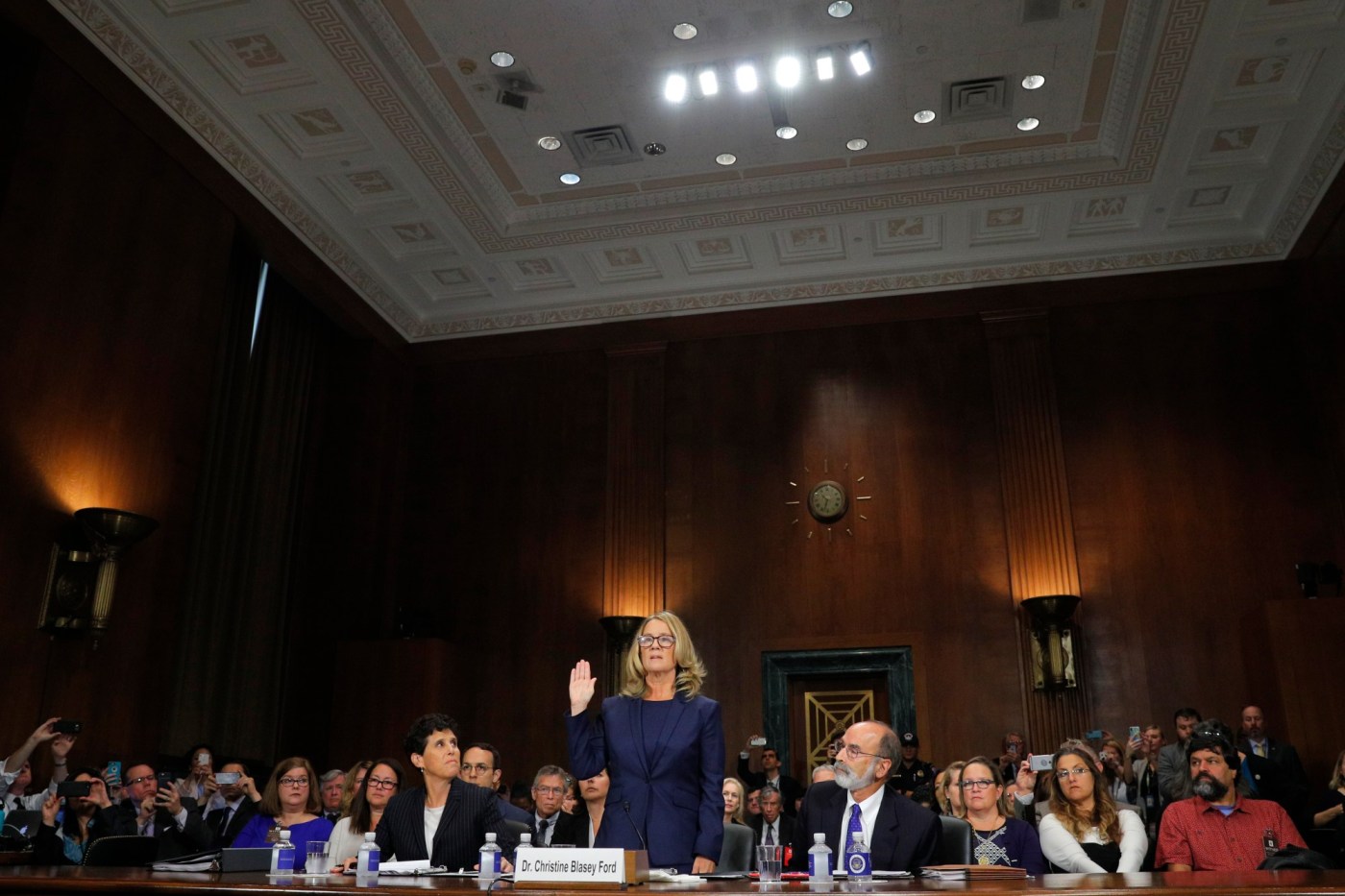
On Sept. 27, 2018, during a day-long hearing by the Senate Judiciary Committee, Christine Blasey Ford said she was “100 percent” certain that she was sexually assaulted by Supreme Court nominee Brett Kavanaugh when they were teenagers, and Kavanaugh then told senators that he was “100 percent certain” he had done no such thing.

Also on this date:

In 1779, John Adams was named by Congress to negotiate the Revolutionary War’s peace terms with Britain.

Related Articles


Today in History: September 26, Kennedy-Nixon face off in TV debate


Today in History: September 25, Bill Cosby sentenced in sexual assault case


Today in History: September 24, Protesting NFL players take a knee


Today in History: September 23, Tiger Woods wins 80th PGA Tour victory after back surgeries


Today in History: September 22, Lincoln issues preliminary Emancipation Proclamation

In 1903, a Southern Railway mail train derailed near Danville, Virginia, killing 11; the accident inspired the famous ballad, “Wreck of the Old 97.”

In 1939, Warsaw, Poland, surrendered after weeks of resistance to invading forces from Nazi Germany and the Soviet Union during World War II.

In 1940, Germany, Italy and Japan signed the Tripartite Pact, formally allying the World War II Axis powers.

In 1964, the government publicly released the report of the Warren Commission, which concluded that Lee Harvey Oswald had acted alone in assassinating President John F. Kennedy.

In 1979, Congress gave its final approval to forming the U.S. Department of Education.

In 1991, President George H.W. Bush announced in a nationally broadcast address that he was eliminating all U.S. battlefield nuclear weapons and called on the Soviet Union to match the gesture.

In 1994, more than 350 Republican congressional candidates gathered on the steps of the U.S. Capitol to sign the “Contract with America,” a 10-point platform they pledged to enact if voters sent a GOP majority to the House.

In 1996, in Afghanistan, the Taliban, a band of former seminary students, drove the government of President Burhanuddin Rabbani out of Kabul, captured the capital and executed former leader Najibullah.

In 2013, President Barack Obama and Iranian President Hassan Rouhani spoke by telephone, the first conversation between American and Iranian leaders in more than 30 years.

In 2021, R&B singer R. Kelly was convicted in a sex trafficking trial in New York, after decades of avoiding criminal responsibility for numerous allegations of misconduct with young women and children.

Today’s Birthdays:

Musician Randy Bachman (Bachman-Turner Overdrive) is 81.
Actor Liz Torres is 77.
Baseball Hall of Famer Mike Schmidt is 75.
Singer and actor Shaun Cassidy is 66.
Comedian Marc Maron is 61.
Actor Gwyneth Paltrow is 52.
Actor Indira Varma is 51.
Musician-actor Carrie Brownstein is 50.
Actor Anna Camp is 42.
Rapper Lil Wayne is 42.
Musician Avril Lavigne (AV’-rihl la-VEEN’) is 40.
Tennis player Simona Halep is 33.
Actor Jenna Ortega is 22.

Trudy Rubin: Will Biden seize last chance for tougher policy on Gaza deal and Ukraine victory?

posted in: Politics | 0

President Joe Biden’s farewell speech to the United Nations General Assembly was clearly not the speech he wanted to deliver.

He had hoped to announce the beginning of a cease-fire in Gaza in return for the release of Israeli hostages. That, in turn, could have halted the tit-for-tat fighting between Israel and Iran’s Lebanese proxy militia, Hezbollah, which claims it is firing across the Lebanese-Israeli border to support Hamas.

Instead, negotiations for such a deal are deadlocked, and Israel has newly plunged into a major cyber and air attack on Hezbollah that could draw in Iran and the United States. At the same time, the other major conflict roiling global stability — Russia’s aggressive war in Ukraine — has come to a critical juncture.

Biden’s speechwriters had to shift gears, with the president stressing his trademark optimism about the potential for resolving these conflicts — along with the pressing new threats from climate and world-changing new technologies like artificial intelligence — if nations work together.

But there was no escaping the fact that a negative outcome in Gaza and Ukraine will shred what remains of the U.N.’s tattered relevance to resolving conflicts — and will undermine the security of the United States.

Let me state up front that Biden’s foreign policy flaws pale beside those of Donald Trump on both issues. Trump’s unswerving support for Israel seems less tied to its security than to the evangelical votes it brings him — as well as to the Jewish votes he grossly demands (with antisemitic language) as a matter of gratitude. And were Trump reelected, he’d quickly hand Ukraine over to Vladimir Putin.

But back to Biden at the United Nations.

There was no point in his repeating forlorn hopes for a cease-fire/hostage deal without changing the U.S. approach toward Israel. Prime Minister Benjamin Netanyahu clearly opposes a deal, and constantly undermined the U.S., Egyptian, and Qatari negotiating teams, leaving Hamas free to reject any bargain.

Now that the Israel-Hezbollah conflict is dangerously expanding, a new approach to the Gaza war is vital but was tellingly missing from Biden’s message. A new U.N. approach is vital, as well.

Related Articles

Opinion |


Thomas Friedman: What should Israel do?

Opinion |


David J. Bobb: Do they even teach civics anymore?

Opinion |


Trudy Rubin: Joe Biden’s foreign policy legacy will go through Ukraine

Opinion |


Paul Krugman: Trump and Vance learned nothing from Obamacare

Opinion |


David French: MAGA wants transgression, and this is what comes with it

The U.N. has failed Israel badly when it comes to Lebanon. Iran has armed proxy militias in the Mideast, including the Hezbollah militia, which now possesses an estimated 150,000 missiles.

Yet, the United Nations Security Council has proven utterly unable to enforce its 2006 Resolution 1701, which demanded Hezbollah pull back from the Israeli border to the Litani River, creating an 18-mile buffer zone to keep northern Israel safe. Hezbollah has refused, and the Lebanese government and army are far too weak to challenge them. U.N. peacekeepers are at the militia’s mercy.

The result has been a disaster for northern Israel. After Hamas attacked on Oct. 7, Hezbollah joined the fight and drove tens of thousands of Israelis from their homes in northern Israeli cities and towns. Nearly 70,000 are still living in makeshift housing.

Israel’s military attack on Hezbollah may hold it temporarily at bay, but it won’t end its threat for the long term. Only a diplomatic deal — fulfilling Resolution 1701, creating a buffer zone, and backed by Arab nations and Security Council sanctions against Tehran — might force Iran to control its proxies.

However, no such progress is possible without parallel movement on Gaza. The Arab world, including states that have peace treaties with Israel, is aghast at the horrific Palestinian civilian suffering in the Gaza Strip, where most of the population is displaced and living without adequate food, sanitation, or shelter. Meantime, violent Israeli settlers are attacking West Bank villages, and far-right cabinet ministers call for Israel’s annexation of the West Bank and Gaza.

Down that road lies an endless cycle of violence between Israelis and Palestinians locked into one state, and the death of any prospects for the two-state solution Biden called for at the United Nations. That path also threatens Israel’s peace treaties with Jordan and Egypt.

There must be another way that combines a humane solution in Gaza with Arab support to rein in Hezbollah and Tehran. More than half the Israeli population, along with military and intelligence officials, want a cease-fire-for-hostages deal.

But that would require Biden to finally exert far more U.S. pressure on Netanyahu, including U.S. support for tough U.N. resolutions against whichever party refuses the Gaza deal — plus U.S. arms cuts for Israel if needed. It would also require strong U.N. and Western pressure on Iran.

No sign of such a policy shift was heard from Biden on Tuesday. Netanyahu is trying to outflank him and waiting for a Trump victory. But the president still has three months more in office to change course.

Similarly, a Biden shift is vital to obtaining a just peace for Ukraine. So is a significant U.N. role.

The most basic principle of the world body, enshrined in its charter, prohibits the use of force against the territorial integrity or sovereignty of any state.

Russia, which sits on the Security Council, has massively defied that principle by invading a peaceful neighbor, trying to annex at least 20% of its territory, and committing heinous war crimes. Ukrainian President Volodymyr Zelensky — who will meet with Biden on Thursday — rightly insists that any peace talks be based on the principles of the charter, not on Putin’s claim that Ukraine bows to his imperial right to take Ukrainian land as a basis for peace.

Here again, the relevance of the U.N. will be defined by whether it defends the principle on which it was created — the post-World War II effort to prevent dictators from expanding their territory by force. In a just world, the U.N. General Assembly would suspend Russia. And no Security Council reform, as is being discussed this week, will have meaning if Moscow retains a veto.

In his speech, Biden asked the right questions: “Will we apply and strengthen the core tenets of the international system, including the U.N. charter … as we seek to … deter new threats? Or will we allow those universal principles to be trampled?

“How we answer these questions in this moment will reverberate for generations.”

Yet, his foreign policy legacy will be defined by how he defends the principle of no gains through force. The immediate test: whether he gives Zelensky a green light to use U.S. long-range missiles to hit aerodromes and weapons depots inside Russia. This moment is critical for Ukraine.

If Biden refuses, he will have permitted a dictator to violate the basic principle required to maintain world order. And his U.N. speech will be recalled as a coda for a president who possessed all the right foreign policy instincts but failed to nail down the outcomes before he stepped down

Trudy Rubin is a columnist and editorial-board member for The Philadelphia Inquirer, P.O. Box 8263, Philadelphia, Pa. 19101. Her email address is trubin@phillynews.com