Recipes: These apple-based desserts are perfect for autumn

posted in: News | 0

I admit it. This isn’t the first time I’ve written about apple desserts in this column. I can’t help myself. I adore sweets that showcase this marvelous fall fruit.

Apple’s sweet-tart personality builds flavors that, in all fairness, are hard to beat this time of year. For the home cook, there is joy in the simplicity of apple-based desserts. Sure, there’s time spent coring and often peeling, but it can become a pleasing Zen-like motion.

When it comes to which apples to use, some varieties are best cooked while others are better eaten raw. Some are delicious eaten either way. Granny Smiths are often the first choice for baking. Their pucker-up tartness and crisp texture often makes them the first choice in tarts, pies or crisps. But don’t rule out the crunchy texture and sweeter flavor profiles of Fuji and Gala apples, Golden Delicious, Honeycrisp, and Pink Lady.

Spiced Apple Cake

The combination of spices in this rustic cake is beguiling. Cinnamon, nutmeg, and allspice team with Granny Smiths and golden raisins to make a delicious dessert. The apples aren’t peeled, an attribute that cuts down on prep time. The original recipe was problematic. The ratio of apples to batter was off, and it needed an additional egg. It’s delicious served with ice cream or whipped cream. Enjoy.

Yield: 8 to 10 servings

INGREDIENTS

8- to 9-inch springform pan
Soft butter for greasing pan
3 medium-sized Granny Smith apples, divided use
1 cup granulated sugar
1/2 cup (1 stick) melted butter, cooled
2 large eggs
1 1/4 cups all-purpose flour
1 teaspoon baking soda
1 teaspoon ground cinnamon
1/2 teaspoon ground nutmeg
1/2 teaspoon ground allspice
1/2 teaspoon salt
1/2 cup golden raisins
Cinnamon Sugar: 2 tablespoons granulated sugar mixed with 1 teaspoon ground cinnamon
Optional garnish: powdered sugar

DIRECTIONS

1.  Adjust oven rack to middle position. Preheat oven to 325 degrees. Use some soft butter to grease an 8- or 9-inch springform pan. Core and thinly slice apples (do NOT peel them). Set them aside in two piles, one pile with slices from two apples and one pile with slices from one apple.

2. In a large bowl, combine sugar, melted butter, and eggs. Stir well to combine (I use a silicone spatula). In a separate large bowl, combine flour, baking soda, cinnamon, nutmeg, allspice and salt; stir to combine with a whisk. Add flour mixture to sugar mixture; stir to thoroughly combine. Add the slices from 2 apples and raisins; stir to combine (yes, this takes some determination). Place mixture in prepared pan, scraping every bit of batter from the bowl with a silicone spatula. Use spatula to even out the surface, moving some batter to any empty spot next to the side of the pan. Arrange apples slices from the remaining apple on top of batter, arranging them slightly overlapping. Sprinkle top of cake with the sugar-cinnamon mixture.

3, Bake 20 minutes and press down the top apples gently with the back of a spoon or spatula so slices are anchored in the cake. Bake a total of 55 to 65 minutes, or until a toothpick inserted in center of cake comes out clean. Place on cooling rack for 10 minutes; run a thin knife around the edge of the cake; unlatch to release and remove the springform ring around the cake. Cool for 1 1/2 hours. Use a thin spatula under the cake just above the cakepan’s bottom to loosen it. Cut into wedges and use a spatula to transfer cake to plates and serve with ice cream or whipped cream. If you like, dust it with powdered sugar.

Cinnamon Bun Apple Pie

The folks at Food Network Magazine came up with this tasty apple pie adorned with a cinnamon-roll crust. To make it, they use a package of refrigerated pie dough. One round of dough is used to line the pie pan, the other is transformed into a special spiral-clad top crust. This round crust is buttered and covered with cinnamon sugar; it’s rolled into a tight log. Cut into 1/2-inch-thick crosswise slices, they are arranged in a circle and rolled out to form the top crust. Voila!

Yield: 6 to 8 servings

INGREDIENTS

One 14-ounce package refrigerated pie dough (package with 2 rounds)
All-purpose flour for dusting
2 tablespoons unsalted butter, at room temperature
1/2 cup granulated sugar, divided use
1 1/8 teaspoons ground cinnamon, divided use
5 assorted apples, such as McIntosh, Granny Smith, and Pink Lady (about 2 pounds)
Juice of 1 lemon
1 teaspoon vanilla extract
1 large egg, lightly beaten, for brushing edge of dough
2/3 cup powdered sugar
2 tablespoons milk, plus more if needed

DIRECTIONS

1. Place a baking sheet in oven and preheat to 400 degrees. Line a 9-inch pie pan with 1 round of refrigerated dough; refrigerate until ready to assemble.

2. Make the cinnamon-roll crust. Unroll the remaining round of dough on a lightly floured surface and spread with butter evenly on top. Combine 1/4 cup granulated sugar and 1 teaspoon cinnamon in a small bowl; sprinkle evenly over butter and gently press with fingers to help mixture adhere. Roll the pie dough into a tight log. Trim and discard about 1 1/2 inches from both ends (I would probably Take these trimmed pieces off and bake them for the kids). Cut the log crosswise into 1/2-inch thick slices. Arrange the pieces cut-side down in a snug circle on floured parchment paper. Lightly dust more flour, then gently roll out into a 10-inch round. Slide the parchment onto a second baking sheet and refrigerate until ready to assemble pie.

3. Peel, core, and thinly slice the apples. Toss with the lemon juice, vanilla, and the remaining 1/4 cup sugar and remaining 1/8 teaspoon cinnamon in a large bowl. Spoon apple mixture into dough lined pie plate. Invert the cinnamon-roll crust on top and peel off the parchment paper (it’s OK if the individual rounds separate a bit in the process). Pinch the edges of the crust together and fold the overhanging dough under itself and crimp. Brush with the beaten egg.

4. Set the pie on the hot baking sheet in the oven and bake until the crust is golden brown and the filling is bubbling, about 50 minutes. (Tent loosely with foil if the top is browning too quickly. Transfer to a rack to cool slightly.

5. Whisk powdered sugar and 2 tablespoons milk in a medium bowl until smooth; add more milk if the glaze is too thick. Drizzle over top of the pie.

Source: “Baking is Fun: 75 Great Cookies, Cakes, Pies and More” by Maile Carpenter and Editors of Food Network Magazine

Apple Crumble

Making an apple crumble that tastes primarily of apples starts with plenty of fruit. This beauty tosses 4 pounds of apples with 2 tablespoons of lemon juice to enhance the bright flavor. Adding just 2 tablespoons of brown sugar to the filling keeps the apples from tasting too sweet. Golden Delicious apples generally have a consistent sweet-side flavor profile, but this recipe also works with Braeburn or Honeycrisp apples or a mix of all three. You should have 4 pounds of apples before peeling and coring.

Yield:  6 to 8 servings

INGREDIENTS

4 pounds Golden Delicious apples, peeled, cored, and cut into ¾-inch pieces
1/2 cup packed (3 1/2 ounces) plus 2 tablespoons packed dark brown sugar, divided
2 tablespoons lemon juice
1 teaspoon table salt, divided
3/4 teaspoon ground cinnamon
1 cup (5 ounces) all-purpose flour
1/2 cup sliced almonds, chopped fine
6 tablespoons unsalted butter, melted
2 teaspoons vanilla extract
2 teaspoons water
For serving: ice cream of whipped cream

Cook’s notes:  Mounding the baking pan with a pile of apples ensures that there will be a substantial layer of fruit filling.

DIRECTIONS

1. Adjust oven racks to upper-middle and lowest positions and heat oven to 400 degrees. Toss apples, 2 tablespoons sugar, lemon juice, ½ teaspoon salt, and cinnamon together in large bowl. Transfer to 8-inch square baking pan with at least 2-inch sides and press into even layer. Cover pan tightly with aluminum foil and place on rimmed baking sheet. Transfer sheet to oven and bake on lower rack for 35 minutes.

2. While apples bake, whisk flour, almonds, remaining ½ cup sugar, and remaining ½ teaspoon salt in medium bowl until combined. Add melted butter, vanilla, and water and stir with spatula until clumps form and no dry flour remains.

3. Remove sheet from oven and smooth top of apples with spatula. If apples have not collapsed enough to leave at least ¼ inch of space below rim of pan, replace foil, return sheet to oven, and continue to bake 5 to 15 minutes longer.

4. Scatter topping evenly over apples, breaking up any clumps larger than a marble. Transfer sheet to upper rack and bake until topping is evenly browned and filling is just bubbling at edges, 25 to 35 minutes. Transfer pan to wire rack and let cool for at least 45 minutes before serving. If desired, serve with ice cream or whipped cream.

Source: Cook’s Illustrated, October 2019

Award-winning food writer Cathy Thomas has written three cookbooks, including “50 Best Plants on the Planet.” Follow her at @CathyThomas Cooks.com.

Related Articles

Restaurants, Food and Drink |


Preserving your summer harvest: Keeping tomatoes, peaches, berries and more all year long

Restaurants, Food and Drink |


Recipes: Make a New Orleans seafood boil as part of your Rosh Hashanah feast

Restaurants, Food and Drink |


Embrace sweet-spicy tamarind for an extra kick in everything from sauces to cocktails

Restaurants, Food and Drink |


Beyond apple pie: Creative ways to use your apple haul this year

Restaurants, Food and Drink |


Quick Fix: Singapore Noodles

Child care burst into the national spotlight at the Vance-Walz debate. Here’s why

posted in: News | 0

Jenny Gold and Kate Sequeira | Los Angeles Times (TNS)

The vice presidential candidates appeared to find some agreement during their Tuesday night debate over child care and paid family leave, in the longest and most in-depth campaign exchange about these issues to date.

In California and throughout the nation, these issues are key to improving quality of life for families that struggle to take time off to care for a newborn or ailing loved one, or to find affordable child care. Despite California’s significant investments in these areas, solutions still fall short of meeting the needs of many parents.

Republicans in Congress opposed President Biden’s ambitious 2021 plan to create an affordable child care system and a universal paid family leave benefit. Yet Sen. JD Vance — former President Donald Trump’s running mate — appeared to offer some support for both issues during the debate, voicing more moderate stances than he has in recent appearances.

“I think there is a bipartisan solution here because a lot of us care about this issue,” Vance said in response to a question from CBS News’ Margaret Brennan about a national paid leave program. As for the child care crisis, Vance agreed with Minnesota Gov. Tim Walz — Vice President Kamala Harris’ running mate — that the government needs to spend more money.

“We’re going to have to induce more people to want to provide child care options for American families because the reason it’s so expensive right now is because you’ve got way too few people providing this very essential service,” he said.

But this diagnosis of the child care market as a simple supply-side problem conflicts with how child care experts see it.

“It reveals a fundamental misunderstanding of the child care problem because it’s a broken market,” said Kathryn Anne Edwards, a labor economist and policy consultant who studies the child care market.

Meanwhile, Vance’s solution — that the problem can be solved by offering families more choice of who can provide care for their children — is something the government already does. And under the current system, low-income families can use subsidies provided by the government to pay for the child care of their choice, including faith-based providers and care provided by a relative or friend.

Why is child care so expensive in the U.S.?

Child care is often described as a “broken market” for good reason: Child care employees are some of the lowest-paid workers in the economy, at an average of $13.22 an hour, yet despite these low wages, the price of care is astronomical for families.

In California, for example, placing an infant in a private child care center cost an average of $19,547 per year in 2021, according to the nonprofit Child Care Aware. That’s 15% of the median income for a married couple in the state, and 47.6% of the median income for a single parent.

There are shortages of care in many places, including Los Angeles. But while Vance’s suggestion to expand supply might help more families find care, it is unlikely to significantly bring down costs.

Related Articles

National Politics |


These Americans naturalized just in time to vote. Many can’t wait to cast a ballot

National Politics |


Key passages from latest filing in federal election case against Trump

National Politics |


What’s next in Trump’s 2020 election interference case

National Politics |


Former Colorado county clerk Tina Peters sentenced to 9 years for voting data scheme

National Politics |


Trump said, ‘So what?’ when told of Pence’s peril during Jan. 6 Capitol riot, US says

That’s because the biggest problem is that child care costs more to provide than families can afford to pay. There aren’t many opportunities to trim costs, because the job of a child care worker can’t be automated and employers can’t pay them any less. Workers are already fleeing the profession in search of higher wages in retail or fast food.

Meanwhile, Edwards says, there isn’t a line of people waiting to open child care centers, because it’s not a profitable business.

Walz was not asked directly about child care, but addressed it in a question about paid family leave in somewhat vague terms, saying that child care workers needed higher wages, and families more support to pay for care.

“You can’t expect the most important people in our lives to take care of our children or our parents to get paid the least amount of money,” he said. “And we have to make it easier for folks to be able to get into that business and then to make sure that folks are able to pay for that.”

In the Democratic plan, this would mean the federal government subsidizing care for more families.

Moving the child care system from a “profit model” to a “reimbursement model,” in which the government pays child care workers what it costs for them to provide the care is “the only solution for child care,” Edwards said. “Workers are not going to get cheaper, care is not going to get cheaper, and more people aren’t going to enter the market.”

What can families spend their child care assistance on?

The government already provides subsidies to low-income families to help cover child care costs; families can also attend free government-funded programs including Head Start and state preschools. Seventeen percent of children younger than 5 in California are served by government-subsidized child care programs.

The federal government helps fund subsidies for families earning a maximum of 85% of their state’s median income — $104,544 for a family of four in California — through the Child Care and Development Block Grant, though many states cap it far lower.

During the debate, Vance said these subsidies fund only “one kind of child care model. Let’s say you’d like your church, maybe, to help you out with child care. Maybe you live in a rural area or an urban area, and you’d like to get together with families in your neighborhood to provide child care in the way that makes the most sense. You don’t get access to any of these federal monies.”

This is false.

The government allows subsidies from the block grant program — in the form of vouchers to families — to be used for a variety of options — including both churches and care provided by a family member, friend or neighbor.

The block grant was created as a “pro-choice federal program” by Republican President George H.W. Bush in 1990, said Bruce Fuller, a UC Berkeley professor of education and public policy. “The idea that the government disincentivizes using grandma is just incorrect.”

The problem is that the available vouchers are not nearly enough to meet the need. Of the nearly 6.3 million children ages 5 and younger in the U.S. whose families qualify for these subsidies, fewer than 840,000 receive it, or about 13%. There are often long lists of families waiting for a voucher to become available, including in California.

Meanwhile, families in the middle class are generally left paying sticker price.

What do Democrats propose as a child care solution?

In September during an interview with members of the National Association of Black Journalists, Harris announced a child care plan proposing that working families would not pay more than 7% of their income for child care.

The 7% cap idea isn’t new. It was proposed in 2021 in Biden’s Build Back Better bill, which Congress failed to pass.

The plan would have established a universal preschool program and capped a family’s child care spending at 7% of income for anyone earning up to 250% of state median income. In California, that’s more than $277,000 for a family of four. Families earning more would have continued to pay full price. The overhaul would have cost an estimated $380 billion over six years.

Meanwhile, a separate proposal mentioned in the 2024 Democratic Party platform would instead cap family costs at $10 a day.

What do Republicans propose as a solution for child care?

Trump has not yet offered details for improving the child care system, and the GOP campaign platform does not mention the issue.

“Child care is child care, it’s something you have to have in this country. You have to have it,” Trump told business leaders at the Economic Club of New York. His proposed tax on imports from foreign nations at higher levels, he said, would “take care” of such problems.

Vance supported this plan during the vice presidential debate. “I think what President Trump is saying is that when we bring in this additional revenue with higher economic growth, we’re going to be able to provide paid family leave, child care options that are viable and workable for a lot of American families.

Why doesn’t the U.S. have national paid family leave?

The U.S. is one of only a few countries that does not guarantee paid leave nationally. Only Washington, D.C., and 13 states — including California — have passed such legislation. But the issue has bipartisan support from voters, according to Laura Narefsky, senior counsel for education and workplace justice at the National Women’s Law Center.

“This is not a polarizing issue for the American people, because at some point everyone has had to give or provide care,” Narefsky said.

Walz, who called paid family leave a “Day One” issue at the debate, touts a program he signed into law in Minnesota that will provide up to 20 weeks in a year for family and medical leave. The program, which will go into effect in 2026, will be funded by a payroll tax shared between workers and employers.

Vance did not say whether there should be a national law but agreed that paid family leave is a “bipartisan issue,” saying that his wife, an attorney, benefited from such a policy from her employer.

Currently, the federal government guarantees up to 12 weeks of unpaid but job-protected family and medical leave for eligible employees. In 2019, Trump also signed into law up to 12 weeks of paid parental leave for qualifying federal employees.

A national paid leave law has been shot down multiple times over the last several decades. An iteration of it made it into the failed Build Back Better bill before getting slashed.

And though Trump was the first Republican president to call for paid family leave, proposed programs during his administration did not receive bipartisan support in part because of their approaches to funding, which required families to borrow against their future selves.

A bill to provide 12 weeks of paid leave was reintroduced to Congress in May 2023.

How does paid family leave work in California?

California is home to the oldest paid family leave program in the country, which it has continued to tweak since its passage in 2002. Starting in January, the state is increasing how much a worker can collect while on family or medical leave as part of an effort to ensure low-wage workers can afford to take it.

Those who earn up to $60,000 a year will be able to get 90% of their income replaced while on family or medical leave in California, up from 60%. Workers who earn more will be able to collect 70%.

To help make up for the increase, California is removing the ceiling on the payroll tax, requiring higher-income earners to contribute the same 1.1% of their earnings as everyone else rather than capping the tax when their wages reach $153,164.

Though most states with paid leave offer up to 12 weeks, California lags behind. The state expanded paid family leave from six to eight weeks in 2020. Despite that, California does have one of the lowest barriers to entry, according to Jenya Cassidy, director of the California Work & Family Coalition. Anyone who earns at least $300 in a year and contributes to state disability insurance is eligible for the benefits.

This article is part of The Times’ early childhood education initiative, focusing on the learning and development of California children from birth to age 5. For more information about the initiative and its philanthropic funders, go to latimes.com/earlyed.

©2024 Los Angeles Times. Visit at latimes.com. Distributed by Tribune Content Agency, LLC.

More restrooms have adult-size changing tables to help people with disabilities

posted in: News | 0

By Tony Leys | KFF Health News

ADAIR, Iowa — The blue-and-white highway sign for the eastbound rest stop near here displays more than the standard icon of a person in a wheelchair, indicating facilities are accessible to people who can’t walk. The sign also shows a person standing behind a horizontal rectangle, preparing to perform a task.

The second icon signals that this rest area along Interstate 80 in western Iowa has a bathroom equipped with a full-size changing table, making it an oasis for adults and older children who use diapers because of disabilities.

“It’s a beacon of hope,” said Nancy Baker Curtis, whose 9-year-old son, Charlie, has a disability that can leave him incontinent. “I’m like, ‘Oh my gosh, we’re finally there.’”

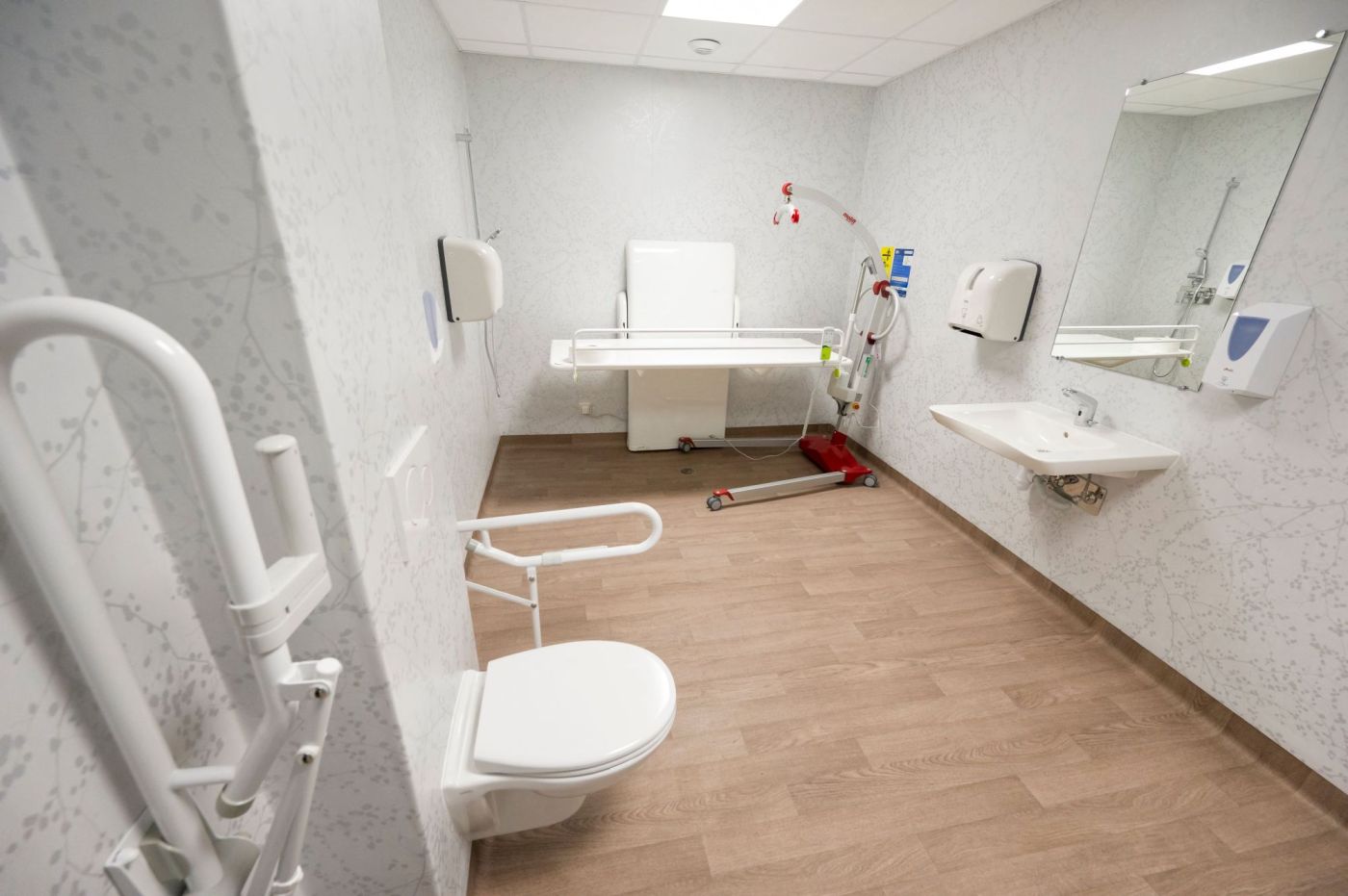
The white changing table is 6 feet long and can be lowered and raised with a handheld controller wired to an electric motor. When not in use, the table folds up against the wall.

The table was recently installed as part of a national effort to make public bathrooms more accessible in places like airports, parks, arenas, and gas stations. Without such options, people with disabilities often wind up being changed on bathroom floors, in cars, or even on the ground outside.

Many families hesitate to go out because of the lack of accessible restrooms. “We all know somebody who’s tethered to their home by bathroom needs,” Baker Curtis said. She doesn’t want her son’s life to be limited that way. “Charlie deserves to be out in the community.”

She said the need can be particularly acute when people are traveling in rural areas, where bathroom options are sparse.

Baker Curtis, who lives near Des Moines, leads the Iowa chapter of a national group called “Changing Spaces,” which advocates for adult-size changing tables. The group offers an online map showing scores of locations where they’ve been installed.

Related Articles

Health |


Stillwater sophomore goes into cardiac arrest during football practice; family raises money for CPR training

Health |


Suni Lee reveals new details about her kidney disease in Glamour woman of the year interview

Health |


US school-entry vaccination rates fall as exemptions keep rising

Health |


A few rural towns are bucking the trend and building new hospitals

Health |


Medicare changes for 2025: What you need to know

Advocates say such tables are not explicitly required by the federal Americans with Disabilities Act. But a new federal law will mandate them in many airports in coming years, and states can adopt building codes that call for them. California, for example, requires them in new or renovated auditoriums, arenas, amusement parks, and similar facilities with capacities of at least 2,500 people. Ohio requires them in some settings, including large public facilities and highway rest stops. Arizona, Illinois, Maryland, Minnesota, and New Hampshire also have taken steps to require them in some public buildings.

Justin Boatner of Arlington, Virginia, advocates for more full-size changing tables in the Washington, D.C., area. Boatner, 26, uses a wheelchair because of a disability similar to muscular dystrophy. He uses diapers, which he often changes himself.

He can lower an adjustable changing table to the height of his wheelchair, then pull himself onto it. Doing that is much easier and more hygienic than getting down on the floor, changing himself, and then crawling back into the wheelchair, he said.

Boatner said it’s important to talk about incontinence, even though it can be embarrassing. “There’s so much stigma around it,” he said.

He said adult changing tables are still scarce, including in health care facilities, but he’s optimistic that more will be installed. Without them, he sometimes delays changing his diaper for hours until he can get home. That has led to serious rashes, he said. “It’s extremely uncomfortable.”

Iowa legislators in recent years have considered requiring adult changing tables in some public restrooms. They declined to pass such a bill, but the discussion made Iowa Department of Transportation leaders aware of the problem. “I’m sorry to say, it was one of those things we’d just never thought of,” said Michael Kennerly, director of the department’s design bureau.

Kennerly oversees planning for rest stops. He recalls an Iowan telling him about changing a family member outside in the rain, with only an umbrella for shelter. Others told him how they changed their loved ones on bathroom floors. “It was just appalling,” he said.

Iowa began installing adult changing tables in rest stops in 2022, and it has committed to including them in new or remodeled facilities. So far, nine have been installed or are in the process of being added. Nine others are planned, with more to come, Kennerly said. Iowa has 38 rest areas equipped with bathrooms.

Kennerly estimated it costs up to $14,000 to remodel an existing rest-stop bathroom to include a height-adjustable adult changing table. Incorporating adult changing tables into a new rest stop building should cost less than that, he said.

Several organizations offer portable changing tables, which can be set up at public events. Some are included in mobile, accessible bathrooms carried on trailers or trucks. Most permanent adult changing tables are set up in “family restrooms,” which have one toilet and are open to people of any gender. That’s good, because the act of changing an adult is “very intimate and private,” Baker Curtis said. It’s also important for the tables to be height-adjustable because it’s difficult to lift an adult onto a fixed-height table, she said.

Advocates hope adult changing tables will become nearly as common as infant changing tables, which once were rare in public bathrooms.

Jennifer Corcoran, who lives near Dayton, Ohio, has been advocating for adult changing tables for a decade and has seen interest rise in recent years.

Corcoran’s 24-year-old son, Matthew, was born with brain development issues. He uses a wheelchair and is unable to speak, but he accompanies her when she lobbies for improved services.

Corcoran said Ohio leaders this year designated $4.4 million in federal pandemic relief money to be distributed as grants for changing-table projects. The program has led to installations at Dayton’s airport and art museum, plus libraries and entertainment venues, she said.

Ohio also is adding adult changing tables to rest stops. Corcoran said those tables are priceless because they make it easier for people with disabilities to travel. “Matthew hasn’t been on a vacation outside of Ohio for more than five years,” she said.

Kaylan Dunlap serves on a committee that has worked to add changing-table requirements to the International Building Code, which state and local officials often use as a model for their rules.

Dunlap, who lives in Alabama, works for an architecture firm and reviews building projects to ensure they comply with access standards. She expects more public agencies and companies will voluntarily install changing tables. Maybe someday they will be a routine part of public bathrooms, she said. “But I think that’s a long way out in the future, unfortunately.”

KFF Health News is a national newsroom that produces in-depth journalism about health issues and is one of the core operating programs at KFF—an independent source of health policy research, polling, and journalism. Learn more about KFF.

Today in History: October 4, Janis Joplin found dead

posted in: News | 0

Today is Friday, Oct. 4, the 278th day of 2024. There are 88 days left in the year.

Today in history:

On Oct. 4, 1970, rock singer Janis Joplin was found dead in her Hollywood hotel room at age 27.

Also on this date:

In 1777, Gen. George Washington’s troops launched an assault on the British at Germantown, Pennsylvania, resulting in heavy American casualties.

Related Articles


Scandia Historic Homes Tour features original Swedish settler’s log cabin


Today in History: October 3, O.J. Simpson found not guilty of murder


Today in History: October 2, Marshall joins Supreme Court


Today in History: October 1, Las Vegas music festival shooting


Today in History: September 30, Berlin Airlift concludes

In 1927, sculptor Gutzon Borglum began construction on what is now Mount Rushmore National Memorial.

In 1957, the Space Age began as the Soviet Union launched Sputnik 1, the first artificial satellite, into orbit.

In 1965, Pope Paul VI became the first pope to visit the Western Hemisphere as he addressed the U.N. General Assembly.

In 2001, a Russian airliner flying from Israel to Siberia was accidentally downed by a Ukrainian anti-aircraft missile over the Black Sea, killing all 78 people aboard.

In 2002, “American Taliban” John Walker Lindh received a 20-year sentence after a sobbing plea for forgiveness before a federal judge in Alexandria, Virginia. (He was released from prison in May, 2019.)

In 2004, the SpaceShipOne rocket plane broke through Earth’s atmosphere to the edge of space for the second time in five days, capturing the $10 million Ansari X prize aimed at opening the final frontier to tourists.

Today’s Birthdays:

Baseball Hall of Fame manager Tony La Russa is 80.
Actor Susan Sarandon is 78.
Actor Armand Assante is 75.
Actor Christoph Waltz is 68.
Singer Jon Secada is 63.
Actor Liev Schreiber is 57.
Actor Abraham Benrubi is 55.
Actor Alicia Silverstone is 48.
Actor Caitríona Balfe is 45.
Actor Rachael Leigh Cook is 45.
Actor Melissa Benoist is 36.
NBA All-Star Derrick Rose is 36.
Actor Dakota Johnson is 35.