Books, like socks, give themselves away behind holiday wrapping. Nothing more so than a coffee table book. Or a beloved classic in hardcover. I’m not saying giving these are bad ideas. I’m saying the surprise is the gift itself. Choose well. Shock. Fascinate. Warm a cockle. It’s not easy, but what follows should ease the deliberation. A number of these books are pricey, but found online at deep discounts. A number are also, for the right person, a gift that never leaves their possession, never finds itself in a thrift store, never even gets lent out.
They’re too personal.
For the right recipient, there’s a not a sock under this tree:
For Someone in Need of Chicago-Bred Inspiration
The time couldn’t be better for “Elizabeth Catlett: A Black Revolutionary Artist and All That It Implies” ($65), the catalog for the decades-spanning exhibition of the Chicago-trained, politically-charged artist, arriving at the Art Institute of Chicago this August. “Patti Smith/Lynn Goldsmith: Before Easter After” ($65) is Goldsmith’s late 1970s images of Smith at the peak of fame, broken up with memoir and poetry by Smith (who spent part of her childhood living in Logan Square). Fifty years later, it’s a master class in effortless cool.
Left to right: “Patti Smith” by Lynn Goldsmith, “When Two or More are Gathered Together” by Neal Slavin, “Secret Pioneer of American Comics” by Frank Johnson, and “The Acme Novelty Date Book” 2002-2023. (Stacey Wescott/Chicago Tribune)
For ‘90s Hipsters, Now Middle-Aged
“The Lumpen Times: 30+ Years of Radical Media and Building Communities of the Future” ($60) is a phonebook-sized ode to one of Chicago’s great cage-rattling magazines. It’s still around, but remember those gray stacks of Lumpen all over town? This is a poke through every provocative, hilarious issue, with essays from muckrackers who made it happen. Slicker, yet no less prescient: “Giant Robot: Thirty Years of Defining Asian American Pop Culture” ($50) is a gorgeously designed greatest articles set from Giant Robot magazine, with articles celebrating Asian liquor stores and street style. Not much here feels dated.
For the Posterity-Minded Gift Giver
There’s a lot of reissued, recovered classics, but the standard is England’s Folio Society. I can’t think of better recent examples than its playfully illustrated new edition of “The Nutcracker” ($70), as written by Alexandre Dumas (the basis, of course, for the more famous holiday ballet); and “Witch Week” ($70), a 1982 British children’s favorite by Diana Wynne Jones, overdo for American love. It tells the story of a young witch at a boarding school — predating Harry you know who by 15 years.
Two Folio Society slipcase books, “Witch Week” by Diana Wynne Jones, left, and “The Nutcracker” on the right. (Stacey Wescott/Chicago Tribune)
For the Relentless Chicago Booster
Nobody loves Chicago like people who can’t shut up about loving Chicago. To a coffee table already heavy with Chicago art books, add “Above & Across Chicago” ($45), aerial photos of parks and harbors that capture the revealing geometry of urban spaces. Local photographer Sandra Steinbrecher’s “The Salt Shed” ($45) is a stage-by-stage photo essay (with context from Chicago History Museum’s Paul Durica) on the restoration of the Morton Salt building into a popular concert hall. Few Chicago coffee tables are untouched by Patrick F. Cannon, whose latest, “Louis Sullivan: An American Architect” ($50) has photos by James Caulfield that offer lost nooks, and notes of neglect.
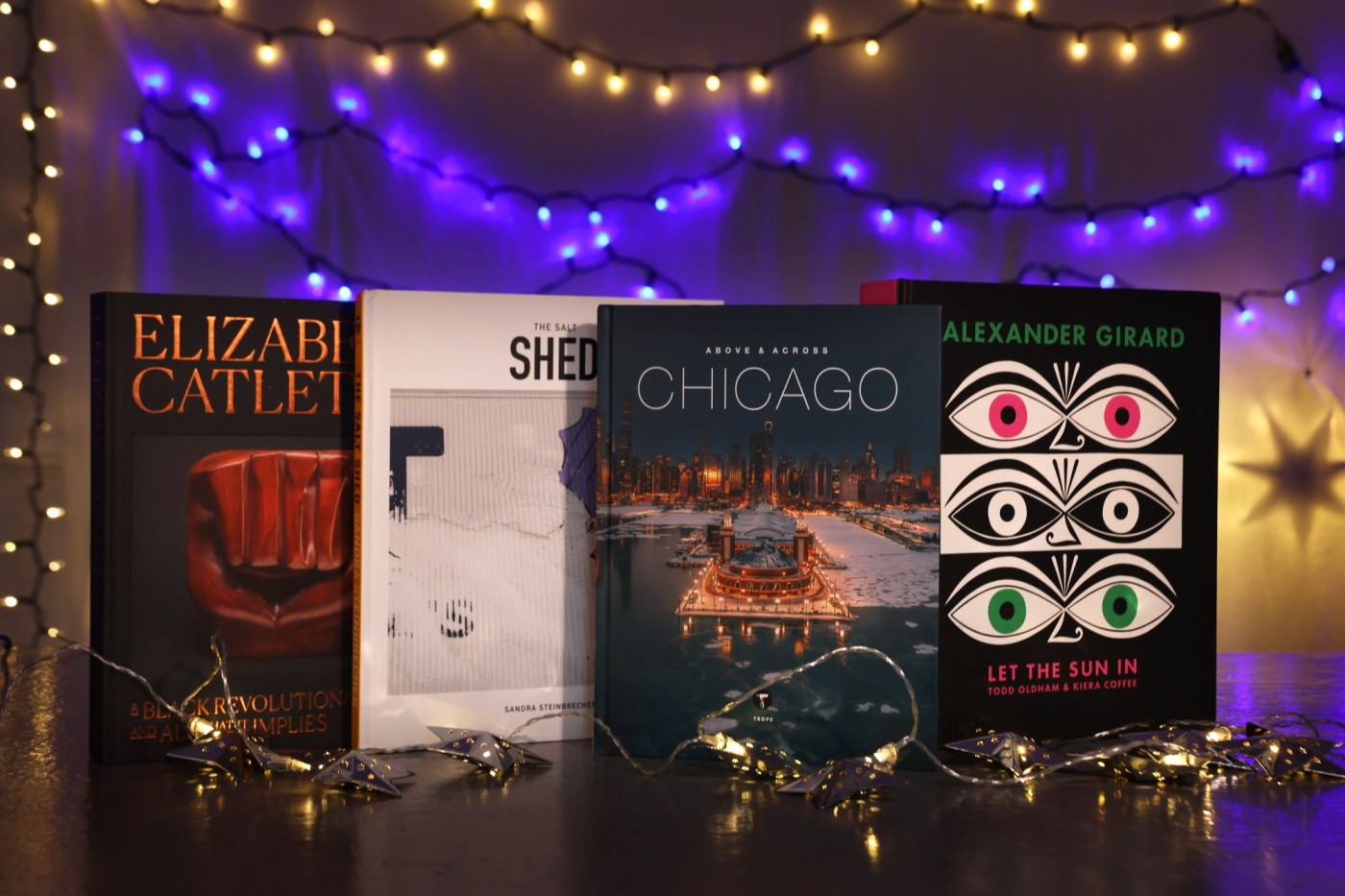
Left to right: “The Salt Shed” by Sandra Steinbrecher, “Above & Across Chicago,” “Elizabeth Catlett,” “The 1619 Project,” and “Alexander Girard” by Todd Oldham and Kiera Coffee. (Stacey Wescott/Chicago Tribune)
For Latino History
In the spirit of its landmark 2020 anthology of Black poetry, Library of America’s “Latino Poetry” ($40) collects 180 poets (including works by Chicago’s Sandra Cisneros) into an unprecedented meal — ideal for noshing, one poem at a time. “The Day of the Dead: A Celebration of Death and Life” ($65) is the best kind of coffee table history, wrapping everything you would want to know about the holiday (its origins, its skeleton creators, etc.) around strikingly colorful images of regional traditions.
Left ro right:”Didion,” “The Best American Science and Nature Writing,” The Best American Food and Travel Writing,” James Baldwin a three-set series of his novels “Go Tell It On The Mountain,” “Giovannie’s Room,” and “If Beasle Street Could Talk,” “Latino Poetry,” and “The Day of the Dead.” (Stacey Wescott/Chicago Tribune)
For the Moviegoer Who Won’t Stream
A pair of Hollywood books in Cinemascope. “1001 Movie Posters: Designs of the Times” ($95) is so physically large it could double as the headstone for this fading art. More than 600 pages of well-chosen examples are assembled, with artist backgrounds, from purely studio-made workmanship to the stylized painted flyers promoting exploitation flicks. “Life: Hollywood” ($250) is two hefty volumes of essentially lost photo essays from the once mighty magazine, covering milestones (the rise of Brando, the making of “African Queen”) and surprising stops (union meetings). Produced with zeal by Taschen, even the heavy paper it’s printed on feels considered, and not unlike “1001 Movie Posters,” it’s less a traditional history than an urgent argument for saving a medium itself.
“Hollywood” is two large 15-inch photo books of hundreds of photos of celebrities taken from Life Magazine between 1936 and 1972. “Magnum America” includes hundreds of images from 1940s through the present. “1001 Movie Posters” are images from more than a century. (Stacey Wescott/Chicago Tribune)
For Ballers
If you can, ignore the rankings of “The Basketball 100: The Story of the Greatest Players in NBA History” ($40). Like similar recent books on baseball and football, it’s a loose, pointillist vehicle into a history of the game itself (written by Athletic staff). Yes, Chicago is well represented, from Michael Jordan (no. 1.) to Artis Gilmore (no. 94). “Courtside: 40 Years of NBA Photography” ($55) is the portfolio of official NBA shooter Nathaniel Butler. There’s zero chronology, but a ton of image shaping.
For Armchair Art Appreciators
I really like Phaidon’s broad surveys, pairing one work with a brief bio. Its latest may be the best yet: “Great Women Sculptors” ($70) touches on famous names (Jenny Holzer) but I bet for many art lovers, there’s lots to discover. Like the puppets of Greer Lankton, a transgender Chicago-based artist who died in 1996 at 38. “National Gallery of Art Collections” ($85), the first survey of the Washington, D.C., institution in decades, lets the work talk, offering little commentary. It’s classic coffee table, hard to stop flipping: Here are sizable reproductions of a little bit of everything, Mary Cassatt, Kara Walker, Titian, Degas — contemporary to 13th century.
For Marvel Fans Who Think They’ve Seen It All
“Mighty Marvel Calendar Book” ($50) gathers every page of the seven years of original work created for Marvel calendars (including a playful Bicentennial calendar in 1976), which were no corporate afterthoughts. Same goes for the pure joy of “Godzilla: The Original Marvel Years” ($100), presented in big heavy pages of bright Saturday morning cartoon color, collecting the entire 24-issue series that ran in the late 1970s. “Fantastic Four: Full Circle (Expanded Edition)” ($65) is actually very expanded, including seemingly every sketch, variant and inspiration that went into Chicago artist Alex Ross’ 2023 bestseller.
Left ro right: “Godzilla, the Original Marvel Years,” “The Mighty Marvel Calendar Book” by Chris Ryall, and “Secret Pioneer of American Comics” by Frank Johnson. (Stacey Wescott/Chicago Tribune)
For Budding Biographers
Remember Little Golden Books? Started during World War II, it became a launch pad for a generation of children’s authors (Richard Scarry, etc.) cutting their teeth on preschool staples like “The Poky Little Puppy.” Eighty-two years later, it’s a mix of vintage titles and contemporary portraits ($6 each): This year, they added Little Golden Books on Zendaya and Pope Francis; there’s also Dr. Fauci and Beyonce — sweetly illustrated, and shorn of controversy. Skewing slightly older is the smart “What the Artist Saw” series ($15 each), mashing artistic lives with influences, reminding children that their world is inspiration.
Several a Little Golden Book biography books including “Beyonce”, “The Kelce Brothers” as well as two slipcase books, “Witch Week” by Diana Wynne Jones and “The Nutcracker,” and two What the Artist Saw books entitled “Frida Kahlo” and “Paul Cezanne.” (Stacey Wescott/Chicago Tribune)
For the Colorfully Stylish
“Iris Apfel: Colorful” ($50), like the fashion designer herself (who died at 102 last spring), is a charming bit of this and that, part memoir (begun when she was 101), family album and creative self-help. “Alexander Girard: Let the Sun In” ($125) is all catalog, and almost a perfect coffee table book: A bottomless showcase of midcentury fabrics, wallpapers and interior design that still have a hold on contemporary tastes. Here’s the guy who came up with the sunken ‘50s living room “conversation pit,” and the murals for John Deere’s Moline headquarters.
For the Morosely Stylish
I picture someone wincing as they unwrap “222 Cemeteries to See Before You Die” ($32) — then spending Christmas day picking through tales of Stone Age mounds erected in Ireland, literary memorials in Ghana and underwater tombs in Florida. (For a book about death, it’s fun.) “Spooky Great Lakes” ($20) also suits a chilly Midwest night. Thirty folk tales, paired with starkly etched illustrations. Werewolves in Green Bay. A deadly elevator in Chicago. Sirens on the Calumet River.
For Anyone in Need of a Cool Book for Kids
You can’t go wrong with Sophie Blackall. Her latest, “Ahoy!” ($20), like most of her work, matches nature with a limitless perspective. Similarly: “In Praise of Mystery” ($19) illustrates a spare, transcendent work by United States Poet Laureate Ada Limón. Slightly older kids will relish “Into the Uncut Grass” ($26), a classically illustrated story by Trevor Noah about the world outside the confines of your backyard. Far from a vanity book, it resembles a vintage keeper. For the kid who won’t read: “Godzilla: The Encyclopedia” ($35) is a neat beast-by-beast comic-ish taxidermy of decades of Zilla-lore, with plenty of words.
For Foodies Who Can’t Cook
“Crumbs: Cookies and Sweets From Around the World” ($50) is the best kind of project cookbook: You will attempt many of the hundreds of cookies here, if only for the challenge of making Senegalese sugar cookies and beer cookies from North Macedonia. And when you give up: Flip through “Julia Child’s Kitchen” ($50), a generous, anecdote-stuffed inventory of everything in that hallowed room — including the Chiquita banana stickers she sneakily slapped under kitchen tables to save time.
Left to right: ”The Mad Files,” “At Wit’s End,” “222 Cemeteries to See Before You Die” by Loren Rhoads, “Crumbs” by Ben Mims, and “The Lumpen Times.” (Stacey Wescott/Chicago Tribune)
For a Comics Lover of a Certain Age
“At Wit’s End: Cartoonists of The New Yorker” ($35) is the kind of gift you (on the sly) keep for yourself: Short profiles of 52 of the magazine’s cartoonists (roughly Roz Chast to Chris Weyant), paired with a sample of their work and a new portrait — simple, insightful and belly-laugh funny. “The Mad Files” ($22) collects 26 takes on the infamous humor mag, including a mini-memoir by R. Crumb and Chicago’s Rachel Shteir on (its rare) female contributors. Speaking of memoirs: Saul Steinberg’s “All in Line” ($35), first published in 1945, is a reissue of one of the most original, a set of line drawings made while fleeing fascist Europe.
For an Aspiring Interior Decorator
Though not really about decorating, “BLK MKT Vintage: Reclaiming Objects and Curiosities That Tell Black Stories” ($40) is a rich trip through the cultural ephemera (Flip Wilson dolls, schoolroom posters, Malcolm X air fresheners) that gets cherished and displayed, with tips for growing your Black archives. “The Decoration of Houses” ($18) is close in spirit to Emily Post — albeit co-written in 1897 by Edith Wharton, who offers advice on cold fireplaces, windows and, yes, bric-a-brac, arguing even then that Americans confuse expensive tastes with smart designs.
For the Friend Who Quotes James Baldwin (But Has Never Read James Baldwin)
This is the centennial of Baldwin’s birth, and there’s no shortage of handsome repackages. The Everyman Library gathers four of his nonfiction classics (including “The Fire Next Time”) into one volume ($32), while Vintage has a box set ($51) of his three best novels (including “Giovanni’s Room), each with a new introduction by a contemporary author.
For an Appreciator of 20th Century Kitsch
“Disco: Music, Movies and Mania Under the Mirror Ball” ($55) might be my favorite coffee table book all year. Journalist Frank DeCaro leaves no relic untouched, starting with Disco Demolition at Comiskey Park, then winds back to interviews with period stars, looks at the fashions, the cash-in movie flops, a history of after-the-club “disco fries.” Smart, funny and absorbing. “Bowlarama: The Architecture of Mid-Century Bowling” ($40) has a decidedly West Coast focus, but its history of bowling alleys — and all the tiki bars and modernist designs (by Frank Lloyd Wright apprentices) that suggests — looks deeply Midwestern.
For the Millennial Who Haunts the Anime Section of Barnes & Noble
“SP20: The Scott Pilgrim 20th Anniversary Color Edition” ($250) resembles, in its packaging, and price, a PlayStation. This collection of six hardcover Pilgrim books (the basis for the cult classic film “Scott Pilgrim vs. The World”) comes bundled with oodles of fun extras, from sticker sheets, making-of material to a concert poster for Pilgrim’s band, Sex Bob-Omb.
For the Family Member Always Talking About History They Don’t Teach
“Evidence” ($50) is pure mystery, a reissue of a legendary art project in 1977 by photographers Larry Sultan and Mike Mandel, who talked 77 institutions (government agencies, corporations) into opening their archives. What they assembled remains compelling, odd and often otherworldly, photos entirely without explanations or context. “The 1619 Project: A Visual Experience” ($65) is more context, a remarkable expansion of landmark journalism, pairing art and archival images to Pulitzer-winning essays rethinking Black America. Through photos, letters and holdings from New York’s Morgan Library, “Belle da Costa Greene: A Librarian’s Legacy” ($50) tells the story of the institution’s first director, whose work established this major research library. Greene was also Black, but spent much of her life passing as white.
For the Music Mythologizer
Marcus Moore’s “High And Rising: A Book About De La Soul” ($30), a love letter of a bio, and Nicole Pomarico’s “Live Long: The Definitive Guide to the Folklore and Fandom of Taylor Swift” ($26) are a pair of pop-music-book unicorns — fan appreciations full of actual insights, not hagiography.
For Anyone Who Misses the Glory Days of Magazines
Library of America wraps its Joan Didion reissues with “Memoirs and Later Writings” ($40), which includes her bestselling late-career memoir “The Year of Magical Thinking.” “A Town Without Time: Gay Talese’s New York” ($30) plays the usual favorites (“Frank Sinatra Has a Cold”), but adds enough obscure pieces (on cats, failing restaurants) to make it worthwhile.
For Anyone Who Had Lots of Subscriptions
The ongoing Best American series ($20 each), created in 1915, has weathered the decline of print media well, consolidating (best food and travel writing are now one book), and smarter still, peered beyond the New Yorker for a new stable of young journalists and fiction writers. This year has mysteries selected by S.A. Cosby and food writing picked by Padma Lakshmi.
For the Obsessive
“The Acme Novelty Date Book: 2002 – 2023” ($50) is the third (and last) of Chicago cartoonist Chris Ware’s notebooks full of sketches, experiments, half-finished thoughts, portraits of cereal boxes, Oak Park avenues — I could go on. Speaking of going on: “Frank Johnson: Secret Pioneer of American Comics” ($50) is the rarely seen lifework of a sometime Chicago musician (and shipping clerk by day) who created daily comics, for himself, using personal notebooks, from 1928 until his death in 1979. It’s a previously unpublished precursor to graphic novels. “Stan Mack’s Real Life Funnies” ($50) is nearly as impressive: Hundreds of weekly strips from the Village Voice, comics entirely created out of conversations Mack overheard.
For Those Worried About America
“Magnum America” ($150), drawn from the enormous Magnum photo archives, is an ambitious attempt at answering: “What is America?” Every major event and cultural quake since 1940 is covered, ugly, hopeful and in between (including Chicago photographer Wayne Miller’s shots of the South Side in the late ‘40s). A more (outwardly) artful answer comes from “Life Dances On: Robert Frank in Dialogue” ($60), the catalog for the new exhibition at the Museum of Modern Art in New York that considers Frank after his landmark book “The Americans.”
Then there’s Neal Slavin’s underrated “When Two or More are Gathered Together” ($45), a reissue of decades of the photographer’s images of groups of Americans, joined by profession or purpose. Hot dog vendors. Gold Star mothers. Magicians. Women office workers in the Loop seeking equity. It’s touching and as Slavin intended, it portrays “who we are trying to be in order to discover who we really are.”
cborrelli@chicagotribune.com