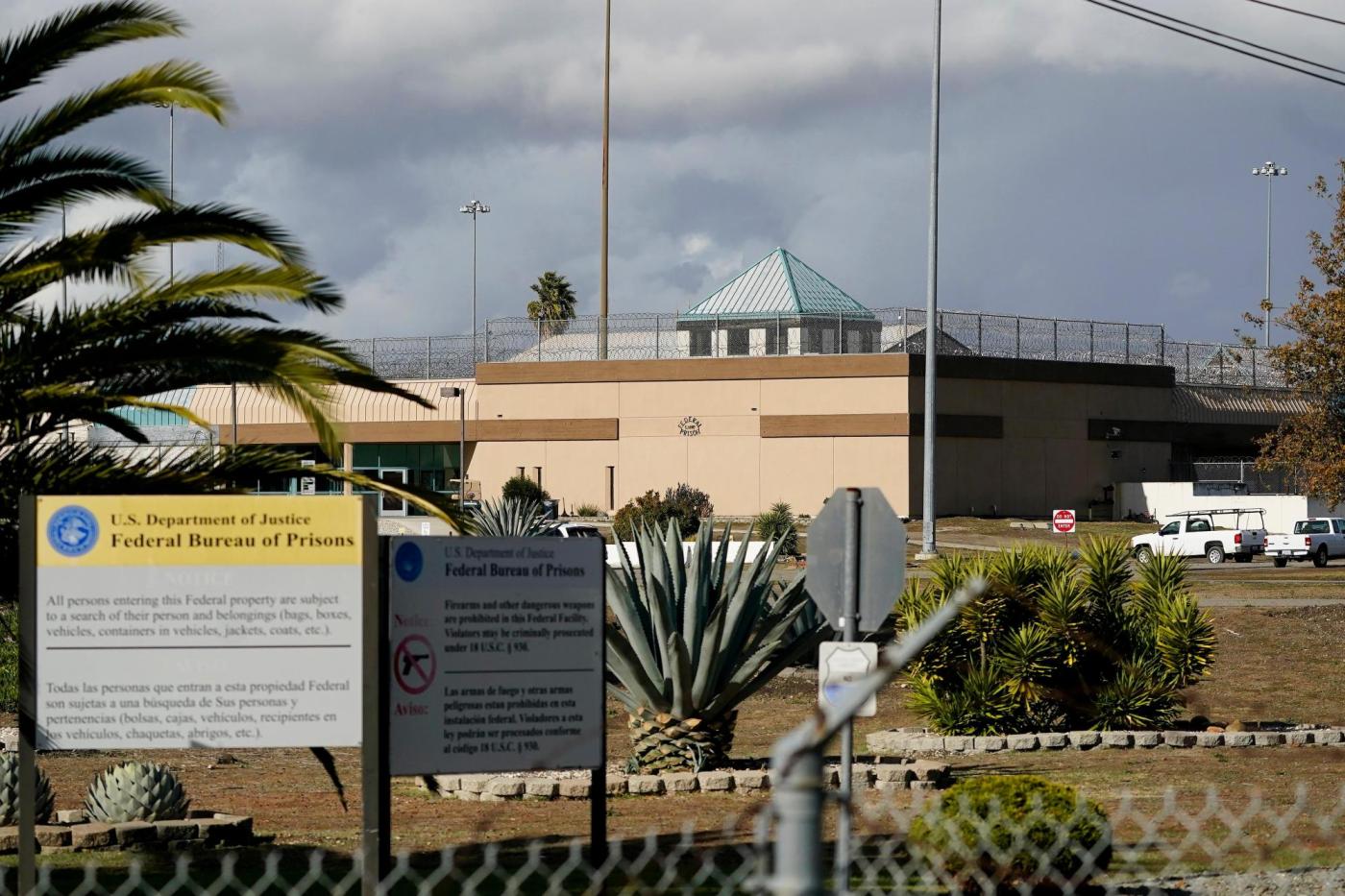
The US government is closing a women’s prison and other facilities after years of abuse and decay

posted in: News | 0

By MICHAEL R. SISAK and MICHAEL BALSAMO

WASHINGTON (AP) — The federal Bureau of Prisons is permanently closing its “rape club” women’s prison in California and will idle six facilities in a sweeping realignment after years of abuse, decay and mismanagement, The Associated Press has learned.

The agency informed employees and Congress on Thursday that it plans to shutter the Federal Correctional Institution in Dublin, California, and its deactivate minimum-security prison camps in Wisconsin, Minnesota, Colorado, Pennsylvania, West Virginia and Florida. Staff and inmates are being moved to other facilities, the agency said.

In a document obtained by the AP, the Bureau of Prisons said it was taking “decisive and strategic action” to address “significant challenges, including a critical staffing shortage, crumbling infrastructure and limited budgetary resources.” The agency said it is not downsizing and is committed to finding positions for every affected employee.

The closures are a striking coda to the Biden administration’s stewardship of the Justice Department’s biggest agency. After repeatedly promising to reform FCI Dublin and other troubled facilities, the Bureau of Prisons is pivoting to closures and consolidation, citing inadequate staffing and staggering costs to repair aging infrastructure.

The permanent shutdown of FCI Dublin seven months after it was temporarily closed in the wake of staff-on-inmate abuse is the clearest sign yet that the agency, which has more than 30,000 employees, 158,000 inmates and an annual budget of about $8 billion, is unable or unwilling to rehabilitate its most problematic institutions.

The Bureau of Prisons and the union representing correctional officers have repeatedly pushed for additional federal prison funding, highlighting what they say is an inadequate amount of money to address pay increases, staff retention and a multibillion-dollar repair backlog.

In a document summarizing the closures, the Bureau of Prisons said it decided to close FCI Dublin after a security and infrastructure assessment following its temporary closure in April. At the time, it appeared the agency was set on closing the low-security prison, but officials held out the possibility that it could be repaired and reopened for a different purpose, such as housing male inmates.

The assessment identified considerable repairs necessary to reopen the FCI Dublin, the agency said. Low staffing, exacerbated by the high cost of living in the Bay Area, also contributed to the decision to close the facility, the agency said.

“As the agency navigates a challenging budgetary and staffing environment, we must make incredibly difficult decisions. FCI Dublin will not reopen,” the agency said.

FCI Dublin’s permanent closure represents an extraordinary acknowledgement by the Bureau of Prisons that it has failed to fix the facility’s culture and environment in the wake of AP reporting that exposed rampant sexual abuse within its walls. Hundreds of people who were incarcerated at FCI Dublin are suing the agency, seeking reforms and monetary compensation for mistreatment at the facility.

The closures at FCI Dublin and across the federal prison system come amid an AP investigation that has uncovered deep, previously unreported flaws within the Bureau of Prisons. AP reporting has disclosed rampant criminal activity by employees, dozens of escapes, chronic violence, deaths and severe staffing shortages that have hampered responses to emergencies, including inmate assaults and suicides.

In July, President Joe Biden signed a law strengthening oversight of the agency after AP reporting shone a spotlight on its many flaws.

Sisak reported from New York.

Hegseth faces senators’ concerns not only about his behavior but also his views on women in combat

posted in: Politics | 0

By MARY CLARE JALONICK, LISA MASCARO and LOLITA C. BALDOR

WASHINGTON (AP) — Pete Hegseth has spent the week on Capitol Hill trying to reassure Republican senators that he is fit to lead President-elect Donald Trump’s Department of Defense in the wake of high-profile allegations about excessive drinking and sexual assault.

But senators in both parties have also expressed concern about another issue — Hegseth’s frequent comments that women should not serve in frontline military combat jobs.

As the former Army National Guard major and combat veteran fights to salvage his Cabinet nomination, meeting with senators for a fourth day Thursday with promises not to drink on the job and assurances he never engaged in sexual misconduct, his professional views on women troops are coming under deeper scrutiny.

North Dakota Sen. Kevin Cramer said Wednesday that he confronted Hegseth about the issue when they spoke one-on-one.

“I said to him, just so you know, Joni Ernst and Tammy Duckworth deserve a great deal of respect,” Cramer said, referring to two female senators who sit on the Senate Armed Services Committee — both of whom are combat veterans.

The role of women in the military is another entry in the far-right’s efforts to return the armed forces back to an earlier era, something Hegseth has embraced with Trump’s approach to end “woke” programs that foster diversity, equity and inclusion in the ranks. The DEI movement is coming under attack as Trump prepares to return to the White House, and he has vowed to fire generals whom he deems “woke.”

Military and defense leaders, however, have argued that it would be fundamentally wrong to eliminate half the population from critical combat posts, and they have flatly denied that standards were lowered to allow women to qualify.

In remarks Wednesday, Defense Secretary Lloyd Austin touted the service of women, including in his own combat units when he was a commander in Iraq.

“If I get a little fired up about this, it’s just because this isn’t 1950. It isn’t 1948. It is 2024,” Austin said.

As Hegseth went office to office this week meeting with GOP senators, he brushed back questions about his past views that women should not serve in combat roles.

“We have amazing women who serve our military,” Hegseth said Tuesday, “amazing women who serve in our military.”

Pressed if they should serve in combat, Hegseth said they already do.

But that’s a turnaround from his earlier statements. Hegseth said as recently as last month that women “straight up” should not serve in combat roles.

It “hasn’t made us more lethal. Has made fighting more complicated,” he said in a podcast before he was nominated by Trump.

In his own writings, he has expanded on views of a more masculine-focused military. Those views are running into icy resistance in the Senate from both sides of the political aisle.

Ernst of Iowa — herself a former Army National Guard member, a retired lieutenant colonel who spent more than two decades in the service — was circumspect after her meeting with Hegseth, saying only that they had a “frank and thorough conversation.”

Related Articles

National Politics |


Elon Musk and Vivek Ramaswamy are bringing Trump’s DOGE to Capitol Hill

National Politics |


Powell: Fed’s independence from politics is vital to its interest rate decisions

National Politics |


Billionaire who performed the first private spacewalk is Trump’s pick to lead NASA

National Politics |


States poised to end coverage for millions if Trump cuts Medicaid funding

National Politics |


Trump nominates cryptocurrency advocate Paul Atkins as SEC chair

She demurred Thursday on whether she will support his nomination, praising his service but telling Fox News that a “very thorough vetting” is needed.

A Republican, Ernst has championed women in service and also, having spoken openly about surviving sexual assault while in college, worked to ensure a safe environment for women in uniform.

On Thursday, Hegseth said his meeting with Ernst was “productive” and that Trump “is behind us all the way.”

As he walked into a meeting with South Dakota Sen. Mike Rounds on Thursday, Hegseth said he’s “fighting and ready to go.”

Sitting with Rounds in his office a few minutes later, Hegseth told reporters that there is “an incredible amount of knowledge” in the Senate and on the Senate Armed Services committee and that “I welcome that knowledge, I welcome that advice. That’s why we’re here.”

Hegseth has yet to meet with Duckworth or any of the other Democrats on the committee. Duckworth, a Democrat and Purple Heart recipient who piloted a Blackhawk helicopter during the Iraq War, and lost both legs when it was hit by a rocket-propelled grenade, also rose to the rank of lieutenant colonel before retiring after 23 years in the Reserve forces. She later served as an assistant secretary at the Department of Veterans Affairs.

Cramer added that he told Hegseth that his confirmation hearing “won’t be pleasant” as Democrats, in particular, grill him on his views.

Trump, for now, appears to be standing aside as Hegseth fights to preserve his nomination, even as suggestions float about a possible replacement pick, including former Trump rival Florida Gov. Ron DeSantis, to lead the Pentagon.

About 17.5% of the more than 1.3 million active-duty service members are women, a total that has grown steadily over the past two decades. They have served in combat in a wide array of military jobs, including as pilots and intelligence officers for years.

The Pentagon formally opened all combat jobs to women in 2015, including frontline infantry and armor posts, and since then thousands of women have been in jobs that until that time were male-only.

As of this year, nearly 4,800 women are serving in Army infantry, armor and artillery job, more than 150 have completed the Army Ranger course and a small number have qualified for more elite special operations units, including as Army Green Berets.

Long-delayed Minnesota iron mining project appears to be nearing finish line

posted in: News | 0

NASHWAUK, Minn. — A controversial $2 billion-plus mining project on Minnesota’s Iron Range that has weathered an economic recession, missed deadlines and payments, bankruptcy, changes in ownership, three gubernatorial administrations and a high-stakes legal battle with a competitor now appears to be moving toward completion, 15 years after construction first began.

Last month at the Mesabi Metallics mine site outside the small town of Nashwauk, 400 workers milled about, over mud stained a rich red from the iron in the earth.

Towering cranes placed steel on enormous buildings where — if all goes to plan — millions of tons of iron ore will soon be dug out of the ground, crushed, processed and then baked in super-hot kilns into high grade taconite pellets, to help supply a new generation of American steel mills.

“We actually have about $550 million worth of steel and parts that are being installed as we speak,” said Mesabi Metallics chief operating officer Larry Sutherland during a tour of the sprawling 16,000-acre site.

“We have about $1.8 billion invested to date, with about another $500 to $600 million to go,” Sutherland added. “So all in we’ll be about a $2.5 billion investment, which is one of the largest capital investments in the history of Minnesota.”

It’s a remarkable turnabout from nine years ago, when the project, owned by Indian company Essar Steel, ran out of cash with the mine half-built. The company owed tens of millions of dollars to contractors and to the state after several missed deadlines and unkept promises. Five years ago Gov. Tim Walz even tried to ban Essar from the state.

Then Minnesota officials yanked key state-owned mineral leases critical to the project, and last year awarded them to rival mining company Cleveland Cliffs.

But despite all those setbacks, Mesabi officials are vowing to complete the massive project within a year. And local residents and officials are cheering them on.

It was standing room only at a recent community meeting at the Nashwauk town hall, where Mayor Cal Saari proclaimed an “Appreciation Day” for Mesabi Metallics and presented the company with a key to the city.

“I’m telling you, in Itasca County, happy days are here again,” said Saari.

Rich ore

Mining companies have eyed the iron ore deposits at the Mesabi site for decades, in an area called the Butler Corridor between Nashwauk and Calumet, where Sutherland estimates there’s 2 billion tons of crude ore still underground.

Sutherland began his career as an 18-year-old union millwright at Butler Taconite, a small mine that operated for nearly two decades in the area before it shut down in 1985.

He went on to lead U.S. Steel’s operations on the Iron Range. Now, 50 years after his first job in the industry, he’s relishing the chance to help build a new mine from scratch.

Inside the 10-story tall concentrator plant under construction, he pointed out huge rotating mills some 40 feet across that will grind the iron ore into a fine powder.

“This is happening,” Sutherland said. “There’s no more questions about the viability of this project. It’s fully financed by our owner, and it’s moving forward to completion.”

The company intends to produce specialized taconite pellets that can be used to create a high-grade product called direct reduced iron to feed electric arc furnaces. Those are more modern, flexible and efficient steel mills that are increasingly replacing the giant blast furnaces located around the Great Lakes.

Sutherland said Essar Steel, Mesabi’s owner, is now debt-free after paying off $26 billion in debt over the past few years.

It’s a far cry from 2016, when Essar declared bankruptcy just before former Gov. Mark Dayton tried to turn over the project to rival miner Cleveland Cliffs.

“Who wants to do business with a company that behaves like this?” Dayton asked, after Essar failed to repay $66 million it owed the state for providing infrastructure to the mine site.

“I’d rather they sell it to somebody who’s going to operate it in a responsible way, where you shake hands at the end of a meeting, and they’re going to keep their word,” Dayton said.

It was a devastating turn of events to local and state officials who backed the project, in large part because Essar promised to not only build a mine, but also the first steel mill to be located on the Iron Range.

But after a couple years and following a complicated legal tussle, Essar eventually regained control of the project, now renamed Mesabi Metallics.

Sutherland, who came on board three years ago, said Essar has repaid contractors, and ramped up work early this year.

State officials confirmed the company is up to date on its repayment plan with the state.

“We realize this project has some history,” Sutherland said at the Nashwauk town hall. “That history is behind us.”

“If anyone thinks we don’t have the bandwidth to move this facility forward,” he added, “watch and see.”

While the focus is on completing a mine and pellet plant, Sutherland said there’s still a possibility of building a value-added iron plant on site, which could help make a more climate-friendly, lower-carbon steel.

The unions whose members are building the project say the focus now should be on finishing the project, not fighting over the past.

“It’s the thousand construction jobs, 700 indirect jobs, 350 multigenerational jobs. We need that on the Iron Range,” said Jason Quiggin, president of the Iron Range Building Trades, during a visit to the state Capitol earlier this year.

Local officials say the family that owns Essar has rebuilt trust through regular meetings. Nashwauk Mayor-elect Gary Heyblom said they’ve developed genuine friendships. The company has also donated nearly a half-million dollars to local organizations since last year.

“They’re wanting to correct the mistakes of the past,” Heyblom said.

Lease battle

Mesabi suffered a major setback a couple years ago when Minnesota officials yanked 2,600 acres of state-owned mineral leases critical to the project, after a series of unmet requirements. Then last year the state awarded those mineral rights to Cleveland Cliffs.

Cliffs wanted the ore to extend the life of nearby Hibbing Taconite. The company is running out of iron ore to mine at the facility, which supports more than 700 jobs. But it also significantly shortened the lifespan of Mesabi’s project.

“Their project went at that point in time, from a project that arguably could have been 20 years plus, to something that shrunk down, depending on how rapidly someone mines… to a six to eight year kind of window,” said Joe Henderson, director of the division of lands and minerals at the Minnesota Department of Natural Resources.

But now, in an ongoing court battle, Mesabi appears to have wrested control of a different 3,200 acres of mineral leases from Cliffs.

Henderson said that could drastically change the math of Mesabi’s project.

“If that court ruling sticks, that just brought, arguably, easy a decade or more of ore back into a Mesabi-Essar project,” Henderson said.

Sutherland said with those additional leases, the Mesabi project could extend 40 to 50 years.

It’s unclear what impact the tussle over mineral leases will have on the future of Hibbing Taconite. The area is now a checkerboard of mineral ownership, which Henderson said can create headaches for mining companies trying to connect the different parcels they control.

Cleveland Cliffs had submitted a plan to the DNR to mine the 2,600 acres it obtained from the state last year, and construct a 14-mile rail line to transport the ore to Hibbing Taconite.

But after the recent ruling in favor of Mesabi for the 3,200 acres, Henderson said Cliffs has paused the project.

“And so they haven’t withdrawn the project, but they’re not moving forward on it at this point in time,” Henderson said.

Cliffs didn’t respond to a request for comment.

Meanwhile Mesabi must also secure an updated permit to mine from the DNR, as well as amended environmental permits from the Minnesota Pollution Control Agency, before it can move forward with its project.

Henderson said the agency is also weighing whether the project requires a fresh environmental review, since the footprint of the mine proposal has now changed.

That decision could impact Mesabi’s aggressive timeline. Sutherland said their goal is to finish construction by the end of next year.

If that happens, a project that has so far delivered only unmet promises, could ship its first railcars of ore by early 2026.

Related Articles

Business |


Burglars believed to be targeting Asian households in Rochester

Business |


St. Cloud City Council seats its first Somali American member

Business |


Minnesota House panel votes to cover DFLer’s workplace employment action

Business |


‘Air guitar’ motorist avoids prison time for fatally striking pedestrian in Carlton County

Business |


Duluth man, 78, dies while skating on thin ice on St. Louis River in Superior

Bitcoin tops $100,000 with Trump-election crypto rally rolling on

posted in: Politics | 0

Associated Press

NEW YORK (AP) — Bitcoin topped $100,000 for the first time as a massive rally in the world’s most popular cryptocurrency, largely accelerated by the election of Donald Trump, rolls on.

The cryptocurrency officially to rose six figures Wednesday night, just hours after the president-elect said he intends to nominate cryptocurrency advocate Paul Atkins to be the next chair the Securities and Exchange Commission.

Bitcoin has soared since Trump won the U.S. presidential election on Nov. 5. The asset climbed from $69,374 on Election Day, hitting as high as $103,713 Wednesday, according to CoinDesk. Just two years ago, bitcoin dropped below $17,000 following the collapse of crypto exchange FTX.

Bitcoin fell back closer to $103,000 early Thursday, but futures are up more than 4%. Even amid a massive rally that has more than doubled the value of bitcoin this year, some experts continue to warn of investment risks around the asset, which has quite a volatile history.

Here’s what you need to know.

Back up. What is cryptocurrency again?

Cryptocurrency has been around for a while now. But, chances are, you’ve heard about it more and more over the last few years.

In basic terms, cryptocurrency is digital money. This kind of currency is designed to work through an online network without a central authority — meaning it’s typically not backed by any government or banking institution — and transactions get recorded with technology called a blockchain.

Bitcoin is the largest and oldest cryptocurrency, although other assets like ethereum, tether and dogecoin have also gained popularity over the years. Some investors see cryptocurrency as a “digital alternative” to traditional money, but the large majority of daily financial transactions are still conducted using fiat currencies such as the dollar. Also, bitcoin can be very volatile, with its price reliant on larger market conditions.

Why is bitcoin soaring?

A lot of the recent action has to do with the outcome of the U.S. presidential election.

Trump, who was once a crypto skeptic, has pledged to make the U.S. “the crypto capital of the planet” and create a “strategic reserve” of bitcoin. His campaign accepted donations in cryptocurrency and he courted fans at a bitcoin conference in July. He also launched World Liberty Financial, a new venture with family members to trade cryptocurrencies.

On Thursday morning, hours after bitcoin surpassed the $100,000 mark, Trump congratulated “BITCOINERS” on his social media platform Truth Social. He also appeared to take credit for the recent rally, writing, “YOU’RE WELCOME!!!”

Related Articles

Business |


MN-based UnitedHealthcare CEO Brian Thompson fatally shot in NYC. Here’s what we know.

Business |


Powell: Fed’s independence from politics is vital to its interest rate decisions

Business |


Don’t overdo it: Here’s what not to fix when selling a house

Business |


3 ways to earn an extra $500 for the holidays

Business |


Australia is banning social media for people under 16. Could this work elsewhere — or even there?

Crypto industry players welcomed Trump’s election victory last month, in hopes that he would be able to push through legislative and regulatory changes that they’ve long lobbied for — which, generally speaking, aim for an increased sense of legitimacy without too much red tape.

Trump made a move in that direction Wednesday when he said he intends to nominate Paul Atkins to chair the Securities and Exchange Commission. Atkins was an SEC commissioner during the presidency of George W. Bush. In the years since leaving the agency, Atkins has made the case against too much market regulation. He joined the Token Alliance, a cryptocurrency advocacy organization, in 2017.

Under current chair Gary Gensler, the SEC has cracked down on the crypto industry, penalizing a number of companies for violating securities laws. But he’s also faced criticism from industry players in the process, like the chief legal officer of Robinhood, who described Gensler’s approach toward crypto as “rigid” and “hostile.” Gensler will step down when Trump takes office.

One crypto-friendly move the SEC did make under Gensler was the approval in January of spot bitcoin ETFs, or exchange trade funds, which allow investors to have a stake in bitcoin without directly buying it. The Spot ETFs were the dominant driver of bitcoin’s price before the election — but, like much of the crypto’s recent momentum, saw record inflows postelection.

What are the risks?

History shows you can lose money in crypto as quickly as you’ve made it. Long-term price behavior relies on larger market conditions. Trading continues at all hours, every day.

At the start of the COVID-19 pandemic, bitcoin stood at just over $5,000. Its price climbed to nearly $69,000 by November 2021, during high demand for technology assets, but later crashed during an aggressive series of rate hikes by the Federal Reserve. And the late-2022 collapse of FTX significantly undermined confidence in crypto overall, with bitcoin falling below $17,000.

Investors began returning in large numbers as inflation started to cool — and gains skyrocketed on the anticipation and then early success of spot ETFs. But experts still stress caution, especially for small-pocketed investors. And lighter regulation from the coming Trump administration could also mean less guardrails.

“I would say, keep it simple. And don’t take on more risk than you can afford to,” Adam Morgan McCarthy, a research analyst at Kaiko, previously told The Associated Press — adding that there isn’t a “magic eight ball” to know for certain what comes next.

What about the climate impact?

Assets like bitcoin are produced through a process called “mining,” which consumes a lot of energy. Operations relying on pollutive sources have drawn particular concern over the years.

Recent research published by the United Nations University and Earth’s Future journal found that the carbon footprint of 2020-2021 bitcoin mining across 76 nations was equivalent to the emissions from burning 84 billion pounds of coal or running 190 natural gas-fired power plants. Coal satisfied the bulk of bitcoin’s electricity demands (45%), followed by natural gas (21%) and hydropower (16%).

Environmental impacts of bitcoin mining boil largely down to the energy source used. Industry analysts have maintained that clean energy has increased in use in recent years, coinciding with rising calls for climate protections