Walmart rolled through 2024, but challenges appear ahead in 2025

posted in: News | 0

By ANNE D’INNOCENZIO, Associated Press Retail Writer

NEW YORK (AP) — Walmart delivered another year of strong sales and profits with its competitive prices an increasingly strong magnet for inflation-weary shoppers, but 2025 appears to come with new challenges in an uncertain economic landscape.

The outlook from the nation’s largest retailer for 2025 is as much as 27 cents below analyst projections for per-share earnings and for the quarter, Walmart’s expectations are as much as 7 cents below Wall Street projections.

Its sales outlook is also disappointing, potentially a reflection of rising challenges ahead as consumers pull back on spending and President Donald Trump’s tariffs on China and other countries threaten the low-price model that is the core of Walmart’s success.

FILE – Shown is a Walmart location in Philadelphia, Wednesday, Nov. 17, 2021. (AP Photo/Matt Rourke, File)

Walmart has built in hedges against some tariff threats. Groceries account for roughly 60%, of its U.S. business, according to the company’s most recent annual report, meaning a huge chunk of sales are not reliant on goods made in China or elsewhere.

Still, shares tumbled nearly 9% before the opening bell Thursday and it pulled other big retailers down with it. The retail sector is the biggest decliner in premarket trading and Target slid 2%.

Walmart is among the first major U.S. retailers to report quarterly financial results and numbers could provide a hint as to the mood of the American shopper, particularly amid new trade barriers that according to most economists threaten to reignite inflation. Consumers over the past year have increasingly focused more on necessities rather than TVs, furniture or appliances. They’ve become much more discerning about big-ticket purchases because of higher costs for credit as well as for groceries.

Walmart has flourished in that environment, using its clout to keep prices down. It’s gained market share, notably among households with incomes over $100,000. Walmart’s online offerings and paid membership, Walmart +, have also drawn wealthier customers

“We have momentum driven by our low prices, a growing assortment, and an eCommerce business driven by faster delivery times,” said CEO Doug McMillon. “We’re gaining market share, our top line is healthy, and we’re in great shape with inventory.”

Still, Walmart could be faced with challenges with the new tariffs carrying more economic risks than during Trump’s first term. If Americans are hit by a new wave of price increases, economists say, and with 70% of the U.S. economy driven by consumers a broad pullback in spending would have ramifications beyond Walmart’s sales.

Government data last week revealed a sharp drop in January retail sales as cold weather kept more Americans indoors. But it was a much bigger drop than economists expected and the biggest in a year. Sales were revised higher for December, possibly indicating a pullback by consumers after a holiday season splurge.

Yet grocery prices, a sore point for American households, continued to rise.

Walmart, based in Bentonville, Arkansas, reported earnings of $5.25 billion, or 65 cents per share, in the quarter ended Jan. 31. That compares with $5.49 billion, or 68 cents per share, in the year-ago period. Adjusted earnings per share for the most recent quarter was 66 cents.

Sales rose 4.1% to $180.55 billion in the quarter.

Analysts expected 65 cents per share on sales of $180.07 billion in the fourth quarter, according to FactSet.

For Walmart’s U.S. division, comparable store sales — which include online and stores open for the past 12 months — rose 4.6% in the U.S., a bit lower than the 5.3% in the previous quarter. The retailer had a 4.2% jump in the U.S. in the second quarter and 3.8% in the first quarter.

Global e-commerce sales rose 16% in the latest quarter, notably slower than the 27% increase in the third quarter.

Walmart expects first quarter earnings per share of between 57 cents and 58 cents, well below the 64 cents Wall Street was expecting, and for the year. Walmart expects earnings per share in the range of $2.50 to $2.60. That’s also off the $2.77 that analysts are predicting, according to FactSet.

It forecast a 3% to 4% increase in quarterly sales or between $166.35 billion and $167.97 billion. That could be a letdown for industry analysts, who had expected sales of $167.05 billion, according to FactSet.

Walmart expects sales to be up anywhere between 3% to 4% for the current year, or between $667.57 billion and $674.05 billion. That too falls short of the $708.72 billion that analysts predicted, according to FactSet.
Sightly more Americans apply for unemployment benefits last week, but layoffs remain relatively low

posted in: News | 0

By MATT OTT, Associated Press

Slightly more Americans applied for jobless benefits last week, but layoffs remained in the same recent healthy range.

The number of Americans filing for jobless benefits rose by 5,000 to 219,000 for the week ending Feb. 15, the Labor Department said Thursday. Analysts projected that 215,000 new applications would be filed.

Weekly applications for jobless benefits are considered a proxy for layoffs.

The four-week average, which evens out some of the week-to-week volatility, fell by 1,000 to 215,250.

Some analysts say they expect layoffs ordered by the Department of Government Efficiency to show up in the report in the coming weeks.

Despite showing some signs of weakening during the past year, the labor market remains healthy with plentiful jobs and relatively few layoffs.

Earlier this month, the Labor Department reported that U.S. employers added 143,000 jobs in January, significantly fewer than December’s 256,000 job gains. However, the unemployment rate ticked down to an even 4%, signaling a still very healthy labor market.

Late in January, the Federal Reserve left its benchmark lending rate alone after issuing three cuts late in 2024. Fed officials are closely monitoring inflation and the labor market for signs of a potentially weakening economy. They expect only two rate cuts this year, down from previous projections of four.

Last week’s consumer prices report that showed that inflation accelerated last month, creating some doubt about whether the Fed will be moved to cut rates at all this year.

The consumer price index increased 3% in January from a year ago, up from a 3 1/2 year low of 2.4% in September. The new data shows that inflation has remained stubbornly above the Fed’s 2% target for roughly the past six months after it fell steadily for about a year and a half.

Overall, while layoffs remain low by historical standards, some high-profile companies have announced job cuts already this year.

Workday, Dow, CNN, Starbucks, Southwest Airlines and Facebook parent company Meta have all trimmed their workforces already in 2025.

Late in 2024, GM, Boeing, Cargill and Stellantis announced layoffs.

The total number of Americans receiving unemployment benefits for the week of Feb. 8 rose to 1.87 million, an increase of 24,000 from the previous week.

Republicans are pursuing separate paths to get Trump’s priorities through Congress

posted in: Politics | 0

By KEVIN FREKING, Associated Press

WASHINGTON (AP) — Senate Majority Leader John Thune teed up a vote this week on a budget plan that sets the stage for a massive boost in defense and border security spending, and leaves a looming tax cut fight for later this year.

The move is designed to give President Donald Trump an early policy win and put pressure on House Republicans to join rather than pursue a separate, more comprehensive effort that also risks taking far longer to pass, if at all.

Trump undercut the Senate GOP’s efforts on Wednesday, calling on both chambers to pass the House budget resolution. “The House Resolution implements my FULL America First Agenda, EVERYTHING, not just parts of it,” Trump wrote on social media.

Yet Thune is proceeding as planned, despite Trump’s stated preference for the House effort.

“If the House can produce one big beautiful bill, we’re prepared to work with them to get that across the finish line, but we believe the president also likes optionality,” Thune said.

The resolution is not a bill and does not get signed into law by the president, but its passage unlocks a process that allows Republicans to enact their priorities later this year even if Democrats unanimously oppose it.

Here’s what to know.

What’s in the Senate plan?

The budget resolution, authored by Sen. Lindsey Graham, the Republican chairman of the Senate Budget Committee, sets the stage for about $342 billion in increased spending on border security, defense and the Coast Guard.

Related Articles

National Politics |


Senate pushes toward confirmation of Kash Patel as FBI director

National Politics |


Trump says federal government should ‘take over’ DC, backing congressional GOP push

National Politics |


Trump backs idea to send some DOGE savings to American citizens

National Politics |


Lutheran Social Services of Minnesota laying off 27 after Trump suspends refugee program

National Politics |


Trump DOJ seeks delay in Minneapolis policing consent decree

Graham said the spending would take place over four years and be paid for with reduced spending elsewhere in the federal government, though the resolution itself does not specify how those cuts would occur.

The budget resolution advanced out of committee last week on a party-line vote. It directs the Senate Homeland Security Committee to increase spending by up to $175 billion, the Senate Armed Services Committee to spend up to $150 billion more and the Senate Commerce panel to increase spending by about $20 billion. This is on top of the annual spending that Congress provides through a separate legislative process.

“Build the wall, deport illegal aliens, and create additional detention space so we don’t have to release illegal immigrants into the community,” Graham said. “And God knows the military needs more money in these dangerous times.”

What happens this week?

The Senate proceeded to Graham’s budget plan on Tuesday evening, opening it up to 50 hours of debate. Once the debate time has expired — but before a vote on final passage — senators will hold what’s known in Congress as a “vote-arama.” It’s a whirlwind series of votes over several hours in which senators seek to amend the plan.

The votes often last into the early morning hours before exhausted lawmakers decide they’ve had enough and move to a final vote.

The amendments often are designed to force lawmakers from the other party to take difficult votes on hot-button issues that could prove difficult to explain in the next election cycle.

Sen. Patty Murray, D-Wash., said Republicans should “get ready for a late night and an early morning.”

“We are going to make sure the people back home know that Elon Musk is firing VA doctors and food safety inspectors — for no cause whatsoever — and illegally defunding the programs that Americans care about,” Murray said.

A long way to go

Once a budget plan is approved, committees would draft legislation consistent with their instructions to find savings or increase spending in programs under their jurisdiction. But the formal work needed to advance those recommendations can’t take place until both the House and Senate pass identical budget plans.

At some point, Republicans in the House and Senate will have to resolve their differences for them to use the tool that will allow the package to pass with a simple majority in the Senate and sidestep a Democratic filibuster. For now, they are competing with each other to win Trump’s favor.

Where the House stands

The House does have momentum for its efforts after a few weeks of delay. The chamber’s Budget panel has advanced its more comprehensive budget plan to the floor on a party-line vote. Speaker Mike Johnson’s office said it will come up for a vote in the full chamber next week when the House returns to Washington.

Their plan would allow committees to provide for up to $4.5 trillion in tax cuts and $300 billion in new spending. It would also instruct committees to make at least $1.5 trillion in spending reductions elsewhere in the federal government over the next decade. And it would lift the debt ceiling so that the U.S. can borrow and continue paying its bills.

The Committee for a Responsible Federal Budget, a nonpartisan fiscal watchdog, estimates that the House budget plan would allow for a nearly $4 trillion debt increase over the next decade.

Johnson can spare only one defection if Democrats are unanimous in opposing the plan next week, creating a high-wire act for his leadership team.

Some Republicans have raised concerns about the level of spending cuts that could occur with programs like Medicaid. But those lawmakers will also feel pressure to help Trump enact his priorities or face his wrath for not going along.

Senate pushes toward confirmation of Kash Patel as FBI director

posted in: Politics | 0

By ERIC TUCKER, Associated Press

WASHINGTON (AP) — The Senate was set to vote Thursday on whether to confirm Kash Patel as FBI director, a decision that could place him atop the nation’s premier federal law enforcement agency despite concerns from Democrats over his qualifications and the prospect that he would do President Donald Trump’s bidding.

Patel cleared the Senate Judiciary Committee last week by a 12-10, party-line vote and is set for consideration by the Republican-controlled Senate on Thursday afternoon.

Related Articles

National Politics |


Trump says federal government should ‘take over’ DC, backing congressional GOP push

National Politics |


Trump backs idea to send some DOGE savings to American citizens

National Politics |


Lutheran Social Services of Minnesota laying off 27 after Trump suspends refugee program

National Politics |


Trump DOJ seeks delay in Minneapolis policing consent decree

National Politics |


What’s going on with the Kennedy Center under Trump?

He is expected to be confirmed unless more than three Republican senators defy Trump’s will and vote against him, which is seen as unlikely. Trump has already secured approval for most of his nominees despite initial Republican skepticism to several of his choices.

Patel, a Trump loyalist who has fiercely criticized the agency that he is poised to lead, would inherit an FBI gripped by turmoil. The Justice Department in the last month has forced out a group of senior FBI officials and made a highly unusual demand for the names of thousands of agents who participated in investigations related to the Jan. 6, 2021 riot at the U.S. Capitol.

Trump has said that he expects some of those agents will be fired.

Republicans angry over what they see as law enforcement bias against conservatives during the Biden administration, as well as criminal investigations into Trump, have rallied behind Patel as the right person for the job. Democrats, meanwhile, have complained about his lack of management experience compared to others who have held the director’s job and highlighted incendiary past statements that they say call his judgment into question.

“My prediction is if you vote for Kash Patel, more than any other confirmation vote you make, you will come to regret this one to your grave,” Democratic Sen. Chris Murphy of Connecticut said this week.

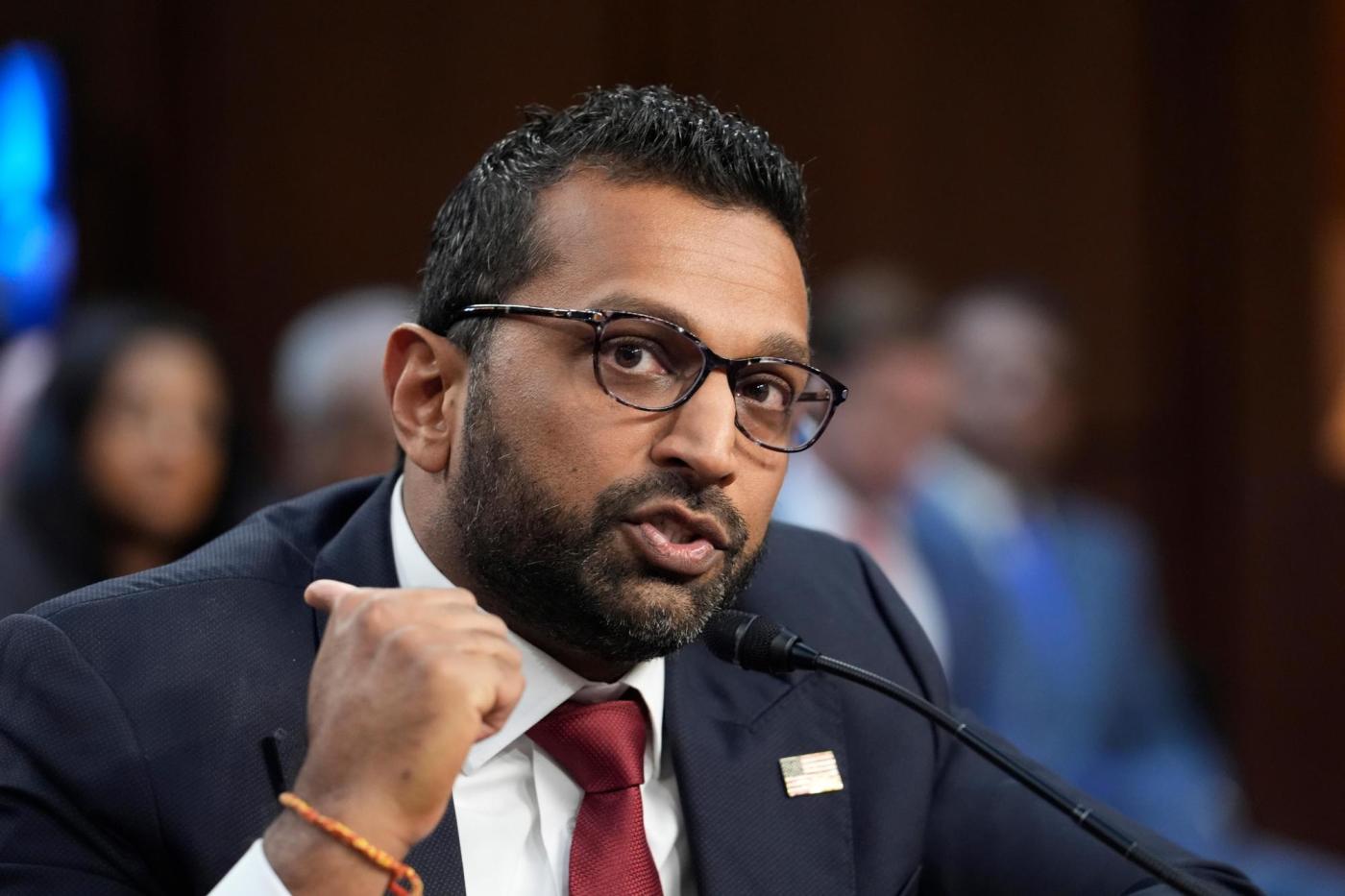
FILE – Kash Patel, President Donald Trump’s choice to be director of the FBI, arrives for his confirmation hearing before the Senate Judiciary Committee at the Capitol in Washington, Jan. 30, 2025. (AP Photo/Ben Curtis, File)

Patel’s eyebrow-raising remarks on hundreds of podcasts over the last four years include referring to law enforcement officials who investigated Trump as “criminal gangsters,” referring to some Jan. 6 rioters as “political prisoners” and pledging to “come after” anti-Trump “conspirators” in the government and media.

At his confirmation hearing last month, Patel said Democrats were taking some of his comments out of context or misunderstanding the broader point that he was trying to make, such as when he proposed shutting down the FBI headquarters in Washington and turning it into a museum for the so-called deep state. And Patel denied the idea that a list in his book of government officials who he said were part of a “deep state” amounted to an “enemies list,” calling that a “total mischaracterization.”

FBI directors are given 10-year terms as a way to insulate them from political influence and keep them from becoming beholden to a particular president or administration. Patel was selected in November to replace Christopher Wray, who was picked by Trump in 2017 and served for more than seven years but who repeatedly angered the president and was seen by him as insufficiently loyal. He resigned before Trump took office.

A former federal defender and Justice Department counterterrorism prosecutor, Patel attracted Trump’s attention during his first term when, as a staffer on the Republican-led House Intelligence Committee, he helped author a memo with pointed criticism of the FBI’s investigation into ties between Russia and Trump’s 2016 campaign.

Patel later joined Trump’s administration, both as a counterterrorism official at the National Security Council and as chief of staff to the defense secretary.