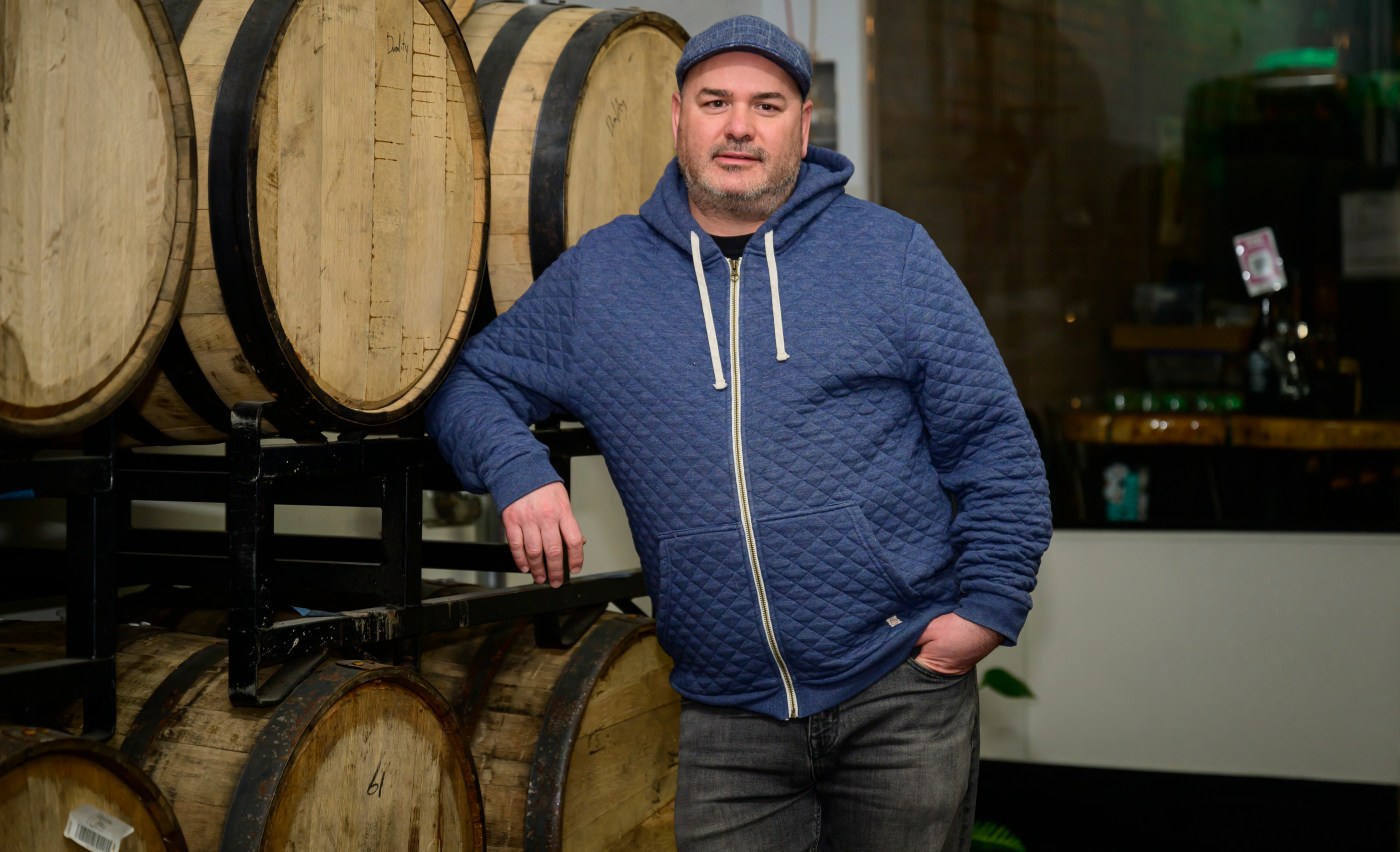
As a commercial broker and real estate developer with a flair for the arts, Rob Clapp has developed a reputation for experimenting with creative solutions to real estate development challenges in unlikely places. When he helped launch the Can Can Wonderland mini-golf, arcade and bar emporium in the basement of the old American Can Factory on St. Paul’s Prior Avenue, the building served no purpose beyond commercial storage for large companies like Goodwill.
Today, it bustles with some 50 commercial tenants, including artists, a brewery, an aerial yoga studio and other light industrial lease-holders.
J. Kou Vang has been no less aggressive about breathing new life into vacant lots and old buildings. His company, JB Vang commercial real estate, in recent years opened affordable housing at The Parkway on East Seventh Street, as well as within the former Landfill Books and Music Warehouse at University Avenue and Griggs Street.
Some might guess the two developers would quickly find common ground, given that each is in charge of a sizable portion of the sprawling Hamm’s Brewery campus just off Payne and Minnehaha avenues on the city’s East Side. Instead, Clapp, who has bought the St. Paul Brewing brewpub and has major stakes in 11 Wells Distillery and two other Hamm’s buildings, remains locked in an increasingly vitriolic three-way dispute over city-backed redevelopment plans that he maintains will put him out of business.
Rob Clapp. (John Autey / Pioneer Press)
He’s now among a handful of property owners standing in the way of a national historic designation for the Hamm’s Brewery — a designation JB Vang is counting on as a first step toward obtaining up to $30 million in state and federal historic tax credits to add more than 200 affordable housing units and an indoor marketplace to the site.
“The city is portraying us as a villain because we’re objecting to the historic designation of these buildings,” said Clapp, leading a tour on Wednesday through his four buildings, which span 130,000 square feet of property. “They’re shocked we would not lend our support, even though they’ve given us no assurances we will survive. We always assumed the city would be truthful when it says these businesses are valued.”
The conflict revolves in large part around a 148-stall surface parking lot that supports St. Paul Brewing and the 11 Wells Distillery. Vang was selected as the preferred developer by the St. Paul Housing and Redevelopment Authority for the HRA-owned portion of the brewery campus about two years ago, and hopes to fill in much of the shared surface lot with 120 units of affordable housing in a new “East End” building.
That structure would reduce the lot to 70-75 stalls while adding new parking demand. Under JB Vang’s proposal, existing Hamm’s buildings would be converted into 89 units of affordable artist housing and a two-story indoor marketplace.
Parking lot at issue
Clapp maintains that losing about half the shared parking in an area with limited transit could trigger the end for St. Paul Brewing, which he’s poured millions of dollars into since taking a gamble in 2020, at the height of the pandemic, and buying the former brewery-turned-brewpub from previous owner John Warner. Both owners, Clapp said, were able to access the shared lot through a handshake agreement with the city.
“Mr. Clapp doesn’t have any kind of agreement for parking on HRA-owned land,” said Nicolle Newton, director of the city’s Department of Planning and Economic Development. “Still, we have worked with the proposed housing developer to redesign the parking to result in as much surface parking for shared commercial use as possible. There’s bus stops nearby. It’s a transit-oriented site. It’s walkable.”
Clapp, who has called city parking studies ill-informed, is hoping Vang and the city will progress more slowly and focus on redeveloping the existing Hamm’s buildings first, holding off new housing in the shared lot until all parties can better assess parking.
Around 2003, the St. Paul HRA acquired nearly five acres of the Hamm’s campus for $1.2 million, and another $5.7 million in public funds — mostly city money — has been put into marketing, asbestos clean-up, demolition, and maintaining the buildings and parking lot.
At the privately-owned St. Paul Brewing, Clapp has installed a full kitchen, a service elevator and extensive decor to an outdoor patio. The patio now hosts a sizable “fire pit canoe” and two shipping containers that have been anchored to the ground and converted into functional outdoor kitchen and service buildings. On the building’s second and third floors, he has his sights set on adding event space, a bar, a Hamm’s Beer museum and other attractions, though he’s wrestling with the city over where to place a needed egress stairway.
In 2022, Clapp and Vang were both among the five respondents to the city’s request for proposals to redevelop the city-owned portion of the Hamm’s site. Vang won out, and Clapp has spent the past two years, he said, struggling to get city planning officials to acknowledge his concerns.
“We will not survive this development as proposed,” said Clapp on Wednesday. “We’ve just been steamrolled and called ‘sour grapes’ because we were not selected for the RFP. I basically have my life savings poured in, and there’s enough challenges for businesses as it is. You never think it’s the city that will take you out.”
Newton said the city’s goal is to provide “much-needed affordable housing (instead of) vacant land, and still have adequate parking for the businesses that are there now. This development was strongly supported by community, it was strongly supported by district councils, it was unanimously approved by the Housing and the Redevelopment Authority.”
Marketplace and rowhomes in question
Vang and Clapp met in November and again in February to see if the two developers could reach compromise, without success. Vang participated in the latest in a series of community outreach discussions led by City Council Member Cheniqua Johnson on Feb. 11. A slide presentation with updates on the development plans has been posted online at the city’s Hamm’s Brewery redevelopment website.
St. Paul City Council member Cheniqua Johnson, Ward 7. (Courtesy of the City of St. Paul)
Johnson on Friday said she met repeatedly with Vang and Clapp, and planned to continue to do so, but affordable housing remains a community priority.
“The JB Vang team even changed the direction of the building so it faces north and south,” said Johnson, noting that the reorientation leaves 75 spaces at the east end of the lot. “I don’t see value in shifting away from adding … housing on this site.”
Following the Feb. 11 presentation, some in attendance were taken aback about how little was shared about JB Vang’s plans for a two-story indoor shopping bazaar, which has been expected to move forward with the help of Hmong American Partnership and the East Side Neighborhood Development Company, who would help recruit small vendors.
The JB Vang company issued a written statement on Friday confirming the market had become a “secondary priority” in order to focus on overall project financing, and a series of affordable rowhomes that had once been part of the proposal had been dropped from the project entirely due to “financing challenges” and “ownership structure.”
Paris Dunning, executive director of the East Side Area Business Association, said both developers have a strong reputation and the city should encourage them to work together.
“We didn’t hear very much about the commercial marketplace last week,” said Dunning on Friday. “I think Rob’s business is the anchor business that the other commercial uses that JB Vang is planning are looking for.”
Darlene LaBelle, who became executive director of ESNDC in September, said on Friday she has not been closely involved with planning for the marketplace, but she was eager to see it move forward, despite Clapp’s objections over parking.
“I get where he’s coming from because it’s his business, but don’t you think if there were more people there, his businesses would benefit?” she said.
Parking analysis
At the city’s request, Walker Consulting completed a parking analysis that found Clapp’s multiple businesses, which include Kora Kombucha and Wonder Fab fabrication studios, would need 308 parking stalls at peak traffic time, and JB Vang’s commercial marketplace would need another 41 stalls. On-site parking for all those commercial uses would total 174 parking spaces, leaving a parking deficit of up to 175 spaces at peak periods.
Clapp, who has questioned the consultant’s approach, said the actual parking deficit may be much higher. He pointed out that JB Vang’s more than 200 units of housing would have access to only an additional 147 designated parking stalls reserved exclusively for residential use, to be located under the new East End building.
City officials note, however, the brewery sits on the Bruce Vento Regional Trail, which is part of a regional bikeway. The future resurfacing of Minnehaha Avenue will eliminate some on-street parking but add a bike lane, and JB Vang maintains some 200 parking stalls for potential overflow parking at an office building near the corner of Minnehaha Avenue and Arcade Street, within walking distance to the brewery.
Newton said that as his businesses expand, Clapp could attempt to make other arrangements with private parking lots in the area, including one directly across Minnehaha Avenue owned by Everest LLC and the Gelb family.
Historic designation in crosshairs
The conflict entered a new phase on Tuesday when the State Historic Preservation Office review board unanimously recommended a federal historic designation for the entire Hamm’s campus. That would be an important step toward helping Vang obtain up to $30 million in state and federal historic tax credits.
Rather than support the historic designation, Clapp — who gets multiple votes as he owns multiple properties — issued a formal objection, as have Hope Academy and Everest LLC. The latter two raised concerns about a potential National Register listing 20 years ago, and those have been on file as standing objections with the state ever since, said Ginny Way, a National Register Architectural Historian in the state office.
“The original nomination was in 2005, and there was owner objection at that time,” Way said.
With a majority of property owners objecting, the National Park System will not list a property for historic designation, she said. The state office is likely to forward the recommendation anyway within the next few days, effectively queuing the project up for immediate listing in the future if enough owners eventually withdraw their objections.
In addition to cutting into business at St. Paul Brewing, Clapp said losing his shared parking lot would also undermine plans to reopen the bar at 11 Wells, and to redevelop a neighboring Hamm’s building that previously housed an aquaponics business. Potential new uses could include a “cannabis collective” or residential housing.
Clapp said if the city is serious about turning its back on an existing business and moving forward without him, it should consider purchasing his end of the campus outright.
“I’m willing to be bought out and take my energies elsewhere,” he said.
Oklahoma man pleads guilty to 2023 shooting death in St. Paul’s Battle Creek neighborhood
St. Paul man, Mounds View woman get federal prison for carjacking woman, 74, in South Minneapolis
St. Paul boy, 11, accidentally shoots himself while recording cellphone video
Letters: Never before have I seen the Democrats in this hot a mess
St. Paul’s Face to Face Academy to honor slain graduate Sam Nordquist