In Hindu folklore, the goddess Durga appears with her dark eyes serene, wearing a billowing scarlet sari, and riding atop a lion as she battles the half-beast, half-human demon Mahishasura, who seeks world dominance. For nine long days and nights, Durga manifests in different forms, her power growing with each, to prevail where male gods had failed. Each of her 10 arms wields weapons, among them a discus from Vishnu, a sword from Ganesha, and a trident from Shiva, the last of which she uses to annihilate the demon on the 10th and final day. Thanks to Durga, evil is extinguished. Good is restored. People can rejoice.
I first read about Durga before I attended a celebration of her victory called Navaratri, or “nine nights” of puja [worship], bhajans [devotional songs], and dancing in a Hindu temple near my home. Starting alongside an autumnal new moon, these celebrations to honor Durga and other goddesses—devoted mothers, fierce warriors, and the divine sources of creativity and wisdom—happen throughout the Indian diaspora, from the stadiums of Gujarat and the ancient temples of Tamil Nadu to community halls in England and an unlikely spot in Texas: Pearland, the sprawling Houston suburb where one of the state’s first Hindu temples was erected, in 1982.
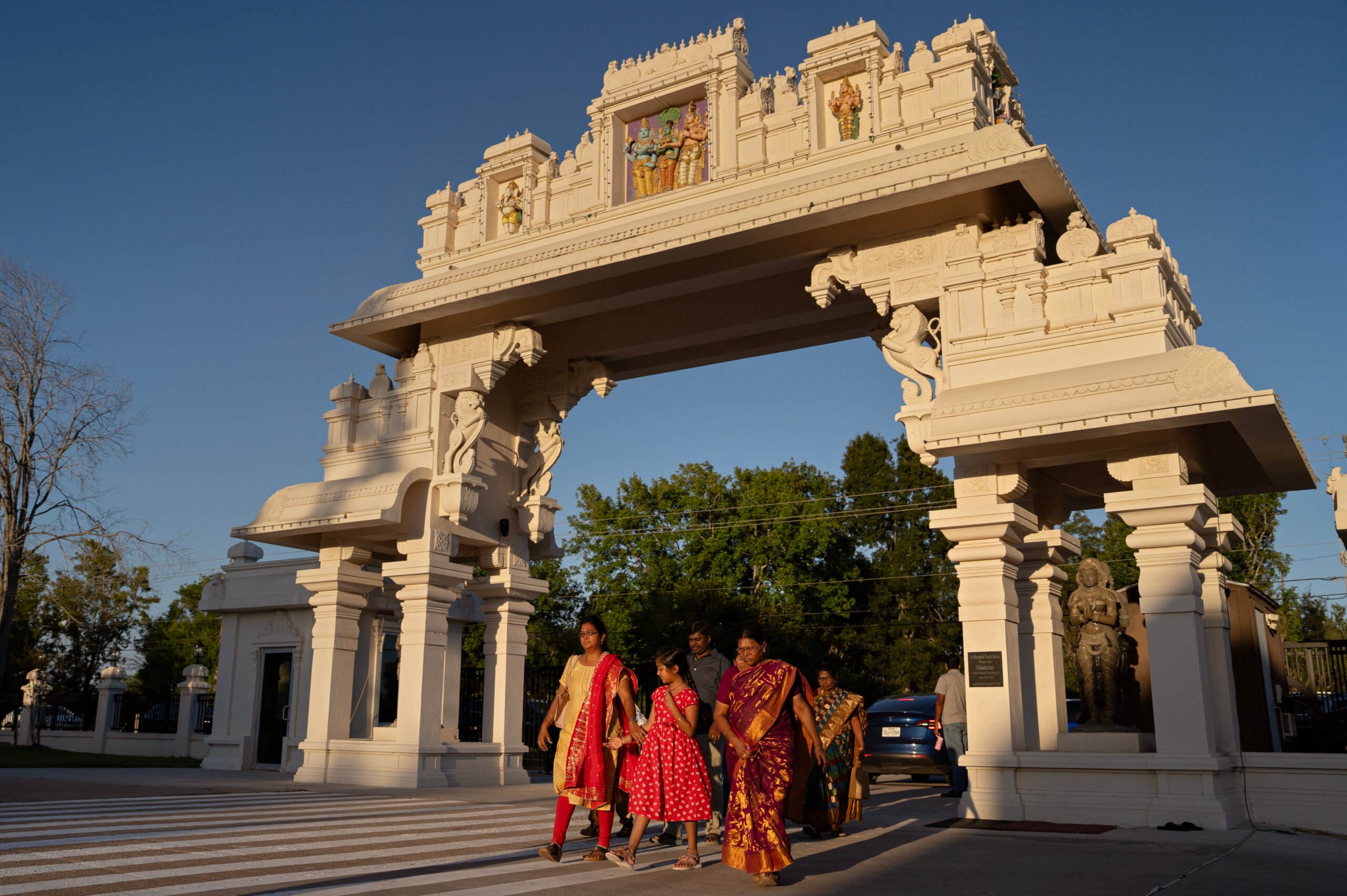
I lived in Pearland for six years, but I didn’t learn about the Sri Meenakshi Temple until last year when I made a wrong turn. Ensconced among ranch-style homes and lots with overgrown grass, the temple’s sculpted stone tower rises 58 feet, seeming to materialize out of nowhere in this otherwise humdrum space where specks of rural Texas persist near the fast-growing city of around 130,000.
The Navaratri festival draws thousands to this spot for celebration in late September. But I’d grown up as a Chinese-American Christian in Houston and knew little of Hindu traditions. I wasn’t sure what I would find when I visited the temple.
People arrive at the Sri Meenakshi Temple in October. (Danielle Villasana)
I’d been taught, even as a girl, that womanhood is a responsibility, a burden to bear to ensure my family’s health and stability. To “eat bitterness,” or chi ku, is often associated with being a woman in Chinese culture. In the biblical Book of Numbers, women must drink bitter water, mixed with curses, to test their matrimonial loyalty. And just as my immigrant mother did, I chose to raise my children in the relative security of suburban isolation, making sure their homework was done, their stomachs full, and their shelter secure.
I regarded Pearland as a bleak place to endure as part of my sacrificial motherhood. So I was surprised to find a temple here where women were both being celebrated and celebrating with so much joy. Instead of the dried lawns and drab concrete of my subdivision, I saw colorful saris. Instead of the austere hymns of my childhood, I heard loud percussive music. And instead of eating bitterness, we consumed payasam, a sweet mixture of milk curds, rosewater, turmeric, and honey.
Here, women far from their families in India find sisterhood. Dancers and musicians from the mother country perform for their compatriots. Devotees stop by at all hours to meditate. And Indian-American kids learn their parents’ Tamil language.
As a journalist and a curious woman, I wanted to dig deeper into what seemed to be a refuge from the usual isolation I felt. Did the Hindu reverence for female goddesses reflect the realities of ordinary women? Did the women who attend this temple view womanhood in the same way I learned to? Or did the multifaceted pantheon of goddesses, or devis, inspire them to be more than sacrificial caregivers?
On a quiet September afternoon before festivities began, I met one of the temple’s founders, Sockalingam “Sam” Kannappan, a retired mechanical engineer who immigrated to attend the University of Texas in 1968. At 82, he and his wife remain active at the temple. “I’m just a worker-volunteer. She’s the one close to the gods,” Kannappan said, smiling and pointing to his spouse, Meenakshi, who shares her name with the deity for which their temple is named, and who kept busy pouring us drinks.
In 1977, after initially worshipping outside Houston’s Rothko Chapel, the Kannappans and other members of the Hindu Worship Society decided to build a Shakti temple, one associated with the goddesses. Most came from Tamil Nadu, a state that attracts religious pilgrims. They sought to create a humbler version of the Meenakshi Temple, an ancient edifice rising 170 feet in the city of Madurai.
“I went to school in Madurai, so the Meenakshi [Temple] is close to my heart,” Kannappan told me. But it was his wife who chose this site. The acreage offered an unobstructed view toward the east; statues of the deities placed there would face the rising sun.
People gather to pray in the temple. (Danielle Villasana)
At that time, Pearland, population only 13,000, was mostly farmland. By 1982, the group had transformed a 35-acre field into a complex of Dravidian architecture, a design characterized by stacked pyramidal towers. The main temple houses the shrines of Vishnu, Shiva, Lakshmi, and Meenakshi the goddess; it is surrounded by a rectangular passageway where people walk in prayer. Pillars made of imported Indian granite buttress four smaller corner temples. Each shrine is protected by a dome decorated with stone carvings of the deities.
Both Pearland and this temple have grown rapidly in 43 years. Like Kannappan, many seek a spiritual and cultural connection to India and to Tamil Nadu here.
When I visited, new staff quarters were under construction. Vatsa Kumar, the temple’s energetic office manager and my tour guide, told me that they need more space to accommodate the 20 families of the priests, workers, and administrators who reside there. Just south of the temples, a banquet hall, cafeteria, and cultural center serve roughly a thousand Hindus who visit weekly and crowds of up to 5,000 for festivals.
“We knew it was going to grow,” Kannappan said, “but not this big.”
On the fifth night of Navaratri, a Friday, hundreds of women gathered in the main temple. Most wore saris of saffron yellow, willow green, and cherry red. Younger women sat packed together on a rug, while older women perched on chairs around them. That night, I met Mridula Padmanabhan, who told me about the ritual honoring women as embodiments of the Shakti, the sacred feminine energy. I watched as priests led women in the Sahasranama Archana, chanting more than 1,000 names given to the goddesses. Devotees handed bouquets of flowers or dishes of fruit and other food to priests, who blessed and then redistributed the offerings. Crushed daisies were rubbed on foreheads, and pieces of blessed fruit were devoured.
Lavanya Suresh at the Pearland temple in October (Danielle Villasana)
Padmanabhan told me that married women traditionally fast for hours before participating in Suvasini Puja. She said many ask the goddesses for “prosperity and good health of the husband.” When I asked, “What about the good health of the wife?” she replied, “If the husbands are good, we will also be good.”
Jayasree Krishnaswamy, a stay-at-home mom who immigrated to Texas in June, told me that unmarried women tend to “ask for a good husband.”
But Shobana Cigatapu, a working mother who is a senior IT systems adviser at Enbridge Energy, told me that Suvasini Puja celebrates not only the bond of marriage but the divine energy of all women. “Female goddesses are considered equal to the male gods. So the women in your family have to be praised, have to be respected, and have to be given whatever she needs. So it educates the others in the family how to put women first.”
Cigatapu has lived in the United States for 20 years, mostly in Houston and nearby Sugar Land. Despite her success in the U.S. corporate world, she said in some ways it’s harder to be a woman here than in Tamil Nadu, where multigenerational family members provide support. “We are trying to cover for an aunt, for a grandmom, for everything. … Because we are missing all of them, and the kids need more attention, we need to take everything on our shoulders,” she said.
While she and other Indian women today are “more independent and more empowered” financially and professionally, Cigatapu said they are still expected to be the primary caregivers for children. For the evening at least, Cigatapu put that pressure aside to celebrate in the company of her sister, her friends, and other women.
After several hours, children became restless and began wading through the sea of women seated on the floor or running underneath the saris of mothers standing in the crowd. The beat of the udukkai drum quickened. The sounds of the nadaswaram, a wind instrument, wound in and out of the room, its pitch rising, as the priests performed their final acts of homage. Then the throng filed out to receive traditional gifts from the temple community: a new sari and a dinner of roti, pulao rice, cheese curry, and sweets.
I returned for the sixth day of the festival with two friends: Poonam Kapoor, whom I’ve known since high school, and Rashmi Kelkar, whom I met through Kapoor, to learn about a tradition called the garba dance. They were eager to share their culture with me and their own kids. The dance originated in Gujarat. But it’s become so popular worldwide that, in recent years, South Asians in the New York area rented out Metlife Stadium to accommodate more than 10,000 participants. The word “garba” comes from a Sanskrit word meaning “womb.” Participants dance in circles, symbolizing the Hindu view of life as a never-ending cycle from birth to death to rebirth. They orbit statues of Durga and other goddesses, fixed touchstones at the center of perpetual change.
A younger crowd, decked out in jeweled saris or bright kurtas, started the dance before we arrived, their swift and fluid movements synchronized. My friends and I, on the other hand, were anything but swift or fluid. While other dancers twirled, I sashayed. When they clapped, I waved. And when they glided left, I stepped right, bumping into my neighbors and stomping on bare feet.
I offered an apology to Durga, praying for forgiveness for my clumsiness and hoping I wouldn’t be that first domino to knock down all others in this tight circle. But other dancers simply smiled and made room, and soon I, too, was somehow dancing in sync, as if this weren’t my first garba. We became a collective blur of whirling bodies momentarily connected in this communal experience.
Over a dinner of mint rice and dum aloo, potatoes with yogurt and herbs, Kelkar—who left India as a toddler, grew up in Singapore and Australia, then moved to Texas in 2022—told us about dancing garba as a teen in Australia as a way to hang out with friends and find good-looking boys. Some singles, Kelkar added, practice for months in hopes of sparking a match in the circle. “Because of the way you dance, you sort of interact with pretty much everyone in the room and can check people out. So literally, that’s what happens; a lot of couples meet here.”
Kapoor, a queer woman who was born and raised in Houston, told me she never felt as though she fit the role for women defined by traditional religious customs. Still, she embraces Hindu philosophy and wants her son Sid to learn about its traditions.
“The beauty of Hinduism is that ultimately all paths lead to one place,” Kapoor said. “I think it’s wonderful to have this culture, and its beauty is that you can kind of debate it and say, ‘This is what works for me.’”
The last night was a quieter affair. Hindus believe Durga defeated the demon king on this day. It’s considered a lucky time to get married, buy a house, or start something new.
The autumn air was heavy with humidity as three teenage girls performed the bharata natya, a classical South Indian dance about the goddess Meenakshi, who was birthed from a sacrificial fire, grew up to defend her kingdom, and later married Shiva as prophesied. The teens’ delicate hand gestures changed to symbolize a fish for the shape of Meenakshi’s eyes or a peacock to depict divine love. Bells around their ankles rang in syncopated beats as they lunged or stomped to mirror the goddess’ warrior stances.
Fourteen-year-old Yavanasri Rajan said she started learning classical Indian dance to please her mother, but it’s grown into “a passion” for her and her friends. “We enjoy showing our expressions and feelings through this dance.” Her days are busy with school, karate, dance, and singing, she said. It’s a childhood that drastically differs from her mother’s.
“Right after school, she had to come home, clean the whole house, and cook for all her nephews and cousins,” Rajan explained. “I have more choices.”
The day after Navaratri ends, families return in droves for an all-day bazaar. There I met Annanniyavani Suresh, 22, who said she also felt lucky to participate in these cultural and religious traditions without the burdens her mother bore. It wasn’t always so easy in Texas. At 13, her family initially settled in Nederland, an oil refinery town. “We didn’t have much to do. On special occasions, we just celebrated at home with our family,” Suresh said.
After moving to neighboring Webster last year, Suresh and her family started attending the Meenakshi Temple, which eased her isolation. While her mom attends puja on Saturdays, Suresh teaches a Tamil language class for kindergartners. On Sundays, her 7-year-old brother attends the Vedic Heritage School to learn about Hindu tenets and traditions.
A candle-lighting (Danielle Villasana)
As the evening progressed, more people came to pay homage to the deities. They walked in a procession around the temple, then separated and scrambled to find food and fun. Some bought dosas and other street food from vendors who’d come from the greater Houston area to create a lively Indian market. Others shopped and haggled for new saris or jewelry from other vendors. Young women got their hands painted with henna. Younger children ran around on the playground, while older kids played basketball.
Somehow, these Texas Hindus have created a community in this suburb to fill their collective longing for home. It’s a community I envy. Although I grew up in Houston, I lack a gathering place with such sisterhood and solace. And as I’m lost in thought, the fireworks begin and everyone heads to open fields behind the buildings. Red, white, and gold lights burst. And, for a brief moment, the bustle stops. Everyone faces the same direction, their eyes riveted on sparks raining through the night sky.
The post A Reporter’s Religious Quest in Houston Suburbia appeared first on The Texas Observer.