
Kathryn Anne Edwards: House Republicans’ budget plan gets poverty all wrong

posted in: Society | 0

House Republicans released a budget proposal that effectively calls for a $4.5 trillion tax cut funded by $1.5 trillion in reduced spending and borrowing the remaining $3 trillion. It should be a challenge to sell a bill that overwhelmingly benefits the wealthiest Americans at the expense of the least affluent on the heels of a pandemic-era economy that generated unfathomable riches for the former and job losses and steep inflation for the latter.

Yet proponents of the bill say it’s not about spending “cuts” but making programs less vulnerable to waste, fraud and abuse — in particular wasting benefits on people not worthy of them. As House Speaker Mike Johnson put it, “You know, work is good for you. You find dignity in work. And the people that are not doing that, we’re going to try to get their attention.”

Such thinking exposes a fundamental misunderstanding of poverty, one that disregards the economic reality of being a low-income American in favor of broad judgment and harsh policy. This approach has three pillars:

1. Poor people comprise a permanent underclass. They have always been poor, and their parents were probably poor, and their children will be too. They comprise an underclass that are unlike most Americans.

Wrong.

As of 2023, the poverty threshold for a family of four was $29,960 in annual income and $14,891 for an individual. According to the Census Bureau, which looked at longitudinal, monthly data on family income over a four-year period, 34% of Americans met the definition of being in poverty for at least two months, with most in poverty for less than a year. Some were in poverty all 48 months, but they accounted for just 2.8% of the total population and 8.2% of the ever-in-poverty population.

Federal Reserve researchers came to a similar result when looking at annual incomes in tax returns, finding 40% of Americans spend at least one year in poverty over a 10-year period. The dips into and out of poverty reflect an increasing trend of income volatility, meaning that income is both unpredictable and unstable.

Poverty isn’t a permanent state or something that afflicts a fixed group, but a risk that almost half of Americans face.


2. Poor people don’t work. What’s keeping people in poverty is a lack of motivation; they just need to get a job. A work requirement to receive public help is simultaneously draconian and tedious but also justified.

Wrong.

Work and poverty can and do overlap. The poverty rate for full-time, year-round workers is 4.1% and for part-time, year-round workers is 14.7%. But those are rates for continually employed individuals. A big predicter of poverty among workers is losing or leaving a job. Again, it’s easy to fall into the personal-failing narrative — they are bad or lazy workers — but keep in mind that many low-wage jobs are low enough in quality that they are hard to keep.

A study of paid leave laws also illuminates the challenges of keeping a low-wage, low-quality job. Some states and localities have instituted mandatory paid sick leave giving all employees the right to take off for illness without being fired and the ability to accrue paid sick time. Researchers found that such laws increase women’s employment by 1.2 percentage points and their earnings by $2,400 annually. The mechanism isn’t sick days themselves (i.e. they aren’t getting $2,400 from calling out sick) but job stability. It’s easier to hold a job when getting sick doesn’t result in being fired. Also, the researchers found the law also reduced the poverty rate for women.

Second, not everyone can work. The two most common reasons that prime-age adults have for not working is disability and caregiving. Were the labor market more hospitable to individuals with a limiting medical condition or to parents of young children, more would work. A lack of labor income may result in poverty, but that’s a function of the circumstances that prevent them from accessing the labor market and the earnings it provides.

Much like the fraction of the poor who meet the mythology of permanently poor, there is similarly a fraction who are not working, not disabled or not caregiving. But they are atypical.


3. Poor people get a lot of help from the government. Between cash, food, health, housing, and childcare, poor people lose money if they try to support themselves because they government already gives them so much.

Wrong.

On some level it comes down to what “a lot” means. Take individuals whose total cash income is less than half the poverty line (so about $8,000 a year). Among those 18 to 29 years old, 47% of their income comes from earnings and just 3% from government cash transfers. Among those 30 to 49 years old, it’s 40% earnings, 9% social security and 15% government cash transfers. (The remaining income comes for the 18- to 29-year-old group is 35% asset income and 14% other income. For the 30- to 49- year-old group it is 20% asset income and 16% other.) Put differently, even the poorest of poor households on average get more cash from working than the government.

Of course, the government is pretty stingy when it comes to actual cash help. There are about 20 million 18- to 64-year-olds who have low-enough cash income to be officially poor but just half a million get welfare benefits (Temporary Assistance to Needy Families) and 4 million get disability (Supplemental Security Income). The vast majority are not eligible for any cash.

In-kind is a different story — at least some of the time. Housing support and child-care support are incredible boons to families that qualify, but the benefits are rationed. About 4 million families get rental support and less than 1 million receive child-care vouchers. Again, most poor households do not get housing or child-care assistance. The real stalwarts of support for the low-income population are the entitlements to food and health, which the vast majority of poor and many not poor people receive. Some 17 million adults receive food stamps (Supplemental Nutrition Assistance, or SNAP) and 32 million are on Medicaid.

So it comes down to whether $2,388 a year in food vouchers (the average SNAP benefit) constitutes “a lot” or if $3,095 (the average spending per adult enrollee in Medicaid) is “a lot.” For reference, 13.6 million tax returns will claim the mortgage interest deduction this year, to the tune of about $2,000 per household.

These enduring poverty myths propel misguided policy like a tax cut financed via lower spending envisioned by Republicans. If the myths were true, the reasonable conclusion is that policy needs to fix these people. The economy is fine, the labor market is fine, the housing market is fine, health insurance is fine — it’s these people and their choices that need addressing.

But these myths aren’t true, which means that instead, policy needs to address the economic and labor market shortcomings that generate poverty and hardship. It puts into perspective just how much is lost with yet another sprawling, multi-trillion-dollar debt-financed tax cut (on the heels of similar cuts in 2001, 2003, 2012 and 2017). That’s a generation’s worth of government spending — of policy opportunities — squandered.

Kathryn Anne Edwards is a labor economist and independent policy consultant. She wrote this column for Bloomberg Opinion.
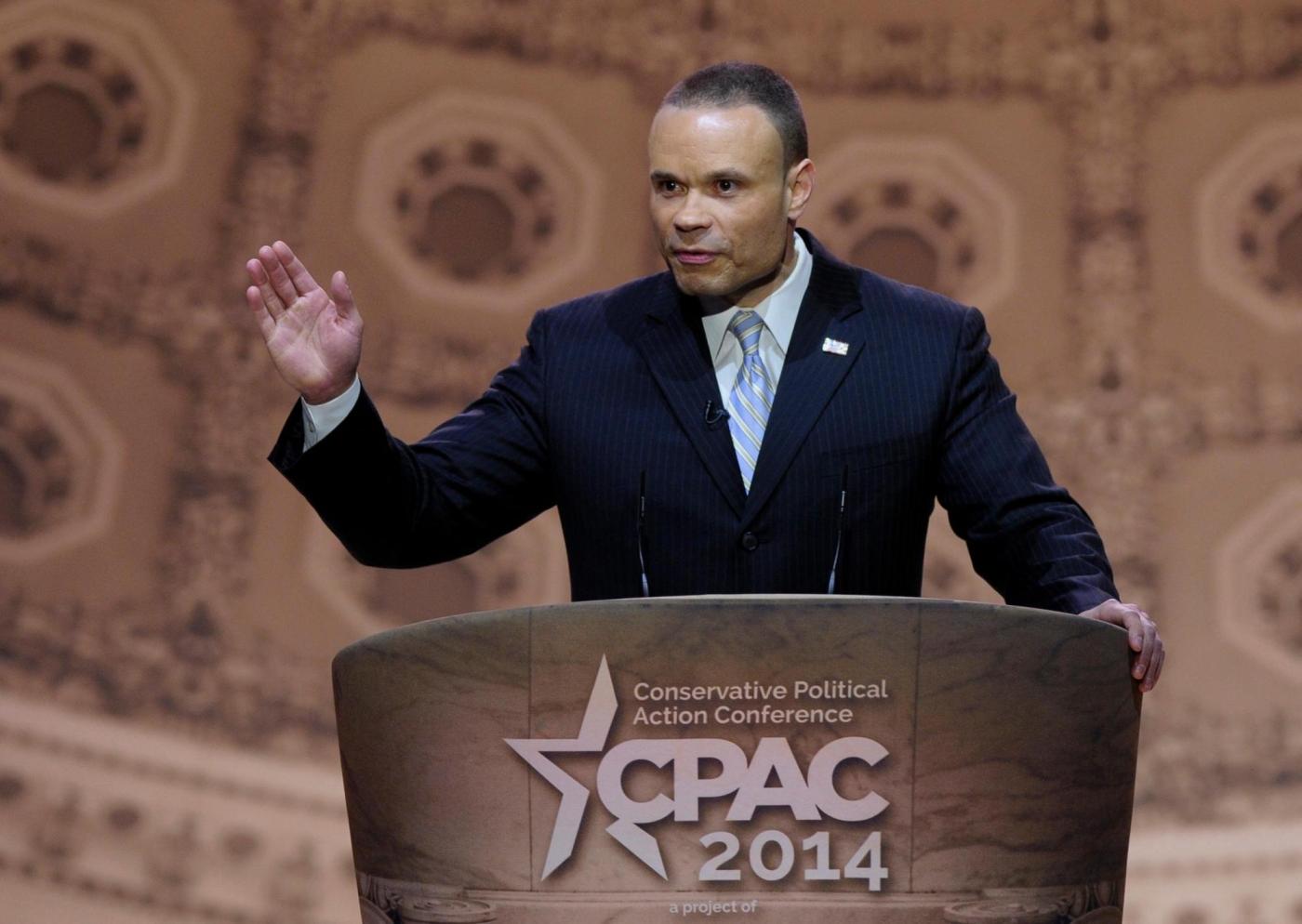

Michelle Goldberg: Trump’s new deputy FBI director has it out for ‘scumbag commie libs’

posted in: News | 0

When a New York jury found Donald Trump guilty on 34 felony counts last year, conservative podcaster Dan Bongino made a veiled threat on social media. “The irony about this for the scumbag commie libs is that the cold civil war they’re pushing for will end really badly for them,” he wrote. Liberals, Bongino said, had been playing at revolution and would now get a taste of the real thing. “They’re not ready for what comes next.”

I suppose he was right about one thing: We’re not ready. On Sunday, Trump announced that Bongino, a former Secret Service agent turned far-right pundit, would be deputy director of the FBI. A man who once claimed that his sole focus was “owning the libs” will now be second-in-command at the nation’s most powerful law enforcement agency, a position that doesn’t require Senate confirmation. Last year on his streaming show, Bongino cackled about the idea that America has a system of checks and balances, saying, with wild, angry eyes, “Power. That is all that matters.” He’s about to have an ungodly amount of it.

Bongino’s boss, of course, will be Kash Patel, the Trumpworld enforcer whom the supine Senate confirmed as FBI director last week. During his confirmation hearings, Patel insisted that, despite publishing an actual enemies list of people he considered deep state villains, he had no intention of turning the FBI into an instrument of retribution. It seemed obvious at the time that he was lying; making Bongino his deputy simply rubs it in our faces. If you wanted to turn the FBI into a Trumpist Praetorian Guard, Bongino is exactly the kind of guy you’d hire.

The new deputy director of the FBI cut his teeth as a talking head with frequent appearances on the Alex Jones show. He then had a show on NRATV, the National Rifle Association’s now-defunct streaming service. Eventually, Bongino became a near-constant presence on Fox News, thrilling a first-term Trump with his apoplectic denunciations of Trump’s foes and, later, his stolen election conspiracy theories.

Bongino and Fox parted ways in 2023 — he says over a contract dispute. He continued to build influence on right-wing video platform Rumble, a company he owns a lucrative piece of, which also hosts Steve Bannon, self-described misogynist influencer Andrew Tate and white nationalist Nick Fuentes. Angelo Carusone, president of watchdog group Media Matters for America, said that even among the right-wing broadcasters with whom Trump has staffed his nascent administration, Bongino stands out as a conduit between the fever swamps and the president. Now Bongino is in a place to turn wild notions from the right-wing internet into pretexts for federal investigations. Before Trump’s inauguration, for example, Bongino said the FBI was “hiding a massive fake assassination plot to shut down the questioning of the 2020 election.” It is hardly far-fetched to think he’d use this phantasm as an excuse to harass Democrats.

In writing about our country’s rapid self-immolation, I try to ration Hannah Arendt references, lest every column be about the ways “The Origins of Totalitarianism,” published in 1951, foreshadows the waking nightmare that is this government. But contemplating Bongino’s ascension, it’s hard to avoid the famous Arendt quote, “Totalitarianism in power invariably replaces all first-rate talents, regardless of their sympathies, with those crackpots and fools whose lack of intelligence and creativity is still the best guarantee of their loyalty.” Trump could have found a smoother and more sophisticated ideologue to help him transform the FBI into a tool of his will, perhaps someone from the Claremont Institute ready to put an erudite spin on authoritarianism. He wanted the jacked-up hothead.

This administration professes a devotion to merit-based hiring, blaming diversity, equity and inclusion initiatives for fostering mediocrity. It should go without saying, however, that excellence is of little interest to the Trumpists, who delight in scandalizing a meritocracy that spurned them. Writing of the conditions in which both Adolf Hitler and Josef Stalin arose, Arendt described a spirit of deep, corrosive cynicism and nihilistic glee at the inversion of old standards. “It seemed revolutionary to admit cruelty, disregard of human values, and general amorality, because this at least destroyed the duplicity upon which the existing society seemed to rest,” she wrote. Sound familiar?

We’re in an uncanny interregnum where Trump and his coterie are laying the foundation for autocracy but have yet to fully consolidate their power. The liberal democracy most of us grew up taking for granted is brittle and teetering, but its fall still feels unthinkable, even if it also seems increasingly inevitable. Perhaps this is one reason Democrats, with a few admirable exceptions, seem so frozen. People who’ve spent their lives working within a system of laws and civic institutions may be particularly unsuited to respond to that system’s failure. But an FBI run by Patel and Bongino is a sign that the system — which for all its manifold flaws has provided Americans a level of stability uncommon in history — is falling apart.

On his show last month, Bongino gloated over the angst Trump’s nominees were causing career civil servants, cheering on the president’s “total personnel warfare.” Then he took out two plastic toy robots: an orange one to represent Trump and a blue one he called “liberal screaming Karen.” He used the Trump robot to beat the lady one, smashing it over and over. “Yes!” he exclaimed. “This is how we fix this place.”

Michelle Goldberg writes a column for the New York Times.


Other voices: White House transparency should extend to records

posted in: Politics | 0

Say what you will about the whirlwind first month of President Donald Trump’s second term, but even his vocal critics couldn’t accuse him of avoiding the media or tough questions.

In stark contrast to his doddering predecessor, Trump defends his agenda virtually every day, providing the American people with regular updates on what his administration is doing and why.

Compare Trump’s vim and vigor with former President Joe Biden’s preference for the White House basement. Axios noted in July that Biden had “engaged in fewer press conferences and media interviews than any of the last seven presidents.” According to presidential scholar Martha Joynt Kumar, Axios noted, Biden had “given fewer media interviews than any other president since at least” Ronald Reagan.

At one point, Joe Concha noted in Politico in 2023, it had been 150 days since Biden had held a formal news conference in the White House. “Let that sink in,” he wrote. “The U.S. president has refused to speak with any reporter who isn’t pre-approved from a very short list in the past five months.”

Trump, meanwhile, has made a number of eye-poking moves in the past four weeks but hasn’t shied away from addressing any controversy. “So far, like a good foreman of a moving company, Trump has done everything he can to guide Americans through his vast and lofty plans and actions,” David Marcus wrote this week for Fox News. “As long as this radical transparency continues, the Trump administration will have a long runway of good will to land its policies and transform America.”

Marcus is correct, and the White House is to be applauded for offering virtually unprecedented access. But for the Trump administration to fully embrace transparency, it must also acknowledge the value of open records and instruct federal agencies to comply with Freedom of Information Act requests rather than obstruct legitimate efforts to keep American taxpayers informed about the workings of the government they fund and the bureaucracies that work on their behalf.

FOIA requests increased significantly during Trump’s first four years in office, and backlogs worsened under Biden. The Nieman Lab, a journalism advocacy group, reports that, “as of the third quarter of 2024, federal agencies had a backlog of over 222,000 FOIA requests, an increase of 10 percent from the previous year.”

Trump’s commitment to accessibility and transparency would be greatly enhanced if his administration worked diligently to ensure that the government responds in a timely fashion to those seeking to view public documents.

— The Las Vegas Review-Journal

Vikings left tackle Christian Darrisaw on track with his recovery

posted in: News | 0

INDIANAPOLIS — After walking back some of his comments on the interior of the offensive line, head coach Kevin O’Connell still made clear Tuesday at the 2025 NFL Combine that he’s looking for more out of the Vikings in the trenches.

“We need to have a level of execution and a level of physicality,” O’Connell said. “After playing really well in December, which was a goal of ours, we’ve got to find a way to get back in the dance and put our best foot forward in January.”

The good news for the Vikings is it sounds as if star left tackle Christian Darrisaw is trending in the right direction as he recovers from a torn anterior cruciate ligament. He suffered the injury while getting rolled up on during a Week 8 loss to the Los Angeles Rams.

“It was a huge loss for a lot of aspects of our play style and what we really wanted to play like through the totality of 2024,” O’Connell said. “Even if we were able to overcome it, we’re very much looking forward to getting CD back.”

Where exactly is Darrisaw with his recovery?

“He’s absolutely killing it every step of the way,” O’Connell said. “I look forward to seeing how the spring and the summer go.”

Carter added to coaching staff

After losing Shaun Sarrett to the Jacksonville Jaguars, the Vikings have hired Keith Carter as an offensive line coach.

In his past, Carter has spent time as the offensive line coach of Tennessee Titans and the New York Jets. In his new role, Carter will report directly to Chris Kuper, who has been the Vikings’ offensive line coach since O’Connell took over.

“I wanted to take the opportunity to get a former No. 1 and a guy that’s been involved in some of the best rushing attacks,” O’Connell said. “He really wanted to come to Minnesota and he’s going to be able to help us a lot and infuse some things into our run game.”

Though some have criticized Carter for his approach, the Vikings did their due diligence and felt comfortable hiring him.

“You’ll find some things about him in regards to being tough on his players,” O’Connell said. “I think in the No. 2 role, he’s going to be really good for us, and he’s in a great spot in his career to really help us.”

Udinski will be missed

Maybe the biggest loss for the Vikings so far this offseason came when Grant Udinski was hired as the offensive coordinator of the Jaguars. In his previous role, Udinski served as the Vikings’ assistant quarterbacks coach, meaning he worked closely with O’Connell.

“Just getting to work with Grant over these past three years has been absolutely one of the highlights of my time in Minnesota,” O’Connell said. “I’ve joked that if we added up all the hours that I’ve spent with Grant one on one, and then we added up all the hours that I’ve spent with my wife over the past three years — even if I’d like to think Leah won out — it’s probably going to be a pretty close finish there.”

The confidence that O’Connell has in Udinski was palpable as he talked about him taking the next step in his career.

“He’s prepared for this opportunity,” O’Connell said. “He’s going to do great things for them.”

Related Articles

Minnesota Vikings |


What’s next for Sam Darnold? Vikings weighing options at NFL Combine

Minnesota Vikings |


Five questions the Vikings must answer at the 2025 NFL Combine

Minnesota Vikings |


Dan Endy Sr., co-founder of NFL Films and Twin Cities sports fixture, has died

Minnesota Vikings |


Aaron Rodgers’ stint with the Jets is over. Vikings among potential landing spots?

Minnesota Vikings |


The Loop Ten Special Edition: Super Bowl LIX