Nvidia sales surge in the fourth quarter on demand for AI chips

posted in: All news | 0

By SARAH PARVINI

LOS ANGELES (AP) — Nvidia on Wednesday reported a surge in fourth-quarter profit and sales as demand for its specialized Blackwell chips which power artificial intelligence systems continued to grow.

Related Articles

Business |


1099-K tax rules: What you need to know if you get paid via Venmo, Cash App or PayPal

Business |


Discussed on Reddit: How to survive a period of unemployment

Business |


Egg prices could jump another 41% this year, USDA says, as Trump’s bird flu plan unveiled

Business |


Slack platform down as users report service outage

Business |


BP to slash spending on net zero ventures as it focuses on oil and gas again

For the three months that ended Jan. 26, the tech giant based in Santa Clara, California, posted revenue of $39.3 billion, up 12% from the previous quarter and 78% from one year ago. Adjusted for one-time items, it earned 89 cents a share.

“Demand for Blackwell is amazing as reasoning AI adds another scaling law — increasing compute for training makes models smarter and increasing compute for long thinking makes the answer smarter,” Nvidia Founder Jensen Huang said in a statement.

Wednesday’s earnings report topped Wall Street expectations. Analysts had been expecting adjusted earnings of 85 cents a share on revenue of $38.1 billion, according to FactSet.

The fourth-quarter earnings are the company’s first report since Chinese company DeepSeek boasted it had developed a large language model that could compete with ChatGPT and other U.S. rivals, but was more cost-effective in its use of Nvidia chips to train the system on troves of data.

The frenzy over DeepSeek caused $595 billion in Nvidia’s wealth to vanish briefly. But the company in a statement commended DeepSeek’s work as “an excellent AI advancement” that leveraged “widely-available models and compute that is fully export control compliant.”

The poster child of the AI boom, Nvidia has grown into the second-largest company on Wall Street — it is now worth over $3 trillion — and the stock’s movement carries more weight on the S&P 500 and other indexes than every company except Apple.

Nvidia and other companies benefiting from the AI boom have been a major reason the S&P 500 has climbed to record after record recently, with the latest coming last week. Their explosion of profits has helped to propel the market despite worries about stubbornly high inflation and possible pain coming for the U.S. economy from tariffs and other policies of President Donald Trump.

Noah Feldman: Some of DOGE’s influence can’t be undone

posted in: All news | 0

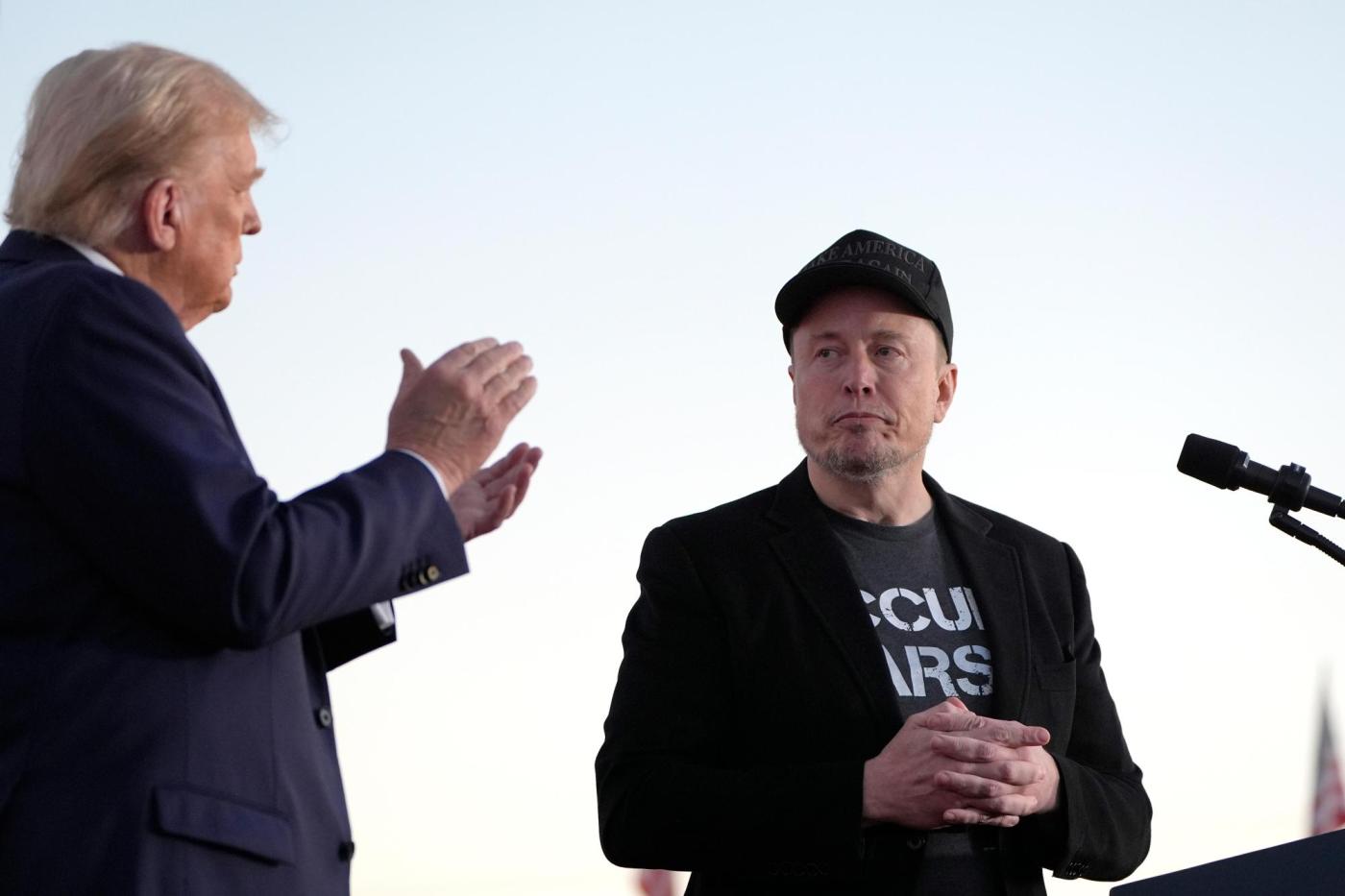
Elon Musk’s Department of Government Efficiency is sowing confusion and chaos, ordering mass firings of government employees and canceling programs despite having no formal legal authority. In a recent decision, Federal District Court Judge Tanya Chutkan noted that Musk’s actions likely violate the Constitution because he has not been appointed by the president nor confirmed by the Senate. Yet the judge rejected a lawsuit to stop DOGE brought by 14 state attorneys general because she held they lacked standing since they had not identified the specific harms their states suffered.

The AGs’ lawsuit, which was filed when Musk was just getting started, can be brought again with more facts to support it. There will also be other lawsuits by individuals who have already lost their jobs and clearly have standing to challenge DOGE’s legality. Some of these lawsuits will likely prevail, and some district court judge, possibly Chutkan, will likely order DOGE to pause its operations in the coming weeks. The Trump administration will appeal, but the irregularity of DOGE is so obvious, legally speaking, that the U.S. Court of Appeals for the DC Circuit will almost certainly affirm the lower court. The Supreme Court is likely to let lower court decisions stand, finding DOGE’s actions unlawful.

But the high probability that the courts will halt DOGE’s operations will be only one episode in an arc with a series’ worth of material. Further litigation would be necessary to unwind what DOGE will already have done. That will take time.

Meanwhile, the Trump administration will be able to keep many fired employees out of their jobs. All the president has to do is have duly appointed officials fire them again. The employees may be owed a little back pay for the time between their unlawful DOGE firing and their lawful firing by legitimate administration officials. Still, they won’t be reinstated unless they were career employees whom no one in the administration may fire without good cause.

Related Articles

Opinion |


Kathryn Anne Edwards: House Republicans’ budget plan gets poverty all wrong

Opinion |


Michelle Goldberg: Trump’s new deputy FBI director has it out for ‘scumbag commie libs’

Opinion |


David French: Trump has one idea

Opinion |


Justin Fox: No, Elon Musk hasn’t ‘discovered’ fraud at Social Security

Opinion |


Bruce Yandle: Are we witnessing ‘creative’ destruction or just plain destruction?

The legal outcome for the program cancellations DOGE has ordered will likely be similar. Even if the DOGE orders are held unlawful, appointed administration officials can ultimately cancel those programs unless they involve specific congressional appropriations made without room for executive branch discretion.

A roadmap for re-canceling DOGE-eliminated programs already exists. Administration officials have reportedly been re-canceling or re-pausing programs unlawfully paused by Trump’s early executive order freezing most government spending. The courts blocked that initial order, so the administration is trying to achieve the same results by other means. Some courts have attempted to block this strategy, but their actions depend on a technical reading of the court order blocking the initial executive order. Eventually, the administration will find a way to cancel programs that aren’t based on specific congressional appropriations.

The upshot is that many DOGE actions will have lasting consequences, regardless of their illegality when they were first taken. Companies regulated by agencies whose employee ranks have been thinned can expect regulatory enforcement to decrease in proportion to the loss of staff. The same applies to industries that need government approvals to do business: If there are fewer staffers to approve applications, the process will slow accordingly.

Sectors like life sciences or pharmaceuticals that rely on government-funded research will also feel the effects of DOGE and other ongoing cuts. Those cuts can be regularized — effectively, they will likely remain in effect whenever they don’t contradict specific congressional appropriations.

To be sure, specific sectors that require government funds can lobby the Trump administration to reverse or choose not to reaffirm the DOGE cuts. Based on the evidence that lobbying the Trump administration successfully is possible, some of those efforts will doubtless succeed. Those sectors can also lobby Congress to resist DOGE-initiated cuts with specific appropriations bills, although Trump would have to sign those if they were to take effect.

What’s more, the obvious lack of strategic planning in the haphazard firings and cuts means that sometimes, the Trump administration will eventually realize that what has been cut was necessary. So, some reversals will be required, even from the administration’s perspective. Once DOGE’s activities are limited by court order, DOGE and Musk won’t be as interested in fighting selective reversals of their actions.

Musk will have good reason to stop actively engaging in DOGE work once the courts catch up and bar its ongoing actions. He will have achieved meaningful influence in government direction without going through the legal formalities of appointment and confirmation. Courts are likely to rule that he must, at a minimum, obey conflict of interest and disclosure rules that he would have no interest in following. His influence on Trump has already demonstrated that he will be able to continue lobbying the president from outside the White House.

What’s more, by receding from day-to-day DOGE action once ordered by a court, Musk may be able to avoid what otherwise looks like unavoidable conflict with Trump. Each man seems to believe he has the upper hand. Both can’t be right. Neither has anything to gain by confrontation with the other.

Musk’s initial DOGE announcement said he planned to leave the job by July 2026. It’s doubtful he will last until then. But the effects of the DOGE experiment will be felt well beyond. They will underscore the limits of the constitutional system in responding quickly to unlawful cuts made by a president happy to act outside the law.

Noah Feldman is a Bloomberg Opinion columnist. A professor of law at Harvard University, he is author, most recently, of “To Be a Jew Today: A New Guide to God, Israel, and the Jewish People.”

Want to be prescribed a new hospital drama? These TV doctors are ready to treat you

posted in: All news | 0

By HILARY FOX, Associated Press

LONDON (AP) — No matter your ailment, there are plenty of TV doctors waiting to treat you right now on a selection of channels and streamers.

Whether it’s Noah Wyle putting on his stethoscope for the first time since “ER,” Morris Chestnut graduating to head doctor, Molly Parker making her debut in scrubs or Joshua Jackson trading death for life on a luxury cruise, new American hospital dramas have something for everyone.

There’s also an outsider trying to make a difference in “Berlin ER,” as Haley Louise Jones plays the new boss of a struggling German hospital’s emergency department. The show’s doors slide open to patients Wednesday on Apple TV+.

These shows all contain the DNA of classic hospital dramas — and this guide will help you get the TV treatment you need.

This image released by Apple TV+ shows Haley Louise Jones as Dr Suzanna Parker in a scene from “Berlin ER.” (Apple TV+ via AP)

“Berlin ER”

Dr. Suzanna “Zanna” Parker has been sent to run the Krank, which is only just being held together by hardened — and authority-resistant — medical staff and supplies from a sex shop. The result is an unflinching drama set in an underfunded, underappreciated and understaffed emergency department, where the staff is as traumatized as the patients, but hide it much better.

From former real-life ER doc Samuel Jefferson and also starring Slavko Popadić, Şafak Şengül, Aram Tafreshian and Samirah Breuer, the German-language show is not for the faint of heart.

Jones says she eventually got used to the blood and gore on the set.

“It’s gruesome in the beginning, highly unnerving. And then at some point, it’s just the most normal thing in the world,” she explains. “That’s flesh. That’s the rest of someone’s leg, you know, let’s just move on and have coffee or whatever.”

As it’s set in the German clubbing capital, the whole city seems to live at a frenetic pace and the staff deals with the pressure by partying. The music, the lighting and the pulse of the drama also rubs off on the audience.

“When I saw it the first time I was sitting there, my heart was racing,” says Jones of watching the program. “I knew what was coming, but I just, you know, my body just reacted. And I think that really says a lot.”

Would she agree to be treated by Dr. Parker? Jones reckons it depends on what day you catch her.

DIAGNOSIS: “This is Going To Hurt” gets the “ER” treatment — side effects include breathlessness and heartbreak.

This image released by Max shows Noah Wyle, left, Mackenzie Astin and Rebecca Tilney, right, in a scene from “The Pitt.” (Warrick Page/MAX via AP)

“The Pitt”

Emergencies are often against the clock, but in “The Pitt,” they are on a timer. Attached to a bomb.

Each episode shows an hour of Dr. Michael Robinavitch’s emergency room shift on one of the worst days of his life. After avoiding all doctor roles since the finale of “ER” in 2009, Wyle pulls on the navy hoodie of a weary Dr. Robby — this time in Pittsburgh.

Initially an idea for a “ER” reboot with producer John Wells, the show morphed into a fresh take on the challenges medical professionals face in the wake of the world-shifting pandemic.

“It felt a little sacrilegious to try to walk back into that arena prematurely,” says Wyle. “It was really only thoughtfully, soberly, cautiously and meticulously that we attempted it again.”

Robby is calm and competent in showing his medical students how it’s done, while keeping his own mental health crisis hidden. Not that there are many places to hide: Wyle explains that they are setting themselves apart from other hospital dramas by turning up the lights, cutting the mood-telegraphing music and showing the real dimensions of the department.

“All of those kind of lend themselves to doing something different,” he says. “Rattling the cage, you know, trying to put a new spin on an old form.”

Joining him in Max’s “The Pitt” are co-stars Tracy Ifeachor, Katharine LaNasa, Patrick Ball and Supriya Ganesh.

As for his own medical knowledge, Wyle says there are procedures he feels adept at least pretending to do. With the amount of time he’s spent playing a doctor, he could have earned his own degree by now.

“I’ve been doing this long enough,” he says. “So I’m either the worst student or one of the best doctor actors around.”

DIAGNOSIS: With front-line workers against the clock, it has a similar pathology to both “ER” and “24.”

This image released by CBS shows Morris Chestnut as Dr. John Watson in a scene from “Watson.” (Colin Bentley/CBS via AP)

“Watson”

Also in Pittsburgh, you’ll find The Holmes Clinic for Diagnostic Medicine, where it’s still life-and-death, but your heart rate can afford to slow a little.

It’s run by Dr. John Watson, former colleague of Sherlock Holmes, the famous sleuth who has bequeathed the funding for the medical center.

Chestnut plays the lead “doc-tective,” as he puts it, leading a team trying to solve medical mysteries while avoiding old foe Moriarty (Randall Park) — Watson is still dealing with a traumatic brain injury from their last encounter.

And Chestnut is no stranger to the long words and Latin terms that accompany hospital dramas. Chestnut was a nurse in “ER,” a former army doc in “Nurse Jackie” and a pathologist in “Rosewood.” More recently, he was the ruthless and talented neurosurgeon Barrett Cain on “The Resident.”

Luckily, his Watson has a better beside manner and uses cutting-edge science to help puzzle out a unique selection of patients, alongside his staff, played by Eve Harlow, Inga Schlingmann and Peter Mark Kendall.

The Sherlock mythology is provided by show creator, Arthur Conan Doyle fan and ex-“Elementary” writer Craig Sweeny, who brings a case-of-the-week style to the program. Chestnut reckons it’s this literary twist on the medical mystery formula that sets it apart from “House MD,” whose lead character was more of a Sherlock.

And he wouldn’t hesitate to be treated by Dr. Watson because “he wants to understand you as a person” and “truly cares” about his patients.

DIAGNOSIS: More tests needed to confirm if “Elementary” or “House” is the leading condition.

This image released by Fox shows Molly Parker in a scene from “Doc.” (Peter H. Stranks/Fox via AP)

“Doc”

Over her 30-year career, Molly Parker has never played a doctor before. In “Doc,” based on a true story, she jumped right in with the top job, chief of internal medicine, at Minneapolis’ Westside Hospital.

A car crash causes the overachieving, work-centric Dr. Amy Larsen to lose eight years of her memory, turning her into a patient with a traumatic brain injury. Parker portrays both versions of Larsen through Fox’s debut season — the career woman in flashback and the mother learning to trust again in the present.

The focus of the show is on feelings over physical ailments, as Larsen has to deal, all over again, with the loss of her son.

“What I liked about this is that it has all the elements of that genre, like it has the high stakes and the mystery illness and the romantic love triangle,” explains Parker, who stars alongside Anya Banerjee, Jon-Michael Ecker, Amirah Vann and Omar Metwally. “But at the center of it is this woman who is going through this really profound grief.”

Parker has learned “not to diagnose yourself on the internet,” a deeper respect for health care workers and that playing a doctor is not easy.

“The most you can do is sort of try to get the words right sometimes,” she says with a smile, admitting she still can’t pronounce the name of one particular drug.

“It’s, like, so important in the entire season,” Parker adds, “and I said it wrong every single time.”

DIAGNOSIS: For fans of “Grey’s Anatomy,” where complications come from relationships rather than infections.

This image released by Disney shows Kate Berlant, left, and Joshua Jackson in a scene from “Doctor Odyssey.” (Ray Mickshaw/Disney via AP)

“Doctor Odyssey”

An honorable mention goes to Dr. Max Bankman of “Doctor Odyssey,” who set sail at the end of 2024 and is finishing up Season One’s maiden voyage March 6 on ABC.

Joshua Jackson, who previously portrayed real-life man of malpractice Christopher Duntsch in “Dr. Death,” is on board as the accomplished and smiley new head of a luxury cruise liner’s medical team. “Doctor Odyssey” comes from super producer Ryan Murphy and is set in the same world as his “9-1-1” franchise, with an upcoming crossover episode starring Angela Bassett.

Phillipa Soo and Sean Teale complete the ship’s medical threesome contending with a surprisingly frequent number of bizarre illnesses and accidents that befall the guest stars (episode one: a broken penis). Jackson acknowledges the cases are “absurd and fun and wild and over-the-top,” much to the amusement of his brother, who runs an actual ER.

But that is the appeal, he says, for viewers to “exhale” and find “welcome relief” from the stress of real life.

“To have this, you know, pretty bauble in the middle of your week to just come in and go on an adventure,” Jackson explains. “The stakes are high, the relationships are intense. Everything’s very dramatic. And 42 minutes later, you realize you’re just in the most beautiful place in the world.”

Unfortunately, his own medical skills remain more Dr. Death than Dr. Bankman.

“I could really, really, deeply mess somebody up,” he says. “I have just enough terminology and jargon to sound like I know what I’m doing, but none of the practical skills.”

Jackson wouldn’t hesitate to put his own health in the hands of Dr. Bankman, though, citing the miracles he’s able to perform weekly on The Odyssey.

DIAGNOSIS: Call “9-1-1” for a therapeutic trip on “The Love Boat.”

Recipe: Comedian Stephen Colbert suggests this method for cooking swordfish

posted in: All news | 0

Comedian, actor, and TV host Stephen Colbert and his wife Evie McGee Colbert have written a lovely cookbook, “Does This Taste Funny?” (Celadon Books). The recipes sound delicious and the photos make me hungry. I dogeared many pages, signals meant to remind me to return to them and test them out.

The easy-to-prepare swordfish was my first try, and it paid off big time. Because that scrumptious fish is expensive, my thought was that it would make a great entrée for a special company meal. The swordfish is broiled with butter, quick and easy. The accompanying mustard sauce can be cooked up while the fish broils; it includes white wine, capers, heavy cream, and of course, Dijon mustard.

And as for the expense, I decided to offer smaller swordfish portions, about 8 ounces, and load up the menu with rice, vegetables and a big salad. Delicious.

Kitty’s Swordfish with Mustard Cream Sauce

Yield: 4 servings

INGREDIENTS

4 swordfish steaks, about 1 inch thick and about 12 ounces each, serve a smaller amount if desired

Salt and freshly ground black pepper

12 tablespoons (1 1/2 sticks) unsalted butter, cut into small pieces, divided use

1/3 cup dry white wine

1/3 cup heavy cream

1 1/2 tablespoons Dijon mustard

1 1/2 teaspoons drained caper, coarsely chopped

Optional garnish: Lemon wedges

Cook’s notes: Be aware that broilers in home ovens vary, and the Colberts note that in a tip next to the recipe. The instructions advise placing the rack in the highest possible position. That would be too high in my oven, a position that would put the fish less than three inches from the broiler element. Instead, I opt for the position that’s a little over 5 inches from the broiler, placing the top of the swordfish about 4 inches from the broiler.

DIRECTIONS

1. Adjust oven rack to about 5 inches below the broiler element (see cook’s notes). Preheat broiler. Place swordfish in a single layer on a rimmed baking sheet. Season generously with salt and freshly ground black pepper on both sides. Dot each with 2 1/2 tablespoons of butter.

2. Broil the fish for approximately 5 minutes on each side, basting with butter before you turn them over. When it is time to flip the butter should be rich nutty brown. (In my oven I broiled for 5 minutes, basted, flipped, and cooked 3 more minutes.)

3. Meanwhile, prepare the sauce. Stir wine, cream, mustard, and capers in a small saucepan and bring to a boil on medium-high heat, then lower heat and gently simmer until sauce is reduced by half, about 5 minutes. Remove from heat and stir in the remaining 2 tablespoons butter. Serve the swordfish topped with sauce. If desired, accompany each served with a lemon wedge.

Source: “Does This Taste Funny” by Stephen Colbert and Evie McGee Colbert (Celadon Books)

Award-winning food writer Cathy Thomas has written three cookbooks, including “50 Best Plants on the Planet.” Follow her at CathyThomasCooks.com.

Related Articles

Restaurants, Food and Drink |


Five weeknight dishes: Recipes that are speedy to make, spectacular to eat

Restaurants, Food and Drink |


Harissa brings complex chili heat to this meaty Libyan soup during Ramadan

Restaurants, Food and Drink |


Recipes: 3 easy and delicious dishes you can make with canned beans

Restaurants, Food and Drink |


Use two types of paprika for the best Hungarian chicken paprikash

Restaurants, Food and Drink |


Recipe: This Lemon-Angel Cake Dessert is sweet and scrumptious