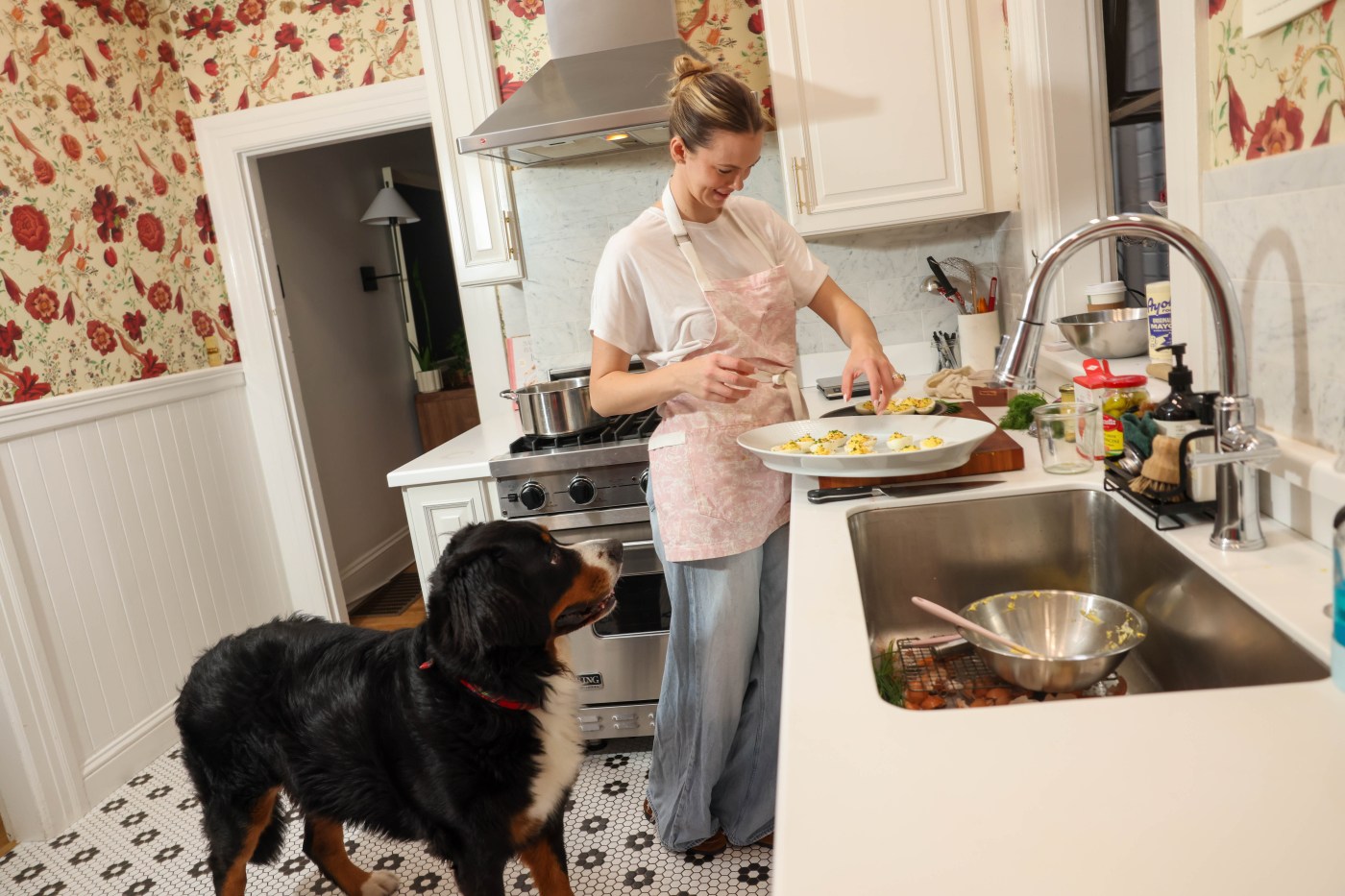
3 Super Bowl recipes from esteemed chefs

posted in: All news | 0

Super Bowl Sunday is almost here! And whether you’re planning to stay glued to each play of the Big Game, tune in for the halftime show and big-budget, best-in-advertising commercials, or just enjoy gathering with friends and family — you’ll need to stay fed during the upcoming extravaganza at Levi’s Stadium in Santa Clara.

Related Articles


5 simple dinners to ease back into cooking in the new year


Gretchen’s table: Cauliflower ‘steaks’ are tender on the inside and crispy on the outside


Even in winter, the sun still shines in these 5 citrus recipes


Resolutions, revived: Five nutritious weeknight dishes


Recipe: This Super Bowl snack is scrumptious and easy to prepare

To help, we’ve asked some of our favorite Bay Area chefs and culinary leaders to share their Super Bowl recipes. Violet Witchel, a San Francisco-based culinary influencer known as Dense Bean Salad Girl, offered up her recipe for Pepperoncini Shallot Deviled Eggs. Oakland’s Tanya Holland shared her recipe for Dominican Pork Guisado — plus some wine pairing tips — perfect for honoring the Caribbean background of this year’s halftime performer, Puerto Rican megastar Bad Bunny.

And while we couldn’t get California-rooted Julia Child to share a Super Bowl recipe (she died in 2004), we tracked down the next-best thing we could: the recipe for a homey vegetarian recipe for Black Bean Chili from Cafe Beaujolais, via chef Julian Lopez. It’s said Child once ordered — and subsequently, made famous — the dish when she visited the Mendocino restaurant in the 1980s. And what’s a more satisfying game day meal than a hearty bowl of chili?

RELATED: 15 fantastic Bay Area game-day picks for wings

Recipes for your Super Bowl LX celebration:

Tanya Holland’s Dominican Pork Guisado
Violet Witchel’s Pepperoncini Shallot Deviled Eggs
Julia Child’s fave black bean chili from Mendocino’s Cafe Beaujolais

How to buy a house in the winter

posted in: All news | 0

If you’re house hunting, last weekend’s record-breaking snowfall is a valid reason to put your search on ice. But winter weather doesn’t faze Desirae Allen, a real estate broker with Sound Realty in Valdez, Alaska. In a city that gets more than 300 inches of snow in a season, that’s just business as usual.

Related Articles


Some companies tie AI to layoffs, but the reality is more complicated


Stocks, gold and silver steady following wild swings overnight


Target’s new CEO faces hometown crisis as he begins turnaround effort


Walser Automotive, Orono man charged with tax evasion scheme


Business People: U.S. Bancorp President & CEO Gunjan Kedia to add chair to her titles

“I’ve got a showing that all of a sudden came unexpectedly, and I haven’t got a guy over there to plow the driveway, ” she says. “I’ve got to tell the buyers, you know, ‘Grab your boots or grab your snowshoes — we’re going to wade our way in.’”

Nationally, winter is the sleepiest season for the housing market, but some home buyers still get it done. About 13,000 houses are sold every day from December through February, reports the National Association of Realtors.

If you’re ready to buy a house — and you made it through the storm with heat and power — why not start looking now? Here’s how to turn the winter off-season into your advantage.

Pay attention to price drops

If you need a reason to crawl out of hibernation, mortgage rates are dangling a rare opportunity. The average 30-year fixed mortgage rate hit 5.97% in the week ending Jan. 22. That’s a full percentage point lower than the average rate in January 2025, and nearly the lowest we’ve seen in three years.

If you don’t have one yet, now’s a good time to shop around for a mortgage preapproval. Get a quote from at least three different lenders to make sure you’re getting the best deal. A preapproval typically locks in your mortgage rate for 30, 60 or 90 days. Try to snag one on the longer side so you’re covered through spring.

When comparing offers, ask if your lender has a “float down” option. This allows you to swap your quoted rate for a lower one if rates keep dropping after your preapproval.

Another way to save: Average prices tend to drop in the winter months. Homes listed from December-February are priced 16% lower than those listed in June, reports the NAR. On top of that, motivated sellers are more willing to negotiate on price — especially if their home has been sitting on the market since summer or fall.

Expect slimmer selection

Winter bargains come with tradeoffs. Inventory is thinner this time of year, limiting buyers’ options. Monica Haynes, director of the Bureau of Business and Economic Research at the University of Minnesota Duluth, says flexibility can help buyers make that dynamic work in their favor.

“If you’re someone who is willing to buy a fixer-upper, or someone who’s willing to overlook some maybe less desirable things, then you can probably get a better deal in the winter,” she says.

In many areas, more listings start popping up in February, but every market has its own rhythm. A local buyer’s agent can help you understand what’s typical in your neighborhood.

Know what a winter inspection can’t spot

When you get to the walk-through phase, pay extra attention to how the house feels in winter weather. Are the windows drafty? How’s the natural light?

Ask the sellers for photos of the property in milder weather. Deep snow can mask major issues, like siding damage, roof issues or problems with the septic system.

Allen, speaking from experience in Alaska, has seen just how weird that reveal can get.

“Is there a dead car out there in the woods that I’m going to be surprised by, come summertime?” she says. “So do a little bit more homework, lean on your home inspection and just really slow down and do your due diligence.”

Stay flexible on timing

Once you’re clear to close, build some wiggle room into your timeline to save money (and stress).

Moving companies often charge less for a winter move, thanks to lower demand in the off-season. However, inclement weather can erase those savings pretty quickly if it leads to longer routes, heavier fuel usage or more labor hours — especially for long-distance moves.

Winter’s slow season can mean more flexible contractor schedules — and potential savings — on cosmetic work like painting or minor remodeling, often at the top of new homeowners’ to-do lists. But with seasonal demand, it might be harder to book plumbers, HVAC techs and electricians.

“Come winter, they are pretty backed up with no heat calls, frozen pipes — you know, more the 9-1-1 things — where they’re using their summers for projects,” Allen says.

Slow down and be intentional

Winter has a way of slowing everything down. While spring brings more listings, it also brings more competition and pressure to move fast.

This time of year, homes tend to attract fewer offers — about two per listing in December 2025, according to the NAR. Compared to peak homebuying season, homes stay on the market a median 20 days longer in the winter, giving buyers more breathing room and negotiating power.

With fewer transactions happening overall, you may get more face time and attention from everyone involved, from your buyer’s agent to the lender to the title company. Instead of rushing, winter gives you space to ask questions and move forward with intention.

When you’re making a decision as big as buying a home, taking your time is a good thing. A slower winter market gives you time to build confidence and figure out each step in the homebuying process. That way, you’re ready whenever the right home comes along — now or in the spring.

Abby Badach Doyle writes for NerdWallet. Email: abadachdoyle@nerdwallet.com.

2-month-olds see the world in a more complex way than scientists thought, study suggests

posted in: All news | 0

By LAURA UNGAR

A new study suggests that babies are able to distinguish between the different objects they see around them at 2 months old, which is earlier than scientists previously thought.

Related Articles


Planned Parenthood drops lawsuit against Trump administration’s Medicaid cuts


Woodbury man with rare skin condition ‘scared to go out’ after ICE detention


Llamas are big pharma’s secret weapon to find new drugs


Boston University researchers say CTE is a cause of dementia


It’s freezing cold and you’ve lost power. Here’s what emergency doctors want you to do

The findings, published Monday in Nature Neuroscience, may help doctors and researchers better understand cognitive development in infancy.

“It really tells us that infants are interacting with the world in a lot more complex of a way than we might imagine,” said lead author Cliona O’Doherty. “Looking at a 2-month-old, we maybe wouldn’t think that they’re understanding the world to that level.”

The study looked at data from 130 2-month-olds who underwent brain scans while awake. The babies viewed images from a dozen categories commonly seen in the first year of life, such as trees and animals. When babies looked at an image like a cat, their brains might “fire” a certain way that researchers could record, O’Doherty said. If they looked at an inanimate object, their brains would fire differently.

The technique — known as functional magnetic resonance imaging, or fMRI — allowed scientists to examine visual function more precisely than in the past. Many previous studies relied on how long an infant looked at an object, which can be difficult to assess at younger ages. Some of those past studies suggested that infants as young as 3 to 4 months could distinguish between categories such as animals and furniture.

“What we’re showing is that they really already have this ability to group together categories at two months,” O’Doherty said. “So it’s something much more complex than we would’ve thought before.”

In the new study, many of the babies returned at 9 months, and researchers successfully collected data from 66 of them. In the 9-month-olds, the brain was able to distinguish living things from inanimate objects much more strongly than in the 2-month-olds, O’Doherty said.

Someday, researchers said, scientists may be able to connect such brain imaging to cognitive outcomes later in life.

Liuba Papeo, a neuroscientist at the National Center for Scientific Research in France, said the number of babies in the study is one thing that makes the work “impressive and unique.” Brain imaging with very young infants presents challenges.

“One — perhaps the most obvious — is that the infant needs to (lie) comfortably in the fMRI scanner while awake without moving,” she said in an email.

O’Doherty, who did the work at Trinity College Dublin in Ireland, said the key was making the experience as comfortable as possible for the babies. Inside the scanner, they reclined on a bean bag so they were snug.

The images “appear really big above them while they’re lying down,” she said. “It’s like IMAX for babies.”

AP video journalist Havovi Todd contributed to this story from London.

The Associated Press Health and Science Department receives support from the Howard Hughes Medical Institute’s Department of Science Education and the Robert Wood Johnson Foundation. The AP is solely responsible for all content.

EU’s foreign policy chief says a Europe-wide army could be ‘extremely dangerous’

posted in: All news | 0

BRUSSELS (AP) — European Union foreign policy chief Kaja Kallas on Monday rejected calls for a Europe-wide army, warning that it could be “extremely dangerous” as the bloc considers ways to provide its own security after the United States warned that its priorities lie elsewhere.

Related Articles


Out with the old? Young Democrats are trying to convince voters to send a new generation to Congress


Misconduct complaint dismissed against judge who handled El Salvador prison deportation case


Planned Parenthood drops lawsuit against Trump administration’s Medicaid cuts


Trump administration to create a strategic reserve for rare earths elements


Speaker Johnson faces tough choices on partial government shutdown and debate over ICE

Talk of a European army has resurfaced amid tensions within NATO over President Donald Trump’s threats to annex Greenland, the semiautonomous territory of NATO-ally Denmark.

“Those who say that we need a European army, maybe those people haven’t really thought this through practically,” Kallas said. “If you are already part of NATO then you can’t create a separate army.”

Kallas told a security conference in Norway that the most important military asset during a crisis “is the chain of command — who gives orders to whom.”

She added: “And if you have, like the European army and then you have the NATO (one), then, you know, the ball just falls between the chairs. And this is extremely, extremely dangerous.”

NATO’s military operations are overseen by a Supreme Allied Commander, who is always a top U.S. officer. The role is currently held by Airforce Lt. Gen. Alexus Grynkewich.

Norway’s Prime Minister Jonas Gahr Støre said: “NATO is there with the decision-making process among allies, which is in itself complex, but it is trained to work.” He rejected calls for a European army, saying that “it is not a road we should travel.” Norway is not a member of the EU.

NATO Secretary-General Mark Rutte said last week that Europe is incapable of defending itself without U.S. military support and would have to more than double current military spending targets to be able to do so.

“If anyone thinks here … that the European Union or Europe as a whole can defend itself without the U.S., keep on dreaming. You can’t,” Rutte told EU lawmakers in Brussels.

Europe and the United States “need each other,” he said.